The Retroid Pocket 5 is not a gaming PC pretending to be portable. It is a portable PS1-to-PS2 emulator with commute-grade battery and pocket-friendly build. At £200/$219 that is a specific proposition, and it holds up well enough that the question is not whether the RP5 is good value but whether it is the right kind of good value for the games you actually want to play. The answer is yes for most of what the £200 / $220 category needs to do, with one caveat on the higher emulation targets that matters depending on your library.
Product Snapshot
| Manufacturer | Retroid |
| Architecture | Qualcomm Snapdragon 865 |
| RAM | 8 GB LPDDR5 |
| Storage | 128 GB UFS 3.1 (microSD expandable) |
| Display | 5.5″ AMOLED 1080p |
| Battery | 5000 mAh |
| OS | Android 13 |
| Weight | ~270 g |
| Release Date | October 2024 |
| Price | £200/$219 |
| Category | Premium Retro Handheld |
Presentation and Build
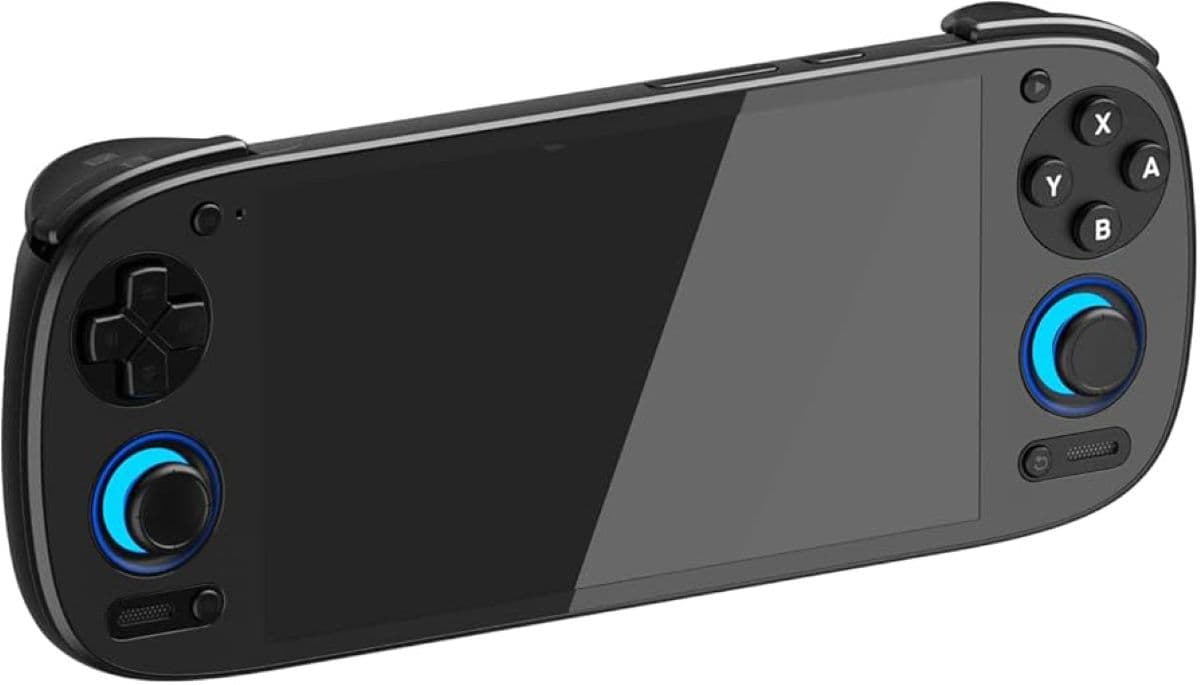
The RP5 chassis is polycarbonate with a textured grip section on the rear. No lateral flex on the triggers; the face buttons have a defined travel that registers cleanly. At 270 g it is lighter than the Steam Deck OLED by about 400 g, which is the relevant comparison for portability rather than the handheld PC category.
The 5.5-inch AMOLED panel is the strongest hardware argument for the device. At 1080p on a screen this size, pixels are not visible at normal playing distance. Black levels on the AMOLED panel give older 2D titles genuine contrast: a dungeon corridor in a GBA RPG reads clearly rather than dissolving into a greyish LCD glow. The 120 Hz refresh rate applies to the Android UI navigation; most emulators cap their output to the emulated system’s native refresh rate, which is typically 60 Hz. That is not a defect; it is accurate emulation behaviour.
The D-pad is a cross type with defined diagonals. It handles fighting game inputs and platformer precision without the rocking-plate issues seen on earlier Retroid hardware. The analogue sticks sit above the D-pad, which mirrors the Xbox layout rather than the PlayStation one. Players who have spent years on DualShock positioning will need a session or two to adjust; after that the grip settles.
One setting worth finding immediately: in the Retroid launcher, set the display colour profile to Standard rather than Vivid. Vivid oversaturates colours in ways that the AMOLED panel does not need; the underlying screen is already high-contrast. Standard gives you accurate emulation colour reproduction on older titles where the palette matters.

Performance
Emulation performance on the Snapdragon 865 runs as follows across the main targets:
| System | Target FPS | Realistic Performance | Notes |
| PS1 | 60 | Full speed, all titles | No notable exceptions |
| PSP | 60 | Full speed, nearly all titles | A few late-era titles need overclocking enabled |
| N64 | 60 | Full speed, most titles | Demanding titles (Conker, Perfect Dark) need resolution scale lowered |
| Dreamcast | 60 | Full speed, most titles | Redream handles the catalogue well |
| Saturn | 60 | Full speed, most titles | Complex 3D scenes in some titles drop to 50 fps |
| GameCube | 60 (30 on demanding) | Most titles full speed; demanding titles 30–45 fps | Dolphin performance profile needed per game |
| Wii | 60 (30 on demanding) | As GameCube; same Dolphin dependency | Open-world Wii titles are the edge cases |
| PS2 | 60 (30 on demanding) | Light-to-mid titles full speed; demanding titles 25–35 fps | AetherSX2 with recommended settings; complex geometry titles struggle |
The PS2 figure is where buyer expectations need managing. Gran Turismo 4, God of War, and Ratchet and Clank titles in that mid-complexity band run between 40 and 60 fps with AetherSX2 settings configured. Shadow of the Colossus and Metal Gear Solid 3 in demanding scenes drop to 25 to 30 fps, which is playable for those titles but not full speed. The Ayn Odin 2 with its Snapdragon 8 Gen 2 clears those titles at closer to 50 to 55 fps in the same scenes. That is the performance gap between the two devices, and it is worth understanding before purchase; our handheld comparison across the 2026 category sets that gap in broader context. If your PS2 library is weighted toward the more demanding end, the RP5 handles the catalogue but not all of it at target frame rates.
Below PS2, the performance story is clean. PSP runs Metal Gear Solid Peace Walker and Persona 3 Portable at full speed without configuration. GameCube handles most of the Metroid Prime series and the major Nintendo titles at 60 fps with a Dolphin performance profile loaded. The Saturn library, which remains underserved on many Android handhelds, performs well on the RP5 with the Yaba Sanshiro emulator.
Value and Longevity
At £200/$219 the RP5 competes with the Anbernic RG556 at a similar price and against the Ayn Odin 2 at £280 to £320/$299 to $349 depending on configuration.
The RG556 uses an Unisoc T618, which is a meaningful step behind the Snapdragon 865 on PS2 and GameCube targets. The RG556 wins on battery capacity (7000 mAh versus 5000 mAh) and is the right choice if battery life on lighter emulation targets is the primary criterion. At the same price, the RP5’s AMOLED panel and stronger mid-range emulation performance are the reasons to choose it over the RG556.
The Ayn Odin 2 at its base configuration costs around £285 / $299. The Snapdragon 8 Gen 2 closes the PS2 gap substantially and begins to push into PS3 territory. For players whose library includes demanding PS2 titles or who want PS3 emulation with some headroom, the ROG Ally X and Asus ROG Ally X represent the next step up into Windows handheld territory, but those are a different category entirely. The Odin 2’s £85/$80 premium over the RP5 is the right trade for players whose catalogue is weighted toward demanding PS2 and above. For players whose catalogue sits at PS2 and below, with PS1/PSP/GameCube as the primary targets, the RP5 delivers 90 per cent of the Odin 2’s output at 70 per cent of the price.
The 5000 mAh battery at light emulation loads (GBA, DS, PS1, PSP) delivers around 6 to 7 hours of play, which covers a return train journey without a power bank. At heavier loads (GameCube at full speed, PS2 mid-complexity titles), the realistic figure drops to 4 to 5 hours. At demanding PS2 titles with AetherSX2 running at higher accuracy settings, expect 3 to 3.5 hours. The device does not run hot enough to be uncomfortable during extended GameCube sessions; the rear surface stays warm rather than hot.
Android 13 and the Retroid launcher receive regular firmware updates. Retroid’s track record on software support is better than most in the category: the RP4 Pro received updates for over a year after launch. The Android foundation also means emulator apps update independently of the device firmware, which gives the RP5’s software longevity beyond what a custom-OS device typically offers. For a longer-term perspective on how handhelds in this category age, our Steam Deck OLED one-year-on piece covers that question in depth.

Technical Notes
The Snapdragon 865 uses Adreno 650 graphics. For emulation purposes, the relevant ceiling is the sustained GPU performance at the device’s thermal limits. The RP5 throttles marginally after extended GameCube sessions at high accuracy settings; the frame rate impact is small (2 to 4 fps) and recovers when the load decreases. It is not a meaningful constraint on normal play sessions.
The 128 GB UFS 3.1 internal storage is fast enough that ROM load times are not a bottleneck. A PS2 ISO loads in under 8 seconds on AetherSX2. The microSD slot accepts cards up to 2 TB, which is sufficient for a comprehensive multi-system library.
Wi-Fi 6 is supported. Bluetooth 5.1 handles external controllers without latency issues. The USB-C port supports data transfer and charging; it does not support DisplayPort alternate mode, so TV output requires a USB-C dock with HDMI. TV docking works via Android’s Miracast or a compatible dock; the experience is functional rather than polished.
The Snapdragon 865 is a 2020 chipset. In 2026, it remains capable for its intended target range (up to PS2 with some limits), but it does not have the headroom that more recent silicon brings to mid-tier handhelds. Buyers whose collections run beyond the PS2 era should consider that the RP5 is not a PS3 device. Buyers whose collections sit at PS1, PSP, N64, GameCube, and mid-complexity PS2 are within the device’s comfortable range; our best Steam Deck games guide provides useful overlap for players considering which library translates best to a portable screen.
Final Word
The Retroid Pocket 5 earns its place in the £200/$220 retro handheld category by doing the things that category requires and not overclaiming on the things it cannot. At Gran Turismo 4 in a mid-complexity scene, the RP5 runs the game. At a Metal Gear Solid 3 heavy-vegetation boss fight, the frame rate drops and the Ayn Odin 2 is the better tool. Both facts are true and neither cancels the other.
For a library built around PS1, PSP, N64, Dreamcast, Saturn, and mainstream GameCube titles, the RP5 covers the catalogue at full speed on a 5.5-inch AMOLED screen, for six-plus hours on a charge at lighter loads. For those weighing whether a dedicated retro handheld is the right call versus a broader-purpose device, our Steam Deck vs ROG Ally X vs Switch 2 comparison maps those choices directly. That is what this device is. The player whose collection lives in that range and who needs a portable that works on a commute, fits in a jacket pocket, and costs £200 rather than £300 has their answer.
FAQ
Is the Retroid Pocket 5 worth buying in 2026?
At £200/$219, the RP5 is worth buying for players whose retro library runs up to and including mid-complexity PS2 titles. The AMOLED screen, 8 GB RAM, and Snapdragon 865 deliver full-speed emulation on PS1, PSP, N64, GameCube, and most PS2 titles. Players who need demanding PS2, PS3, or above should budget for the Ayn Odin 2 at £280 to £320/$299 to $349 instead.
How does the Retroid Pocket 5 handle PS2 emulation?
PS2 emulation on the RP5 using AetherSX2 covers the catalogue unevenly. Light-to-mid-complexity titles (Gran Turismo 3, Persona 4, Jak and Daxter) run at 40 to 60 fps with recommended settings. Demanding titles with complex geometry or open-world rendering (Shadow of the Colossus, Grand Theft Auto San Andreas with traffic density raised, Metal Gear Solid 3 exterior environments) drop to 25 to 35 fps. That is the practical boundary. Configure AetherSX2 per game rather than using a global high-accuracy setting.
How does the Retroid Pocket 5 battery life compare to the Anbernic RG556?
The RG556's 7000 mAh battery outlasts the RP5's 5000 mAh on lighter emulation targets: at PS1 or GBA loads, the RG556 reaches around 10 hours versus the RP5's 6 to 7 hours. At GameCube or heavier PS2 loads, the gap narrows because the Snapdragon 865 is more efficient per frame rendered at those targets than the Unisoc T618. For commute use at mid-range emulation loads, both devices cover a return train journey comfortably.
How does the Retroid Pocket 5 compare to the Ayn Odin 2?
The Ayn Odin 2 uses a Snapdragon 8 Gen 2, which handles demanding PS2 titles and early PS3 emulation more capably than the RP5’s Snapdragon 865. The performance gap is clearest on demanding PS2 titles, where the Odin 2 holds 50 to 55 fps in scenes the RP5 manages at 25 to 35 fps. The RP5 costs around £85/$80 less depending on configuration. For libraries at GameCube and below, the RP5 is the better value. For libraries weighted toward demanding PS2 and above, the Odin 2 is the right purchase.
What emulators work best on the Retroid Pocket 5?
AetherSX2 for PS2 with per-game settings; Dolphin with a saved performance profile for GameCube and Wii; Redream for Dreamcast; Yaba Sanshiro for Saturn; DuckStation for PS1; PPSSPP for PSP. The Retroid launcher installs most of these on first setup. Check the emulator settings per system rather than using global defaults; the Snapdragon 865 benefits from per-game optimisation on the heavier targets.