REVIEW
RTX 4060 Review 2026: The Used-market Contract at £230
RTX 4060 review 2026: at £230 used it covers 1080p High without upscaling, but the 8GB ceiling and absent DLSS 4 narrow the case. Read the used-market verdict.

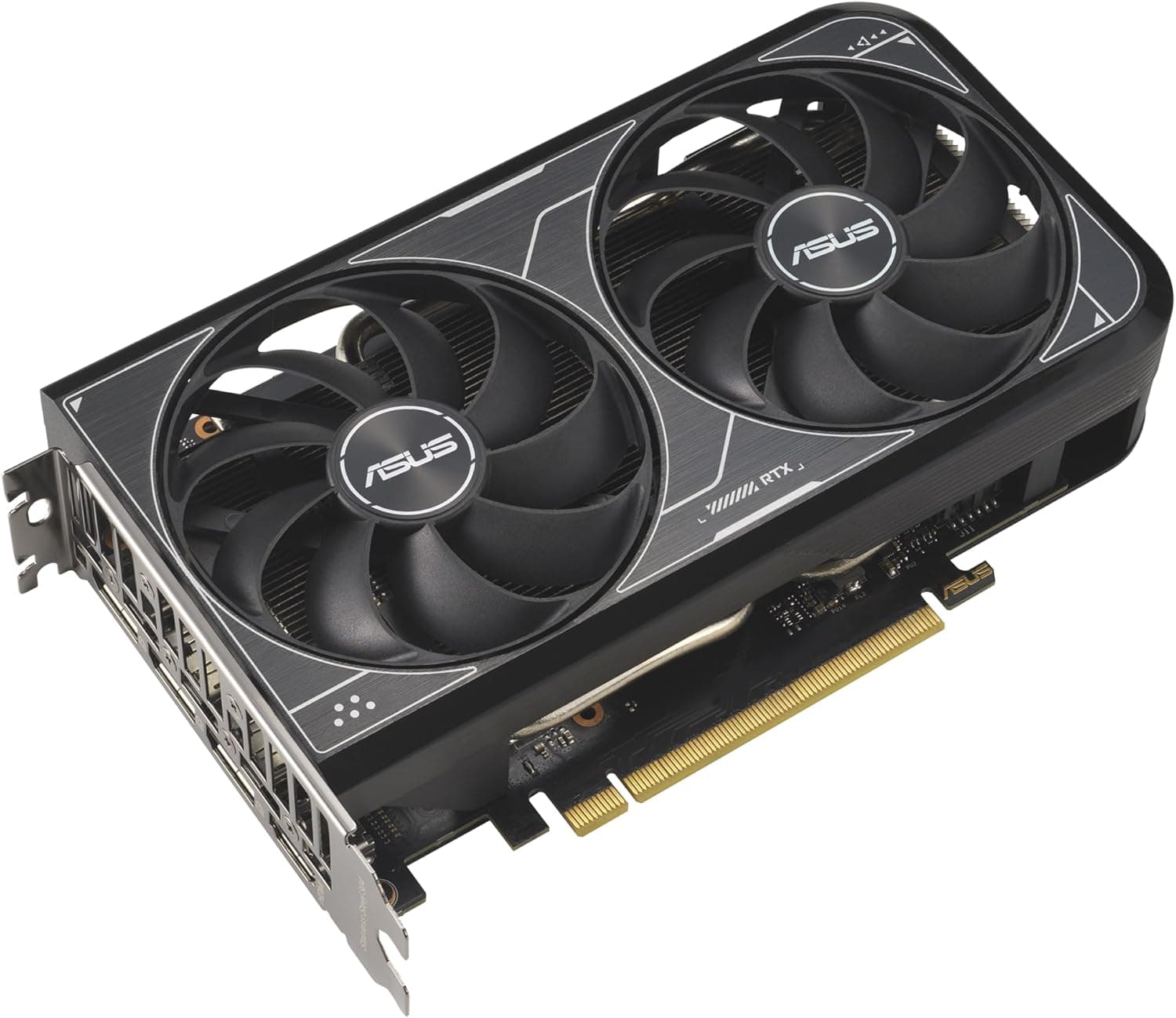
The RTX 4060 entered the market in mid-2023 as NVIDIA’s answer to the budget 1080p tier, and the arguments made for it at launch were honest within their frame: 3072 Ada Lovelace CUDA cores, a 115W TGP, and DLSS 3 Frame Generation access at a price point where the competition had no equivalent. That frame has shifted. In 2026, the RTX 4060 is primarily a used-market proposition at around £230, sitting below a direct successor in the RTX 5060 at £330 and above the sub-£150 clearance tier. The question is whether the card still earns its place in that gap, and if you can find an RTX 4060 on Amazon at the used-market rate, whether it is the right buy.
Product Snapshot
| Manufacturer | NVIDIA |
| Architecture | Ada Lovelace (AD107) |
| Process | TSMC 4N |
| VRAM | 8GB GDDR6 |
| Memory Bus | 128-bit |
| CUDA Cores | 3072 |
| Boost Clock | ~2.46 GHz (published) |
| TGP | 115W (published) |
| PSU Recommended | 550W |
| Power Connectors | 1x 8-pin |
| Release | June 2023 |
| Price | ~£230 used/~£270 new/~$230 used/~$299 new |
| Category | Budget 1080p |
Presentation and Build
Partner cards for the RTX 4060 are now three years old in the second-hand market, which makes the build assessment practical rather than theoretical: these are cards that have been run in real systems, and the physical condition matters in ways it did not at launch. The Founders Edition is a compact two-slot design with a short PCB that fits in virtually any case with a PCIe slot. Partner variants from ASUS, MSI, and Gigabyte added bulk in the original release window, with dual-fan and triple-fan shrouds that extended the card’s length beyond the Founders Edition’s footprint.
Build quality on used examples varies by seller and usage history rather than manufacturer design. The thermal paste on a three-year-old card that has run gaming workloads at sustained load may benefit from replacement: this is a known maintenance consideration for any GPU at this age, and the RTX 4060’s 115W TGP means that a degraded interface does not become catastrophic, only incrementally noisier as the fan curve compensates. Physically, the AD107 die is small enough that the card runs cool under most conditions even without intervention.
The 8-pin power connector is the RTX 4060’s most practical legacy advantage over its successor. Where the RTX 5060 requires a 16-pin connector with an 8-pin adapter on most existing power supplies, the RTX 4060 connects directly to any power supply built since roughly 2012. For a builder upgrading a system rather than building new, this is a frictionless install.
Performance and Software
The 1080p rasterised case for the RTX 4060 in 2026 is still intact, but it has developed limits that were not visible at launch. Monster Hunter Wilds at High settings 1080p holds a playable baseline on the RTX 4060, which is a playable baseline but not the headroom a card in this tier should offer in a title released thirty months into the card’s lifespan. Elden Ring at max settings 1080p runs above a comfortable rate in open-world traversal and drops in the densest particle-heavy boss arenas, where the 128-bit memory bus narrows the available bandwidth. Cyberpunk 2077 at High settings without ray tracing holds an acceptable rate at 1080p.
The 8GB GDDR6 ceiling is now the RTX 4060’s primary performance constraint at 1080p Ultra rather than its compute throughput. In texture-heavy titles with high-resolution asset packs enabled, the card’s 8GB allocation is under genuine pressure: Hogwarts Legacy at Ultra 1080p on PC with high-resolution textures enabled produces VRAM allocation warnings and measurable frame-pacing irregularity that the GPU’s compute performance alone would not cause. The 128-bit bus compounds this: where the RTX 4060 Ti’s wider bus provides relief when VRAM pressure spikes, the RTX 4060’s narrower bus limits recovery bandwidth. The card earns its 1080p High-to-High-Ultra contract; it does not earn the full 1080p Ultra contract in 2026 titles with aggressive texture budgets.
DLSS 3 is available on the RTX 4060, and DLSS 3 Frame Generation remains functional in supported titles. What the RTX 4060 cannot access is DLSS 4: the Multi Frame Generation architecture and the updated transformer model for upscaling quality shipped with Blackwell and are not backported to Ada Lovelace. DLSS 3 Quality mode upscaling is still competitive against FSR 3 in supported titles, producing acceptable image quality at 1440p from a 1080p base render. But the gap between DLSS 3 and DLSS 4 in upscaling sharpness and ghosting reduction is measurable in direct comparisons, and it will widen as more titles implement DLSS 4 natively.
RTX 4060 review 2026: the used-market contract at £230
7.5/10
Buy on Amazon
Price and availability from Amazon
Value and Longevity
The RTX 4060 at £230 used occupies a defensible but narrowing position. The RTX 5060 at £330 new is approximately 25-30% faster at 1080p rasterised, carries GDDR7 memory bandwidth, and brings DLSS 4 access, including Multi Frame Generation. The £100 premium for new Blackwell versus used Ada Lovelace is a straightforward cost-to-capability trade-off: the RTX 5060 is the better card across every measurable axis, and at £330 it is not dramatically more expensive for a buyer with budget flexibility.
The case for the RTX 4060 at £230 is specific: a buyer who is primarily gaming at 1080p High rather than Ultra, who does not require DLSS 4, and whose upgrade window is two years rather than four. At that usage profile, the RTX 4060 delivers what it costs and does not deliver what it does not cost. The case against it is equally specific: a buyer who wants 1080p Ultra across demanding 2026 titles, who intends to keep the card through 2028, or who cares about DLSS 4 quality upscaling should spend the additional £100 for the RTX 5060.
The longevity question is the 8GB GDDR6 ceiling in a market where 12GB is increasingly the useful minimum at 1080p Ultra in texture-intensive titles. We have covered GPU VRAM requirements and what they mean for 1080p gaming builds on this site, and the pattern the RTX 4060 will follow is already visible in 2025 and 2026 titles: the card’s compute performance will outlast its VRAM allocation at the texture settings its successor tier supports comfortably.
Technical Notes
DLSS 4 is not available on Ada Lovelace hardware: this is the RTX 4060‘s most significant software limitation in 2026, and it requires direct statement. The Multi Frame Generation architecture in DLSS 4 requires Blackwell. The transformer model for DLSS 4 upscaling quality, which produces sharper results with reduced ghosting versus DLSS 3, is also a Blackwell-exclusive feature. NVIDIA confirmed no DLSS 4 backport to Ada Lovelace in 2024; this position has not changed.
DLSS 3 Super Resolution, which the RTX 4060 does support, remains functional and competitive in supported titles. DLSS 3 Frame Generation, which requires a base frame rate above 60fps to operate without introducing perceptible latency, is available across the RTX 4060’s supported title library.
Thermal performance on a well-maintained used example is a strong point of the RTX 4060’s design. The 115W TGP means the card runs coolly relative to its performance tier: a competent mid-tower case keeps junction temperatures comfortably under 80°C in sustained gaming sessions, and the card’s power delivery imposes no meaningful constraint on budget and mid-range power supplies. A 550W unit with 8-pin cabling handles the RTX 4060 without issue alongside a current-generation mid-range CPU.
Final Word
The RTX 4060 earns its £230 used case on the condition that it is read correctly. The card holds the 1080p High-to-High-Ultra contract across 2026 titles without significant qualification, runs at 115W in a tier where its successor requires 145W, and installs into more existing systems via its 8-pin connector than any current-generation GPU. Those are structural advantages for the use case the price point describes. The case it does not earn is the one the RTX 5060 makes: 1080p Ultra across demanding 2026 and 2027 titles, DLSS 4 frame generation as a genuine multiplier, and a VRAM allocation that does not buckle in high-texture workloads. A buyer who has read our RTX 5060 review and arrived at £230 as their hard ceiling has the correct card. A buyer who has flexibility to £330 should spend it.
Is the RTX 4060 worth buying in 2026?
At around £230 used, the RTX 4060 is worth buying for a buyer with a 1080p High-to-High-Ultra target and a two-year upgrade horizon. It delivers its performance contract at that resolution without requiring DLSS upscaling as a baseline crutch, and its 115W TGP and 8-pin connector make it a practical fit for a wide range of existing systems. It is not worth buying at any price above £250 when the RTX 5060 sits at £330 new.
How does the RTX 4060 compare to the RTX 5060?
The RTX 5060 is approximately 25-30% faster at 1080p rasterised, carries GDDR7 memory bandwidth versus the RTX 4060's GDDR6, and adds DLSS 4 Multi Frame Generation and transformer-model upscaling quality. The performance gap is real and measurable in current titles. The value gap of roughly £100 between a used RTX 4060 and a new RTX 5060 makes the RTX 4060 defensible only for buyers with a strict budget ceiling.
Is 8GB VRAM still enough in 2026?
At 1080p High settings in most 2026 titles, 8GB remains sufficient. At 1080p Ultra in texture-intensive titles with high-resolution asset packs enabled, the RTX 4060's 8GB GDDR6 is under measurable pressure: VRAM allocation warnings appear in Hogwarts Legacy with high-res textures, and Monster Hunter Wilds at Ultra 1080p shows frame-pacing irregularity that the GPU's compute performance would not otherwise cause. The 8GB ceiling is adequate for 1080p High; it is a genuine constraint at 1080p Ultra in 2026 titles.
Does DLSS 4 work on the RTX 4060?
DLSS 4 Multi Frame Generation and the updated transformer upscaling model are Blackwell-exclusive features and have not been backported to Ada Lovelace. The RTX 4060 supports DLSS 3 Super Resolution and DLSS 3 Frame Generation, both of which remain functional across the existing supported title library. For buyers for whom DLSS 4 quality upscaling is a purchase criterion, the RTX 4060 is not the correct card.
Where should I buy an RTX 4060 used?
The £200-230 price range represents the correct value window for a used RTX 4060 in mid-2026. At above £250, the case against buying new at the RTX 5060 tier becomes difficult to justify. Before purchasing used, verify the seller's usage history where possible, and budget for thermal paste replacement if buying from an unknown source: a three-year-old GPU run at sustained gaming workloads benefits from fresh interface material before extended sessions.