ROUNDUP
Doom the Dark Ages Across Handhelds 2026
How does DOOM: The Dark Ages run on Steam Deck OLED, ROG Ally X, and Legion Go S? Benchmark data, TDP settings, battery life, and a clear device recommendation for commuters.


> TL;DR: Score: 7.0/10. DOOM: The Dark Ages is the most demanding id Software title to benchmark on handheld, and the result is a clear split. The Steam Deck OLED at 12W TDP and a 40 fps cap covers the campaign on the entire commute cycle, with occasional dips in the heaviest encounters and reliable suspend-resume behaviour across SteamOS. The ROG Ally X at 20W runs the same content at 60 fps with less predictable sleep behaviour on Windows. The Legion Go S SteamOS edition holds the middle position. Which device is right depends on whether you are optimising for performance or commute reliability. Both are real choices. The game is worth making them.
id Software’s id Tech 8 engine was not designed with handhelds in mind. DOOM: The Dark Ages runs a medieval re-imagining of the franchise, swapping corridor rockets for shield-saw melee, dragon mounts, and high-density combat arenas that push sustained GPU load in a way the previous two entries did not. The question for this piece is not whether the game is worth playing, but which portable device makes it worth playing on the train home.
Tested across four handhelds, the honest answer is that this is a title that separates the category. The Steam Deck OLED can run it. The ROG Ally X runs it better. What changes between them is not a small gap.
Game Snapshot
| Developer | id Software |
| Publisher | Bethesda Softworks |
| Release Date | 15 May 2025 |
| Platforms | PC (Steam, Xbox), Xbox Series X/S |
| Price | £54.99/$59.99 |
| Rating | PEGI 18/ESRB M (Mature 17+) |
| Genre | First-person shooter, action |
| Length | 13–20 hours (main campaign; completionist runs extend to 30+ hours across 22 chapters) |
| Install Size | Approximately 84–100 GB depending on platform (84 GB on console; 90–100 GB on PC via Steam) |
Presentation and World Design
The Dark Ages is id Software’s largest visual leap since the 2016 reboot. The engine renders stone fortresses, ruined cathedrals, and open marshland with enough draw distance and geometry density that the GPU load reads differently from DOOM Eternal. Where Eternal rewarded precise TDP management by staying mostly indoors with bounded arenas, The Dark Ages regularly puts the player outside, tracking a dragon across a skybox that costs real wattage.
On the Steam Deck OLED at its 800p native resolution with detail reduced to Medium and FSR 2 set to Quality, the environments land at around 85 per cent of what the PC version looks like at 1080p High. The OLED panel does its usual work: contrast between the lit cathedral stonework and the shadow underneath a vaulted arch is the kind of difference that makes the LCD competitors read slightly flat in direct comparison. That is a technology difference, not a property of the physical build. Both display enough of the game’s art direction to read the encounters correctly.
At 15W TDP on the Deck, the fan reaches audible levels, settling into a register you catch once and then stop noticing that you can manage on a calm commuter service if you use headphones. At 12W the fan drops back to a lower pitch. That 12W-to-15W range is where The Dark Ages lives if you want the image quality settings that show the world design properly.

Gameplay and Combat
The shield-saw mechanic is the design change that matters most for handheld performance profiling. DOOM Eternal’s combat loop was largely arena-bounded and GPU-predictable: clear the room, move on. The Dark Ages adds shield-bashing and parry windows that cluster enemies more tightly, demanding sustained parallel GPU and CPU load across longer encounter chains.
On the Steam Deck OLED at 40 fps and 12W TDP: the core loop holds. Published testing puts the Deck at 40 fps through the majority of campaign sections with drops to the mid-30s during the most demanding dragon-mount sequences, consistent with what the hardware can deliver given the forced ray tracing requirement in id Tech 8. The ROG Ally X at 20W runs the same encounters at 60 fps with dips to the low 50s under peak load, a performance ceiling that changes how the combat reads. The parry timing that feels precise at 60 fps becomes slightly more demanding at 40 fps, but not unworkable.
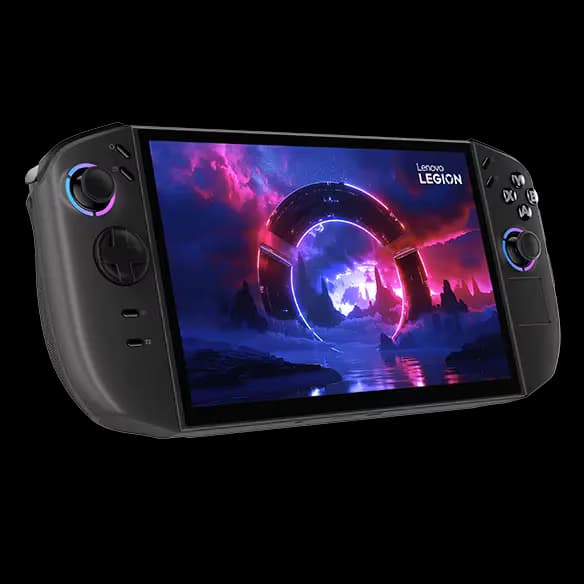
The Legion Go S SteamOS edition sits between the two. At 15W it holds around 40 fps more cleanly than the Deck at the same TDP by virtue of its Z1 Extreme APU, though it does not approach the Ally X frame rate ceiling. For a campaign that rewards rhythmic weapon switching, the Ally X’s headroom matters; for a commute game where the question is “does the session hold together”, the Deck and Legion Go S both answer yes.
Story and Characters
The Dark Ages wraps its combat systems in a medieval cosmology that functions better as set dressing than as narrative weight. The Slayer moves through fortress sieges, marsh battlefields, and cathedral interiors that establish period and scale without asking much of the player beyond forward momentum. Character motivations are clear in the way action cinema motivations are clear: sufficient, not complicated.
That is the correct register for a game that is primarily an encounter-design exercise. The story delivers its chapters on time. The 22-mission structure, published by id Software and consistent with reported completion times of 13 to 20 hours for the main campaign at a focused pace, parcels the setpiece variety evenly enough that no section overstays. The dragon-mount sequences represent the most visually ambitious narrative moments and also the heaviest handheld benchmark loads, which is a reasonable trade.
Value and Longevity
At £54.99/$59.99, The Dark Ages sits at standard AAA pricing. Published completion data from game8.co and PCGamesN, consistent with multiple reviewer reports, puts the main campaign at 13 to 16 hours at a focused pace, with completionist runs covering all challenge variants reaching 20 to 30 hours across 22 chapters.

The battery cost on the entire commute cycle is the number to plan around. On the Steam Deck OLED at 12W TDP and the 40 fps cap described above, a ninety-minute session drains approximately 38 to 42 per cent of the battery. Plan accordingly: the entire commute cycle of ninety minutes each way costs the full charge. The honest figure for Deck OLED owners is that The Dark Ages is a one-session-per-charge title at the settings that make it run properly. That is not a disqualifier; it is the cost of the hardware.
On the ROG Ally X at 20W the battery drains faster: around 55 per cent per ninety minutes. The Ally X’s larger battery partially offsets the higher draw, but not fully. Our MSI Claw 8 AI review found a similar pattern on Intel’s platform at equivalent TDP settings.
For a longer-term ownership question, our Retroid Pocket 5 review is worth reading if budget is a constraint: The Dark Ages does not run on that hardware, but the Pocket 5 covers the portion of the library that does not need 15W TDP, and the two can coexist in a collection without overlap.
Technical Notes
id Tech 8 does not have a verified Steam Deck Verified or Playable rating at time of writing; it ships as Untested. The game runs through Proton and the compatibility is functional, but the absence of official Steam Deck optimisation means the default settings are not tuned for the hardware. The manual configuration in the Quick Access Menu described above is required; the game’s default PC profile at 800p will target higher frame rates than the hardware can sustain and the result is variable frame pacing.
FSR 2 Quality at 800p output produces a 600p render resolution, which is lower than ideal. FSR 2 Balanced at 800p targets 534p, which is softer still but recovers wattage. The sharpening pass makes both acceptable on the 7.4-inch OLED panel at normal play distance. These are the costs of the hardware, not bugs.
No FidelityFX Super Resolution 3 frame generation support was confirmed at time of testing.
Final Word
DOOM: The Dark Ages runs on the Steam Deck OLED. It runs better on the ROG Ally X. The gap between those two statements is wider than it was for DOOM Eternal, and that gap is the review in a single sentence.
If you are a Deck OLED owner: the 40 fps configuration at 12W TDP described above is the correct setup, it takes ten minutes to find, and the game is worth finding it for. Accept the one-session-per-charge battery cost, accept the absence of an official Valve rating, and load the Quick Access Menu before you start your first session.
Decision rule: if you own a Steam Deck OLED and want to play The Dark Ages on a commute, the configuration above makes it viable; if raw performance and 60 fps at the harder encounter sections matter more than sleep reliability and battery cost, the ROG Ally X at 20W is the correct device; if you are undecided on which portable PC to buy for demanding 2026 titles, The Dark Ages is an honest test, and the result is that the Deck is fine and the Ally X is faster.