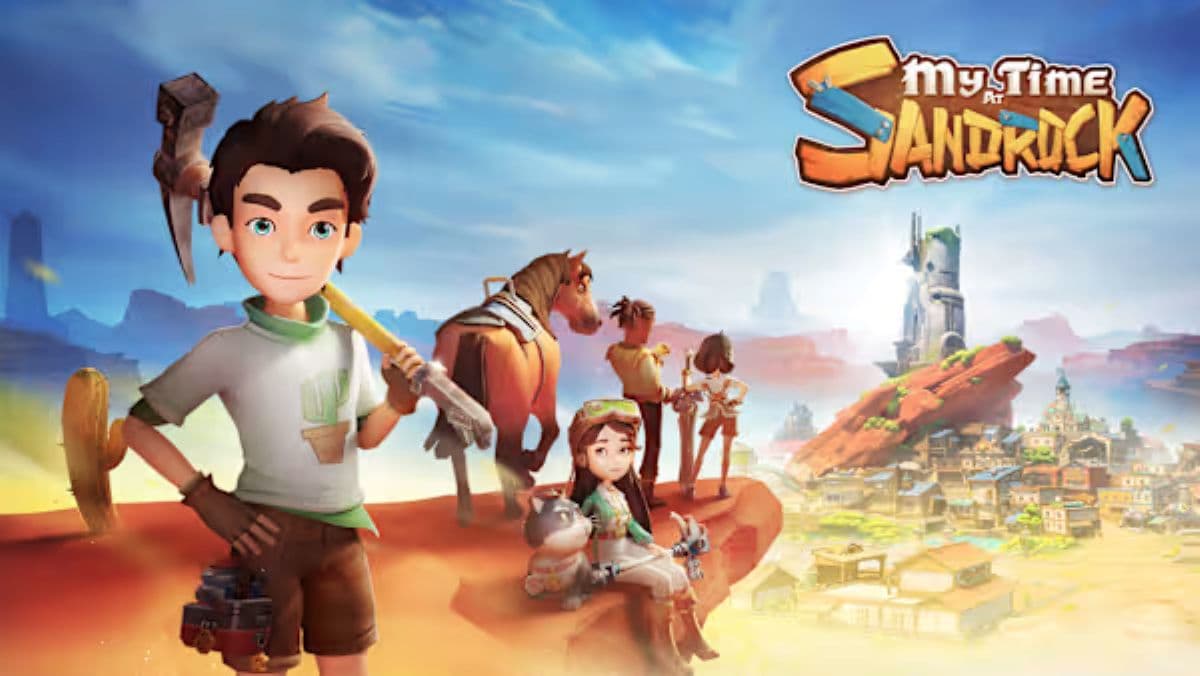
The desert is a formal choice. Most life-sims work in green: grass, forest canopy, the kind of soft palette that signals welcome before the player has done anything to earn it. Sandrock refuses that shortcut, and the refusal is the argument. The commission board, the copper dust, the particular quality of the late-afternoon light on sandstone: everything in this game earns its sense of place by being specific about the wrong kind of beautiful.
Pathea’s sequel to My Time at Portia is a more considered piece of design than its predecessor, and the desert setting is the reason.
The constraint forced every subsequent decision. Where Portia could hide a thin ambient layer under birdsong and rustling, Sandrock has to build atmosphere out of dry wind and metal, which requires the sound team to be deliberate. Where Portia’s lushness was welcoming by default, Sandrock’s aridity means the first few days feel genuinely sparse, which is correct: the loop is about building something where nothing was.
Game Snapshot
| Developer | Pathea Games |
| Publisher | PM Studios |
| Release Date | 2 November 2023 |
| Price | £29.99/$39.99 |
| Rating | PEGI 7/ESRB E10+ |
| Genre | Cosy life-sim/Workshop crafting |
| Length | 50-80h main story/120h+ completionist |
| Install Size | ~12 GB |
Presentation and World Design
The Eufaula Desert is the most coherent biome Pathea have built. Portia’s world was pleasant but episodic: a green valley that accumulated rather than held together, each area feeling like a separate design decision rather than a continuous place. Sandrock holds together. The colour temperature is consistent, running warm through midday and cooling into dusty rose towards evening, which makes the day cycle feel like an actual passage of light rather than a slot machine turning. The rocks have the right texture for baked sandstone, which is to say they look hard and hot, and the player registers this before the game explains the setting in words.
The workshop sits on the eastern edge of town, which means the player always approaches it from the same direction, which means the game can build a particular relationship between the player and the view. After thirty hours, the workshop’s silhouette against the evening sky is a known thing. The game trusts this kind of accumulated familiarity.
The architecture of Sandrock itself is deliberate in the quieter way: squat buildings in off-white and terracotta, market stalls with fabric awnings in dusty greens and yellows, the central plaza laid out so that the player can see most of the town at once. This matters for a game built around social relationships. The player can watch characters move between their daily routines from a single vantage point, which is how the world communicates that these are inhabitants rather than quest dispensers.
One specific thing: the sound when a sandstorm begins. It arrives at the edge of hearing first, a low register that rises over perhaps fifteen seconds before the visual effect follows. The game could have triggered both simultaneously. It didn’t.

Gameplay and Combat
The commission system is the structural innovation that Portia attempted but did not fully commit to. In Sandrock it is the loop’s architecture: players accept commissions from the board, gather materials, build requested items in the workshop, and deliver to deadline. The deadlines are generous by default. The commission board respects the player’s ability to manage a schedule without constant pressure, which is the correct register for a game in this genre.
The workshop crafting is the section that most rewards attention. Assembling items requires placing components into a station, running the assembly, and waiting a measured amount of time. There is a skill tree that shortens cycle times and unlocks higher-tier crafting, but the game does not gate progress behind optimisation: a player who builds more slowly but consistently will clear commissions at the same pace as one who has maximised the efficiency nodes. This is a design position about who the game is for.
The gathering world has light combat with desert fauna, relics, and ruin explorers. The combat is functional rather than interesting: a third-person brawler with a stamina bar that the player will find adequate and then largely forget about. The game treats it as the price of admission for the mid-game resource tiers, which is an honest framing. When the combat disappears from a session because the player is deep in a long commission chain, nothing is lost.
The pacing of commissions scales gently through the seasons. Early commissions ask for basic components and deliver modest coin. Later commissions ask for research-gated intermediaries and deliver enough coin to purchase rare materials, which closes the loop: the commission system is its own resource economy, which is tidy.
The day-night cycle is longer than Portia’s, which turns out to matter. The player can complete the morning’s assignments, sit with the results for a moment, and then choose an afternoon activity without the loop rushing them toward sunset. The loop is unhurried. That is the point.

Story and Characters
The narrative structure is lighter than the crafting loop, which is correct for this kind of game. A builder arrives in Sandrock under a contract with the Civil Corps, the game’s loose governance body, and over the first year helps the town recover from a resource shortage and fend off a competing corporate interest. The plot does not demand close reading. It provides enough momentum to carry the player through the seasonal transitions and enough resolution at the end of each arc to make the year feel like a chapter rather than a drift.
The marriage candidates are Sandrock’s most discussed aspect, and the game’s best formal decision about them is restraint. Owen runs the medical clinic and has the manner of someone who has chosen this small town rather than ended up in it, which is a narrative distinction the game conveys without stating. Mi-an works in the research department with a specificity of interest that the game lets develop across several seasons before it becomes significant. Logan is the rival-turned-something, which is the most conventionally plotted arc, and the one that works least precisely because it leans on that convention.
The game’s treatment of the pre-existing residents is where the lighter narrative is most visible. Characters have daily schedules and recurring dialogue, but the depth varies: some characters are given two or three lines that crystallise them, and some are given considerably more. The Civil Corps officers have the most consistent characterisation. The town’s shopkeepers are functional rather than interesting, and the game does not pretend otherwise.
The implied story, what the environment tells the player without dialogue, is Sandrock’s real storytelling strength. A town that is clearly in recovery, with construction scaffolding visible on several buildings and a water reclamation project that the player can physically watch progress across the seasons, says more about the setting than most of the written dialogue does.

Value and Longevity
At £29.99 the question is almost settled by the length before any other consideration applies. A player who engages with the main seasonal arcs and a moderate number of commissions will see 50 to 60 hours without trying, and completionists who want to reach maximum relationship levels with multiple characters and complete the full commission ledger will find 120 hours insufficient. This is more content per pound than almost anything else in the genre at this price point.
The more relevant question is whether those hours hold together or pad. The first two in-game years hold together well. The commission board refreshes at a rate that keeps the workshop loop active without making it feel like piecework. The social systems have enough depth to make the relationship tracking feel purposeful rather than completionist box-ticking.
Year three and beyond are where the honest assessment requires a caveat. The commission board’s late-game content scales less elegantly than the mid-game: higher-tier commissions begin to ask for large quantities of components in combinations that can feel more like stockroom management than crafting. The social depth with most secondary characters by this point has plateaued. The game’s strongest argument for continued play in the late stages is the multiplayer mode, which changes the texture of the workshop loop considerably by distributing the commission workload.
For those who own this on Switch and are willing to accept the performance constraints (covered in Technical Notes), the value proposition is strong precisely because the short-session structure suits handheld play. Thirty minutes of commission work on a commute is a well-calibrated version of this loop.
For a comparison of how Sandrock’s depth compares to other titles in the genre, Stardew Valley’s recent 2026 re-evaluation is useful context, and Littlewood’s stripped-back take on the post-hero life-sim covers the lighter end of the spectrum.

Technical Notes
The PC version is the reference build. Frame rates hold consistently above 60fps on modest hardware, the load times are short, and the game received a substantial patch cadence in its first year that addressed most of the early launch stability issues. Steam Deck verification is current; the game runs well on deck at medium-high settings with a stable 40fps cap, which suits the frame of a handheld life-sim session.
The Switch version requires a separate consideration. Performance in docked mode is acceptable at approximately 30fps with minor dips during busy town sequences. Handheld mode runs at a lower resolution with more pronounced dips when the player is near multiple NPCs or during sandstorm events. This is not a performance level that breaks the game’s comfort if the player is already comfortable with 30fps cosy games: the loop is slow enough that frame dips register as minor texture rather than obstruction. It is worth knowing before purchase.
The Cozy Grove Switch 2 port handles the handheld-optimised life-sim differently; that comparison is worth reading if the Switch version is the intended platform.
PS5 and Xbox Series X run clean. The current-gen console versions are not substantially improved over the base versions in ways the player will notice during normal play, which is fine: the game did not need visual enhancements that would disrupt its established register.
Final Word
Sandrock is better than Portia, and the reason is formal rather than commercial. Pathea chose a setting that required them to earn atmosphere rather than inherit it, and the discipline imposed by that choice runs through the commission system, the ambient layer, the pacing of the day cycle, and the restraint in the social writing. The game’s argument is that the workshop loop is its own kind of comfort: repetitive in the way a morning routine is repetitive, measured in the way a skilled person’s working day is measured. After fifty hours, the late-afternoon light on the sandstone workshop wall is a known thing. The game built that familiarity deliberately.
The Switch performance caveat is real for players who are sensitive to frame rate. For everyone else: this is the life-sim that most clearly knows what it is trying to do.
FAQ
Is My Time at Sandrock worth buying in 2026?
Yes, particularly if the workshop crafting loop appeals: 50 to 80 hours of well-paced commission work at £29.99 remains a strong value argument two years after launch, and the current patch state is stable and content-complete. Players who found Portia unfocused or uneven will find Sandrock the more confident of the two.
How does My Time at Sandrock compare to Portia?
Sandrock is structurally more coherent: the commission system is better designed, the desert setting is more intentional than Portia's valley, and the social character writing is more consistent across the main cast. Portia's green palette and looser pacing may suit players who preferred the earlier game's gentler rhythm, but Sandrock makes the stronger design argument on most criteria.
Is My Time at Sandrock good on Switch?
The Switch version runs at approximately 30fps docked with minor dips in busy sequences, and at a lower resolution in handheld mode. This is manageable for a slow life-sim but worth knowing in advance. Players sensitive to frame rate should consider the PC or PS5 version. The handheld short-session structure does suit the game's loop well if performance is acceptable.
Does My Time at Sandrock have multiplayer?
Yes. The multiplayer mode supports co-operative play where multiple builders share a commission board and workshop. It changes the texture of the loop considerably by distributing the workload and introducing a social layer to the crafting sessions. It is currently online-only and requires all participants to be at a similar stage of progress for the commissions to scale correctly.
How long does My Time at Sandrock take to complete?
The main seasonal arcs run 50 to 80 hours for most players at a comfortable pace. Full completionists targeting maximum relationship levels, all commission types, and late-game research will find 120 hours a realistic estimate. The game is designed for long-form engagement rather than a single finish line.
8.1
Great
SpawningPoint Verdict
Review summary
The desert is a formal choice. Most life-sims work in green: grass, forest canopy, the kind of soft palette that signals welcome before the player has done anything to earn it.