REVIEW
7.6· Great
Marathon PS5 Review: Bungie’s Hostile, Beautiful Bet
Marathon PS5 review: Bungie’s extraction shooter delivers best-in-class gunplay and striking art. Thin launch content and a steep learning curve hold it back.

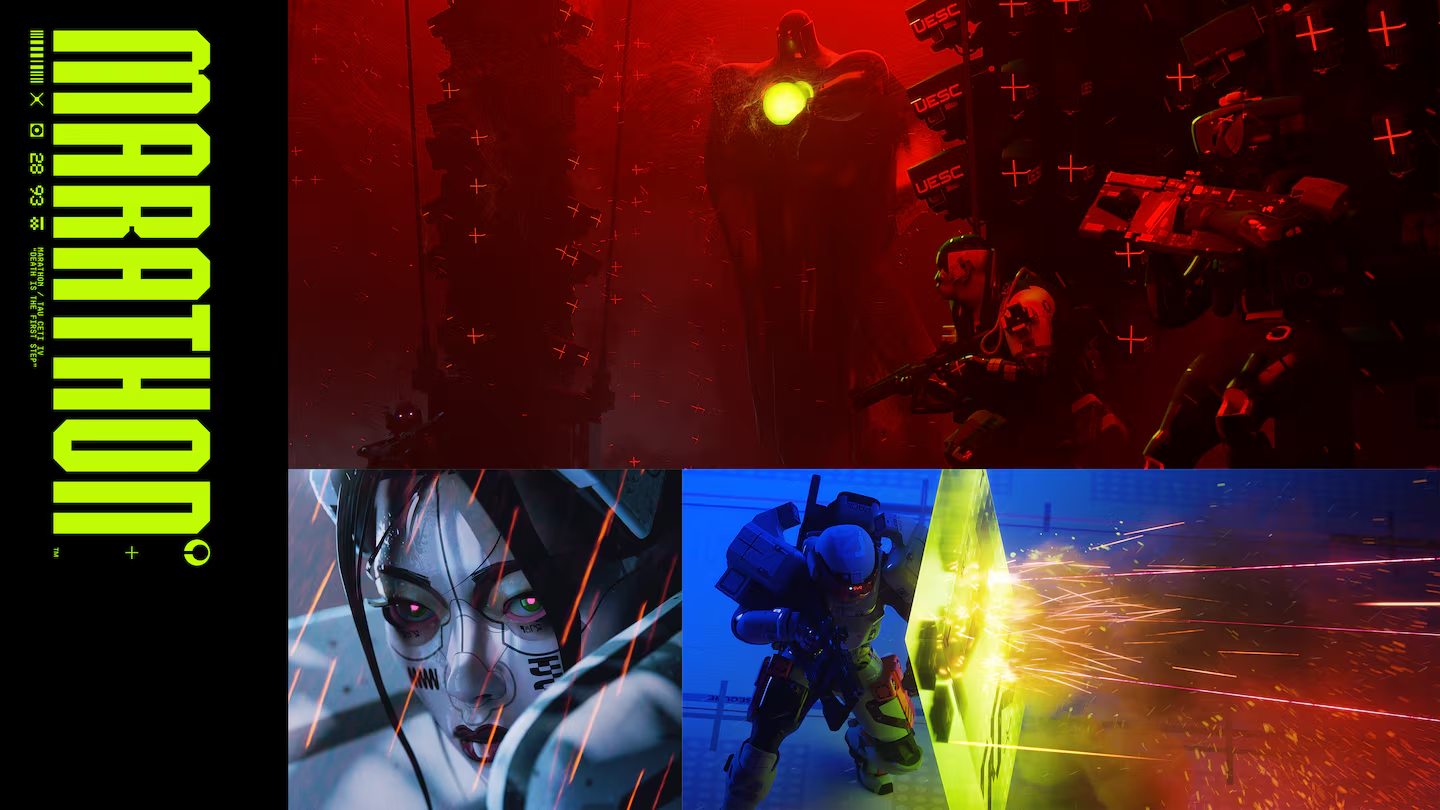
The best-feeling shooter of 2026 launched with three maps, a hostile UI, and a battle pass that insulted its own audience. Marathon’s gunplay is flawless. Everything around it is a work in progress. The shooting mechanics are exceptional, the visual identity is unlike anything else in the extraction space, and the core loop, deploy, scavenge, fight, extract, or die, creates authentic pressure that justifies every punishing death. Marathon earns its best moments. It also earns its worst: hostile onboarding, a dreadful UI, and a microtransaction structure that drew justified backlash. At $39.99, Bungie is selling a foundation rather than a finished building. The foundation is spectacular. The building is incomplete.
Game Snapshot
| Developer / Publisher | Bungie / Sony Interactive Entertainment (PlayStation Studios) |
| Release Date | 5 March 2026 |
| Platforms | PlayStation 5, Xbox Series X/S, Windows (Steam) |
| Price | $39.99/£34.99 |
| Rating | ESRB T (Teen)/PEGI 16 |
| Genre | First-person extraction shooter (PvPvE) |
| Length | 25-minute match timer; session-based |
| Install Size | ~20-25 GB |
Presentation and World Design
Marathon’s visual identity is its second-strongest asset. The neon-heavy, stylised art direction draws from cyberpunk, brutalism, and deep-space horror to create environments that feel genuinely alien. Tau Ceti IV’s three launch maps, Outpost, Dire Marsh, and Perimeter, are architecturally distinct and visually striking. The problem is that there are only three of them. By hour fifteen, spatial memory replaces discovery. By hour thirty, the maps feel thin.

Season 1’s addition of the Cryo Archive, a raid-like endgame map that opened on 20 March, extends the rotation meaningfully. The Cryo Archive introduces verticality, multi-stage objectives, and environmental hazards that the launch maps lack, and it represents the kind of design ambition that Marathon needs more of. It is also the strongest argument for Marathon’s long-term trajectory: if future seasonal content matches this quality, the thin launch content becomes a footnote.
On PS5 Pro, Marathon achieves something technically remarkable. Bungie renders the game natively at 5K, then downsamples to 4K using PSSR, the inverse of PSSR’s typical upscaling use case. The result is one of the sharpest, cleanest visual presentations on console. The frame rate is stable across both PS5 variants. For anyone weighing the PS5 Pro investment, Marathon is one of the most technically impressive showcases available.
Marathon: Gameplay and Combat
Nobody does an FPS like Bungie. That reputation rests on a specific quality: the way weapons feel. Marathon inherits Destiny’s gunfeel DNA and strips it of the power-fantasy padding. Weapons are heavy, punchy, and lethal. Each archetype, from close-range shotguns to precision rifles, carries a distinct personality through recoil patterns, audio design, and visual feedback. The shooting is the foundation, and it is flawless.
The extraction loop layers risk onto that foundation. Each 25-minute match drops players (solo, duo, or three-person squad) onto a shared map populated by AI combatants and other player squads. The objective: scavenge high-tier loot, complete faction contracts, and extract alive. Death means losing everything carried into the run. The stakes are real, and the tension they generate transforms every firefight from a mechanical exercise into a decision: engage or evade, loot or escape, risk or survive.

Seven Runner Shells at Season 1 launch provide distinct playstyles, and the build-crafting system, cores, implants, and weapon modifications, adds the kind of incremental optimisation that kept Destiny players engaged for years. The three factions (Sekiguchi Genetics, MiDa, UESC) offer reputation progression with meaningful unlock trees. The endgame loop through the Cryo Archive gives invested players a reason to push beyond the standard extraction cycle.
Where Marathon struggles is accessibility. The onboarding is poor. The UI is, frankly, awful: overloaded, unintuitive, and hostile to new players trying to parse the game’s many systems. The learning curve is steep enough that the first five to ten hours feel punishing rather than challenging. This is a deliberate design choice. Whether it is a wise one depends on the audience Bungie intends to build. For comparison, ARC Raiders offers a more approachable extraction experience at a similar price point.
Story and Characters
Marathon has no single-player campaign. The lore is delivered through in-raid discoveries: environmental storytelling, data logs, faction narrative threads, and endgame revelations unlocked through the Cryo Archive. The world-building is surprisingly rich for a multiplayer-only title, constructing a coherent mythology around Tau Ceti IV’s colonisation history, the UESC’s security apparatus, and the Runners’ origins as cybernetic mercenaries.
The narrative approach rewards long-term investment. Patience is the price of entry. Early hours offer fragments. Dozens of hours later, those fragments assemble into a picture that several reviewers described as compelling. The lore unravelling is the closest Marathon comes to a traditional story arc, and for players who engage with it, the payoff is there. For players who do not read logs or explore environmental details, Marathon has no story at all. There is no middle ground.
The Runner Shells themselves have personality in their design language (visual identity, movement feel, ability kits) but no narrative characterisation. They are vessels, not characters, though each Shell’s design language carries personality without dialogue. For the target audience, this is sufficient. Players seeking a richer narrative experience in 2026 should look elsewhere: Clair Obscur: Expedition 33 is remains our standout story-driven title.

Value and Longevity
At $39.99, Marathon sits below the standard AAA price point and above free-to-play competitors. The pricing creates a tension: players are paying for a premium product that also asks for additional spending through a $10 seasonal Reward Pass and a premium currency (Lux) store. The Reward Pass drew criticism at launch for poor cosmetic quality and no premium currency rebate, standard features in competing battle passes. Bungie’s microtransaction pricing initially required spending $15 to afford a single Runner skin listed at 1,120 Lux when the $10 bundle only included 1,100 Lux. The studio corrected this after backlash. Cosmetics are the only purchasable items; there is no pay-to-win.
Bungie has committed to supporting Marathon “for many years” with seasonal content drops including new maps, Runner Shells, and gameplay features at no additional cost beyond the base game. That promise matters. The trajectory matters more than the launch state, and the early signs (Cryo Archive quality, rapid responsiveness to pricing feedback) suggest commitment. For anyone tracking the best PS5 games, Marathon’s sales of approximately 1.2 million copies and $55 million in revenue through late March fell below Sony and Bungie’s expectations, but 91% positive Steam reviews and a rising user reception score (from 4.7 at launch to 5.7) indicate a player base that is growing rather than shrinking. Players who require a deep map rotation at launch or a cosmetics system that matches free-to-play competitors should wait for Season 2.
Marathon PS5 Pro: Technical Notes
Marathon is a technical showcase on PS5 Pro. The engine delivers. The 5K native rendering, downsampled via PSSR rather than upscaled, produces exceptional image clarity and makes Marathon the first title to use Sony’s reconstruction technology in reverse. The 60 fps target holds with no noticeable drops on either PS5 variant. The game runs at a solid 60fps with no hiccups. The ~20-25 GB install size is remarkably lean for a modern shooter, and cross-play with Xbox and PC ensures a healthy matchmaking pool. PC is a different story.
On PC, the Tiger Engine shows rougher edges: reports of high CPU utilisation, low GPU utilisation, and frame rate ceilings around 80-100 fps suggest optimisation work remains. Frame generation support is “being considered.” System requirements are described as forgiving, making Marathon accessible across a wide hardware range. A full third-party technical breakdown has not been published as of writing.
Final Word
Marathon is Bungie’s most confident game since the original Destiny, and its most hostile. The gunplay is immaculate: heavy, precise, and satisfying in a way that no other extraction shooter matches. The art direction creates a visual identity that earns its screenshots. Every match generates genuine tension, the kind where a successful extract with a full inventory produces a rush that keeps players queuing for one more run. The launch is thin. Three maps, an awful UI, and a microtransaction stumble are real problems, not launch-window excuses. But the foundation Bungie has built is the kind you can feel the future of: Cryo Archive proves the studio knows what this game needs to become. It is the kind of shooter where a two-minute firefight in a neon-lit corridor against a squad you did not know was there becomes the most memorable moment of your gaming week. That is worth $39.99. Whether it is worth $39.99 plus a seasonal battle pass plus premium skins is a question Bungie has not yet answered cleanly. For context on where Marathon sits against the broader library, see our best PS5 games of 2025 rankings.

FAQ
Is Marathon free to play?
Marathon is a premium title priced at $39.99/£34.99, not free-to-play. It was initially rumoured to be free-to-play during development, but Bungie committed to a premium model. All future seasonal content (maps, Runner Shells, gameplay features) is included in the base price. Additional spending is optional through the $10 seasonal Reward Pass and premium cosmetics.
Is Marathon like Destiny?
Marathon inherits Bungie’s signature gunfeel and some structural DNA (build-crafting, faction systems, seasonal content model), but the gameplay loop is fundamentally different. Destiny is a cooperative PvE-focused looter-shooter. Marathon is a competitive PvPvE extraction shooter where death means losing your carried inventory. The shooting mechanics will feel immediately familiar to Destiny players; everything else is new.
How does Marathon compare to other extraction shooters?
Marathon’s gunplay is best-in-class, surpassing Escape from Tarkov and ARC Raiders in weapon feel and feedback. Its visual identity stands apart from any competitor. It is less accessible than ARC Raiders and less simulation-focused than Tarkov. The content offering at launch (three maps) is thinner than established competitors. The build-crafting depth is comparable to Tarkov’s modification systems.
Is Marathon on Game Pass?
Marathon is not available on any subscription service and requires a one-time purchase of $39.99/£34.99 on PS5, Xbox Series X/S, or PC (Steam). Cross-play and cross-save are supported across all platforms.
Is Marathon pay to win?
Marathon is not pay-to-win. All purchasable items are cosmetic only. Gameplay-relevant content (maps, Runner Shells, weapons, gameplay items) is available to all players each season. The premium currency (Lux) and seasonal Reward Pass provide cosmetic customisation options. Bungie has committed to this model going forward.
How many players does Marathon have?
Marathon launched with 88,337 peak concurrent players on Steam, settling to approximately 22,000 concurrent by late March 2026. Daily active users across all platforms were estimated at 345,000 in late March. Total sales were estimated at 1.2 million copies ($55 million revenue) by late March. The player base has been growing since launch.
Is Marathon single-player or multiplayer only?
Multiplayer only. Marathon has no single-player campaign. All gameplay takes place in shared PvPvE matches lasting up to 25 minutes. Players can enter matches solo, as a duo, or as a three-person squad. Lore is delivered through environmental storytelling and in-raid data logs rather than a structured campaign.
What are Marathon’s microtransactions like?
Marathon uses two currencies: Silk (earned in-game) and Lux (premium, purchased with real money). The seasonal Reward Pass costs $10 with free and premium tracks. At launch, pricing drew criticism: Runner skins cost 1,120 Lux, but the $10 bundle included only 1,100 Lux. Bungie adjusted the bundle to 1,120 Lux after backlash. The Reward Pass was also criticised for low-quality cosmetic rewards and no Lux rebate.
How does Marathon run on PS5 Pro?
Marathon renders natively at 5K on PS5 Pro, downsampled to 4K using PSSR (the inverse of typical upscaling). It maintains a locked 60 fps with no reported drops. The visual clarity is amongst the sharpest on console. Base PS5 also targets 60 fps at a lower undisclosed resolution. Both versions run stably.
Is Marathon worth it in 2026?
Marathon is worth it in 2026 for players who prioritise shooter mechanics above all else. The gunplay is best-in-class, the aesthetic is unique, and the extraction loop produces real stakes. The launch content is thin (three maps) and the learning curve is steep. Seasonal updates are expanding the experience at no extra cost. At $39.99, the foundation justifies the investment for shooter enthusiasts.
7.6
Great
SpawningPoint Verdict
Review summary
Marathon is Bungie’s PvPvE extraction shooter set on Tau Ceti IV in the year 2893. The gunplay inherits and refines Destiny’s best-in-class shooting mechanics, delivering weapons that feel heavy, precise, and lethal. The extraction loop, enter, collect, and survive long enough to extract, or lose everything carried in, creates authentic pressure. The neon-cyberpunk art style is its own, and PS5 Pro’s PSSR pipeline produces remarkable image quality at a stable 60 fps. The launch is thin: three maps, poor onboarding, a hostile UI, and microtransaction pricing that drew justified criticism before Bungie corrected course. Seasonal content (including the strong Cryo Archive endgame map) is included in the $39.99 base price. The foundation is exceptional. The superstructure needs building. Cross-play and cross-save support all platforms.