REVIEW
8.2· Great
Super Mario Party Jamboree Review 2026: Nintendo’s Most Generous Party Game Yet

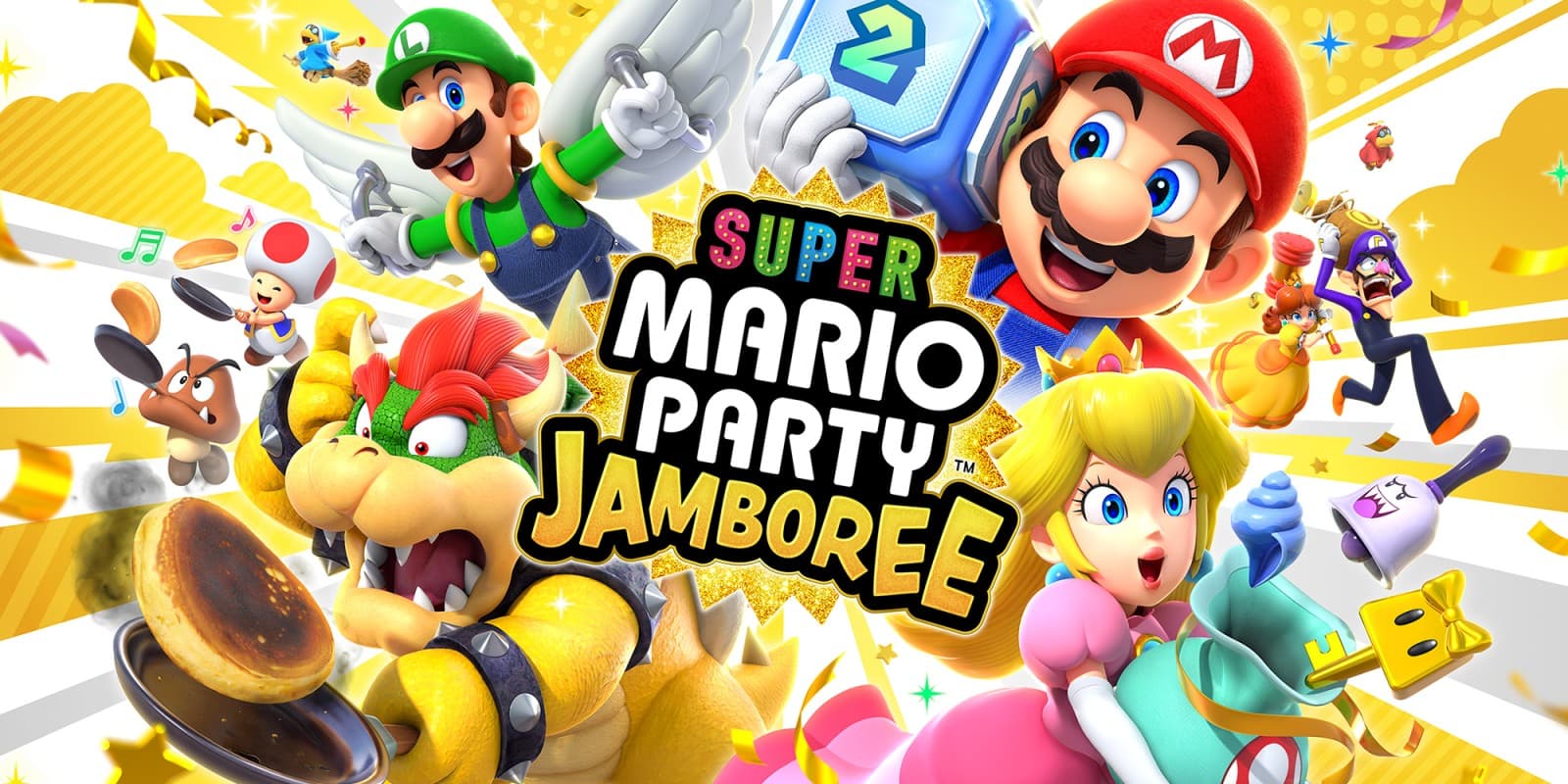
A party game that runs to twenty-two characters and seven boards is making an argument. Jamboree’s argument is that abundance is generosity. NDcube built their biggest Mario Party yet, and the size is earned. It is a game that has worked out what each new element is for.
Game Snapshot
| Developer | NDcube |
| Publisher | Nintendo |
| Release Date | 17 October 2024 (Switch 2 enhanced 2025) |
| Platforms | Nintendo Switch/Switch 2 |
| Price | £49.99 | $59.99 |
| Rating | PEGI 3 | ESRB E |
| Genre | Party Game |
| Length | 20-40 hours main/100+ hours completionist |
| Install Size | ~6.5 GB |
Presentation and World Design
The boards in Jamboree are themed tightly enough that each one has a distinct atmosphere. Rainbow Galleria places players inside a shopping centre that fills in around them as the game progresses, stalls opening, crowds appearing, the whole space becoming louder and more particular as the stars are claimed. Goomba Lagoon changes with the tide in ways that alter the board’s layout mid-game. These are not backdrops. They are designed systems that happen to be visually legible. The Nintendo Switch 2 displays these boards cleanly in both docked and handheld configurations, and the visual legibility transfers across both modes.

The visual register is Nintendo’s standard party-game palette: saturated primaries, thick outlines, character animations that prioritise read-at-a-distance clarity over detail. There is nothing here that will test the Switch 2’s capabilities, and there does not need to be. What matters is that the boards are fun to read. A player at the other end of a sofa should be able to tell, at a glance, where the stars are, who is ahead, and what the interesting move might be. Jamboree passes that test.
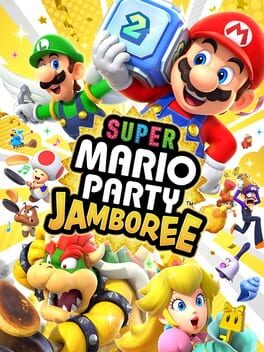
The twenty-two playable characters are a reasonable range of the Mario roster’s regulars and a few who appear rarely enough to register as a small treat. Pauline, Ninji, and Splatoon’s Inklings are among the guest inclusions. The roster does not feel padded. Each character has a distinct animation set that carries their personality into the board-game idle moments, and the effort is visible.
Gameplay and Combat
The board game mode is where Jamboree lands its central argument. Each of the seven boards has a mechanical identity that goes beyond its visual theme. King Bowser’s Keep uses the game’s rivalry system, in which pairs of players compete across the board for dominance of specific zones. Mega Wiggler’s Tree Party introduces a collective-action structure, where all players contribute to a shared goal alongside the usual competitive play. These are not modifiers. They are the reason each board has a different strategic texture.
Mini-games arrive after every round and number over one hundred in total. The range is broad. Motion-control entries use the Joy-Con or Switch 2 controllers with a directness that short rounds suit well. Jamboree sits comfortably among the best Nintendo Switch 2 games available in 2026 precisely because the mini-game design respects the hardware’s input options rather than forcing novelty. Button-only entries are precisely timed and readable. The best of them work because the input matches the visual read: what the player sees is what the player is asked to do, with a small window of execution that rewards attention rather than reflex. The weakest entries are the ones where the physical action and the on-screen representation are slightly misaligned, where the player wins or loses without quite understanding the mechanism. These are a minority.
The star-collecting loop is the game’s spine, and it is well paced. Stars move each round, coins are earned and lost through mini-games and board events, and the gap between first and last place rarely becomes unresolvable before the final rounds. This is not an accident. The coin-distribution economy, the item system, and the moving-star mechanic are all calibrated against each other in ways that become legible after two or three games. A new player is not lost. A returning player finds layers. That is the correct outcome for a game of this kind.
Jamboree also includes a Bowser Kaboom Squad mode, a cooperative mini-game structure, and a set of activities in the Jamboree Town hub area. None of these are filler in the way that some Mario Party side content historically has been. The cooperative mode is short and well-tuned. The town activities are compact. The game knows when to stop.
Story and Characters
Party games do not carry narrative weight, and Jamboree makes no pretence of doing so. What it does is maintain its characters across all modes with enough personality that the cast earns its size. Mario, Peach, Waluigi, and Daisy all behave consistently with twenty years of accumulated shorthand. The newer inclusions, Pauline in particular, carry their own distinct energy. The same sense of cast-as-community that makes Animal Crossing: New Horizons on Switch 2 compelling across long play arcs shows up here in miniature, concentrated into board-game idle animations and reaction sequences.

There is a small amount of framing text around the Jamboree Festival concept, but it exists only to justify the visual variety of the boards. The real characters in a party game are the players, and the game knows this. The board events, the rival pairings, and the mini-game results are designed to generate the kind of moment that becomes the story players tell after the session ends: the last-round star steal, the item chain that reversed an impossible deficit, the mini-game loss that no one saw coming.
The Kamek-event system, which draws from a set of random board interventions, is the game’s primary chaos mechanism. At its best it redistributes tension without simply randomising the result. A Kamek event mid-game that shuffles star positions creates a new strategic state rather than simply undoing the one before it. The design intention is clear. The execution is consistent enough to trust, even when a specific event lands badly for a specific player.
Value and Longevity
Seven boards is the most the series has offered in a single entry. The replayability across those boards is genuine: each plays differently enough that a player who has exhausted one will find the next one asks different things. The mini-game count means that the rotation across play sessions stays fresh well past the point where smaller libraries begin to repeat.
The online mode supports up to twenty players in the Koopa’s Tycoon Town board, which is a distinct mode designed for online interaction. It works. The latency in mini-games is managed well enough that motion-control entries remain viable online, which is a decision that required deliberate network architecture. The game earns its online claim.

At £49.99/$59.99, the question of value is answered by the play context. For a household with regular local-play sessions, Jamboree is the most complete version of the formula Nintendo has shipped. For a solo player with no regular social group, the value requires more investment in online play to realise. For context on how Jamboree fits the Switch 2’s broader platform landscape, it is one of the clearest demonstrations of what the platform does that its competitors do not: shared-screen social play with a library designed around it. The game’s offline solo-play modes are present and functional, but the game’s real argument is social. Played socially, it justifies the price across many sessions.
Technical Notes
The Switch 2 enhanced version runs without incident in both docked and handheld mode. Frame rate is stable across all mini-game types, including the more complex motion-control entries and the busiest board moments. Load times are short. The game respects the hardware it runs on by not asking more of it than the experience needs. Anyone comparing the platform options before purchase will find the Switch 2 versus Steam Deck OLED breakdown a useful reference; Jamboree is one of the titles that tips the balance toward Switch 2 for households that prioritise shared-screen play.
Save reliability is standard Nintendo: reliable and automatic. There are no reported stability issues with the Switch 2 version at launch. The game is the correct size for its content. Nothing here will test hardware patience.
Final Word
The boards in Jamboree are built to be played more than once, which sounds like a modest ambition and is not. A party game that the player wants to return to is making a structural argument that most entries in the genre fail to make: that the experience of playing together has been considered carefully enough to justify repetition. The Goomba Lagoon board, specifically, is the kind of design that rewards a second playthrough because the tide behaviour takes one game to understand and a second to use. That is the correct shape for this kind of game. A solo player without a regular local group will exhaust the offline modes within ten hours and find diminishing returns in the online queues; the game is not for them. Return to it with people.
FAQ
Is Super Mario Party Jamboree good for short sessions?
Super Mario Party Jamboree suits short sessions well, with individual board games running between 25 and 45 minutes depending on round count and mini-game length. The game's structure does not punish stopping between sessions, and the mini-game mode offers standalone play without committing to a full board run.
How does Super Mario Party Jamboree compare to Mario Party Superstars?
Super Mario Party Jamboree has more content, with seven original boards against Superstars' five returning boards, and over one hundred mini-games against Superstars' roughly one hundred classic entries. Superstars has the stronger individual board selection by reputation; Jamboree has the more varied mechanical range across its boards, particularly in the rivalry and collective-action systems.
Is there combat or failure in Super Mario Party Jamboree?
There is no combat in the traditional sense. Mini-game losses cost coins, and board events can reverse a lead late in the game, but the failure states are mild and the economy is designed to keep most players in contention until the final rounds. The game's difficulty is social rather than mechanical.
Can Super Mario Party Jamboree be played online?
Super Mario Party Jamboree includes full online play with support for up to twenty players in the Koopa's Tycoon Town mode. Standard board games are also playable online with up to four players. A Nintendo Switch Online subscription is required. The online infrastructure handles motion-control mini-games without significant degradation.
Is Super Mario Party Jamboree worth it on Switch 2?
For a household that plays regularly with others, yes. The Switch 2 enhanced version runs cleanly, the seven-board library provides meaningful variety across sessions, and the online mode adds longevity beyond local play. Solo players will find less to hold them, as the game's central argument is social.
8.2
Great
SpawningPoint Verdict
Review summary
Super Mario Party Jamboree is the most content-rich entry in the series, and the content is purposeful. Seven boards each carry a distinct mechanical identity. A library of over one hundred mini-games provides enough variety that the rotation across play sessions stays fresh. The star economy is carefully tuned. The online mode works. The Switch 2 enhanced version runs without incident. What the game asks, in return for this scale, is that it be played with people. Played socially, it justifies every element of its size. Played solo, it is functional and incomplete. The distinction is not a flaw. It is the game's honest statement of what it is and what it is for.