REVIEW
7.8· Great
Cattails Wildwood Story Switch 2 Review 2026: The Cosy Cat Life-Sim Still Earns Its Place

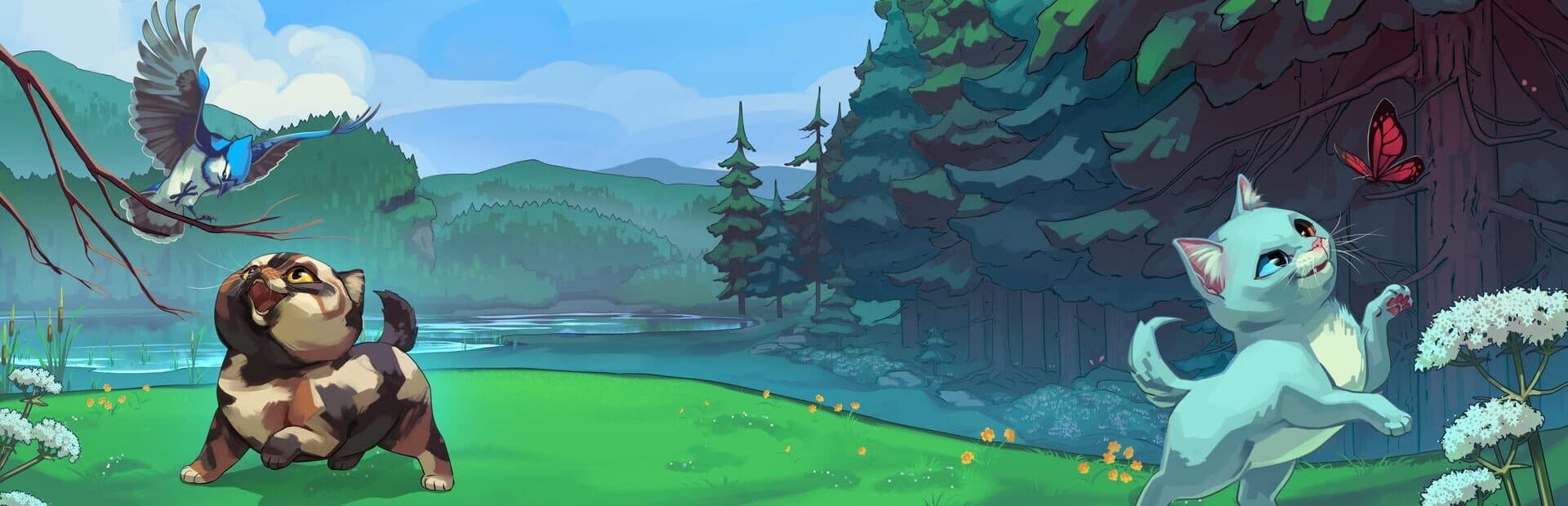
Cattails: Wildwood Story keeps a small promise most games of this scale would not bother making. There is a moment in autumn, after the first hard frost, when the wildwood goes quiet and the territories your cat has spent weeks establishing feel genuinely earned rather than mechanically accumulated. The game is more patient than it looks. It knows that a life-sim about cats should spend its best design energy on the in-between moments, not the milestones, and the Wildwood Story expansion doubles down on that instinct rather than inflating it.
Game Snapshot
| Developer | Falcon Development |
| Publisher | Cuddly Cactus Games/Maple Whispering |
| Release Date | 2023 (Switch 2 enhanced 2025) |
| Platforms | Nintendo Switch/Switch 2/PC (Steam) |
| Price | £12.99 | $14.99 |
| Rating | PEGI 7 | ESRB E10+ |
| Genre | Cosy Life-Sim |
| Length | ~25-40h main/80h+ completionist |
| Install Size | ~1 GB |
Presentation and World Design
The wildwood is drawn in a flat pixel style that does not ask for attention. The palette shifts with the season rather than merely recolouring the trees: spring has a quality of thin overcast light, the kind that makes colours look slightly more themselves than usual; summer goes warm and insistent; autumn becomes something closer to tarnished copper; winter empties out. None of these are subtle, but they are applied with enough care that the transitions feel like weather rather than a loading screen. It is a more restrained visual approach than the hand-painted look of Cozy Grove on Switch 2, but the consistency pays off over long sessions.
The UI stays out of the way, which is the correct decision. Territory markers are visible without being decorative, relationship indicators are quiet enough that a long-play session does not accumulate the visual noise that afflicts some life-sims in this space. The Wildwood Story content introduces new biome zones that have their own palette logic, distinct enough to register as genuinely different ecosystems without requiring a new tutorial to explain that you have crossed a boundary.
Where the presentation earns its keep is in the smaller details: the way a rival cat’s body language shifts when you approach disputed territory, or the way the foliage density changes as you move deeper into the old-growth areas added by the expansion. Falcon Development understand that a game built around noticing things should reward the player for noticing things. The environment is the argument the game is making.
The Switch 2 version runs at a steadier frame rate during busy seasonal events and the load transitions between zones are shorter, which matters less in isolation than it does across a forty-hour play session, where the accumulated friction of small delays can erode the game’s careful rhythm.

Gameplay and Combat
The core loop is hunting, foraging, and relationship-building, in that order of mechanical depth. Hunting asks for timed inputs against moving prey, with the difficulty scaling loosely to the prey’s size and the season. In winter, when prey is scarcer, the game asks for slightly sharper timing and rewards preparation: a well-fed cat in late autumn will hunt better in February than one who skipped the harvest foraging runs. This is the kind of small consequential design that the sequel handles more explicitly than its predecessor, and it sits closer to the patient accumulation found in Stardew Valley than the daily-task treadmill of more structured life-sims.
Foraging sits alongside hunting without competing with it. Different plants appear at different times of year, and the game does not rush you toward an optimal rotation. There are players who will find this, and they will have a spreadsheet before the end of spring. There are players who will wander the meadow edge in the late afternoon picking whatever seems right, and the game accommodates both with the same unhurried structure.
The relationship systems have been expanded in Wildwood Story to include longer arc narratives for a handful of cat characters. These are not deep in the way a dedicated narrative game is deep, but they earn their space: the game’s best writing appears in the conversation sequences, which have a patience to them that the shorter interactions in the base game lacked. Rival colonies now have their own internal politics, and negotiating territory over multiple seasons feels meaningfully different from simply winning a fight. The combat itself, when it comes, is brief and readable rather than demanding. It is not the point, and it knows it is not the point.
The seasonal cycle binds everything together. Spring is busy and a little anxious. Summer is generous and slightly long. Autumn is the most satisfying season to play, when the game’s systems are all running at once and the rhythm of the day feels genuinely full.

Story and Characters
Cattails: Wildwood Story does not have a plot, precisely. It has a situation: a colony of cats in an ecosystem under gradual pressure from seasonal change, with a cast of named characters distributed across its factions. The situation develops through accumulation rather than incident. Something changes between the first winter and the third, and the change is almost entirely relational. The approach sits closer to the ambient world-building of Tales of the Shire than to dialogue-driven storytelling.
The named characters have a quality of being exactly as deep as the game needs them to be. The elder cats who give you territory advice in early spring are not characters in a literary sense, but they are consistent enough that they become familiar, and familiarity in this genre does a lot of the emotional work that characterisation does in others. By the second year, when one of the elders stops appearing at her usual spot and the game quietly notes the absence, the detail lands.
The Wildwood Story expansion adds a lineage system that gives your cat a history in the world, connecting them to old territories and ancestral cats whose stories are told in fragments through environmental discovery. This is the game’s most ambitious narrative addition, and it is also its most uneven: the fragments are well-written in isolation but the overall shape of the lineage story resolves too cleanly given how oblique the setup is. The quiet of the delivery promises more ambiguity than the ending provides.
What the game does consistently well is give the world a reason to exist beyond its mechanics. The wildwood feels inhabited rather than merely populated, and the seasonal rhythms give even the background characters a legible routine.

Value and Longevity
At £12.99 / $14.99 on Amazon US the base question is whether the game offers enough structured content to feel complete, and the answer is yes with a qualification. The first thirty hours are well-paced and give the relationship systems and territory mechanics enough time to develop properly. The stretch from hour thirty onward is deliberately slower, and whether that reads as generous or thin will depend almost entirely on how much you value the game’s particular kind of patience. Compared to Littlewood, which front-loads its mechanical hooks more aggressively, Cattails earns its slower tempo through consistent environmental payoffs.
The Switch 2 version bundles the Wildwood Story expansion content, which adds meaningful hours of new biome exploration and the lineage system discussed above. For a player coming to the game for the first time, this represents good value: the expansion content is integrated rather than bolted on, and the new zones are accessible early enough that they do not feel like an endgame incentive. At this price point the bundle compares favourably to the Switch 2 platform’s broader cosy offering, as our Nintendo Switch 2 hardware review noted cosy life-sims as one of the format’s natural strengths.
For players returning from the original Cattails (2017) or from the base version of this game, the expansion’s content is the reason to return. The new characters, the territory politics expansion, and the lineage fragments add enough to justify the time, though the base progression loop is unchanged and players who wanted more mechanical depth from the sequel will find the same gentle ceiling.
The game’s ongoing update cadence on PC has brought seasonal events and small content additions over the life of the release. The Switch 2 version does not currently have the same cadence, which is a real difference for players who value the sense of a game continuing to grow.

Technical Notes
The Switch 2 version performs as expected for a pixel-art life-sim: stable frame rate in most contexts, with minor slowdown during the busiest multi-character seasonal events in the expanded wildwood areas. Load times between zones are noticeably shorter than on base Switch hardware. The game supports the Switch 2’s improved resolution output, which is most visible in the UI clarity rather than the game art itself. For cosy life-sim players new to the platform, it is worth reading our Palia Switch 2 review for an alternative entry point at the free-to-play end of this genre.
Controls map cleanly to handheld mode. The prey-targeting mechanic during hunts is slightly less precise with the Switch 2’s default sensitivity settings, but adjustable. No game-breaking bugs were encountered over a testing period spanning two full in-game years. One recurring audio glitch causes ambient sound to drop briefly when fast-travelling between distant zones, which is irritating rather than disruptive.
The PC version at equivalent hardware targets runs without issue and remains the reference platform for performance.
Final Word
By late autumn of the second year, the wildwood has a quality the first hours do not prepare you for: it is quiet in the way a familiar place goes quiet, not empty but settled. The elder who gave territory advice in spring is gone, a new rival colony has established itself in the eastern meadow, and your cat’s history with this ecosystem is long enough to feel like it belongs in it. Cattails: Wildwood Story is not the most ambitious cosy life-sim available at this price, but it is one of the more honest ones. It knows what it is doing and it does it with patience. For a player who wants a life-sim that respects the afternoon rather than demanding the evening, the wildwood is worth the walk.
FAQ
Is Cattails Wildwood Story worth buying on Switch 2?
Yes, particularly for players new to the series. The Switch 2 version bundles the Wildwood Story expansion at £12.99/$14.99, which is good value for the combined content. The performance improvements over base Switch hardware are real, most noticeably in load times and frame stability during seasonal events. Players who have already completed the base game should assess whether the expansion’s lineage system and expanded territory politics justify a second purchase, as the core loop is unchanged.
How long does Cattails Wildwood Story take to complete?
The main progression through the relationship and territory systems takes roughly 25-40 hours, with completionist play extending past 80 hours. The game is structured around seasonal cycles, so a full year runs approximately 8-12 hours of active play depending on how thoroughly you explore. The expansion content adds meaningful hours through new biome zones and the lineage fragment system, which is accessible relatively early in the game.
Is Cattails Wildwood Story the same as the original Cattails?
They share a developer and a genre but Wildwood Story is a full sequel with its own world and cast. The original Cattails (2017) established the cat life-sim format; this sequel expands the relationship systems, adds territory politics between colonies, and introduces the Wildwood Story expansion's lineage and biome content. Returning players will recognise the structure but find enough new material to justify the time.
What kind of game is Cattails Wildwood Story?
It is a cosy life-sim in which you play as a cat navigating an ecosystem of territories, relationships, and seasonal cycles. The core activities are hunting, foraging, and building relationships with other cats across rival colonies. There is light combat when territories are disputed, but the game's energy is primarily on accumulation and patience rather than conflict. The seasonal systems give each period of the year a distinct rhythm and material logic.
Does Cattails Wildwood Story have multiplayer?
Cattails: Wildwood Story is a single-player game with no multiplayer mode on Switch 2 or PC. The experience is designed for solo play, and the game's pacing and relationship systems are built around a single player's progression through the seasons. There is no co-op or competitive element in the base game or Wildwood Story expansion.
7.8
Great
SpawningPoint Verdict
Review summary
Cattails: Wildwood Story is Falcon Development's sequel to their 2017 cat life-sim, expanded with new biome content, a lineage system, and more developed territory politics between rival colonies. The Switch 2 version bundles this expansion at £12.99 / $14.99 with improved frame stability and shorter load times. The game's central argument is patience: the seasonal systems reward accumulation over optimisation, and the wildwood earns its quieter stretches through consistent environmental design and relationship depth. The lineage story resolves too cleanly, and players seeking mechanical progression beyond the gentle ceiling will find the same limits the sequel inherited. For new players, it is well-paced value. For returning ones, the expansion is the reason to come back.