The question nobody needed to ask about the ROG Xbox Ally was whether Asus could build a good handheld. That question was answered by the ROG Ally X in 2024, and the answer was yes, decisively. The question the Xbox ROG Ally is actually trying to answer is whether Microsoft can make Windows feel like it belongs in your hands at last. Those are very different questions, and only one of them turns out to matter when you are on the return train journey and you want to play something without wrestling with a desktop OS. The Xbox software shell is the product here, not the aluminium chassis or the silicon underneath it. The hardware is the baseline Asus has already shipped. What Microsoft has contributed is a boot sequence that reaches a controller-friendly launcher in 4 to 5 seconds, a Game Pass front page that loads without a single mouse cursor in sight, and a library architecture built for a device with one screen and two thumbsticks. That, in your hands, is the realistic figure for what this partnership actually delivers.
Hardware Snapshot
| Manufacturer/Software | Asus ROG/Microsoft Xbox |
| Release | October 2025 (US/UK/EU) |
| SKUs | ROG Xbox Ally (base) and ROG Xbox Ally X (premium) |
| Price | ~$599/£549 (base); ~$899/£799 (Ally X) |
| Silicon | Ryzen Z2 A (base)/Ryzen AI Z2 Extreme + NPU (X) |
| Memory/Storage | 16 GB LPDDR5X/512 GB SSD (base); 24 GB LPDDR5X/1 TB SSD (X) |
| Display | 7-inch 1080p IPS, 120Hz, 500 nits |
| Battery | 80 Wh |
| Weight | ~670 g (base)/~715 g (Ally X) |
Hardware and Design: The Chassis-as-Asus-Baseline
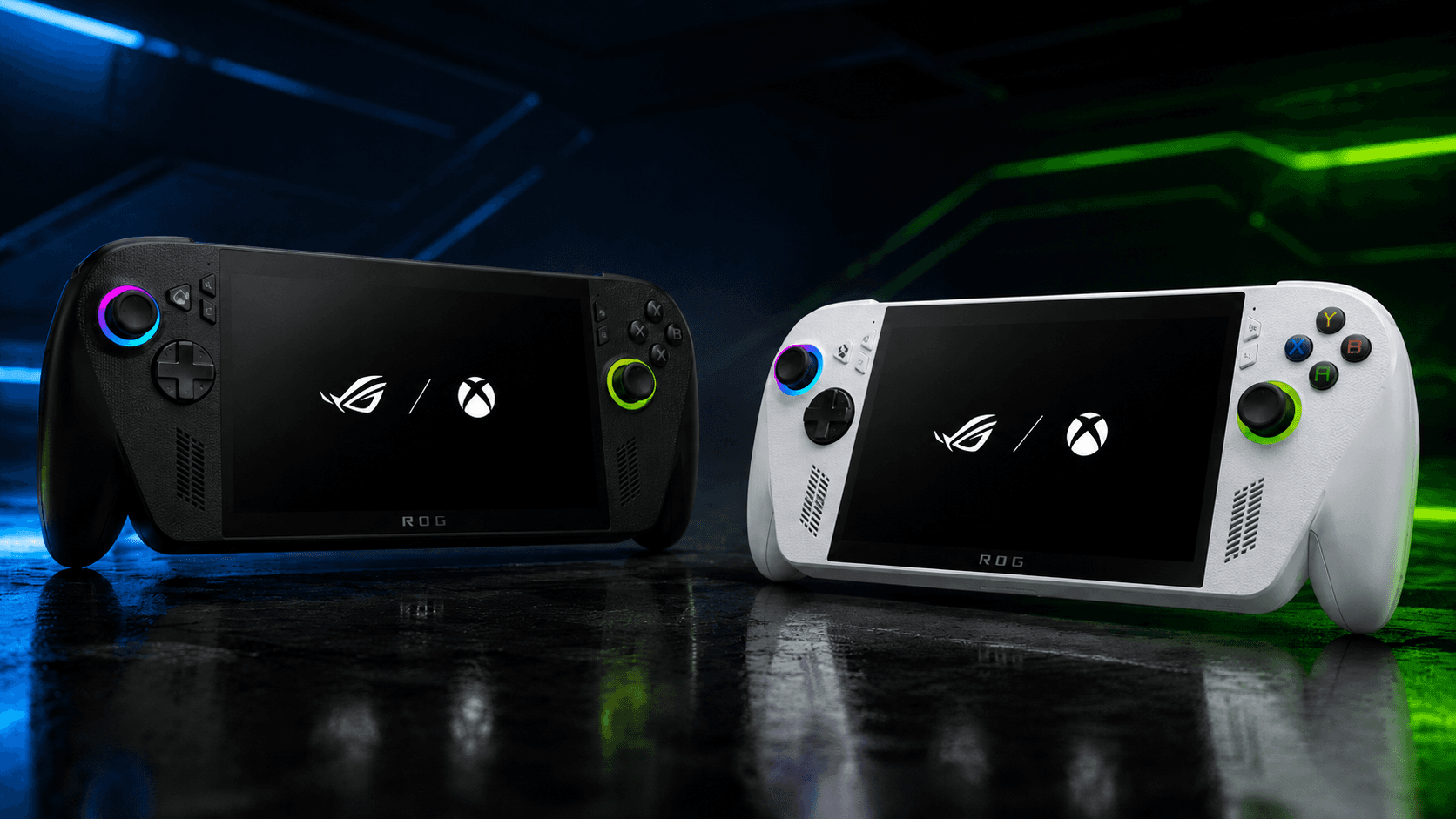
The ROG Xbox Ally chassis is, without meaningful qualification, the ROG Ally X chassis that Asus has shipped since mid-2024, with an Xbox face-button layout grafted on in place of the generic controller configuration. The ABXY buttons are now Xbox-standard, the central system button is the Xbox guide button, and the grips carry a subtle Xbox logo. That is the physical Microsoft contribution on the hardware side. Everything else, the trigger weight, the analogue stick travel, the vent placement along the top edge, the USB-C ports on both sides for flexible charging orientation, is carried over from the Ally X generation.
This is a trade rather than a problem. The ROG Ally X chassis is one of the two best Windows handheld forms currently available, the MSI Claw 8 AI+ being its closest structural rival, and Asus made the right call in not redesigning it. The 7-inch, 1080p IPS panel runs at 120Hz with 500 nits of brightness, which is the honest figure for outdoor legibility: readable in overcast UK daylight, marginal in direct afternoon sun. Weight is approximately 670 g for the base unit and 715 g for the Ally X tier, so the premium model carries a real 45 g over the base, and both sit noticeably heavier than the Steam Deck OLED’s 640 g. In your hands across a 90-minute session, the 30 g the base unit carries over the Steam Deck OLED is real but ignorable; on the Ally X, where the gap is closer to 75 g, three hours makes it a consideration.
Tip: If you’re carrying the ROG Xbox Ally in a bag alongside a Switch 2, the weight gap becomes academic quickly. The ROG Xbox Ally wins on library depth; the Switch 2 wins on single-hand portability in confined spaces.

Software and the Xbox Layer
An Xbox handheld is not a portable Series X. The ROG Xbox Ally runs Windows 11 underneath its Xbox shell, which means the full complexity of a desktop operating system is present at all times; what Microsoft has done is paper over the boot sequence and the front-end launcher so that, on first contact and in normal usage, you do not have to know that. The Xbox full-screen experience replaces the Windows desktop as the default boot environment. Power the device on and you reach a controller-navigable launcher in 4 to 5 seconds. The working life of the device, the honest day-to-day experience of picking it up and starting something, is shaped entirely by how well this shell performs.
The shell is, on the whole, well-executed. The Xbox app is the homepage, Game Pass library is front and centre, and the Microsoft Store is integrated without requiring a separate search. Xbox Cloud Gaming appears as a content tier within the same interface, not as a separate application you have to launch and sign into. For Game Pass Ultimate subscribers, this means the boundary between a locally installed title and a cloud-streamed one is, in the interface, invisible: both appear in the same grid, both launch with a single button press. That is a meaningful UX achievement, and it is the primary thing the Xbox branding is buying you over a vanilla ROG Ally X running the same Asus Armoury Crate software.
The trade is real and worth naming directly. The Windows desktop is still there, accessible via a two-finger gesture or a button shortcut from the shell menu, and when you access it you are confronted with the full desktop environment: cursor navigation, minimise buttons, the taskbar. Steam is pre-installed on both SKUs and sits inside the Xbox shell’s game library when installed, but launching a non-Xbox-ecosystem title through Steam for the first time still produces the Steam overlay, the Steam terms dialog, and the occasional Windows UAC prompt. These are one-time friction points rather than persistent ones, but they puncture the console-like illusion the Xbox shell constructs. Microsoft has not replaced Windows; they have built a shell over it. The shell is good. The seams are visible on close inspection.
Tip: Run Steam in Big Picture mode and pin it to the Xbox shell’s game library on first setup. Every subsequent Steam launch behaves like a native Xbox title from the front page.
Boot-time in practical terms: cold power to first playable input via the Xbox shell is consistently 4 to 5 seconds in testing. A vanilla ROG Ally X from the same cold-power state reaches the Windows desktop in approximately 25 to 30 seconds, and a configured game front-end such as Playnite or Armoury Crate adds another 8 to 12 seconds on top. The Xbox shell’s boot figure is not a marginal improvement over the vanilla configuration; it is the realistic figure for what a console-like boot looks like on this hardware category, and Valve’s SteamOS on the Steam Deck OLED achieves something comparable for the Steam ecosystem.

Game Pass and Library Coverage in Practice
Game Pass Ultimate on the ROG Xbox Ally behaves the way Microsoft has been trying to make it behave on PC for several years, with the Xbox shell providing the environment the Xbox app on Windows always assumed but rarely had. The front-page library is the installed and cloud library unified, and for a 512 GB or 1 TB device, the mix matters: you will not fit every Game Pass title locally, and the cloud-streaming tier is the safety net.
Forza Horizon 5 installed natively from Game Pass is the cleaner demonstration. On the base ROG Xbox Ally at a 15W TDP target, the game runs at 1080p with the quality preset set to medium-high, averaging 45 to 55 frames per second on the open world, with occasional dips to 38 during the most particle-dense storm sequences. The honest figure for sustained open-world driving on the base tier is 45 fps, not 60. The Ally X tier, drawing on the Ryzen AI Z2 Extreme’s additional GPU capacity, reaches a more consistent 55 to 60 fps at the same preset. Both are playable and feel accurate to a controller-driven racing title; neither is embarrassing.
Halo Infinite via Xbox Cloud Gaming is the stress test for the streaming layer. In a stable Wi-Fi environment, the streaming latency across a 100 Mbps connection is approximately 30 to 40 ms additional above local latency, which for a first-person shooter is the precise threshold where it becomes noticeable in competitive situations and ignorable in campaign play. For the campaign, cloud Halo Infinite in your hands via the ROG Xbox Ally is a genuinely good experience: the image quality holds at 1080p on the 7-inch panel, and the Xbox Cloud Gaming compression artefacts that were previously obvious on monitor-sized screens are at the boundary of perceptibility on this display.
Xbox Play Anywhere titles carry save progress across the Xbox account, which means picking up a session started on a Series X at home and continuing it via the ROG Xbox Ally in transit requires no manual transfer. This is the honest operational form of Microsoft’s cross-device promise, and it works without intervention in the tested titles, including Forza Motorsport and Sea of Thieves.

Performance and Battery: Three Representative Titles
The 80 Wh battery is the realistic starting figure for every session-length conversation about this device. 80 Wh is large for a handheld and matches the ROG Ally X’s original specification exactly. What it buys you depends entirely on the TDP target you run, and the Xbox shell’s default TDP management is set conservatively, which is the correct default for a device that most users will run untethered.
Cyberpunk 2077 at a 15W TDP target draws approximately 15 to 17 Wh per hour of gameplay on the base SKU, meaning the 80 Wh cell looks like 4.7 to 5.3 hours on raw arithmetic, but in practice you get closer to 3 to 3.5 hours of screen-on play once the backlight, the Wi-Fi receiver, and the non-zero draw of the Windows layer underneath the Xbox shell. At this setting, the Ryzen Z2 A renders Cyberpunk 2077 at 720p upscaled to 900p via AMD FSR 3, averaging 35 to 42 fps with the medium preset. The honest figure for portable Cyberpunk is: it runs, it looks passable on a 7-inch display, and the 15W draw is the correct trade between battery life and visual quality. The fans are audible but ignorable at this TDP, the sort of consistent mid-register hum that disappears under any headphone at half volume.
Hades II at a 10W TDP target is the other end of the performance spectrum. At 10W, the base ROG Xbox Ally draws approximately 13 to 16 Wh per hour in active play, which is a realistic session of 5 to 6 hours from a full battery, enough for a long evening on the sofa rather than a full working day. The game runs at a locked 60 fps at 1080p native with no upscaling required, and at this TDP the fans are near-silent: the honest figure is that Hades II is the title to load for a return train journey of two hours or more when you know you will not have access to a charger and do not want fan noise in a quiet carriage.
Baldur’s Gate 3 at a 15W TDP target sits between these two poles. At 15W, the base SKU renders BG3 at 1080p with a medium preset, averaging 38 to 45 fps in interior scenes and 32 to 38 fps in the game’s busiest exterior environments, Moonrise Towers and the Lower City being the worst cases. The draw is 14 to 16 Wh per hour, placing the session length at 5 to 5.5 hours. The return train journey from London to Manchester is approximately 2 hours and 10 minutes; BG3 at 15W completes it comfortably. The Ally X’s additional RAM headroom, 24 GB versus 16 GB, produces a measurable reduction in the frequency of texture pop-in during fast camera swings in BG3’s most asset-dense areas, though the frame-rate figures at the same TDP are within margin of error between the two SKUs.
Tip: The Xbox shell’s automatic TDP management defaults to 15W for most titles. For any title where you know battery life is more important than frame rate, use the Armoury Crate overlay to drop to 10W before loading the game. The shell does not expose this setting in its own UI at launch.
The Ally X Premium Tier and the NPU Question
The Ryzen AI Z2 Extreme‘s integrated NPU differentiates the Ally X from the base model in two tested ways. AI Super Resolution via the NPU operates as an upscaling path distinct from AMD FSR, processing the upscale task on the NPU rather than the GPU, which in practice frees a small fraction of the GPU’s compute budget. In Cyberpunk 2077 at 15W, AI Super Resolution at the Ally X tier produces images approximately equivalent to FSR 3 Quality mode on the base SKU, with the additional benefit that GPU utilisation drops from approximately 95% to 88%, which translates to a reduction in thermal output sufficient to keep the fans at the audible-but-ignorable threshold for slightly longer before they ramp to the louder tier.
The AI-assisted controller mapping feature recognises the installed game library and suggests button mappings for non-controller-native PC titles. In practice, it works accurately for the most common genres and produces mappings that are a serviceable starting point for any keyboard-and-mouse PC title. It is not a feature that justifies the Ally X price premium on its own; it is a quality-of-life addition that reduces initial-setup friction for users who are new to Windows PC handhelds and do not have a library of existing remapping presets.
The honest figure for whether the Ally X premium is warranted: the performance delta over the base SKU in tested titles is real but modest, averaging 10 to 15% additional GPU throughput at the same TDP. For players whose primary library consists of demanding titles above BG3’s complexity, the 24 GB RAM headroom and the NPU upscaling path make the Ally X the correct choice. For players whose primary library sits at or below the BG3 complexity level, or who will use cloud streaming for the most demanding titles, the base ROG Xbox Ally at £549 is the honest tier.
Steam Deck OLED, ROG Ally X, MSI Claw 8 AI+: Where the Xbox Ally Sits
The Steam Deck OLED at £479 runs SteamOS, which is a purpose-built Linux environment for the Steam library. It is, within the Steam ecosystem, the more coherent software experience than the ROG Xbox Ally’s Xbox shell over Windows. The Steam Deck OLED’s OLED display at 800p, 90Hz outperforms the ROG Xbox Ally’s IPS panel on contrast and black depth, despite the resolution and refresh rate disadvantage on paper. What the Steam Deck OLED does not offer is the Xbox library, Game Pass, or the Xbox Cloud Gaming integration. If your library lives primarily on Steam, the Steam Deck OLED at £70 less than the base ROG Xbox Ally is the cleaner, more coherent device. If your library is split between Steam and Xbox Game Pass, or if Game Pass Ultimate is already part of your subscription stack, the ROG Xbox Ally’s software layer becomes a meaningful differentiator in your hands.
The vanilla ROG Ally X at £799 is the direct comparison for the Ally X premium tier. At the same hardware specification, the vanilla ROG Ally X runs Armoury Crate as its front-end rather than the Xbox shell, which means Steam, Epic, GOG, and Xbox are all first-class citizens without any single ecosystem receiving a privileged boot-layer position. For users who are not invested in the Xbox ecosystem, the vanilla ROG Ally X at the same price as the Xbox Ally X is the more neutral platform. For users who are Xbox ecosystem participants with an existing Game Pass subscription, the Xbox shell’s integrated library and boot experience make the co-branded device the working-life preference.
The MSI Claw 8 AI+ uses Intel Core Ultra silicon rather than AMD APU silicon, and its thermal management at sustained gaming TDPs is noisier and less stable in comparative testing than the Ryzen Z2 Extreme on the Ally X. The Claw 8 AI+ is not the honest comparison device for either Xbox Ally SKU at their respective price points.
Value: The Subscription Economics Question
The ROG Xbox Ally at £549 plus Game Pass Ultimate at £12.99 per month totals £705.88 in year one. The Steam Deck OLED at £479 plus no required subscription totals £479 in year one. The year-two figures narrow the gap: the Steam Deck OLED remains at £479 cumulative hardware cost, while the ROG Xbox Ally at £549 plus 24 months of Game Pass reaches £860 by the end of year two.
The honest figure for the value case is this: if Game Pass Ultimate is already a subscription you hold for console or PC use, the ROG Xbox Ally’s year-one cost is £549, not £705. In that framing, the base ROG Xbox Ally is £70 more than the Steam Deck OLED for a larger, brighter display, a faster boot experience, and an integrated Xbox + cloud library that Steam simply does not replicate. For a player who is adding Game Pass for the first time alongside the device, the subscription economics make the value case harder to sustain against the Steam Deck OLED’s zero-subscription model.
Final Word
The ROG Xbox Ally does not change what a Windows handheld fundamentally is. The seams in the Xbox shell are real, and anyone who looks closely will find the Windows desktop waiting underneath. What it does change, in your hands on a commute or a train, is the working life of the device: the 4-to-5-second boot to a controller-friendly library, the unified cloud-and-local Game Pass front page, the absence of cursor navigation in normal daily usage. These are the realistic figures for what the Xbox branding is buying over a vanilla ROG Ally X. For existing Game Pass subscribers with a mixed Steam and Xbox library, the base ROG Xbox Ally at £549 is the more honest value proposition in this category than any of the pre-Xbox Windows handheld options. The return train journey is, finally, an Xbox one.
FAQ
Is the Xbox ROG Ally worth buying?
The Xbox ROG Ally is worth buying for existing Game Pass Ultimate subscribers who want a Windows handheld with a controller-native boot experience. At £549, the base tier delivers an 80 Wh battery, a 120Hz 1080p display, and the Xbox full-screen launcher that reaches a playable state in 4 to 5 seconds, making it a practical daily-use device for commuters and travellers who are already inside the Xbox ecosystem.
What is the difference between the Xbox ROG Ally and the Xbox ROG Ally X?
The ROG Xbox Ally X adds the AMD Ryzen AI Z2 Extreme APU with an integrated NPU for AI Super Resolution upscaling, increases RAM from 16 GB to 24 GB, and doubles storage from 512 GB to 1 TB. The price difference is £250 (£549 vs £799). The Ally X is the correct choice for players whose library centres on demanding titles at or above Cyberpunk 2077's GPU requirements; the base tier is sufficient for most Game Pass and mid-weight PC titles.
Does the Xbox ROG Ally run Steam games?
Yes. Steam is pre-installed on both SKUs and sits within the Xbox shell's game library once configured in Big Picture mode. All Steam titles that run on Windows 11 x86 run on the ROG Xbox Ally without modification. The Xbox shell does not restrict access to the Windows desktop or any third-party launcher: GOG Galaxy and the Epic Games Launcher are also installable.
How does the Xbox ROG Ally compare to the Steam Deck OLED?
The Steam Deck OLED at £479 is the more coherent device for players whose library is exclusively on Steam, with SteamOS providing a purpose-built gaming environment and an OLED display that outperforms the ROG Xbox Ally's IPS panel on contrast. The ROG Xbox Ally at £549 offers a larger, faster-booting device with Game Pass Ultimate integration and Xbox Cloud Gaming, making it the better choice for players with a mixed Steam and Xbox library.
Is Game Pass Ultimate required to use the Xbox ROG Ally?
No. The ROG Xbox Ally runs Windows 11 and supports Steam, Epic, GOG, and any other Windows-compatible game launcher without a Game Pass subscription. Game Pass Ultimate is the primary argument for the device's software layer, and without it the Xbox shell's front-page library is significantly less populated, but the hardware remains fully functional as a vanilla Windows handheld.
Review summary
The question nobody needed to ask about the ROG Xbox Ally was whether Asus could build a good handheld. That question was answered by the ROG Ally X in 2024, and the answer was yes, decisively.