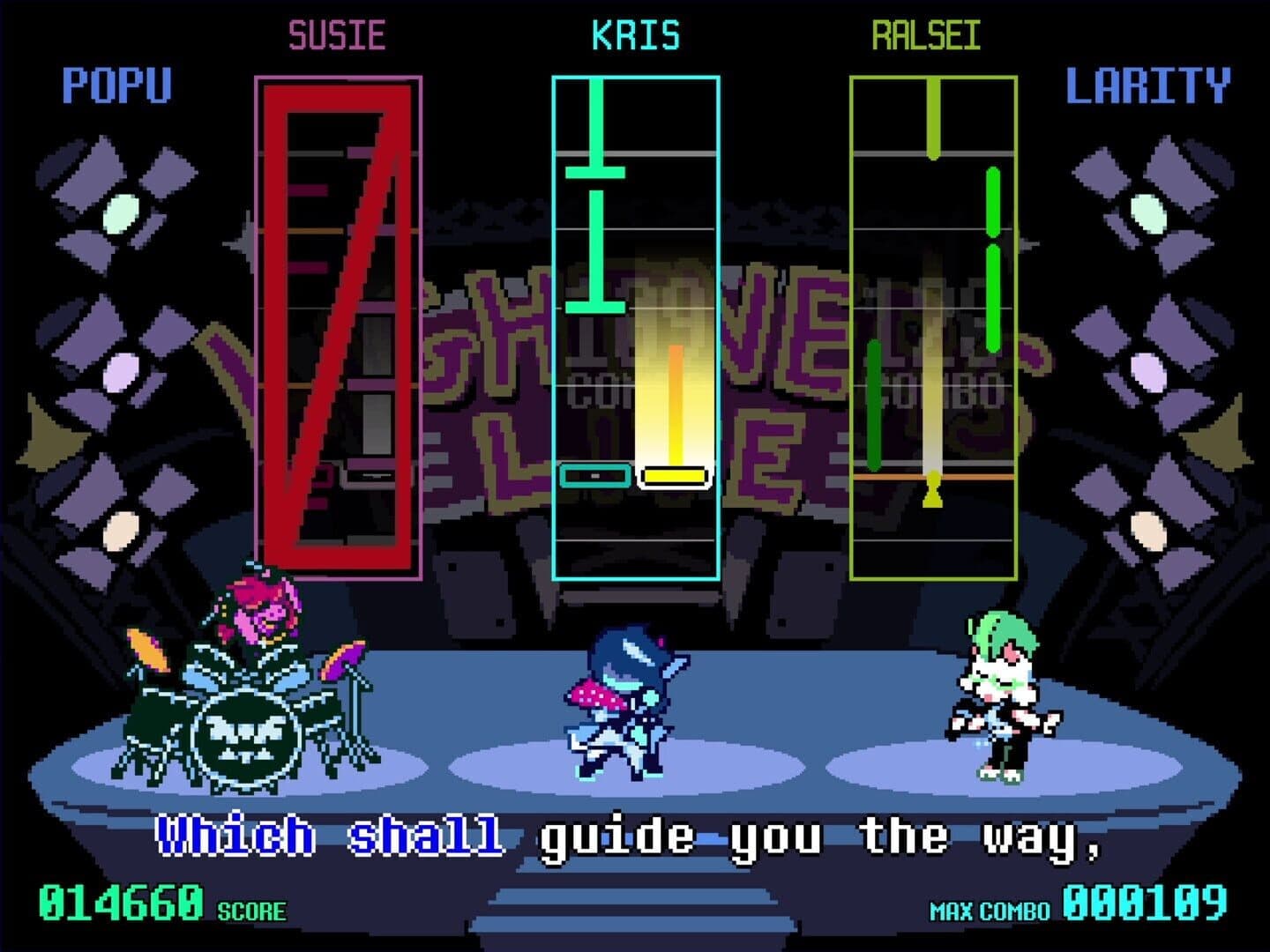
Eleven months on from release, Deltarune Chapter 3 has clarified its argument. The chapter’s central mechanic, a TV studio dark world governed by a host named Tenna who is genuinely terrified of being switched off, is not a theme dressed as a setting: it is an encounter architecture, and Toby Fox and 8-4 built the entire combat and narrative scaffolding around the question of what happens when something designed to hold an audience understands it is losing one. That question lands with more structural weight than Chapter 2’s Cyber World managed, because the game earns the absurdity through the same system it uses to stage the threat.
Game Snapshot
Developer: Toby Fox / 8-4
Publisher: Toby Fox
Platforms: PC (Windows, macOS), Nintendo Switch, Nintendo Switch 2, PlayStation 4, PlayStation 5, Xbox
Release Date: 4 June 2025
Rating: PEGI 7/ESRB E10+
Price: £19.99/$24.99 (Chapters 1-4 bundle; Chapters 1-2 previously free)
Genre: Turn-based RPG/narrative
Length: 5-8 hours main story; 12-15 hours completionist
Install Size: ~1 GB (full four-chapter bundle)
Presentation and World Design
TV World is the first dark world in the series to begin the chapter without a light world transition, and that structural choice does design work. The player arrives already inside the television, inside the Dreemurr family home’s dark counterpart, with no normalised reference frame available. The world reads as a studio before it reads as a threat: red carpet floors, stanchions along the periphery, Tenna’s face reproduced on every screen and statue that lines the corridors. The construction girders visible behind the walls are not decoration; they establish that this place is a set, and a set can be struck.
The audio does the tonal work the visuals cannot carry alone. Tenna’s theme shifts from the brassy-light register of a television studio bumper to something that compresses and unravels under its own surface pressure as his confidence cracks, and the dynamic mix tracks that shift in real time during the encounter sequence. The game understands that a horror in the Undertale lineage operates through sound before it operates through image: the moment Tenna’s pitch starts looping and the audio cue misaligns from the expected beat is when Chapter 3 announces its true genre register.
Where the presentation earns the score: the Knight’s first direct encounter is staged against an architecture the chapter has spent five hours constructing as a show space, and the contrast between Tenna’s lit-set staging and the Knight’s unlit, unscored arrival does the tonal shift without a line of dialogue.

Gameplay and Combat
The ACT-versus-FIGHT split that defined Chapters 1 and 2 is applied here with greater encounter-level specificity than before. Tenna is the clearest demonstration of this: his ACT options are not alternatives to combat but are the combat’s instruction sequence. To spare Tenna, the player must work through a series of escalating ACT interactions that mirror the stage of his breakdown, and each one unlocks a new bullet board phase that teaches what the next ACT requires. The design contract is unambiguous: the game will not present a combat state it has not taught you to read.
The bullet board work in the Tenna encounter is the chapter’s mechanical high point. His interface manipulation, the apparent splitting of the board into two halves, is staged as a red herring: the split is cosmetic, the player can cross the seam, and the game is measuring whether the player trusts the information they have been taught over the new visual information being presented. It is an encounter that stages a test of learned vocabulary over instinctive response. The Knight fight immediately following removes that buffer: the board split is now real, and the sequence recontextualises everything the Tenna fight taught about reading visual input.
The weird route complicates this structure cleanly. Playing Chapter 3 while carrying weird route state from Chapters 1 and 2 alters the narrative register without altering the encounter architecture, which is the correct implementation of a moral-consequence system in a game whose mechanics are teaching tools. Ralsei’s explicit criticism of the player’s choices, one of the few moments in the series where a companion disagrees out loud, is staged at the exact point where the weird route’s cost becomes legible to the party rather than only to the player. The encounter contract holds in both directions: the weird route earns its cost by making the cost observable.
The ACT economy for minor enemies is less rigorously designed than the major encounters. Several TV World combatants have ACT trees that resolve in one action without escalation, which means the teaching structure the boss encounters rely on is absent at the ground level. This is not a failure but a pacing concession, and Chapter 3 is shorter than its predecessors in ways that make the concession readable.

Story and Characters
Spamton’s presence in Chapter 3 is not a callback; it is a design argument about what the series does with characters whose arc appeared resolved. He appears without announcement in a bonus room reached through a specific ACT interaction with a green Tenna screen, and the cutscene is staged as a brief, undignified confirmation: Spamton approaches Tenna, is not recognised, and is immediately foam-sprayed. That is the entirety of his role in this chapter, and it is precisely enough. The game does not retry the emotional economy of Chapter 2’s Spamton encounters; it uses his reappearance to confirm a theme, that this world discards things that no longer serve a function, and then removes him again.
Tenna is a more structurally interesting character than his game-show-host framing suggests, because the game is explicit about what he represents without explaining it. He is terrified of the player’s attention moving elsewhere. The bonus round, which escalates from staged game show tension to something that compresses into genuine distress, is the encounter where that architecture arrives in full: Tenna is not the obstacle, the chapter’s design says; obsolescence is, and Tenna is its most legible face.
The Knight’s appearance at the chapter’s close does not resolve the identity tension the series has been building, and that restraint is the correct narrative decision. What the final sequence stages instead is a spatial argument: the shelter door that has been inaccessible opens a fraction when Kris is alone, after the Knight has passed through. The game says something structural about proximity and intent without declaring what either means. Narrative through staging rather than through exposition.
Value and Longevity
Deltarune Chapter 3 arrived as part of the £19.99/$24.99 four-chapter bundle that launched on 4 June 2025. Chapters 1 and 2 were previously available as free releases, and the paid bundle represents the first commercial step in a series structured so that future chapters beyond 4 will be added without additional cost. As a value proposition, Chapter 3 is most accurately assessed alongside its paired release: Chapter 4 is included in the same purchase, and the two together represent a substantial narrative and mechanical sequence for the price. The four-chapter bundle is available on Amazon.
For a comparable reference in narrative RPG pricing, see our Baldur’s Gate 3 versus Divinity Original Sin 2 breakdown, which covers what the genre standard looks like at different price points. Chapter 3 alone runs 5-8 hours main story. The weird route extends and recontextualises that runtime for players who have carried moral-choice state from earlier chapters, though it does not add encounter content. Completionist play that includes the bonus room discovery and all ACT trees runs closer to 12-15 hours across Chapters 3 and 4.
Replayability is meaningful here in a way it is not for most games in the series lineage. The Tenna bullet board, once the visual-input deception has been understood, plays differently: the player reads the board correctly on a first pass and the chapter’s teaching structure becomes visible as architecture rather than as experience.
Technical Notes
The Windows and macOS builds perform without reported issues at the series’ characteristic resolution and engine. Chapter 3 inherits the RPG Maker MV infrastructure of its predecessors, and the frame rate is consistent across the TV World’s more visually dense areas, including the Tenna encounter’s interface manipulation sequences, which are the most technically demanding moments in the chapter. For a review of our findings on Elden Ring’s PC performance as a genre reference point, the contrast with Chapter 3’s technical footprint is notable.
The Switch and Switch 2 builds were confirmed as cross-buy at launch; the same applies to the PS4 and PS5 versions. No significant performance discrepancies have been reported across platforms. The install footprint for the full four-chapter bundle is approximately 1 GB, which is unusually compact for a 2025 RPG release and reflects the engine’s asset efficiency rather than content depth. The PS5 version supports save file import from the PS4 version. No major post-launch patches have been required for Chapter 3.
Final Word
The Tenna encounter is the clearest test case for what Deltarune Chapter 3 is doing: a fight that teaches visual deception as its lesson, then uses the Knight fight immediately following to confirm that the lesson was the preparation. Nothing in the chapter is placed without function. The weird route’s integration, the Spamton cameo’s deliberate smallness, the shelter door opening a fraction at the close: these are design arguments, not callbacks. The game that earns this chapter is the one a player brings into it, and Chapter 3 is explicit about that. A player who has spent time with Chapters 1 and 2 and wants to understand what the series is building structurally will find Chapter 3 its most architecturally coherent chapter yet. A player who has not played earlier chapters should begin there: Chapter 3 does not supply context it expects you to carry.
FAQ
Is Deltarune Chapter 3 worth playing?
Yes, and particularly so for players who completed Chapters 1 and 2. Chapter 3 delivers the series’ most precisely designed boss encounter in the Tenna fight, a TV studio dark world that builds its horror through encounter architecture rather than atmosphere, and a Knight reveal sequence that earns the tension the previous chapters constructed. At £19.99/$24.99 for the four-chapter bundle, the value case is straightforward.
How long is Deltarune Chapter 3?
The main story runs 5-8 hours depending on combat approach and exploration. Players carrying weird route state from earlier chapters, or pursuing the Spamton bonus room and full ACT completion, can expect 12-15 hours across Chapters 3 and 4 combined. Chapter 3 is the shorter of the two paid chapters, but the pacing is deliberate: it spends its runtime efficiently rather than generously.
Do I need to play Undertale before Deltarune Chapter 3?
Undertale is not a prerequisite for understanding Chapter 3's mechanics or story. Deltarune operates as a separate world with its own characters and rules, and the chapter's core encounter design is self-contained. Players with Undertale context will recognise tonal and thematic callbacks, particularly in how the game handles consequence and the treatment of characters like Spamton, but those callbacks function as layers rather than foundations.
What is the weird route in Deltarune Chapter 3?
The weird route is a moral-consequence path available to players who chose to harm characters and use Snowgrave in Chapter 2. In Chapter 3, carrying that state alters Ralsei's behaviour, produces one of the few moments in the series where he directly criticises the player's choices, and shifts the narrative register of the Knight encounter without changing the combat architecture. It is the game's most structurally honest consequence system: the weird route earns its cost by making the cost visible to the party.
When is Deltarune Chapter 4 releasing?
Chapter 4 released simultaneously with Chapter 3 on 4 June 2025 as part of the same £19.99 / $24.99 bundle. Both chapters are available now across PC, Nintendo Switch, Switch 2, PlayStation 4 and 5, and Xbox. Future chapters beyond Chapter 4 have been confirmed as free updates to the same purchase.
8.5
Great
SpawningPoint Verdict
Review summary
Deltarune Chapter 3 is the series' most architecturally coherent chapter, using the TV studio dark world of TV World to build its horror and comedy through encounter design rather than atmosphere. The Tenna boss fight is the clearest demonstration of Toby Fox's approach: a combat sequence that teaches visual deception as its lesson, then confirms that lesson in the Knight encounter immediately following. Spamton's brief, undignified reappearance and the chapter's closing shelter-door sequence both stage their arguments without explanation. At £19.99 / $24.99 for the four-chapter bundle, with future additions confirmed as free, Chapter 3 rewards the investment of the chapters before it. Recommended for players who have completed Chapters 1 and 2.