The cat in Little Kitty, Big City does not know where home is. That is the whole premise, stated plainly in the first five minutes, and Double Dagger Studio does not embellish it with urgency. The player falls from a high window, lands in an alley, and the city begins. There is no timer. There is no threat. There is only the city, arranged in small walkable districts, and the steady pull of a domestic animal finding its way back to a particular window ledge. It is a game about the patience of the lost, which is a different register from the panic of the lost, and the distinction is the thing worth understanding before buying.
Game Snapshot
| Developer | Double Dagger Studio |
| Publisher | Double Dagger Studio |
| Release Date | 9 May 2024 |
| Platforms | PC/Nintendo Switch//PS5/Xbox Series X|S |
| Price | £19.99 | $24.99 |
| Rating | PEGI 3 | ESRB E |
| Genre | Cosy adventure |
| Length | 3-5 hours (main story)/8-10 hours (completionist) |
| Install Size | ~2 GB |
Presentation and World Design
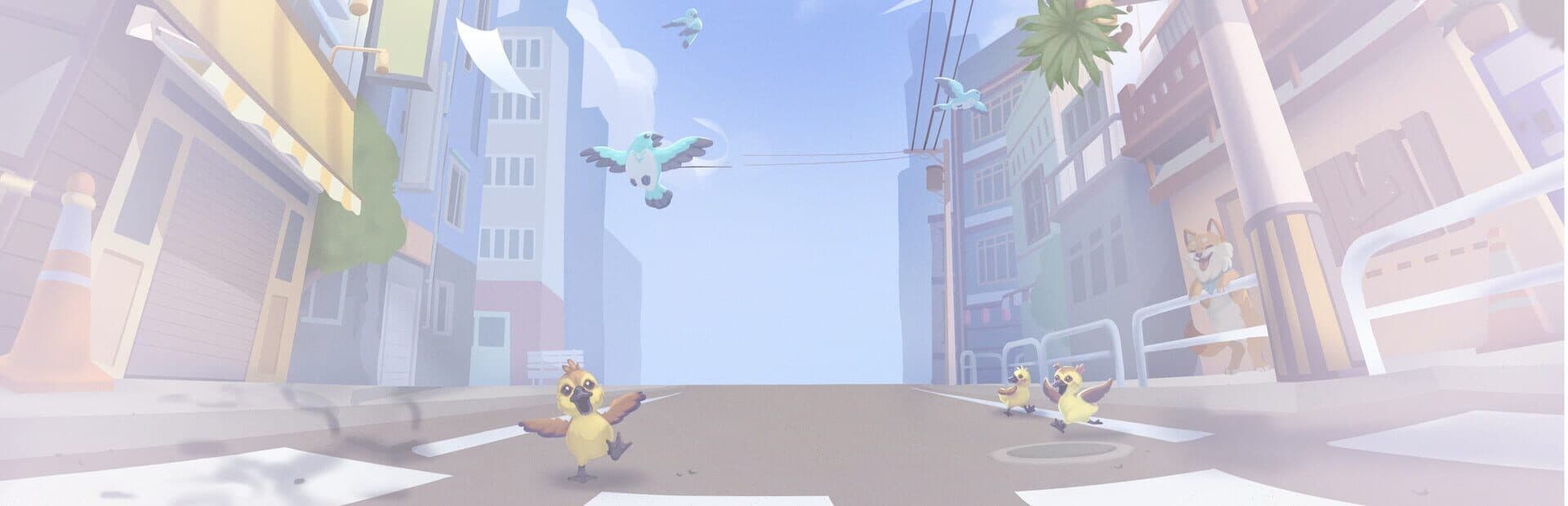
The city in Little Kitty, Big City is not a large city. It has four named districts, a train station, a rooftop garden, a canal, a convenience store, and a ramen restaurant, and the whole thing can be traversed in under ten minutes if the cat moves with purpose. That apparent smallness is, in fact, the design position. The world is built at cat scale rather than map scale, which means that a fire escape is a landmark, a garden wall is a journey, and a skylight is a problem worth solving. The camera sits at a low isometric angle that keeps the horizon close and makes the architecture feel substantial in a way that a wider view would dissolve.
The colour palette is warm without being saturated. Autumn browns and dusty terracottas sit against the cooler grey of the concrete, and the ambient light shifts through the day cycle in a way that reads more like late afternoon than morning, which gives the whole world a pleasant slightly-tired feeling, the feeling of a city at the end of its working hours. The ambient audio layer is consistent with this: delivery trucks, a distant radio, footsteps on pavement somewhere above, the sound of water in the canal when the player stays still long enough for it to register. The game does not annotate these sounds. It trusts the player to hear the city rather than be told what it sounds like.
The named districts have distinct textures without being heavily contrasted. The market area has awnings and produce crates; the residential district has window boxes and parked bicycles; the industrial waterfront has chain-link fencing and padlocked doors that the cat cannot open but can sit beside, considering. Nothing is wasted, and nothing is overloaded.

Gameplay and Combat
There is no combat. The game makes no apology for this. The loop is: explore, acquire fish (the currency), trade fish with neighbourhood cats for accessories, help the humans and animals the city contains, and accumulate the steps needed to complete the home arc. The mischief mechanic runs alongside all of this. The cat can knock things from shelves, pull laundry from lines, steal a human’s hat, sit in a plant pot, and generally behave as a cat behaves, and the game offers small serotonin-like rewards for doing so: a counter that tracks the hats stolen, a human’s exasperation rendered in a small floating emote, the satisfying animation of a carefully stacked display meeting the floor.
The platforming is light. Jumps are generous, the cat cannot fall to its death, and the controls keep the verb set simple: move, jump, meow, push, and the context-sensitive interact that handles most of the world’s affordances. This simplicity is the correct decision for the game’s goals, which is a point worth making clearly. The game is not easy because the developer could not make it harder. It is easy because difficulty would change the register entirely. A puzzle that stumped the player for twenty minutes would turn the city from a place of patient wandering into a place of obstacle and friction, and the game’s emotional contract depends on the city remaining accessible.
The NPC interactions carry most of the meaningful variety. The neighbourhood cats have individual personalities and small request chains. A crow named Edo trades information for fish. A raccoon named Pickle trades fish for found objects and makes a face about it. These are brief exchanges, but they are written with a dry lightness that sits naturally with the game’s overall register: unhurried, slightly deadpan, kind without being saccharine. The mischief counter runs in the background of all of this as a reminder that the game has a sense of humour about what cats actually do.

Story and Characters
The home arc is simple and structured. The cat must find enough fish and complete enough tasks to earn the knowledge of the route back to its window. The game frames this not as a quest log but as an accumulation: each completed task opens the city slightly further, each interaction with a neighbourhood cat adds a small thread, and the ending arrives when the city has been known well enough. There is a human in the apartment the cat is trying to return to. The game withholds that relationship until the final approach, and the withholding is the right formal choice: the ending lands because the player has been carrying the premise long enough for it to have weight.
The NPC vignettes are the secondary story surface, and the better ones are very good. A pigeon on the train station roof is trying to navigate something the game never fully names, and the three-exchange arc with that pigeon is quiet and precisely calibrated. A pair of older cats in the residential district have a warmth that the game earns by leaving most of it implied. These are not deep characterisations. They are the right width and depth for the form: enough to feel like people, not so much that they demand more space than the game can give them. The narrative sits at a scale consistent with the gentle character-driven approach of Tiny Bookshop, where the emotional register is built from small reliable observations rather than dramatic revelation.
The home arc does not complicate itself. It arrives, it completes, and the final image is quiet enough to earn the feeling without stating it. The game trusts the player to supply the sentiment from the arrangement of the scene, which is the only way this kind of ending works.

Value and Longevity
At three to five hours for the main arc and eight to ten for full completion, Little Kitty, Big City is correctly priced. The £19.99 entry point buys a specific thing: a single afternoon and a complete evening, or three or four shorter sessions across a week, in which the city is explored fully and the home arc is resolved. The player who spends four hours in the city and leaves having done everything once will not feel cheated. The completionist run adds the accessory collection, the full mischief counter, and a handful of NPC chains that the main arc brushes past, and the additional time is pleasant rather than padded.
Replayability is limited and the game knows this. Once the home arc is complete and the city has been fully known, there is no mechanism to sustain further sessions. This is not a flaw. This is the game being honest about its form. It belongs to the same shelf as Alba: A Wildlife Adventure: a complete, bounded thing that does not apologise for being finished. The player who wants a game that stretches across weeks and seasons should look at the longer cosy catalogue. The player who wants a game that sits in a single afternoon and ends gracefully will find exactly that here.

Technical Notes
The PS5 version runs at a steady 60 frames per second and presents the game at its cleanest. Load times are minimal. The Switch version runs at a lower but consistent frame rate in both docked and handheld mode, with only occasional dips in the more complex outdoor areas during weather transitions. Those dips are brief and do not affect the play experience in a meaningful way, which is the only note worth making about the Switch build: it runs well enough for a game where the pleasure is in looking carefully at small things rather than reacting quickly to moving ones. The Steam Deck build is similarly stable in the recommended settings profile, which makes the game well-suited to short handheld sessions before the platform’s battery reaches its limit. No crashes or progression-blocking bugs were encountered across platforms. For a broader view of how cosy games perform across different platform configurations, the Cozy Grove Switch 2 review offers a useful point of comparison.
Final Word
Little Kitty, Big City is a game that asks the player to sit with the city rather than pass through it. The moment that holds is a late-afternoon sequence near the canal, when the ambient layer drops to almost nothing and the only sound is the cat’s paws on the cobblestones and a distant radio playing something that the game keeps just below recognisability. It is a small structural choice, and it is the right one. The game belongs with players who find the completionist arc of larger open worlds more exhausting than satisfying, who want an afternoon with a beginning and a middle and a quiet ending. The cat does not know where home is for three to five hours, and then it does, and the city continues without it.
FAQ
Is Little Kitty, Big City worth buying?
Little Kitty, Big City is worth buying at its current price for players who want a complete, bounded cosy experience. The game is honest about its duration: three to five hours for the main arc, up to ten for full completion. It does not overstay its form, and it is priced in proportion to what it offers. Players seeking ongoing progression mechanics or seasonal content cycles will find the catalogue limited; players who want a single well-designed city to explore fully will find it well worth the cost of entry.
How long is Little Kitty, Big City?
The main story arc in Little Kitty, Big City takes between three and five hours to complete, depending on how much the player explores before following the central thread. Full completion, including all accessory collections, NPC request chains, and mischief tasks, extends the experience to roughly eight to ten hours. The game is designed for short sessions and rewards them more than extended ones; two-hour evenings suit its rhythm better than full-day runs.
Is Little Kitty, Big City on Switch?
Little Kitty, Big City is available on Nintendo Switch and runs well on the platform. The frame rate is lower than the PS5 version but consistent, with brief dips in the more visually complex outdoor districts that do not affect play. Handheld mode suits the game's short-session structure particularly well, and the smaller screen size does not compromise the isometric city's readability. The Switch version is a good way to experience the game for players who prefer handheld play.
What is the home arc in Little Kitty, Big City?
The home arc is the central narrative thread: the player's cat has fallen from a high window and must find its way back. Progress is earned through completing tasks for the city's residents and trading fish with the neighbourhood cats, which gradually opens the route home. The game withholds the full context of the cat's domestic situation until the final approach, and the ending arrives through accumulation rather than event. It is a quiet premise handled with restraint.
Is Little Kitty, Big City suitable for children?
Little Kitty, Big City carries a PEGI 3 / ESRB E rating and is suitable for children. There is no violence, no failure state beyond mild inconvenience, and no content that requires parental oversight. The controls are accessible for younger players, the jump mechanics are forgiving, and the cat cannot come to harm. It is a patient and unhurried game, which may suit slightly older children more than very young ones who want faster feedback loops, but there is nothing in the content that restricts the audience by age.
7.9
Great
SpawningPoint Verdict
Review summary
Little Kitty, Big City is a cosy cat exploration adventure built at the scale of a cat's attention rather than a map's ambition. The city is small, walkable, and carefully observed: four districts with distinct textures, a day cycle that earns its atmosphere, and an ambient audio layer that trusts the player to notice rather than be told. The home arc is quiet and structurally sound, the NPC vignettes are written with dry care, and the mischief mechanic sits lightly alongside the rest. At three to five hours for the main story and up to ten for full completion, the game is correctly priced and honest about its form. It is a complete, bounded thing, and it does not apologise for ending.