REVIEW
7.9· Great
Monster Hunter Wilds Title Update 1 Review 2026: The Leviathan and the Endgame Contract

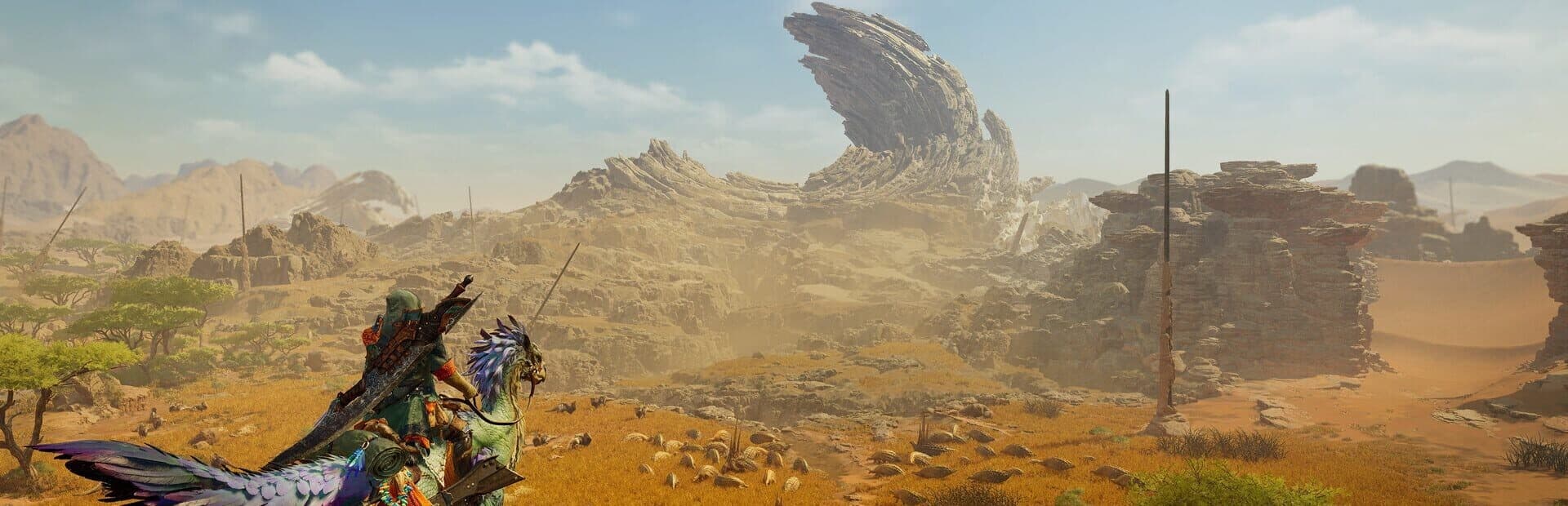
Monster Hunter Wilds launched with a combat system that earned its difficulty through staged encounter design: each new creature introduced attack patterns that built on established vocabulary before asking the player to execute at higher fidelity. Title Update 1, released in April 2025, is the first post-launch test of whether that contract extends beyond the base game. The patch delivers three distinct difficulty tiers in a single free package, adding Mizutsune as a new flagship creature, the High Rank version of the final story boss as an endgame destination, and the first Arch-Tempered encounter as a timed pressure-test for the top of the build curve. What it does not do is rewrite the base game’s encounter logic. The question worth answering is whether the new content builds on that logic or simply appends to it. The answer is uneven, and the distinction matters.
Game Snapshot
| Developer | Capcom |
| Publisher | Capcom |
| Base Game Release | 28 February 2025 |
| Title Update 1 Release | 4 April 2025 (free) |
| Platforms | PS5, Xbox Series X/S, PC |
| Price | Free update (base game £54.99 | $59.99) |
| Rating | PEGI 16 | ESRB T (Teen) |
| Genre | Action RPG |
| Base Game Length | 40-60 hrs (main)/100+ hrs (endgame) |
| Install Size | Varies by platform |


Presentation and World Design
Mizutsune is a Leviathan-class creature last prominent in Monster Hunter Rise, and its integration into the Wilds biome staging is among the cleaner design decisions in the update. The creature is placed in the Scarlet Forest, where its bubble-and-foam traversal reads against the environment’s existing terrain geometry rather than landing as a foreign object. The foam mechanics are not decorative: Mizutsune’s bubble field alters the player’s movement coefficient, applies status conditions at different saturation levels, and shifts from a debuff to a buff depending on the creature’s phase state. The game does not explain any of this in text. It is taught through encounter repetition, which is the correct method.
High Rank Zoh Shia’s visual presentation is a rework of the base game’s final boss rather than a replacement. The arena staging for the HR variant is structurally identical to the story encounter, which creates a legibility advantage: a player who completed the main campaign has a spatial map of the encounter before the fight begins. The HR version does not introduce new sightline geometry. What it introduces is a recalibrated damage economy and attack-phase sequencing that assumes the player is operating with a fully constructed build rather than an in-progress one. That is the correct approach for content designed to sit at Hunter Rank 50.
The Grand Hub, introduced alongside the update, adds a social layer that the base game’s lobby system lacked. It is infrastructure rather than content, but it is well-executed infrastructure: the seasonal event cadence it enables, beginning with the Blossomdance festival, gives the endgame time-sink structure that a long-cycle action RPG requires.

Gameplay and Combat
Mizutsune’s encounter design is the update’s strongest contribution to the combat vocabulary. The creature stages its phases through a readable tell system: the transition from standard combat to enraged foam saturation is preceded by a specific body animation, and the attack cycle that follows the transition is a constrained repertoire that the player can catalogue and respond to within two or three attempts at Hunter Rank 21 entry level. This is not the most demanding encounter in the game, nor should it be: its structural job is to introduce a new mechanic and establish its rules before the Tempered variant raises the cost of misreading them.
The Tempered Mizutsune encounter, unlocked at Hunter Rank 41, is where the contract tightens. The attack-cycle timing does not change from the standard version, but the damage multiplier is calibrated to punish the specific window of execution failure rather than applying blanket pressure. A player who has read the standard version’s tells correctly will find the Tempered encounter a fidelity test rather than a vocabulary test: you already know what is coming; the question is whether your execution is clean enough. That is a well-constructed escalation.
Arch-Tempered Rey Dau, available as a timed event from late April into May 2025, operates at a different register entirely. The encounter assumes a complete build optimised for elemental matching and skill stacking, and its attack-phase sequencing is denser than anything in the base game’s standard roster. The Gamma armour set it rewards sits at the top of the defensive curve, which correctly positions it as the carrot for endgame engagement rather than a shortcut through it. The limitation is structural: the timed availability means its role as an endgame benchmark is temporary by design.
The weapon balance changes bundled with the update address genuine design failures rather than performing adjustment theatre. Hunting Horn and Light Bowgun corrections fix input-execution failures that the base game shipped with: the Hunting Horn simultaneous-input issue was not a difficulty question but a contract violation of the same class as a parry window that triggers on the wrong frame. Correcting it is the correct priority. The broader elemental and skill-value recalibration for endgame content is less visible at the encounter level but matters for build construction: the pre-update endgame had effective skill ceilings that concentrated viable builds too narrowly, and the rebalance loosens that constraint without levelling the tiering entirely.
What the update does not address is the mid-tier endgame thinness between the HR 21 Mizutsune entry point and the HR 50 Zoh Shia destination. Players who complete the Mizutsune encounter at HR 21 and are working toward HR 50 are engaging with content the base game already provides. The update does not scaffold that progression. That is a design gap rather than a design failure, but it is the reason TU1 lands as a strong endgame addition rather than a complete endgame expansion.

Story and Characters
Title Update 1 does not add narrative content in the sense of new dialogue, new characters, or new environmental storytelling. The Mizutsune quest chain is framed through Kanya’s assignment structure, which fits the base game’s relational architecture without extending it. The High Rank Zoh Shia quest unlocks through a story mission at HR 50 that provides brief contextual framing for the difficulty escalation, but that framing is functional rather than substantive: it is an unlock gate dressed as a story beat.
The more interesting narrative contribution is structural. High Rank Zoh Shia positions the endgame boss as an ongoing presence rather than a single confrontation resolved by the main campaign. The base game stages Zoh Shia as a climactic encounter that ends a story arc. The HR version restages the same encounter as a systems challenge, which shifts the reading from narrative resolution to mechanical argument. The game earns this reframing through the recalibrated difficulty: the HR fight does not feel like a narrative repeat because it is asking a different question of the player. Whether the player’s build has matured sufficiently to meet the new calibration is a better question than whether the narrative would benefit from expanded dialogue.
The seasonal festival content, which begins with the Blossomdance event, contributes limited cosmetic and collectible content through the Grand Hub. Its narrative function is to give the live-service cadence a calendar identity. It succeeds at that and asks nothing more of itself.

Value and Longevity
Title Update 1 is free, which changes the terms of the value assessment. The correct question is not whether the content is worth the price of entry but whether it extends the effective play horizon meaningfully for a player who has completed the base game’s main campaign and initial endgame loop.
For a player at Hunter Rank 21 with a coherent build, the Mizutsune encounter adds two to three hours of first-clear and immediate repetition content, extending to ten or more hours across the full weapon-upgrade tree for the new armour and weapon sets. The Tempered variant doubles that estimate for players grinding specific skill configurations. High Rank Zoh Shia is a ten-hour destination for players building toward HR 50 across the existing content, with the fight itself adding perhaps two to four hours of direct engagement once unlocked. Arch-Tempered Rey Dau, during its timed window, adds a hard endgame destination that rewards sustained engagement.
The aggregate is not enormous by the standard of a paid expansion, but it is competent and well-targeted as a free update: it adds content at the correct difficulty tiers without invalidating existing progression. The endgame weapon and skill rebalance extends the build-construction phase for players who had already optimised against the original caps. The Grand Hub’s seasonal event structure commits to a post-launch cadence that the base game’s infrastructure did not support, which is the update’s most important long-term contribution.
For context on how this endgame expansion approach compares across action RPG post-launch cadences, the Elden Ring approach of substantial standalone DLC versus Capcom’s rolling free update model represent different answers to the same question about how to honour players at the far end of a long game. For a comparative view of how build-depth decisions in RPGs function differently at the system level, Baldur’s Gate 3 versus Divinity: Original Sin 2 remains a useful structural reference, even across genre lines.
Technical Notes
Monster Hunter Wilds shipped with frame-rate stability issues on PS5 in certain high-density combat scenarios, and Title Update 1 does not significantly change that picture. The Mizutsune encounter is well-behaved: the Scarlet Forest location’s geometry is not taxing enough to produce the particle-load issues that the base game’s more visually complex boss arenas exposed. High Rank Zoh Shia’s arena is unchanged from the base game’s version, and the frame-time behaviour is consistent with the original encounter: stable through the majority of the fight, with minor drops during peak particle accumulation in the final phase. Nothing here requires a footnote that was not already present.
The weapon balance fixes are invisible at the technical level, which is the correct outcome: a fixed input-execution bug should not be perceptible as a change, only as the absence of the prior failure. Hunting Horn players who were affected by the simultaneous-input issue will notice the correction through the absence of incorrect behaviour, which is the only signal that matters.
Final Word
Title Update 1 holds its side of the contract in the encounters that matter most. The Mizutsune escalation from standard through Tempered is the argument worth pointing to: the encounter teaches itself at the standard tier and then asks the player to execute correctly at the Tempered tier without changing the vocabulary. That is encounter design that respects the player’s time and attention rather than substituting difficulty pressure for teaching structure. High Rank Zoh Shia recontextualises the base game’s climactic boss as a systems challenge rather than a narrative event, which is the correct framing for content positioned at Hunter Rank 50. The mid-tier progression gap and the timed nature of Arch-Tempered Rey Dau are real limitations, and subsequent updates have the job of addressing both. As a first post-launch commitment, this is Capcom demonstrating that the contract extends beyond the initial release. Recommended for players who completed the main campaign and want to know whether the endgame is worth returning to. The answer is yes, conditionally.
FAQ
Is Monster Hunter Wilds Title Update 1 free?
Yes, Title Update 1 is a free update for all Monster Hunter Wilds owners across PS5, Xbox Series X/S, and PC. It was released on 4 April 2025 and requires no additional purchase. The update adds new monsters, endgame content tiers, weapon balance corrections, and the Grand Hub social feature. Previous owners of the base game received the update automatically upon patch release.
What new monster is in MH Wilds Title Update 1?
The flagship new monster is Mizutsune, a Leviathan-class creature returning from Monster Hunter Rise. It uses bubble and foam mechanics that shift between debuffing and buffing states depending on phase. A Tempered version unlocks at Hunter Rank 41. The update also adds High Rank Zoh Shia (HR 50) and the timed Arch-Tempered Rey Dau encounter as additional endgame destinations.
Is Title Update 1 worth returning for?
For players who completed the main campaign, the update adds two meaningful endgame destinations in High Rank Zoh Shia and Arch-Tempered Rey Dau, plus a well-staged new creature encounter with Mizutsune and its Tempered variant. The weapon balance corrections fix genuine input-execution failures, and the broader elemental rebalance extends build construction. Players who had exhausted the base game's endgame loop will find substantive new content at the correct difficulty tiers.
How does MH Wilds Title Update 1 compare to TU2?
Title Update 1 introduced one new creature (Mizutsune) alongside endgame variants of existing monsters. Title Update 2, released on 30 June 2025, added two creatures simultaneously with Seregios and Lagiacrus, alongside the Festival of Accord: Flamefete and additional Arch-Tempered content. TU2's roster expansion is broader; TU1's value lies more in its foundational endgame scaffolding, including the Grand Hub and the initial skill and elemental rebalance that subsequent updates built on.
When is Monster Hunter Wilds Title Update 3 releasing?
Title Update 3 launched on 29 September 2025 across all platforms. It introduced Omega Planetes, a crossover monster from Final Fantasy XIV, alongside the Festival of Accord: Dreamspell and FFXIV job-themed content. The update was made available as a free download and included a permanent extreme-difficulty quest for players at Hunter Rank 41 and above, with an event-tier version for Hunter Rank 100.
7.9
Great
SpawningPoint Verdict
Review summary
Monster Hunter Wilds Title Update 1 is a competent and well-targeted free update that delivers content at the correct difficulty tiers for its intended audience. Mizutsune is the standout addition: a creature whose encounter escalation from standard to Tempered demonstrates that TU1's design team understands the teaching logic the base game established. High Rank Zoh Shia repositions a resolved narrative encounter as an ongoing endgame systems challenge, earning the reframing through recalibrated difficulty rather than new story content. The weapon balance corrections address real contract failures. The limitations are real, specifically the mid-tier progression gap and the timed availability of Arch-Tempered Rey Dau, but they do not undermine the update's core contribution. For players invested in the endgame loop, this confirms that the post-launch commitment is genuine. Recommended.