

There is a moment in Split Fiction, roughly three hours in, when Mio and Zoe are running through a dragon-lit canyon while the camera pulls back to show exactly how much world surrounds them, and the person sitting next to you on the sofa makes a noise that is not quite a word. Not awe, exactly. Something quieter: recognition that the people who built this thought hard about what you would feel right here, at this exact second. That is what a Split Fiction review should probably begin with, because that care is the whole argument. Hazelight Studios has taken the co-op narrative-adventure they proved was possible with It Takes Two in 2021 and produced something more settled, more formally generous, and more assured of its own ambitions. Comfort is a craft choice, not a default, and Split Fiction makes that case across twelve distinct worlds without once raising its voice.

Game Snapshot
| Detail | Info |
| Developer | Hazelight Studios |
| Publisher | Electronic Arts |
| Release Date | 6 March 2025 |
| Price | £44.99 | $49.99 (Friend’s Pass: free for a second player) |
| Rating | PEGI 12 | ESRB T (Teen) |
| Genre | 2-player co-op narrative-adventure |
| Length | 14-16 hours (main story); 18-22 hours with Side Stories |
| Install Size | Approximately 35 GB (PS5) |
Presentation: Two Imaginations, Twelve Worlds
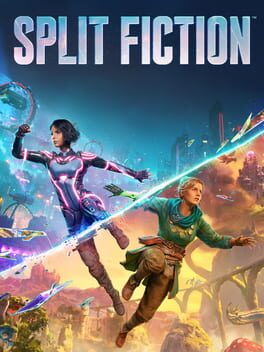
Split Fiction earns its visual ambition not by being loud but by being precise about contrast. Mio Hudson’s worlds are neon-lit, hard-edged, occasionally beautiful in the way a wet motorway at night is beautiful: the cyberpunk city blocks are rendered with a surface sheen that makes them feel like adverts for a life you would not actually want to live. Zoe Foster’s worlds push in exactly the opposite direction, muted greens and amber warmth, dragon-scale textures that look hand-laid, a mermaid kingdom where the light behaves like it does through glass on a kitchen window at golden hour. The chapter that lands most squarely as a visual achievement is the tooth-fairy kingdom, which places both players inside something that looks drawn rather than modelled, a storybook mise-en-scene that Hazelight commits to completely rather than using as a brief novelty stop.
What keeps all twelve worlds from feeling like a showreel is that each one introduces a mechanic that belongs specifically to it, which means the environment is never decoration; it is the grammar of how you play. The sci-fi AI-revolution chapter reads like a factory floor that has started to argue with itself, and the geometric logic of that setting produces control puzzles that would make no visual sense anywhere else. Hazelight’s art direction team has understood that co-op games can spend their visual budget either on scale or on texture, and chose texture. The result is a game that looks different in every chapter without ever feeling inconsistent in its quality. Presentation: 9.5 out of 10.

Co-Op Design: How the Mechanic Pairing Works
This is the section of a Split Fiction review that carries the most weight, because the co-op design is the engine that makes everything else possible. Hazelight assigns each chapter a mechanic pair, one ability for Mio and one for Zoe, that is asymmetric by design: the two abilities do not do the same thing, do not feel the same to hold, and are useless in isolation. What makes this the kind of design that respects the player’s afternoon is that neither player can progress by being skilled enough to compensate for the other. There is no carrying. The design assumes parity of attention rather than parity of reflexes, which is a meaningful distinction for anyone who plays games with a partner who has different thresholds for mechanical pressure.
In the cyberpunk chapter, Mio gains a grapple that propels her laterally across surfaces while Zoe controls a tether that can lock objects in place at range. To cross a particular gap, Mio must throw herself forward while Zoe pins the landing platform so it does not rotate; the sequence takes four seconds and communicates something about trust without using the word. This pattern repeats across every chapter in a different register, and the rhythm of learning a new pairing every hour or so is the kind of design that does not exhaust itself, partly because Hazelight is disciplined about retirement. No mechanic outstays its welcome by more than about forty minutes.
The role-swapping during puzzles is where Split Fiction is at its most confident. Most co-op games assign roles that are stable across the whole experience. Split Fiction assigns roles that are stable for a chapter and then dissolves them, asking both players to relearn their relationship to the other’s ability. This is warmth as a structural claim rather than a tonal register: the game is genuinely interested in the person playing alongside you, not just in whether you complete the level. The tutorial philosophy matters here, too. New abilities arrive with a short, low-stakes space to find your feet, never a wall of text, and the partner can always see what you are trying to do before the game asks you to do it together. Co-Op Design: 9.5 out of 10.
Mio and Zoe: Writers Who Disagree
The two protagonists are not generically pleasant to be around, which is a deliberate and welcome choice. Mio Hudson is a sci-fi writer whose pragmatism curdles occasionally into curtness, and Zoe Foster is a fantasy writer whose warmth edges towards naivety when the situation calls for clear-headedness. They are placed inside J.D. Rader’s story-simulation machine, the Rader, at opposite ends of a dispute about what stories are for, and the game uses that disagreement as the structural spine of the whole arc rather than resolving it early and moving on.
What the writing does well is hold the disagreement as a real one. Mio is not wrong to be sceptical of Zoe’s instincts, and Zoe is not wrong to think Mio’s efficiency misses something essential. The chapter set inside Mio’s AI-revolution world is particularly strong here, because the thematic content of the world, machines deciding what humans are worth, is the same argument Mio and Zoe are having about each other’s fiction. That kind of structural alignment between world and character arc is the kind of design that gives the story texture it would not otherwise have.
The voice performances carry the relationship through moments where the writing itself is thinner, mainly in the middle chapters where the dialogue runs on momentum rather than observation. But the arc resolves with sufficient specificity that the ending earns its warmth without sentimentality. Story: 8.5 out of 10.

The Side Stories Layer
Side Stories are discrete, unlockable short experiences tucked into each chapter, and they represent a different kind of generosity than the main campaign. They are not required. They do not gate progress. They are simply there for players who want to stay longer in a world that has been treating them well, and the range of what they contain is wider than the main game’s mechanics because they are under no obligation to serve the narrative.
Some are comedic, a frog-catching mini-game that takes about six minutes and produces the kind of laughing that involves falling sideways slightly. Some are formally strange, a short sequence set in a world where the aesthetic rules of the main campaign are suspended entirely. A few are genuinely difficult, which is interesting given that the main campaign calibrates away from frustration. The Side Stories seem to be where Hazelight put experiments they were not ready to commit to at full campaign length.
What they add, structurally, is the sense that the game trusts you to decide when you are done. That is rarer in co-op design than it sounds. Most co-op games end and you are finished. Split Fiction ends and you can continue in a way that respects your shared time without demanding it. The kind of design that leaves a door open rather than closing it behind you. Value: 8.5 out of 10.
Comparison: What Carried from It Takes Two
It Takes Two (2021) established that a co-op game could take asymmetric mechanics seriously across a full campaign without sacrificing narrative. Split Fiction has the same DNA, but the relationship between the two games is closer to edition than sequel: Hazelight identified what the earlier game was reaching for and removed the uncertainty from the execution.
It Takes Two changed its mechanics every chapter but occasionally fumbled the transition, leaving players with a pairing that did not quite cohere before the game retired it. Split Fiction has tighter chapter seams. The mechanic pairs feel like they were tested until the moment of dissolution was as satisfying as the moment of introduction, which is a much harder problem to solve than making a mechanic interesting to begin with. There is also less tonal volatility. It Takes Two had chapters that were genuinely distressing alongside chapters that were light; Split Fiction is more consistently pitched, which will read as a limitation to some players and as craft to others.
What carried most directly is the belief that co-op play is the content, not the frame around it. Neither game could be played solo without losing the central argument. Split Fiction pushes that belief further by making the asymmetric pairing more legible from the first minute of each chapter, so the player who is less familiar with the design language of co-op platformers can orient themselves faster. Hazelight’s lineage from 2021 to 2025 is a refinement story, and the refinement is substantive.

Friend’s Pass and the Co-Op Economics
The Friend’s Pass is the part of a Split Fiction review that has to be stated plainly because it is unusual enough to require it: one player buys the game at £44.99 and one player downloads the Friend’s Pass for free and joins them online. The second player does not need to purchase anything. This is not a trial or a limited-time feature; it is the standard release structure.
For co-op games, which require two players to justify their existence, this is a meaningful design decision at the economic level. It removes the barrier of coordinating a simultaneous purchase, which is the most common reason co-op games gather dust in wishlists. The practical effect is that the person in a household who is more likely to research and buy a game can do so knowing that their partner does not need to commit financially before trying the experience.
Replay and Friend’s Pass: 9.0 out of 10. The replay ceiling is modest for most pairs, given that the mechanic pairings are the attraction and are fully legible after one playthrough. But the Friend’s Pass structure makes the initial access so frictionless that value across a partnership holds even at full price.
Final Word
The scene that earns Split Fiction‘s final score is in the tooth-fairy kingdom: a short stretch where both players must trust the other’s timing completely, the margin is tight, and the reward is a visual sequence that would look impressive in isolation but lands much harder because you built it together. That is the kind of design Hazelight has been working towards since It Takes Two, and Split Fiction is where it arrives with confidence.
This is a game for pairs who want something that respects both their time and their attention, without requiring competitive instincts or high tolerance for repeated failure. It is not for players who want to play alone, for whom the Friend’s Pass is genuinely useful but the solo mode remains nonexistent. For anyone with a willing partner, whether on the same sofa or online, Split Fiction is the most formally settled co-op game Hazelight has made, and comfort is a craft choice, not a default. That choice is visible on every screen.
FAQ
Is Split Fiction worth it in 2026?
Split Fiction holds its value well into 2026 because the co-op design is structured around mechanic pairings that do not date: each chapter introduces an asymmetric ability set, uses it for roughly forty minutes, and retires it cleanly. The fourteen to sixteen hours of main campaign, combined with unlockable Side Stories and the Friend's Pass structure that lets one player join for free, means the effective cost per hour of co-op play is among the lowest in the genre. If you have a willing co-op partner, the investment is straightforward.
Can you play Split Fiction solo?
Split Fiction cannot be played solo. The entire design is built around two players holding different abilities that are useless in isolation; every puzzle, traversal sequence, and combat encounter requires both players to act. This is a structural decision, not a missing feature. If you want to play it, you need a partner. The Friend's Pass means that partner does not need to purchase the game separately, which removes the most common practical barrier to starting.
How long is Split Fiction?
The main story runs approximately fourteen to sixteen hours for most pairs playing at a measured pace. Players who unlock and complete the Side Stories, discrete short experiences tucked into each chapter, can add four to six hours on top of that. The game does not encourage rushing, and the Side Stories in particular are designed to be explored when you want to stay in a world rather than when the game demands it. A full playthrough with Side Stories typically lands between eighteen and twenty-two hours.
How does Split Fiction compare to It Takes Two?
Both games use the same structure: asymmetric mechanic pairings that change with each chapter, a co-op requirement, and a narrative that uses the game world to reflect the protagonists' relationship. Split Fiction refines that structure in two key ways. The chapter transitions are tighter, meaning new mechanic pairs arrive with clearer orientation and retire before they overstay. The tonal range is narrower, which makes Split Fiction more consistently warm where It Takes Two was occasionally distressing. Players who loved It Takes Two will recognise the design language and find it more precisely executed here.
What is the Friend's Pass?
The Friend's Pass is Hazelight's standard access model for Split Fiction: one player purchases the game at full price, and their co-op partner downloads the Friend's Pass at no cost and joins them online. The second player experiences the full game, not a limited version. Both players need an internet connection for online co-op; local split-screen does not require the Friend's Pass because both players use the same console. The Friend's Pass does not expire and is not a promotional offer. It is how the game is designed to be accessed.
9.0
Outstanding
SpawningPoint Verdict
Review summary
Split Fiction is Hazelight Studios at their most formally confident: a co-op narrative-adventure built around asymmetric mechanic pairings that take both players seriously, across twelve worlds that are visually and mechanically distinct without feeling inconsistent. The story of Mio and Zoe holds a real disagreement at its centre and resolves it with enough specificity to earn the warmth it closes on. The Side Stories add texture without demanding attention. The Friend's Pass removes the most common economic barrier to starting. At 9.0 out of 10, this is the kind of design that respects the player's afternoon, in a good way, which in co-op terms means it also respects the person sitting next to you. Warmth as a structural claim, delivered with craft and care.


