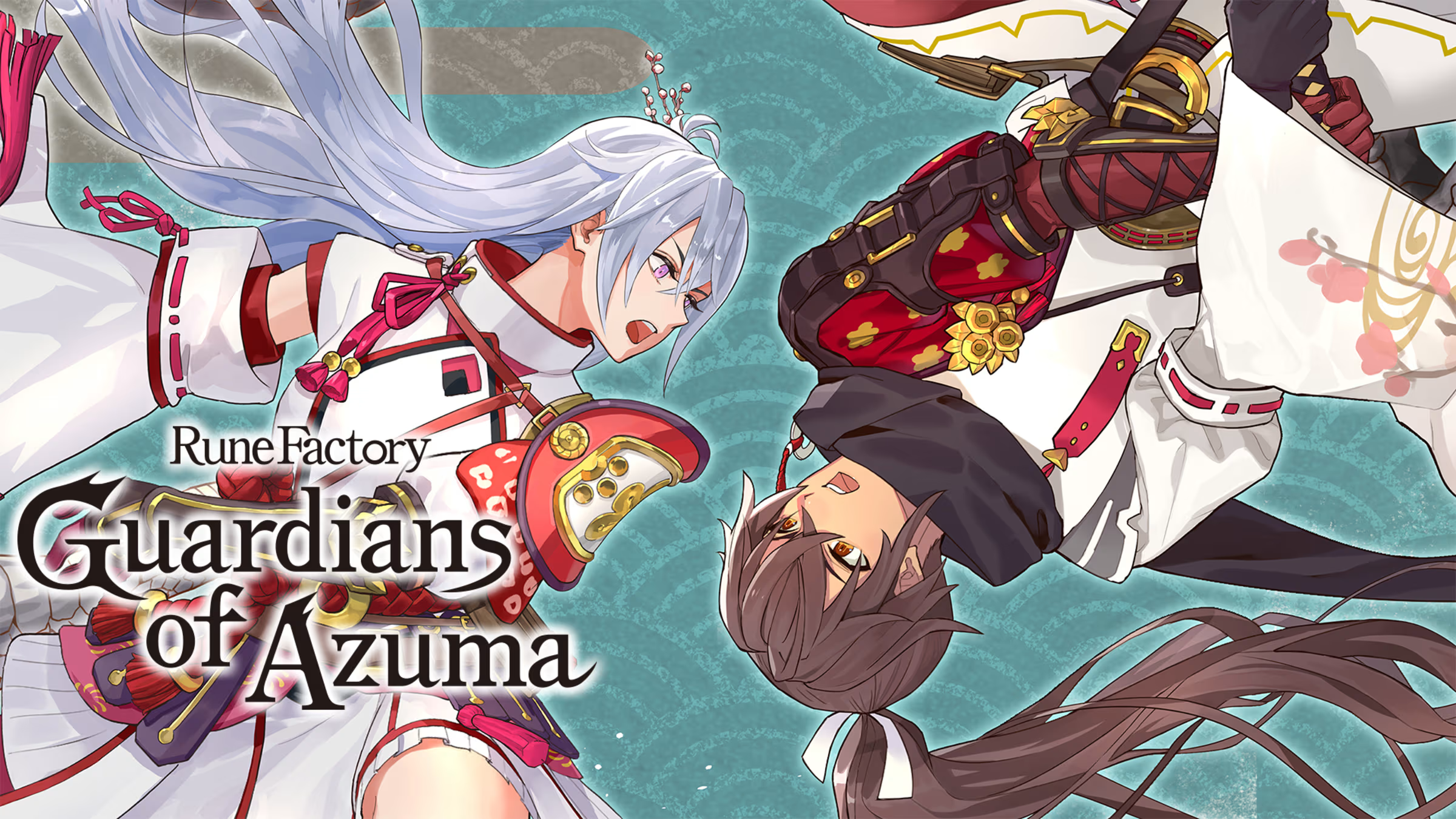
Rune Factory: Guardians of Azuma teaches its farming loop the same way a well-designed action game teaches its combat: through escalating constraint, one variable at a time. The series has always understood that a social simulation layered over an action-RPG is not two games in one but a single contract, where the farming informs the combat and the combat informs the farming, and Guardians of Azuma is the most coherent expression of that contract the franchise has produced. The Azuma setting, a Japanese-inflected archipelago of island villages recovering from a cataclysm, does structural work rather than decorative work: the seasonal crop cycles, the village rebuilding systems, and the dungeon encounter design are all staged in an order that makes each new system legible before it becomes load-bearing. A year on from its May 2025 release, the question is whether that coherence holds across the full runtime.
It does.
Game Snapshot
| Developer / Publisher | Hakama/Marvelous |
| Release Date | 30 May 2025 |
| Platforms | Nintendo Switch/Switch 2, PlayStation 5, PC (Steam) |
| Price | £49.99 | $59.99 |
| Rating | PEGI 7 | ESRB E10+ |
| Genre | Farming-RPG/Action-RPG |
| Length | 40-60 hours (main story); 80-100 hours (completionist) |
| Install Size | ~10 GB |
Azuma as Architecture: The Setting Does Work
The Azuma archipelago is structured as a sequence of island communities, each with a distinct economic role in the rebuilding effort the game is staging around the player character’s arrival. The first island, Midori-jima, functions as the tutorial environment in the same sense that a well-designed soulslike’s opening area functions as one: it introduces crop rotation, the community relationship system, and the dungeon-entrance structure in an order that builds toward complexity rather than delivering it simultaneously. The bamboo groves and terraced fields are not atmospheric decoration but spatial information: the elevation geometry of the terraced plots teaches the crop-adjacency rules before those rules become consequential in the later islands’ denser farming layouts.
Hakama’s art direction is Japanese-minimalist in a way that serves encounter design as much as atmosphere. The torii-gate dungeon entrances mark transitions between the village-management layer and the combat layer clearly enough that the player develops a spatial model of which zones belong to which system. The visual separation is functional: it removes ambiguity about which rules apply in which space.
The seasonal weather system changes which crops are viable and which dungeon environmental hazards are active, and the two are not independent. The Autumn season on Midori-jima reduces the visibility in the bamboo-forest dungeon routes, which the encounter design uses to reframe monster approach angles that were fully readable in Summer. That is atmosphere used as constraint.

The Farming Loop: System as Contract
The village-rebuilding loop is the game’s central mechanical argument, and Guardians of Azuma makes it more explicit than any previous entry. Each island community has a resource-dependency chart the player can access from the village board: Midori-jima needs rice and timber to unlock its second-tier farming plots; the trading-port island of Shiro-jima needs processed goods, not raw materials, which means the player must build a processing facility before that relationship advances. The dependency chain is not hidden: it is the game telling the player, clearly, what the next step is and what the cost of getting there will be.
The crop system is the deepest layer, and Guardians of Azuma teaches it through named failure rather than passive tutorials. The first season in which the player attempts to multi-crop without managing soil-nutrient levels produces a low-yield harvest that the village board reflects immediately: reduced relationship progress, delayed unlock of the second farm plot, a companion’s questline that stalls because its trigger requires a relationship tier that the missed harvest delayed. The system punishes early mismanagement not through a game-over screen but through a cascade of small delays that compound into a meaningful setback. That is the correct way to teach a farming loop: make the consequence legible, make it recoverable, and let the player identify what went wrong.
The Azuma-specific addition to the farming system is the Kami Bond mechanic, which ties crop quality to the relationship level with the island’s guardian spirit. Each island spirit has a preferred offering type, and regular offerings during harvest season produce a Kami Blessing that boosts the following season’s yield and unlocks special crop variants. The mechanic introduces a resource allocation decision that the earlier islands do not require: the player can maximise immediate yield by ignoring the Kami Bond, or invest in offerings for compounding returns later. The game does not tell the player this trade-off exists until the first season on the second island, which is the correct teaching order: the first island establishes the farming rhythm, the second introduces the decision that makes the rhythm strategic.
Combat feeds back into the farming loop at the crafting tier. The dungeon-drop materials from each island’s boss encounters unlock the tools that make the next tier of farming viable: the Azuma Hoe, which the player cannot craft without defeating the second island’s guardian boss, is required for the nutrient-management system on the third island’s plots. The dependency is not arbitrary gating; it stages the introduction of the more complex farming systems at the moment the player has demonstrated they can manage the simpler ones. The contract between the farming loop and the combat loop is explicit and functional.

Combat: Action-RPG Layer and What It Argues
Guardians of Azuma’s combat is the series’ most encounter-aware iteration. The dungeon design stages each floor around a named monster type with a specific attack vocabulary, and the introduction order is calibrated so that the first appearance of each new type occurs in a controlled environment before that type appears in the mixed-enemy encounters of the dungeon’s later floors. The Feral Tanuki on the first dungeon’s second floor teach their sweep attack in an open room with no other enemies; the first time a Feral Tanuki appears alongside a Kappa archer is on the floor after the one where the player faced Feral Tanuki alone. That is tutorial design embedded in encounter structure rather than delivered as a separate onboarding sequence.
The weapon system offers six types: sword, spear, dual blades, hammer, staff, and the Azuma-exclusive fan weapon. Each has a distinct movement economy. The spear has the longest reach and the narrowest input window for its counter-strike; the dual blades have the shortest reach and the widest window for the dodge-cancel that sets up their combo-string. The game does not explain these relationships directly. It teaches them through the first dozen encounters of each weapon type’s introductory dungeon section. A player who has committed to the spear by the third island has built a specific encounter-reading posture: long-range pressure, counter-window identification, retreat management. Switching weapons at that point requires rebuilding a different vocabulary. The game supports that switch but does not smooth it over.
The Harvest Festival boss fight on Shiro-jima is the named encounter that demonstrates what the combat system is capable of at mid-game. The boss, a corrupted harvest spirit called the Murakumo, has three phase transitions timed to the seasonal weather system: it begins in Summer configuration, transitions to Autumn at roughly 60 percent health, and completes in Winter configuration. Each phase change alters its attack cycle and the elemental weakness the player has to target. The Summer phase teaches the counter-window timing; the Autumn phase adds a ranged attack that forces position adjustment; the Winter phase recontextualises the counter window from the first phase by narrowing it while adding a telegraph that was not present earlier. The fight earns its length.
The companion combat system, where marriage candidates can join dungeon runs and contribute to combat through support abilities, is well-integrated at the mechanical level. The companion AI reads correctly: support companions do not block the player’s line of sight, do not interrupt combo strings, and do not activate their support abilities during the player’s counter-window. Those are three things companion AI in this genre frequently gets wrong, and Guardians of Azuma gets all three right.

Story and the Rebuilding Frame
The narrative premise of Guardians of Azuma is a reconstruction effort: the player character arrives in an archipelago damaged by a cataclysm called the Azuma Fracture and works with each island’s community to restore their agricultural and spiritual infrastructure. The reconstruction framing is structurally honest because it matches what the game’s systems are actually doing: the player is managing resource chains, relationship networks, and combat encounters in service of measurable restoration progress. The story tells the player what the mechanics are also telling them, which is the correct alignment between narrative and system.
The five marriage candidates, one central to each island, are written as community members with roles in the rebuilding effort rather than as romantic rewards waiting to be unlocked. Haruki, the island blacksmith’s apprentice on Midori-jima, has a questline that gates on the crafting progression; his narrative arc is about whether he has the skills to restore the forge that the Azuma Fracture damaged, and the player can only advance that arc by demonstrating equivalent crafting progress themselves. That is character writing routed through the game’s own systems, which is more interesting than character writing that runs parallel to them.
The antagonist structure involves a faction called the Void Tenders, who believe the Azuma Fracture should be allowed to continue because it will eventually purify the archipelago. The philosophical opposition is thin as written, but it does something useful: it gives the game a reason to stage each island’s guardian-boss encounter as a corrupted version of the spirit that the Void Tenders have influenced rather than as a generic monster. The narrative is the encounter justification, and the encounter is the narrative’s clearest expression.

Value and the Hundred-Hour Question
The main story across five islands runs to roughly 40-60 hours depending on how systematically the player manages the relationship questlines and the farming calendar. A player who prioritises combat and story will reach the credit sequence faster; a player who builds every farming upgrade and completes every companion questline will have substantially more to do. The distinction is not padding: the farming and relationship content is the game’s argument, not its filler, and a player who skips it is playing a shorter, less coherent version of what Guardians of Azuma is building.
The post-credits content adds two additional islands accessible only after the main story concludes, each with a new farming system variant and a new guardian-boss encounter. The content is designed for players who have the full farming vocabulary from the five main islands and want to see what that vocabulary looks like under harder constraints. It does not recycle the base game’s systems; it extends them. For players on Nintendo Switch 2, the enhanced version includes a new companion from those post-credits islands with a questline that integrates into the main story at two earlier points, which is the correct way to add content to a system-heavy game: through connection rather than addition.
The SpawningPoint Nintendo Switch 2 review covers the hardware context in detail; what is relevant here is that Guardians of Azuma is among the Switch 2 titles where the enhanced version is the better purchase if the hardware choice is already made, specifically because the post-credits companion’s integration into the main story makes the mid-game relationship systems more legible in retrospect. Players on Switch or PS5 are not playing a lesser game; they are playing a game that does not have that integration, which is a difference worth noting rather than suppressing.
Technical Notes
Performance on Nintendo Switch 2 is stable throughout, including the Murakumo boss arena on Shiro-jima, which is the heaviest particle load the game produces. The enhanced version runs at a consistent frame rate across all five islands and the two post-credits islands, with no frame-time drops during the phase-transition sequences that were occasionally uneven on the original Switch hardware at launch.
The original Switch version had documented frame-rate instability in the Shiro-jima and fourth-island dungeon sections during the launch window. Hakama patched this in version 1.0.4 (released July 2025), and the current state of the Switch version is substantially better than launch reports suggested. Playing from version 1.0.4 onwards, the frame pacing is acceptable across all standard encounters; there is occasional instability in the largest outdoor farming areas during the Autumn seasonal transition, but it does not affect combat encounter performance.
PS5 performance is clean throughout with no notable frame-time issues in any encounter or outdoor area. The load times on PS5 are the fastest across all platforms and the visual resolution is the sharpest, though the game’s art direction is not one that demands hardware resolution headroom to read correctly.
PC performance scales appropriately across a range of hardware. The minimum specifications are honest: the game runs at its recommended settings on hardware from four years ago without requiring optimisation work from the player.
Final Word
Guardians of Azuma earns its ambition. The Murakumo fight on Shiro-jima, which is where the combat system demonstrates what it has been building toward across the first two islands, is also the moment the farming loop’s dependency chain delivers its clearest argument: the Azuma Hoe required to prepare Shiro-jima’s nutrient-dense plots comes from the materials that encounter drops, and a player who has been managing the Kami Bond investment since Midori-jima arrives at that fight with a resource surplus that makes the preparation legible rather than a grind. The two halves of the contract arrive at the same moment.
This is the Rune Factory entry for players who want to see what the series does when it commits to its own systems. The genre comparison is not Stardew Valley: that game is a farming sim with light relationship content. Guardians of Azuma is a systems-RPG where farming is the encounter design. Players who want lighter commitment will find Cozy Grove the appropriate step down in system density. Players who want what Guardians of Azuma is actually offering should start on Switch 2 if the hardware is available, or on PS5 if it is not. The contract holds across both platforms.
FAQ
Is Rune Factory Guardians of Azuma worth it in 2026?
Guardians of Azuma has improved significantly from its launch-window state following the July 2025 patch, and the post-credits island content has added material that extends the farming vocabulary without repeating it. At £49.99/$59.99, the 40-60 hour main story plus accessible post-game content represents a coherent value proposition for players who want a systems-RPG with a well-designed farming loop. The Nintendo Switch 2 enhanced version is the better purchase if the hardware choice is already made, given the post-credits companion's integration into the main story. The base versions on Switch and PS5 are complete purchases without it.
How long is Rune Factory Guardians of Azuma?
The main story across the five islands runs to roughly 40-60 hours depending on how systematically the player manages the farming calendar and relationship questlines. A player who prioritises combat and the central narrative reaches the credits faster; a player who completes every companion questline and builds every farming upgrade will reach 80-100 hours before the post-credits islands open. The longer route is not padding: the farming and relationship content is the game's central argument, and the completionist runtime reflects genuine system depth rather than repetition.
How does Rune Factory Guardians of Azuma play on Switch versus Switch 2?
The original Switch version had frame-rate instability in two of the dungeon sections at launch, patched in version 1.0.4 (July 2025). From that patch forward, the Switch version runs acceptably across all encounters, with occasional instability in large outdoor farming areas during seasonal transitions that does not affect combat performance. The Switch 2 enhanced version runs at a stable frame rate throughout and includes a new companion whose questline integrates into the main-story relationship systems at two earlier points. That integration makes the mid-game farming systems more legible in retrospect. PS5 performance is clean throughout with faster load times than either Switch version.
Does Rune Factory Guardians of Azuma have multiplayer?
Guardians of Azuma is a single-player game. There is no co-operative multiplayer or asynchronous content. The companion combat system, where marriage candidates join dungeon runs, is AI-controlled and cannot be handed to a second player. The series has not included multiplayer in any mainline entry, and Guardians of Azuma does not introduce it.
How does Rune Factory Guardians of Azuma compare to Story of Seasons?
The two series share a farming-sim foundation but operate at different system densities. Story of Seasons prioritises farming and relationship content with light combat; Guardians of Azuma treats combat as an equal architectural layer, with dungeon-drop materials required for farming tool progression and the boss encounters staged as the primary system-unlock mechanism. A player who wants the farming and social simulation without significant combat investment will find Story of Seasons the more appropriate entry point. A player who wants the two systems to reinforce each other mechanically, where progress in one unlocks progress in the other, will find Guardians of Azuma the more coherent argument.