RETROSPECTIVE
9.0· Outstanding
Prince of Persia The Lost Crown Retrospective 2026: Two Years On, the AAA Metroidvania That Held


The AAA metroidvania should not work. The form’s economy is indie-shaped: small studios with strong design discipline, tight scope, and the freedom to refuse padding. A large publisher’s budget introduces pressures that cut against all three of those conditions, and the genre’s history is not short on cases where those pressures won. Two years on, the Prince of Persia Lost Crown retrospective case rests on a single counter-argument: Ubisoft Montpellier produced a metroidvania whose encounter and traversal sequences are not merely paired but paired in argument. The platforming gauntlets teach a movement vocabulary; the combat arenas then require exactly that vocabulary. The contract between player and form survives the AAA budget intact. That is not a modest achievement. It is the achievement.
Game Snapshot
| Developer / Publisher | Ubisoft Montpellier/Ubisoft |
| Release Date | 18 January 2024 (Steam: 14 August 2024) |
| Platforms | PS5, PS4, Xbox Series X|S, Xbox One, Switch, PC, Amazon Luna |
| Price | £44.99 | $49.99 Standard, £54.99 | $59.99 Deluxe |
| Rating | PEGI 12 | ESRB T |
| Genre | 2.5D metroidvania action-platformer |
| Length | 20-25 hours main story, 35-40 hours main + side content |
| Install Size | ~30 GB base, ~3 GB Mask of Darkness DLC |
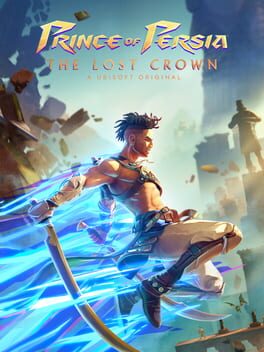
Presentation and the 2.5D Argument
The 2.5D format is a choice with consequences. A fully three-dimensional metroidvania carries different spatial demands than a side-scrolling one; a strictly 2D presentation forecloses certain kinds of visual argument. Ubisoft Montpellier’s choice of 2.5D is a design decision as much as an aesthetic one: the parallax layering allows the game to communicate depth and architectural scale without sacrificing the spatial legibility the platforming vocabulary requires. The foreground, midground, and background layers are not decorative; they are the encounter’s stage, and the staging mechanism depends on the player reading those layers correctly.
The Persian mythology visual language is the consistent register: Zoroastrian fire imagery, Mount Qaf’s distorted architecture, the colour palette drawn from miniature painting traditions where gold and deep blue dominate. The animation quality is the format’s argument in its most visible form: Sargon’s movement is fluid across the transition points between traversal and combat, which is the correct relationship. A 2.5D metroidvania that reads choppy at the switch from platforming to fighting has failed the form’s most basic contract. Lost Crown does not fail it. The visual direction is functional as well as beautiful, which is the rarer achievement here: the environments stage the encounters as much as they frame them.

Movement Vocabulary
The five core abilities are the game’s spine. They are not unlocks that expand the traversal option set; they are vocabulary that the encounter design then deploys as a grammar. Ubisoft Montpellier’s central design argument is this: every traversal ability has a combat use, and every combat ability has a traversal use. The pairing is deliberate and consistent. A game that ships a wall-jump for traversal only, or a projectile for combat only, has not made this argument. Lost Crown makes it at every ability in the set.
Rush of the Simurgh is the air-dash: the foundational traversal-and-combat ability, introduced early and used throughout. As traversal, it crosses gaps the single-jump cannot reach and initiates the mid-air combinations the later gauntlet sequences require. As combat, the dodge window is the air-dash activation window; the game stages encounters where the correct response to an incoming attack is not a ground-dodge but an aerial repositioning that also closes distance for the next offensive exchange. The Rush of the Simurgh does not feel like a traversal ability repurposed for combat or vice versa; it reads as a single tool with two applications, which is the correct architecture.
Shadow of the Simurgh is the position-marker: Sargon leaves a shadow at a fixed point in space, and a second activation teleports him back to it. The traversal use is precise platforming over multiple gap sequences, where the margin for error without the shadow is zero. The combat use is the game’s most inventive application of the ability set: mid-fight, the shadow allows repositioning across the arena with a precision that the dodge alone cannot provide, particularly in the encounters where arena hazards restrict where the ground-dodge can safely land. The ability does not rewind time; it rewinds position. The distinction matters for how the encounter uses it.
Cuckoo Whisper is the projectile-deflection and time-rewind on individual objects: a targeted ability that slows or reverses specific environmental elements. As traversal, it opens routes that require moving a platform or reversing a gate’s direction at a moment the fixed-timer version would close. As combat, it deflects specific enemy projectiles back at the source, and the timing of that deflection is a parry-adjacent skill the game teaches through the approach gauntlets before each encounter that requires it. The dodge window and the Cuckoo Whisper deflection window are distinct; recognising which the current encounter is testing is part of the game’s vocabulary-building argument.
Wings of the Falcon introduces vertical traversal: wall-jumping and the multi-wall sequences the game’s upper zones require. Its combat application is the vertical repositioning those sequences teach, the capacity to move to an elevation that a ground-bound encounter has not prepared the player for. Glaive of Time is the projectile ability for distance coverage and dash combination sequences: it functions as a ranged attack in combat, but the traversal gauntlets in the later zones use the Glaive’s arc and timing to activate distant switches without the player physically reaching them.
The five abilities together constitute a movement vocabulary: a set of tools with defined applications that the encounter design cross-references. The platforming gauntlet that precedes a boss arena is not a difficulty buffer; it is the vocabulary lesson the boss encounter is about to test. That is the contract Ubisoft Montpellier is making.

Combat Encounters and the AAA Contract
The encounter design is where the AAA-budget pressure is most visible and where the game earns or loses its argument. A large publisher’s fight design can become spectacle-first: elaborate multi-phase bosses that impress before they teach, encounter arenas that look expressive without doing encounter-design work. Lost Crown’s boss encounters are staged to teach, and the staging mechanism in each case is the platforming gauntlet and ability-gate that precedes the arena.
Jahandar is the first true test of the encounter-traversal pairing. The approach to Jahandar’s arena stages the player through a gauntlet that specifically requires the Rush of the Simurgh: the gap sequences cannot be closed without the air-dash, which means a player who reaches the arena has already demonstrated the ability the fight then requires them to use offensively. Jahandar’s attack vocabulary forces repositioning at a speed the ground-dodge alone cannot sustain; the fight is built around the air-dash as the correct response to its heaviest attacks. The parry window exists in Lost Crown’s system, but Jahandar is not a fight that rewards parry-first play: the stagger economy favours the player who repositions correctly and attacks in the openings, not the player who tries to tank through the contact. The encounter teaches this through failure, which is the form’s classical teaching method. It earns the cost of that failure by ensuring every failed attempt clarifies the correct response, and the contract holds.
Menolias stages the encounter around the air-dash unlock in a more explicit way: the arena geometry is designed around the ranged attack patterns of a boss whose ground is not safe. The player who does not have the Rush of the Simurgh’s aerial repositioning reads the arena as a wall of incoming projectiles with no clean ground-path through them. The player who has internalised the air-dash reads the same arena as a sequence of repositioning windows the fight is opening for them. The stagger economy changes accordingly: Menolias staggers to aerial attacks timed correctly, and the game stages the encounter to reward the player who has moved the fight off the ground.
The Manticore encounter, known within the game as Azhdaha in its final phase, is the game’s most structurally ambitious encounter sequence. The multi-phase architecture escalates the ability demands: the first phase requires the Rush of the Simurgh for gap management and the Shadow of the Simurgh for repositioning across a hazard field; the second phase adds Cuckoo Whisper deflection requirements as the projectile density increases. The dodge window in the second phase narrows relative to the first, which is the correct escalation: a player who has been relying on the dodge window as their primary defensive tool finds it taxed at exactly the point the encounter-design wants them to integrate the Shadow teleport. The game stages the encounter to force the vocabulary expansion.
Queen Thomyris tests the full ability roster: the climactic encounter is structured so that no single ability dominates the correct response strategy. The parry window is present but not the primary defensive tool; the stagger economy rewards sustained offensive pressure in the openings between Thomyris’s attack cycles; the air-dash and shadow repositioning are both required across the arena’s geometry. Vahram, the final encounter, confirms the argument the game has been making across its entire encounter sequence: the moveset reads as a complete vocabulary when the player has been taught how to use it, and Vahram’s design stages the encounter to require every element of that vocabulary in the correct sequence. The fight earns the cost. It is the AAA-budget contract’s final argument, and it holds.

The Memory Shard System
The Memory Shard system is Lost Crown’s contribution to the metroidvania form’s design conversation, and it is the most considered innovation in the game. The traditional metroidvania backtracking model requires the player to hold a mental map of locked doors, unreachable passages, and sealed switches, and to recall which of those map-markers corresponds to which newly acquired ability. The cost of this model is cognitive load; the benefit is the discovery-contract that defines the form’s experience: the player explores, identifies a barrier, acquires the capability, returns. The barrier-to-capability-to-return loop is the form’s economy.
The Memory Shard system does not remove this loop. It tools it. At any point in the game, the player can take a screenshot of any environmental detail: a sealed passage, a locked door, a marked switch, a route that requires an ability not yet acquired. That screenshot is pinned to the map at the corresponding location. When the player later acquires the relevant ability, the map displays the pinned location. The Discovery contract is preserved: the player still needs to find the barrier, still needs to acquire the capability, still needs to return. The Memory Shard removes the one part of that loop that is not discovery but recollection: the cognitive burden of cross-referencing a mental map against a newly acquired ability. The game does not tell the player where to go. It reminds them where they chose to note.
The distinction matters because the alternative route, objective markers and waypoint systems, breaks the discovery contract entirely. The Memory Shard system breaks nothing; it supplements memory with a player-controlled annotation layer. In an AAA-budget production where the map is large and the ability acquisition sequence spans twenty hours, this is the correct design decision. The game earns the trust it is extending to the player’s sense of direction, and the Memory Shard is the tool that makes that extension viable.
Story and the Immortals
Sargon is the youngest of the seven Immortals, a warrior brotherhood who serve as Persia’s elite defenders. The story’s inciting event is straightforward: Prince Ghassan is kidnapped and taken to Mount Qaf, the cursed mountain that traps the kingdom in distorted time, and Sargon is sent to retrieve him. The narrative that follows is a character study of Sargon’s position within the Immortals, the tensions between them, and the revelation that the mountain’s distorted time is not merely a backdrop but the game’s core antagonist-logic. The time-distortion is not environmental decoration; it is the reason Sargon’s ability set includes the Shadow of the Simurgh and Cuckoo Whisper, abilities that interact with time’s fabric directly.
The story serves the encounter design rather than dominating it, which is the correct relationship in a metroidvania. The Immortals as a group are characterised economically: each member’s personality informs how they stage the encounter in which they appear, either as opponent or as ally. The story’s weakest section is its middle, where the revelations about the mountain’s history deliver through cutscene rather than through encounter-design, and the connection between narrative and system loosens. The closing sequence, where the time-distortion logic and the Sargon character arc converge at Vahram, restores the argument that the story and the encounter design are addressing the same question.
Accessibility and Why It Matters Here
Lost Crown shipped on 18 January 2024 with a full accessibility suite: difficulty customisation that adjusts combat timing windows and damage output independently, motion settings for camera shake and screen-flash effects, full control remapping, navigation assist, and an exploration mode that reduces the consequences of combat failure to the point where the traversal sequence, rather than the encounter sequence, is the primary challenge. These options were present at launch, not patched in later. The distinction matters because accessibility options added post-launch suggest a responsive correction; options shipped at launch suggest a design philosophy.
Ubisoft Montpellier’s philosophy here is legible: the encounter-traversal pairing is the argument, and the game should be able to make that argument to players who interact with it at different tolerances for timing demands. The parry window can be widened. The stagger economy can be made more forgiving. The air-dash dodge window can be extended. None of these adjustments remove the argument; they adjust the precision at which the player needs to execute it. The contract between player and form survives across all difficulty settings, which is the correct test of whether the accessibility implementation has understood the game.
The Mask of Darkness DLC and Free-DLC Argument
The Mask of Darkness Within DLC released on 18 September 2024, eight months after launch, and was free for all owners of the base game. It added an expanded zone: the Mask of Darkness region, an underground area connected to the main Mount Qaf map with its own environmental identity and a set of encounters that assume the player has completed a substantial portion of the main game. The zone is not a standalone expansion; it is an addition to the existing map that the Memory Shard system integrates cleanly.
The decision to release it as free content is the argument. A paid DLC model for a post-launch zone addition is standard for AAA publishing; Ubisoft chose against it. The decision communicates something about the project’s contract with its playerbase: the base game’s £44.99 price point was the complete proposition, and the additional content was Ubisoft Montpellier extending that proposition without re-opening the financial contract. Whether that decision reflects a marketing strategy or a design philosophy is not distinguishable from the outside, but the outcome is the same. The Mask of Darkness DLC is the kind of post-launch addition that the form rewards: it extends the map without inflating the initial price, and it respects the Memory Shard system’s discovery architecture.
Final Word
The game that earns the retrospective case is the one whose argument still reads two years after launch. Lost Crown’s argument reads. The encounter design’s vocabulary-pairing thesis, most legibly demonstrated in Queen Thomyris’s multi-phase test of the full ability roster, has not aged because it was not built on novelty: it was built on the correct relationship between traversal and combat, and that relationship does not expire. Players who want pure traversal with minimal combat integration, the classic exploration-first metroidvania, will find Lost Crown’s encounter-staging demands too consistent; the combat is not an interruption to the traversal but its paired argument, and resisting that pairing is resisting the game. Players who engage with both registers will find the most considered AAA metroidvania of the current generation. The AAA metroidvania should not work. Lost Crown is the proof that it can.
FAQ
Is Prince of Persia: The Lost Crown worth playing in 2026?
Prince of Persia: The Lost Crown is worth playing in 2026 as a complete, polished metroidvania whose encounter and traversal design has not degraded with time. The game launched in a stable state across all platforms, the Mask of Darkness DLC is free for all owners, and the Movement Vocabulary and encounter-staging architecture are as legible now as they were in January 2024. At £44.99 Standard or lower in sales, the value proposition is clear.
How does Lost Crown compare to Hollow Knight or Animal Well?
Lost Crown occupies a different position within the metroidvania genre than Hollow Knight or Animal Well. Hollow Knight is a precision-platformer with a soulslike combat emphasis and a vast interconnected map; Animal Well is a pure exploration-and-puzzle metroidvania with no direct combat. Lost Crown sits between them: it has both a full combat vocabulary, parry windows, stagger economy, and multi-phase boss encounters, and a traversal vocabulary that its platforming gauntlets teach systematically. The AAA budget distinguishes it from both in presentation scale, and the Memory Shard system is its specific design contribution to the form.
Is the Mask of Darkness DLC included with the base game?
The Mask of Darkness Within DLC is free for all owners of the base game and has been available since its release on 18 September 2024. It is not included on the disc or download at launch but is downloadable at no additional cost from the relevant platform storefront. Players who purchased the Standard edition at £44.99 receive the DLC at no extra charge, which extends the game's map with the Mask of Darkness zone and additional encounters that assume a substantial portion of the main game has been completed.
What is the Memory Shard system?
The Memory Shard system is a route-design tool built into Lost Crown's map. At any point, the player can take a screenshot of any environmental detail: a locked passage, a sealed door, an unreachable route, a marked switch. That screenshot is pinned to the map at the corresponding location. When the player later acquires the ability that opens the route, the map displays the pinned screenshot as a reminder. The system preserves the metroidvania form's discovery contract, the player still needs to find the barrier and acquire the capability, while removing the cognitive burden of cross-referencing a mental map against a newly acquired unlock.
Should I buy the Standard or Deluxe edition?
The Standard edition at £44.99 / $49.99 is the complete game and includes access to the free Mask of Darkness DLC. The Deluxe edition at £54.99 / $59.99 adds a digital art book and the game's soundtrack, both of which are substantive given Ubisoft Montpellier's Persian mythology visual direction and the original score's quality. Players whose primary interest is the game itself will find the Standard edition sufficient; players who want the art and soundtrack as companion materials will find the Deluxe edition worth the additional £10 / $10.
9.0
Outstanding
SpawningPoint Verdict
Review summary
Prince of Persia: The Lost Crown, released by Ubisoft Montpellier on 18 January 2024 across PS5, PS4, Xbox Series X|S, Xbox One, Switch, PC, and Amazon Luna, is the AAA metroidvania argument that holds two years on. Sargon's quest across Mount Qaf is structured around five core abilities: the air-dash Rush of the Simurgh, the position-marker Shadow of the Simurgh, the deflection tool Cuckoo Whisper, the vertical traversal Wings of the Falcon, and the projectile Glaive of Time. Each is paired by design: every traversal ability has a combat application, and every combat ability has a traversal use. The boss encounter sequence from Jahandar to Vahram constitutes a vocabulary-teaching arc that justifies the form's discovery contract at AAA scale. The Memory Shard system is the game's design contribution to the genre. At £44.99 Standard with the free Mask of Darkness DLC, the value proposition has not weakened with time.


