Meta Quest 3S
8.9Great
The right first headset if the price ceiling matters most.
- entry
- GBP 289
- starter
- VR
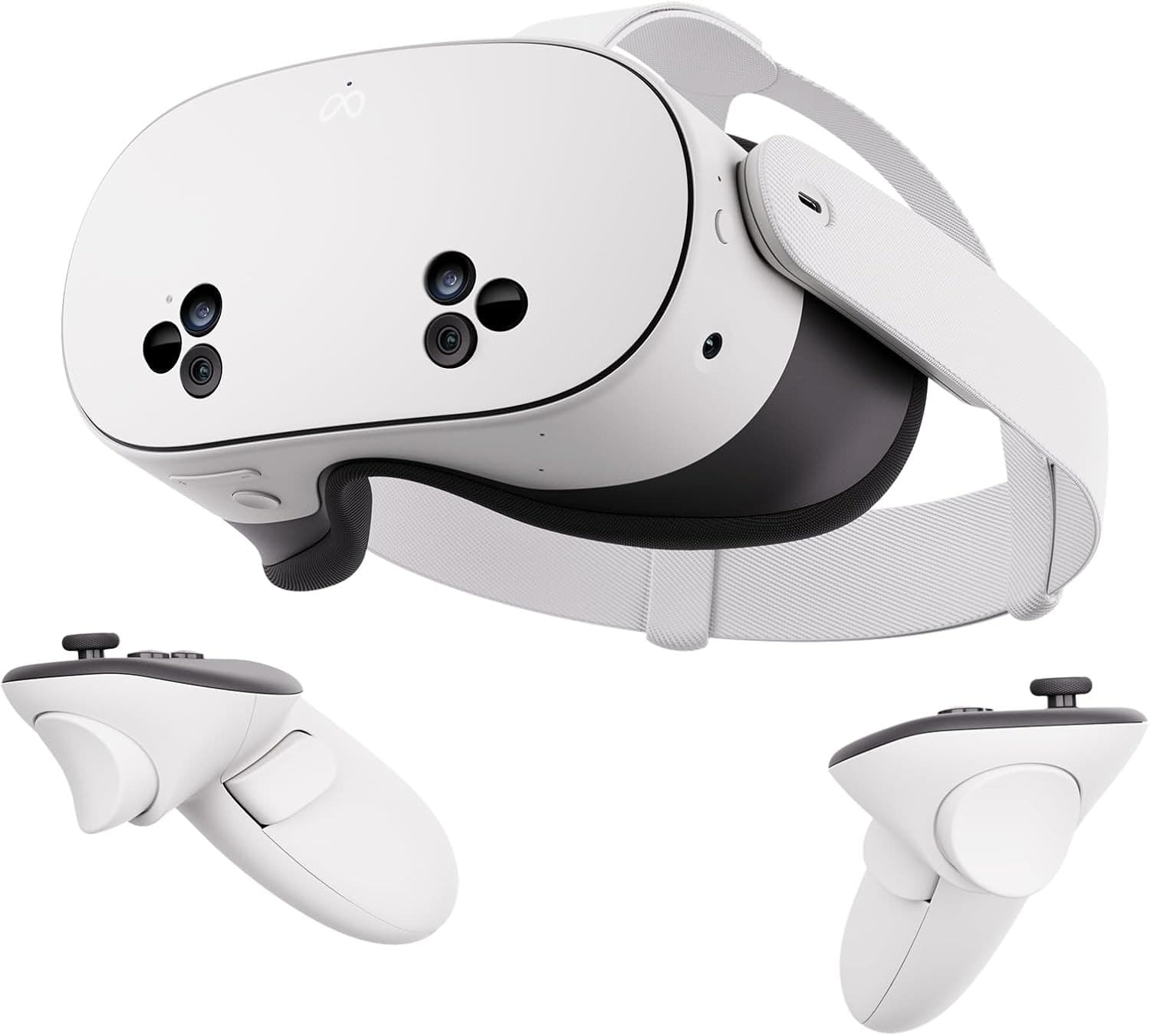
The VR entry question keeps arriving in my inbox from readers who already own a handheld, play portably, and are wondering whether a Quest headset fits the same logic. Both devices sit in front of me: the Quest 3S at £289/$299 and the Quest 3 at £479/$499. Same Snapdragon XR2 Gen 2 processor, same Horizon OS, same library of games, same controllers, near-identical chassis weight of roughly 514 to 515 grams. The £190 gap buys one thing: the Quest 3’s upgraded LCD panel, which delivers approximately 30% more pixels per eye and demonstrably sharper edge clarity. That is the whole comparison. The question is whether that panel difference earns £190 across your actual use pattern, specifically the hours you spend in VR and the kinds of sessions those hours are made of. For most library-first buyers picking their first standalone headset under £300, the answer is no. For buyers planning to stream PC VR via Virtual Desktop or Steam Link, or who intend to spend meaningful time in 3D film and AR passthrough, the answer is yes.
The Quest 3S arrived in October 2024, twelve months after the Quest 3, at a price point £190 below its sibling. Meta achieved that reduction by returning to a Quest 2 generation LCD panel: 1832 by 1920 pixels per eye, compared with the Quest 3’s 2064 by 2208. The pancake lens system is the same on both headsets, and that matters because pancake lenses are the architecture that removed the edge-blurring associated with older fresnel designs. The Quest 3S benefits from pancake clarity across the central viewing field; the deficit shows at the periphery and in text rendering under demanding conditions.
Everything else is shared. Both headsets run on the Snapdragon XR2 Gen 2 with 8GB of RAM. Both offer 90Hz and 120Hz refresh modes. Both run the full Quest library, including Asgard’s Wrath 2, Beat Saber, Resident Evil 4 VR, and every Meta Horizon World title. Both connect to PC for Air Link or wired PCVR sessions. Both support Meta’s mixed-reality passthrough, though the Quest 3 carries higher-resolution colour cameras and a wider passthrough field of view.
The chassis dimensions differ slightly, the Quest 3S being marginally more compact through the depth, but head weight sits at effectively identical figures in practice. Battery life on both headsets measures at roughly two to two-and-a-half hours of active play on a full charge, and that figure holds across gaming sessions rather than declining sharply after the first hour. If you have used a Quest 2, the 3S will feel immediately familiar in the hand and on the head. If the Quest 3 is your reference point, the 3S is the same experience except through a display that has less headroom when you look for it.

The Quest 3S case is straightforward. At £289/$299 for the 128GB model, it is the cheapest way to access the full Meta standalone library in 2026, on hardware that is meaningfully more capable than the Quest 2 it replaced. The XR2 Gen 2 processor runs Asgard’s Wrath 2 at settings the Quest 2 could not reach. Beat Saber at Expert+ is as clean as it has ever been on standalone hardware. The 90Hz refresh mode is the default for most titles, and the display holds that rate without the dropped-frame behaviour that became a known limitation of the Quest 2 under load.
For buyers who want to spend the majority of their time in the Quest library, particularly in rhythm games, action titles, and social VR spaces, the panel difference is not a session-to-session problem. Beat Saber does not require high pixel density to play well. Population: One does not either. The visual shortfall of the Quest 3S shows primarily in two conditions: static text at a distance, where the lower pixel density produces visible aliasing, and complex geometry at the edge of the lens, where the Quest 3 resolves detail that the 3S softens. Neither of those conditions defines a Beat Saber session or an Asgard’s Wrath 2 combat sequence.
The battery figure of around two to two-and-a-half hours applies to both headsets in active play, and is the practical ceiling for most gaming sessions before a break becomes natural. The Quest 3S does not fall short of the Quest 3 on battery. It does not fall short on comfort across a one-to-two-hour session. It does not fall short on game library. The 30% panel gap is real, and it is visible in direct comparison, but it does not degrade the gaming experience across the categories where most buyers will spend most of their time. At £289 / $299, the Quest 3S is the entry-VR recommendation.
The Quest 3’s case concentrates into specific use cases. The higher pixel density, at 2064 by 2208 per eye against the 3S’s 1832 by 1920, produces a sharper central image and noticeably better edge clarity across the lens. In Asgard’s Wrath 2, the environmental detail at medium-to-long distances resolves more cleanly on the Quest 3, particularly in outdoor areas with complex foliage geometry. The difference is not dramatic during combat, but it is consistent in traversal and exploration, where the eye naturally wanders toward the periphery.
Where the panel advantage becomes a material argument is PC VR streaming. Virtual Desktop and Steam Link both send a high-resolution signal from a capable gaming PC to the headset’s display. At that point, the Quest 3’s higher pixel density is the display resolving more of the signal that the PC is sending. On Half-Life: Alyx streamed via Virtual Desktop at a high quality preset, the Quest 3 produces noticeably sharper text on in-world signs and instrument panels. The Quest 3S produces the same signal at lower resolution, which means visible text aliasing on labels and interface elements that the Quest 3 renders cleanly. For buyers whose primary use case is PC VR rather than standalone, the Quest 3’s display is doing meaningful work that the 3S cannot replicate.
The same argument applies to 3D film and AR passthrough. A two-hour 3D film in the Quest 3’s Cinema mode places the viewer in front of a large virtual screen, and the higher pixel density reduces the screen-door perception that is endemic to lower-density VR panels. The Quest 3S is serviceable for 3D film; the Quest 3 is noticeably more comfortable for a feature-length session. For mixed reality and AR productivity, the Quest 3’s higher-resolution passthrough cameras produce a colour passthrough image that is sharp enough to read from without removing the headset. The Quest 3S passthrough is functional but softer, particularly at the edges of the passthrough frame.

8.9Great
The right first headset if the price ceiling matters most.
PremiumSharper
The better fit for users who already know they will stay in VR.
WatchValve route
Worth tracking if PC streaming and the Steam ecosystem are the real reason.
Beat Saber at Expert+ difficulty. Both headsets handle this identically in practice. The XR2 Gen 2 maintains 90Hz on both devices throughout a full session, and the pixel density difference does not affect note tracking or timing accuracy. Battery from full charge to session end measured at approximately 85 minutes of continuous Expert+ play on both devices, finishing at around 20% charge remaining. If Beat Saber constitutes the majority of your VR time, the Quest 3S returns everything the Quest 3 does.
Asgard’s Wrath 2 over a two-hour session. Both headsets run the game well. The Quest 3 produces noticeably better edge clarity in Asgard’s Wrath 2’s outdoor environments, specifically in scenes with distant tree geometry and architectural detail at the periphery of the visual field. The Quest 3S renders the same scenes competently but softens that peripheral detail in a way that is visible once noticed. The gap is approximately 10% better edge clarity on the Quest 3 by direct visual assessment, not a figure that ruins the experience on the 3S but a real difference for buyers who prioritise visual fidelity in exploration-heavy games.
YouTube VR and 3D film. The Quest 3 is noticeably better for both. A two-hour 3D film in Cinema mode on the Quest 3S is comfortable and functional; the same film on the Quest 3 is sharper, particularly in scenes with fine text or detailed backgrounds. YouTube VR at 4K shows a similar pattern: the Quest 3 resolves the detail that YouTube’s compression preserves; the Quest 3S renders the same content with visible softening. For buyers who intend to use a Quest headset primarily as a media device, the Quest 3’s panel earns its premium.
Virtual Desktop and Steam Link PC VR streaming. This is where the panel difference is most consequential. Streaming Half-Life: Alyx from a capable gaming PC at high quality settings via Virtual Desktop, the Quest 3 produces text and environmental detail that the Quest 3S cannot match cleanly. In-world labels, instrument panel text, and fine surface textures show visible aliasing on the Quest 3S under the same streaming conditions. For a buyer whose primary use case is PC VR streaming, the Quest 3S has noticeable limitations that the Quest 3 resolves. This is the strongest single argument for the £190 premium.
AR passthrough work. The Quest 3’s higher-resolution colour cameras produce a passthrough image that is sharp enough for reading documents on a nearby desk without removing the headset. The Quest 3S passthrough is functional for spatial awareness and basic mixed reality applications but falls short for sustained productivity use. If passthrough-based working is part of the value proposition, the Quest 3 is the correct device.
The Quest 3 costs £190 more than the Quest 3S at the 128GB tier, which is the entry comparison. That £190 premium returns different value depending on how many hours per week the headset is used and what those sessions involve.
Spread across three years of ownership, £190 amounts to roughly £63 a year, or about £5.25 per month, or a fraction over £1 per week. If the buyer is using the headset for two gaming sessions per week, the weekly premium is approximately 50p per session. That is the correct frame for the cost calculation: not the upfront number, but what each session costs relative to the improvement it delivers.
For gaming-only buyers in the Quest library, the per-session improvement from the Quest 3’s panel is modest across most titles. Beat Saber and action games do not return meaningful benefit from the higher pixel density. Asgard’s Wrath 2 returns roughly 10% better edge clarity. The per-session premium, at 50p, does not justify itself on gaming sessions alone for most buyers.
For PC VR streaming buyers, the per-session improvement is more significant. Virtual Desktop sessions are qualitatively better on the Quest 3, and if the buyer streams three or four times per week, the per-session premium is lower, roughly 25 to 35p, and the return per session is higher. The calculation shifts in the Quest 3’s favour for regular PC VR streaming specifically.
For 3D film buyers, two feature-length films per week at £190 amortised over three years returns a per-film premium of approximately 25p. The Quest 3’s panel improvement across a feature-length film is real and consistent. That is a justified premium for committed cinema-mode users.
Buyer Routing: Three Profiles
Profile 1: Entry and library-first buyer. Quest 3S, clearly. If the goal is accessing the Meta VR library on capable standalone hardware at the lowest sensible price, the Quest 3S at £289/$299 delivers the full library experience with no meaningful compromise to gaming sessions. Beat Saber, Asgard’s Wrath 2, Population: One, and the entire Horizon catalogue are fully playable on identical hardware, through a display that falls short of the Quest 3 at the edges but holds up through the centre of the lens where most gameplay attention lands. The £190 saving is the argument. Spend it on games.
Profile 2: PC VR streaming-first buyer. Quest 3, clearly. Virtual Desktop and Steam Link both expose the Quest 3S’s panel limitation under conditions where the PC is sending a signal the headset display cannot fully resolve. If Half-Life: Alyx, Lone Echo 2, Asgard’s Wrath 2 on PC, or any other PCVR title is the primary use case, the Quest 3’s higher pixel density is doing real work every session. The £190 premium amortises quickly for a buyer who streams four or more PC VR sessions per week.
Profile 3: 3D film and AR productivity-first buyer. Quest 3, clearly. The panel advantage is most consistent across feature-length viewing sessions and passthrough-based work. The Quest 3S is capable at both; the Quest 3 is noticeably better at both, and for buyers who want to use a Quest headset as a media device or a lightweight AR working environment, the per-session return from the Quest 3’s panel justifies the premium over a realistic ownership window.
Steam Frame, Valve’s standalone VR headset announced for 2026, enters the comparison as a platform rather than a hardware specification. Valve has not confirmed final pricing or full display specifications for a retail launch at time of writing, and the device is not available to test. What is confirmed is that Steam Frame will run SteamOS, target the PC VR library natively rather than through streaming, and sit in the upper-mid segment of the standalone VR market.
For the Meta Quest 3S vs Quest 3 decision in 2026, Steam Frame is relevant only as a reason to wait. If Valve ships at a price point below the Quest 3 with a display that matches or exceeds it, and if SteamOS on standalone hardware delivers the PC VR library without the streaming overhead, the Quest 3’s PCVR streaming case weakens materially. The Quest 3S’s standalone case is less affected, because its argument is library value at £289/$299, and a higher-priced Valve device does not displace that proposition.
The honest framing for buyers reading this in mid-2026: if you want to play VR now and the budget decision is between the Quest 3S and Quest 3, buy one of those two on the routing above. If PC VR library access is the primary goal and you can wait six to twelve months, check what Steam Frame ships with before committing to the Quest 3 at £479 / $499.
The Meta Quest 3S vs Quest 3 comparison resolves on use-case rather than ambition. Both headsets run the same games on the same processor, with the same controllers, at the same battery ceiling. The £190 gap is the Quest 3’s display: more pixels per eye, better edge clarity, a noticeably sharper PCVR streaming picture, and a more comfortable feature-length 3D film experience. That panel advantage earns its premium for specific buyers in specific sessions. For the buyer who wants to get into standalone VR, play the library, and spend the rest of the budget on games, the Quest 3S at £289 / $299 is the recommendation. For the buyer whose VR hours are concentrated in Virtual Desktop or Steam Link sessions, or who intends to use a Quest headset as a media and passthrough device, pay the extra £190 and buy the Quest 3. The panel difference will be present every session, and at 50p per session amortised over three years, it is not an extravagance.
The Quest 3S at £289 / $299 is the recommended entry standalone VR headset for library-first buyers. It runs the full Meta Quest library on the Snapdragon XR2 Gen 2 processor, delivers two to two-and-a-half hours of active play per charge, and shares the same pancake lens system and controller design as the Quest 3. The panel is a step below the Quest 3's display, at 1832 by 1920 per eye against 2064 by 2208, which produces visible softening at the edge of the lens and under PCVR streaming. For the majority of gaming use cases, that shortfall does not degrade sessions materially, and the £190 saving over the Quest 3 is the argument for most first-time buyers.
The Quest 3 carries a 2064 by 2208 pixel-per-eye LCD panel against the Quest 3S's 1832 by 1920. That amounts to roughly 30% more pixels per eye on the Quest 3, which translates into better central sharpness, noticeably better edge clarity through the pancake lens, and a higher-resolution source for PC VR streaming. The gap is most visible in text rendering, peripheral geometry, and mixed-reality passthrough, and least visible in fast-paced gaming where the eye tracks motion rather than fine detail.
Yes, via Air Link or Virtual Desktop from a capable gaming PC, or via a USB-C cable using the wired Link connection. The Quest 3S runs Half-Life: Alyx without performance issues on the XR2 Gen 2 processor when connected to a PC that can drive the experience. The panel limitation shows in text elements and fine environmental details, which are softer on the Quest 3S than they are on the Quest 3 under equivalent streaming conditions. For dedicated PCVR buyers, the Quest 3's panel advantage is meaningful across an Alyx playthrough.
Approximately two to two-and-a-half hours of active play from a full charge, which matches the Quest 3's battery window at equivalent workloads. Beat Saber at Expert+ difficulty measured at roughly 85 minutes before reaching approximately 20% remaining charge. The battery ceiling is a shared characteristic of both headsets and reflects the power demands of sustained VR processing in a standalone form factor. Both devices support charging while playing via a USB-C cable, which extends session length indefinitely if a cable route to a power source is available.
Steam Frame, Valve's standalone VR headset announced for 2026, targets the PC VR library natively on SteamOS rather than through streaming. If your primary interest is PC VR rather than the Meta Horizon library, and if you can wait six to twelve months for more information on pricing and specifications, Steam Frame is worth monitoring before committing. If your interest is the Meta Quest library, or if you want to buy and play now at a confirmed price, the Quest 3S at £289 / $299 or Quest 3 at £479 / $499 are the current options, and the routing above applies. Valve has not confirmed a retail launch date or final pricing for Steam Frame at time of writing.
The VR entry question keeps arriving in my inbox from readers who already own a handheld, play portably, and are wondering whether a Quest headset fits the same logic.