REVIEW
7.6· Great
Hell Is Us PS5 Review: A Mapless Mystery Worth the Effort
Hell Is Us on PS5 is a bold, waypoint-free action-adventure that rewards curiosity and note-taking, even if combat repetition and UI friction hold it back.

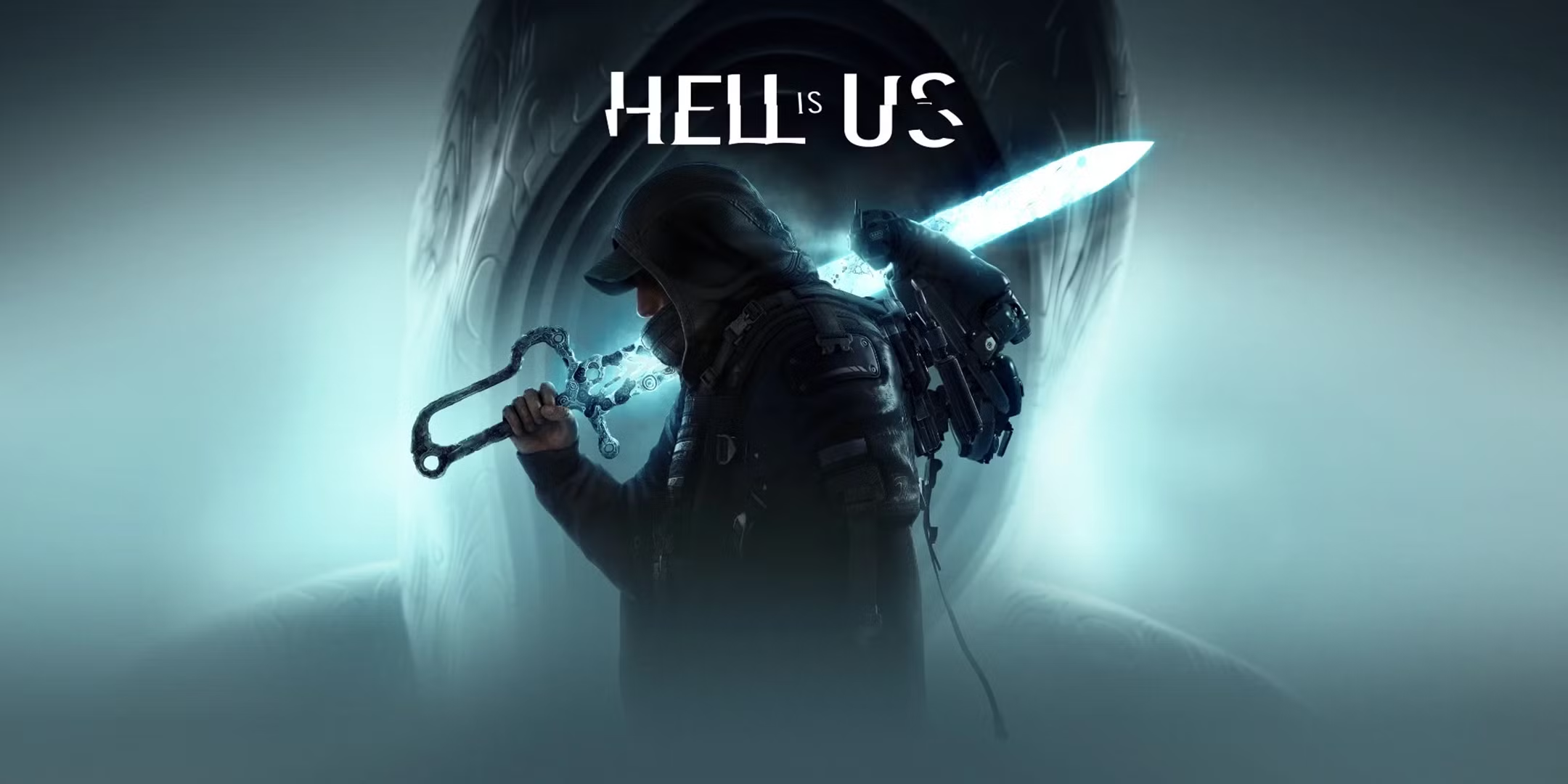
Hell Is Us is one of those rare modern games that trusts you enough to let you be lost, not in an open-world bloat sense, but in a proper “figure it out” way. It drops you into Hadea, a country torn apart by civil war and haunted by something far stranger, then refuses to smooth the edges with a constant trail of icons. You get clues, scraps of context, a data pad full of notes, and the expectation that you will actually read them.
That design choice is the point, and it is also the gamble. When Hell Is Us clicks, it feels like solving a mystery in motion. You spot a landmark someone mentioned two conversations ago, realise a symbol on a wall matches a sketch you saved, and suddenly an objective becomes a destination you earned rather than a GPS coordinate.
The flip side is that deliberate friction can start to feel like stubbornness. Hell Is Us can be compelling, sometimes brilliant, occasionally abrasive, and very much not designed to please everyone. It is the kind of game where keeping a small notebook nearby can genuinely help, because you will be juggling names, places, and implications more than you would in a waypoint-led action adventure.
 The mapless, waypoint-free exploration is the main draw. Instead of constant objective markers, you rely on directions, descriptions, and your own notes. The in-game data pad helps, but the experience is at its best when you treat it like a detective board, connecting fragments until the route forward becomes obvious. It is a brave design in an era that often fears player frustration, and it creates moments of genuine satisfaction.
Combat is more divisive. It is melee-focused, with stamina management, dodges, blocks, and parries forming the foundation. In one-on-one fights it can feel deliberate and crunchy, with a nice sense of weight behind strikes. The drone adds a useful layer, functioning as a tactical tool rather than a second gun. There are also systems tied to enemy behaviour and resistances that encourage you to think a little, not just mash.
Where it struggles is repetition and crowd control. Enemy variety can feel thin over a long campaign, and some encounters turn messy when multiple threats stack together. The fundamentals are solid, but the game does not always do enough with them to keep combat as interesting as the investigation side. The result is that you may find yourself pushing through fights to get back to the next clue, which is not ideal for an action-adventure that positions combat as a core pillar.
The mapless, waypoint-free exploration is the main draw. Instead of constant objective markers, you rely on directions, descriptions, and your own notes. The in-game data pad helps, but the experience is at its best when you treat it like a detective board, connecting fragments until the route forward becomes obvious. It is a brave design in an era that often fears player frustration, and it creates moments of genuine satisfaction.
Combat is more divisive. It is melee-focused, with stamina management, dodges, blocks, and parries forming the foundation. In one-on-one fights it can feel deliberate and crunchy, with a nice sense of weight behind strikes. The drone adds a useful layer, functioning as a tactical tool rather than a second gun. There are also systems tied to enemy behaviour and resistances that encourage you to think a little, not just mash.
Where it struggles is repetition and crowd control. Enemy variety can feel thin over a long campaign, and some encounters turn messy when multiple threats stack together. The fundamentals are solid, but the game does not always do enough with them to keep combat as interesting as the investigation side. The result is that you may find yourself pushing through fights to get back to the next clue, which is not ideal for an action-adventure that positions combat as a core pillar.

 The strongest narrative element is the setting itself: the sense that war has carved deep scars into people and institutions, and that the supernatural horror is tangled up with human violence rather than replacing it. Notes, conversations, and environmental storytelling carry a lot of the weight, which pairs nicely with the “no hand-holding” structure.
Character work is more uneven. Side characters can be memorable in brief bursts, often because they are shaped by survival rather than spectacle. Rémi himself is harder to love. He is functional as a player anchor, but he can feel emotionally distant, and that distance sometimes blunts the personal stakes that should drive the journey. The bigger ideas are compelling, but the human centre does not always land with the punch it seems to be aiming for.
The strongest narrative element is the setting itself: the sense that war has carved deep scars into people and institutions, and that the supernatural horror is tangled up with human violence rather than replacing it. Notes, conversations, and environmental storytelling carry a lot of the weight, which pairs nicely with the “no hand-holding” structure.
Character work is more uneven. Side characters can be memorable in brief bursts, often because they are shaped by survival rather than spectacle. Rémi himself is harder to love. He is functional as a player anchor, but he can feel emotionally distant, and that distance sometimes blunts the personal stakes that should drive the journey. The bigger ideas are compelling, but the human centre does not always land with the punch it seems to be aiming for.


Game Snapshot
| Developer | Rogue Factor |
| Publisher | Nacon |
| Release Date | 04 September 2025 |
| Platforms | PS5, Xbox Series X|S, PC |
| Price | £49.99/$59.99 |
| Rating | PEGI 16 (Horror, Language, Violence) | ESRB M (Blood, Drug Reference, Strong Language, Suggestive Themes, Violence) |
| Genre | Third-person action-adventure |
| Length | 25-30 hours (main story) and about 40 hours (story + side content) |
| Install Size | 20.9GB |
Presentation and World Design
Hadea is a grimly convincing place. The environments lean into a bleak, war-scarred mood, with long stretches of quiet tension punctuated by sudden, uncanny imagery. It is not just “dark” in a video game sense. The world-building is pointed about human cruelty, and the game is unafraid to linger on the aftermath. That makes the tone heavy, but it also gives the setting a sense of purpose rather than just dressing. Visually, the PS5 version sells that atmosphere through strong lighting and stark contrasts. Outdoor areas can feel washed with cold air and distance, while interior spaces are built to feel oppressive, like you have stepped into a history that does not want you there. Dungeons in particular are where the art direction shines, shifting from open zones into dense, labyrinthine structures that feel designed around puzzles and spatial memory. The standout design choice is how navigation is embedded into the world. Landmarks, signage, architecture, and environmental detail do the work a minimap usually would. When it is working, it is genuinely immersive, because you are looking at the world, not at a HUD. If you tend to love atmosphere-first horror-adjacent worldbuilding, our Silent Hill f PS5 review is another strong reference point for how far mood and environmental storytelling can carry a game even when mechanical edges show. The downside is simple: some players will bounce off the expectation to pay attention, especially if they prefer a brisker pace or like to dip in and out without reorienting.Gameplay and Combat
At its heart, Hell Is Us is an exploration game wearing an action-adventure coat. The loop is simple: arrive in an area, gather leads, follow them through observation and deduction, and push into a dungeon-like space where puzzles, combat encounters, and story beats tighten together.
The mapless, waypoint-free exploration is the main draw. Instead of constant objective markers, you rely on directions, descriptions, and your own notes. The in-game data pad helps, but the experience is at its best when you treat it like a detective board, connecting fragments until the route forward becomes obvious. It is a brave design in an era that often fears player frustration, and it creates moments of genuine satisfaction.
Combat is more divisive. It is melee-focused, with stamina management, dodges, blocks, and parries forming the foundation. In one-on-one fights it can feel deliberate and crunchy, with a nice sense of weight behind strikes. The drone adds a useful layer, functioning as a tactical tool rather than a second gun. There are also systems tied to enemy behaviour and resistances that encourage you to think a little, not just mash.
Where it struggles is repetition and crowd control. Enemy variety can feel thin over a long campaign, and some encounters turn messy when multiple threats stack together. The fundamentals are solid, but the game does not always do enough with them to keep combat as interesting as the investigation side. The result is that you may find yourself pushing through fights to get back to the next clue, which is not ideal for an action-adventure that positions combat as a core pillar.
Story and Characters
Hell Is Us opens with intrigue and a sense of disorientation that fits its themes. You play as Rémi, returning to Hadea to uncover personal answers while the country collapses around him. The narrative is dense, and it throws names, factions, and historical baggage at you early, almost daring you to keep up. When you do, the story feels richer for it, because you are not just following a plot, you are assembling it.
The strongest narrative element is the setting itself: the sense that war has carved deep scars into people and institutions, and that the supernatural horror is tangled up with human violence rather than replacing it. Notes, conversations, and environmental storytelling carry a lot of the weight, which pairs nicely with the “no hand-holding” structure.
Character work is more uneven. Side characters can be memorable in brief bursts, often because they are shaped by survival rather than spectacle. Rémi himself is harder to love. He is functional as a player anchor, but he can feel emotionally distant, and that distance sometimes blunts the personal stakes that should drive the journey. The bigger ideas are compelling, but the human centre does not always land with the punch it seems to be aiming for.
Value and Longevity
On Hell Is Us length, expect roughly 25-30 hours for the main story and around 40 hours with side content. That is substantial without being endless, and it suits the design, because the investigation structure thrives on momentum. Overstaying would risk turning note-taking into a chore rather than a pleasure. Side content tends to complement the core loop, giving you extra mysteries and context rather than filler tasks. Replay value is more about approach than content. If you love piecing things together, revisiting areas with better understanding can be satisfying, and difficulty options encourage experimentation if you want a harsher or gentler combat experience. If you are mostly here for action, though, the repetition in enemy types may make a second run a harder sell. If you are weighing it against other big PS5 releases, our Best PS5 Games of 2025 roundup is a useful sanity check for what else is competing for your time.
Technical Notes
Hell Is Us PS5 performance is generally solid in day-to-day play, and load times are brisk, which helps because the game asks you to move between spaces and revisit earlier areas. The bigger practical issue tends to be usability. Text and menu organisation can feel smaller or clunkier than they should, and because the game leans so heavily on written clues and inventory notes, that matters more here than in most action games. If you play from a sofa at distance, readability is worth considering, because you will be reading a lot. Overall stability is solid for most players, but it is not a spotless technical showcase. It is the kind of game where an awkward UI choice can be more annoying than a rare performance wobble, simply because of how often you engage with the investigation tools.Final Word
Hell Is Us is at its best when it refuses to treat you like a tourist. Its mapless design is not a gimmick, it is the foundation, and it creates the kind of earned progress that too many modern games have forgotten. When you solve a route from a description, crack a puzzle from a half-remembered clue, or finally understand what a symbol has been hinting at for hours, it feels fantastic. The trade-off is that everything else has to keep pace with that ambition, and combat does not always. There is weight and tension here, but also repetition and occasional frustration, especially when fights turn into a scrum. Add a UI that can be more awkward than it should be, and you have a game that demands patience as well as curiosity. If you want a PS5 action-adventure that rewards attention and trusts your instincts, Hell Is Us is easy to recommend. If you want constant forward motion and clean combat variety, it may feel like hard work. Either way, it is hard to forget.
FAQ
Is Hell Is Us open world on PS5?
Not in the “giant seamless sandbox” sense. It is better described as semi-open, with sizeable areas you can explore, revisit, and gradually understand, connected by progression gates and story beats. The key difference is navigation. You are expected to use directions, landmarks, and clues rather than relying on a traditional map with icons. If you enjoy learning spaces by memory, it fits beautifully.
Is Hell Is Us a Soulslike?
It borrows familiar ideas, especially stamina-based melee combat, dodges, blocks, and the general tone. However, it is not built around the same death-loop structure that defines many Soulslikes, and the bigger focus is investigation and puzzle-led exploration. Think “Souls-flavoured action” supporting a mystery adventure rather than a pure genre entry.
Does Hell Is Us really have no map or quest markers?
It avoids the usual map-and-waypoint approach. Instead, you piece together where to go from dialogue, notes, and environmental cues, with your data pad acting as a clue organiser rather than a satnav. That is the whole appeal, but it also means you will occasionally feel uncertain, especially if you step away for a few days mid-quest. Keeping brief notes helps a lot.
How long is Hell Is Us on PS5?
Expect around 25-30 hours for the main story, and roughly 40 hours if you also pursue side content and optional mysteries. The pacing is shaped by how quickly you solve puzzles and how thorough you are with exploration. Players who love poking into every corner will naturally trend longer, while confident solvers can move faster.
How does Hell Is Us run on PS5?
In general it is stable, with fast load times and solid presentation that suits its moody tone. The bigger practical issue tends to be usability. The game leans heavily on reading clues and managing notes, and small text or clunky menus can be more irritating than any minor performance wobble. If you play far from your screen, readability is worth considering.
7.6
Great
SpawningPoint Verdict
Review summary
Hell Is Us on PS5 is a confident, sometimes confrontational action-adventure built around one brilliant idea: you navigate and progress through observation, deduction, and your own notes, not a minimap. Hadea’s war-ravaged setting is bleak and memorable, and the dungeon spaces in particular deliver striking atmosphere and satisfying, clue-led puzzles. Combat is sturdy and weighty, but it can feel repetitive over time, especially in multi-enemy encounters, and the interface is occasionally clunky for a game that asks you to read constantly. If you enjoy mapless exploration, waypoint-free progression, and feeling clever, it is a compelling 25-40 hour journey.