REVIEW
8.6· Great
Graveyard Keeper Review 2026, the Cosy Management Game That Doesn’t Apologise for the Bones


A corpse in this game arrives on the slab with a quality rating, and the game files the rating with the same quiet administrative chime it uses for finished bread. The sound is not horror. It is the sound of a register being kept. This Graveyard Keeper review, eight years on from launch and with all five DLCs bundled, argues that the warmth is real and the bones make it more deliberate, not less. The white-skull and red-skull system is a crop-quality meter in a different costume: tend the resource, grade the result, log the outcome, sleep, repeat. The kind of design that respects the player’s afternoon does not always look like a farm. Sometimes it looks like a cemetery rating slowly climbing through the seasons.
Game Snapshot
| Field | Value |
| Developer | Lazy Bear Games |
| Publisher | tinyBuild |
| Release Date | 15 August 2018 (PC, Mac); June 2019 (PS4, Xbox One); June 2020 (Switch) |
| Platforms | PC, Mac, Switch (and Switch 2 backwards compatible), PS4 and PS5, Xbox One and Xbox Series X and S |
| Price | £15.99 | $19.99 base, £34.99 | $39.99 full bundle with all five DLCs |
| Rating | PEGI 12 |
| Genre | Medieval graveyard management sim, cosy-adjacent |
| Length | About 30 to 40 hours base, plus around 30 hours of additional DLC content |
| Install Size | Around 1 GB on PC, modest on every platform |
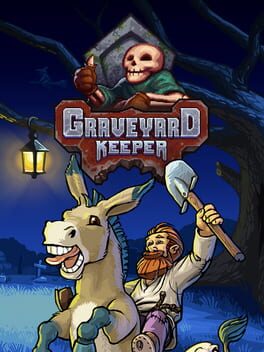
The Cosy Frame Doesn’t Apologise for the Bones
The opening hours of Graveyard Keeper ask the player to drag a body across a damp field by lantern light, and the game treats the dragging with the same patience a farming sim would give to hauling a sack of turnips. The framing is the argument. The player is not invited to flinch. The work is the work, and the game’s interest is in the texture of the work, not in shock. Comfort is a craft choice, not a default. Graveyard Keeper makes that case by holding its register steady whilst its subject would, in less assured hands, slide into either grim performance or nervous comedy.
The white-skull and red-skull quality system is the structural giveaway. A fresh body is graded; the player can improve the grade by removing the worse organs and adding tools and patience, and the cemetery’s rating climbs as the average quality climbs. This is a crop loop. The verbs are not the verbs of horror. The verbs are accumulate, grade, place, complete. The Bishop pays for higher cemetery ratings, which means the loop has the same economic shape as any farming sim’s: do the work, earn the rating, unlock the next tier of materials.
What separates the game from its warmer peers in the genre is the willingness to keep this register without softening either end. The morgue is not gothic decoration; it is a workspace. The graveyard is not haunted scenery; it is an inventory. The kind of design that respects the player’s afternoon does not negotiate with the macabre. It simply holds it.

The Cosy-Management Loop
A day in Graveyard Keeper begins with the donkey at the gate. The cart arrives, a body is delivered, and the player’s morning is structured by whatever that body needs: a stint at the autopsy table, a trip to the church for the Friday service, a few hours at the writing desk to upgrade a sermon, a stop at the stone-cutter for the next headstone. The loop borrows from Stardew Valley in its grammar (collect, process, grade, sleep) and reorganises the nouns. The day cycle is long enough to fit two or three of these tasks before the light goes, which is the correct pace for a game that wants its rhythm to settle.
The craft web is wider than the loop’s surface suggests. Stonecutting feeds carpentry, which feeds church furniture, which feeds the alchemy tree, which feeds the writing system. The relationships are legible without being signposted. The player learns the dependencies by following a single goal back through its prerequisites, and the learning itself is part of the satisfaction. The kind of design that trusts the player to notice the dependency tree is the kind of design that has read its own systems carefully.
The graveyard bell at the start of the church service is the loop’s clearest sonic anchor. The bell rings, the morning’s craft work stops, the player walks to the church, and the social half of the day begins. The transition is small and consistent, and the game uses it the way a farming sim uses sundown: a known boundary, a known prompt, a marker that lets the player release one task and pick up another. The save chime at the end of a session has the same quality. It does not resolve. It simply notes that a day has ended and another is available.
This is the right kind of easy. Difficult enough at the work, generous enough about returning to it.
Gerry the Skull and the Cast
Gerry the Skull sits on a stone in the orchard and offers commentary, and Gerry’s writing is the best argument the game makes for itself outside of its loop. The dialogue is dry, short-clause, and slightly literary. Gerry does not narrate the player’s emotional state. Gerry observes, complains, and occasionally offers a piece of practical advice phrased as an observation. The companion is the quiet kind, which is rarer in the genre than the loud kind, and the rarity is the value.
The supporting cast holds the register. The Bishop is brisk and transactional; Horadric the Innkeeper has a publican’s economy with words; the Inquisitor introduces friction without ever tipping the game into thriller pacing; the Donkey is silent, named, and present, which is the correct treatment for transport that has a personality without a story. A game in this genre often fills its village with talkative archetypes. Graveyard Keeper fills its village with silhouettes, and the silhouettes hold up because each one is drawn in the same dry ink.
The kind of design that earns its companion does not over-write the companion. Gerry is on the stone. Gerry will be there tomorrow.
The Five DLCs Walked Through
The five DLCs are bundled in the current package on every platform, and they layer onto the base loop without correcting it. Each one adds without rewriting.
Stranger Sins (December 2019) introduces the tavern as a social hub and the confession booth as a craft tool. The pacing of NPC relationships shifts: the village conversations have a venue, and the morning loop now ends in the evening with a drink and a confession that feeds back into the church economy. The DLC is the social tier the base game was implying.
Game of Crone (August 2020) brings Clotho, the witch in the dark wood, and the first zombie workers. The flavour darkens slightly toward folklore, and the labour bottleneck of the late game gets its first answer. The new area is small and dense, which is the correct size for the addition.
Better Save Soul (November 2021) is the religious tier-up. Faith mechanics deepen, the Friday sermon becomes a system rather than a beat, and the church loop has somewhere to grow into. For the player who engaged with the service side of the base game, this is the structurally most significant DLC.
Last Journey (February 2023) is the ferryman expansion. A new river-crossing area unlocks late, a narrative layer about passage and obligation runs underneath the new geography, and the game gains its widest map. The pacing of the new area is slower than the base, which is appropriate for what it is saying.
Breaking Dead (May 2024) is the most mechanically interesting. Zombie workers automate sections of the corpse pipeline, the thematic resonance is on the nose, and the writing handles the on-the-nose with the same dry register that carries Gerry. The automation is generous without being silly.
The five DLCs sit on the base game the way a well-organised drawer sits in a kitchen. Everything is where it should be, and nothing is where it does not need to be.

Where the Pacing Earns the Cost (And Where It Doesn’t)
The early-game grind is real, and it is the honest critique of the package. The first several hours ask the player to make repeated runs for materials before the craft tree opens into anything that feels like a system. The cemetery rating climbs slowly. The first upgrades are far apart. The loop’s pleasures are not yet visible.
This is a design choice, not a design failure, and the distinction matters. The game is asking for patience the way a long novel asks for the first hundred pages. The pace is correct at hour ten and rewarding at hour twenty. The cost is paid at hour two, when the player has not yet been shown why the cost is worth paying.
The fix, for the patient player, is to trust the loop. The fix, for the rest, is to know that this is the contract. Graveyard Keeper respects the player’s afternoon once the player has agreed to give it more than one afternoon. The early gate is the toll for the rhythm that follows. It would be a kinder game with a gentler opening, and it would also be a different game, which is not quite the same thing.
Switch 2 vs PC vs PS5, What’s the Best Way to Play in 2026
The Switch backwards-compatible build runs without incident on Switch 2 hardware, and the handheld posture is the right match for the game’s cadence. A graveyard-keeper afternoon sits comfortably in an armchair, the screen close, the cart arriving at the gate, the day cycle short enough to fit a session before dinner. The Switch 2 is the recommendation for the player who wants the game in the cadence the game intends.
PC is the recommendation for the player who wants modded extensions. The community has produced quality-of-life additions that smooth the early gate, and the keyboard-and-mouse handling suits the inventory layer better than a controller does.
PS5 and Xbox Series carry the bundle as the physical option, which matters for the player who wants a shelf copy of a complete game with all five DLCs. The game runs without incident on each of these, which is the correct outcome for a game of this kind.

Final Word
The game ends most days the way it begins: a body at the gate, a chime when the quality is logged, the lantern light settling on the headstones whilst Gerry offers a dry observation from his stone. Eight years on, this is still the cleanest cosy-management loop in its register. The warmth is not despite the bones. It is built from them. There is a path here that rewards returning to, and the cemetery’s rating, slowly climbing, is the quiet record that the player has returned. Graveyard Keeper is the kind of design that trusts the player to find that warm without being told it is warm. That trust is the craft.
8.6
Great
SpawningPoint Verdict
Review summary
Graveyard Keeper, in its 2026 bundle, is the cleanest cosy-management loop in its register, and the five DLCs (Stranger Sins, Game of Crone, Better Save Soul, Last Journey, Breaking Dead) layer onto the base game without correcting it. Lazy Bear Games and tinyBuild have kept the cross-platform versions current, and the £34.99 or $39.99 bundle is one of the most complete packages in the genre at the price. The early-game gate is real, and the patience the game asks for is genuine. Players who give the loop the afternoon it wants will find a game that respects the time it has been given and earns the warmth it holds.


