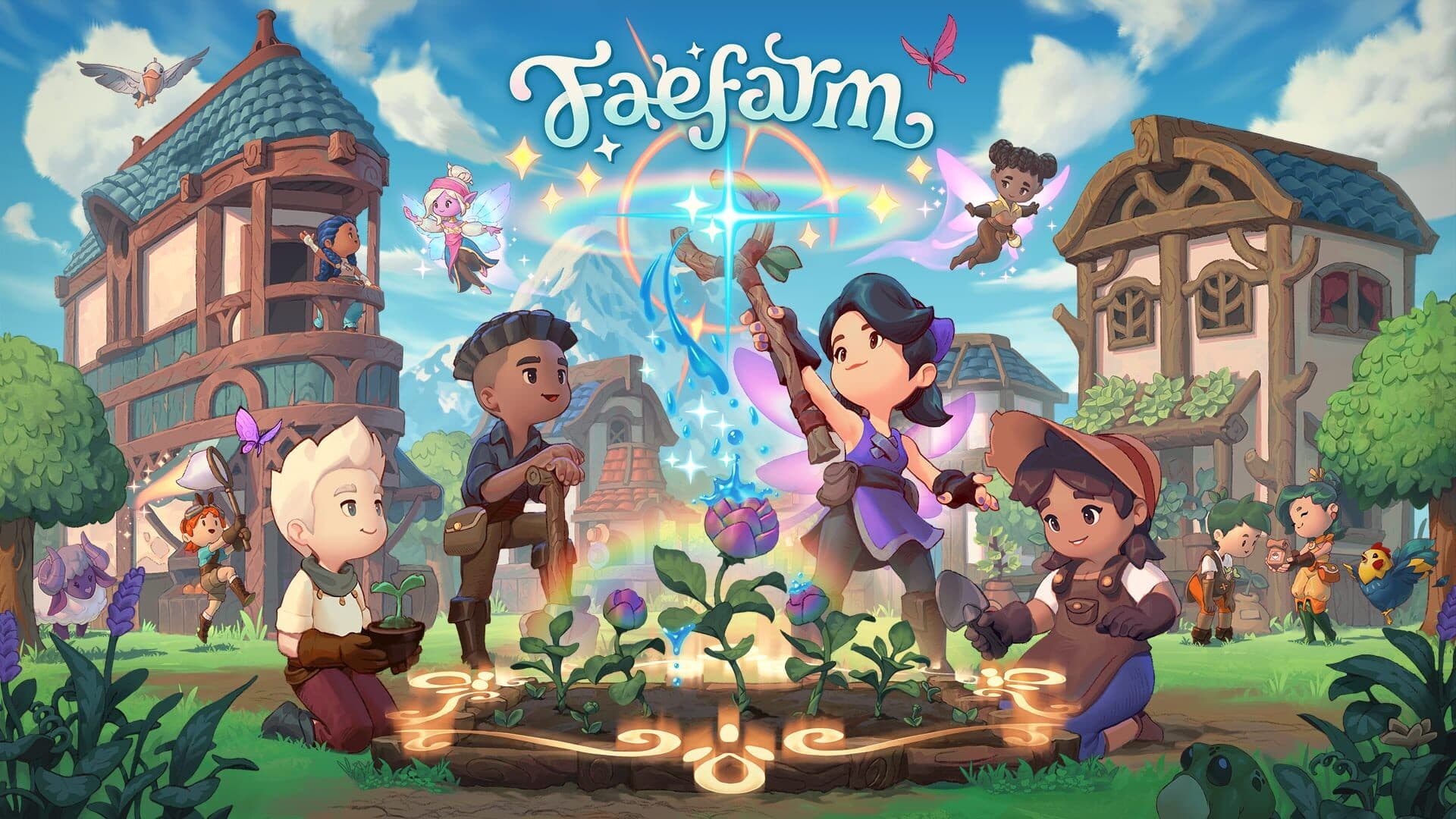
Azoria has a particular quality of early-morning light at the start of the first in-game season, before the first quest log has filled in and before the crop rows are anything other than bare soil, and the game builds a surprising amount of its argument around that quality. The magic layer in Fae Farm is not decoration. It is the reason the farming is worth doing. That is a harder thesis to land than it sounds, and the Switch 2 version, arriving nearly two years after the original release, lands it more cleanly than the 2023 launch build did. The two years matter. The game that exists now is a better answer to the question Phoenix Labs was trying to ask.
Game Snapshot
| Developer | Phoenix Labs |
| Publisher | Phoenix Labs |
| Release | Original: 8 September 2023 (PC/Switch); Switch 2 enhanced: June 2025 |
| Platforms | PC, Nintendo Switch, Nintendo Switch 2 |
| Price | £34.99 | $39.99 |
| Rating | PEGI 7 | ESRB E10+ |
| Genre | Cosy farming-life-sim with magic |
| Length | 30-50h main story/80-100h completionist |
| Install Size | Approx. 3 GB |
Presentation and World Design
Azoria is an island, which is the correct setting for a game asking the player to pay attention to one place for a long time. Islands have edges. They tell you where the world stops, and within those edges the game can accumulate texture without the pressure of infinite expansion. The visual identity here is informed by fae illustration: soft-edged architecture, flora that glows at the margins, seasonal colour shifts that are not subtle but are never quite garish. The biome variety is meaningful. The Fae Realm proper is distinct from the beach districts and the marsh regions in a way that reads as design intent rather than palette-swap; each zone has its own ambient layer, its own soil colour, its own overnight sound.
The art style is quiet in the literary sense: it does not draw attention to itself, and this is the correct choice for a game asking the player to look at small things. The character creation suite is generous by genre standards, covering a wider range of physical types and aesthetic choices than the genre’s standard-bearers. The seasonal transitions are well-timed: early autumn in Azoria looks different from late autumn in a way you notice without being told to notice it.
The Switch 2 visual upgrade is present in the right places. Handheld resolution is cleaner, the loading transitions are shorter, and the frame pacing in handheld mode is consistent in a way the original Switch build was not. The environmental detail in the Fae Realm zones particularly benefits from the cleaner resolution, because those areas ask the player to read small structural clues in the terrain. The game runs without incident in handheld mode, which is the correct outcome for a farming sim whose primary session shape is the late afternoon.

Gameplay and Combat
The farming loop in Fae Farm is structured around a premise that took some time to articulate clearly: magic is not a shortcut for the farming, it is a different register of the same attention. Watering a crop and casting a growth spell are not interchangeable. The spell is faster and costs mana; the manual watering builds stamina and occasionally surfaces a secondary resource. The game is asking which kind of attention the player wants to give to a given morning, not simply how to progress most efficiently. This is a meaningful distinction, and it is the kind of design that separates a cosy game with a design sensibility from one with a cosy aesthetic.
The crafting system is layered without being opaque. Early-game progression through tool upgrades follows a legible arc: gather the material, build the bench, upgrade the tool. The introduction of Fae crafting stations in the mid-game opens a second tier of resource logic without discarding the first. The game is forgiving of early mistakes in allocation, which is the correct posture for a farming sim asking the player to experiment. Crops do not fail catastrophically. A misallocated tool slot is recoverable within a few in-game days.
The combat is light, which is the right level for this genre. The realm corruption mechanic introduces low-threat encounters in the dungeons beneath each biome: wave-clear rooms with straightforward patterns, simple dodge windows, and item drops that feed directly back into the farming and crafting systems. Combat depth is minimal by design. It sits at the level of obstacle rather than challenge, and the obstacle serves a structural purpose: the dungeon resources are the only path to certain mid-game crafting tiers. This is honest design. The game does not pretend the combat is more than a gating layer.
The multiplayer implementation handles the co-op farm premise better than most genre peers. Four-player sessions share a single farm state without the awkward economy splits that plague comparable titles. A guest joining mid-season can contribute meaningfully to existing projects rather than starting a parallel track. This is a small structural decision that turns out to matter across a sixty-hour playthrough.

Story and Characters
The main story arc involves the island’s escalating realm corruption, a handful of fae antagonists with moderately interesting motivations, and a resolution that arrives somewhere between the second and third in-game year. The narrative is adequate. It is not the reason to be here. What the story does correctly is stay out of the way of the life-sim loop during the first season, surfacing quest beats at a cadence that reads as invitation rather than interruption.
The cast of marriage candidates is the more carefully written element. Fae Farm has twelve marriage candidates across gender lines, covering a wider range of personality registers than comparable titles. The relationship-building system is patient: gifting, conversation, and quest completion accumulate across multiple seasons without the sense that a numerical threshold is the only engine. The late-game marriage ceremony integrates into the seasonal calendar in a way that feels like an event rather than a menu option.
The NPC daily schedules give Azoria a quality of being inhabited rather than populated. The individual characters have specific locations at specific times, which means the player’s second-year knowledge of where to find someone at mid-morning feels earned. The fae-folk side characters are less developed than the main romance candidates, but they carry the atmospheric register consistently: they speak in short, slightly formal sentences that suit the setting without requiring the player to read paragraph-length dialogue.
There are limits. The main antagonist’s motivation resolves too cleanly in the final act, and the resolution sequence asks the player to accept a logic the narrative has not quite prepared. The game also introduces a secondary cast member in the third act whose integration into the farm feels underdeveloped. For a forty-hour story, these are not fatal problems. They are the signs of a writing team that was more comfortable with character texture than with structural plotting.

Value and Longevity
At £34.99, Fae Farm is priced correctly for what it offers. The main story arc runs thirty to fifty hours depending on how much secondary content the player pursues; a completionist run targeting all relationships, all dungeon tiers, and all crafting stations extends to eighty to a hundred hours. The game does not inflate its length artificially: the late-game content is substantively different from the early-game loop rather than a numerical extension of it.
Post-launch support has been consistent. The Switch 2 update arrived approximately twenty-one months after the original Switch release and brought the visual and performance improvements alongside a modest content addition to the Fae Realm’s upper tiers. Earlier updates across the life of the original version addressed the pacing issues that early players noted in the second year. The second year is now better structured than it was at launch. This matters because a farming sim’s longevity depends almost entirely on whether the developer continues to find things for the player to do once the primary loop is established.
The multiplayer mode extends the value calculation for players with willing co-op partners. A shared farm across sixty hours is a meaningfully different experience from a solo run, because the resource allocation decisions become collaborative rather than personal. For a game at this price point, the multiplayer provision is well above genre average.
A note on the comparison with our Stardew Valley review 2026: Stardew remains the genre benchmark for mechanical depth, and Fae Farm does not match it there. What Fae Farm does differently is integrate a magic system as a structural design layer rather than a visual garnish, which is a distinct offer. The two games are answering related but not identical questions, and for a player whose interest is specifically in the magical register, Fae Farm earns its price.

Technical Notes
The Switch 2 version runs at a stable frame rate in handheld mode across varied conditions: open-field farming, busy market areas, and the Fae Realm dungeon sections all hold to a consistent pace. The original Switch build had frame-rate inconsistency in the larger biome transitions, which was noticeable when moving between the marsh district and the upper Fae zones. That inconsistency is resolved.
Load times are shorter than the original Switch build by a meaningful margin. The transition from the farm to the dungeon entrance and back again, previously the longest load sequence in the game, now completes in what feels like a brief scene-change rather than a wait. This is a quality-of-life improvement that changes the rhythm of a dungeon-plus-farming session.
The original Switch version remains functional and is still being updated. Players who do not own a Switch 2 are not playing a broken version of the game; the original holds up across its current patch level. The Switch 2 version is a cleaner experience, particularly in handheld mode and in the visually dense Fae Realm zones, but the upgrade is incremental rather than transformative. The game’s design merits apply across both versions. If the Nintendo Switch 2 review prompted the purchase of new hardware, Fae Farm is a game that benefits from it. If not, the original version is not a lesser experience in the ways that matter.
Final Word
Fae Farm on Switch 2 is the version of this game that lands the argument Phoenix Labs was making in 2023. The magic is not decoration. The farming is not padding. The two systems ask for different kinds of attention across the same morning, and the game trusts the player to read that distinction rather than explaining it. The marriage candidate writing is above genre average, the multiplayer structure is better than most comparable titles, and the post-launch commitment has addressed the pacing problems that made the original second year feel thin. The Switch 2 enhancements are meaningful in handheld mode specifically: cleaner resolution, stable performance, shorter load breaks between dungeon runs. The quiet kind of game. The kind that respects the player’s afternoon.
FAQ
Is Fae Farm worth buying in 2026?
Yes, particularly on Switch 2. The game has received consistent post-launch support since its 2023 release, and the current build addresses the second-year pacing issues that were the most common criticism of the original version. At £34.99 with thirty to one hundred hours of content and a strong multiplayer mode, it is well-priced for the experience it offers. The magic-plus-farming integration is the genre's most structurally honest treatment of that combination, and that distinction holds up across nearly three years of genre competition.
How does Fae Farm compare to Stardew Valley?
They are different answers to a related question. Stardew Valley is the genre benchmark for mechanical depth and narrative texture built from player-authored moments; Fae Farm integrates a magic system as a structural design layer that changes how the farming feels rather than adding a visual garnish on top of it. Our [Stardew Valley review 2026](https://spawningpoint.com/stardew-valley-review-2026/) covers that game's current state in detail. Players whose primary interest is magical world-building will find Fae Farm the more purposeful choice; players who want the genre's deepest mechanical loop will find Stardew the more rewarding one. There is room for both saves.
What is the difference between the Switch 2 and the original Switch version?
The Switch 2 version runs at a stable frame rate in handheld mode across all biomes, with noticeably shorter load transitions between the farm and dungeon areas. The visual resolution in the Fae Realm zones is cleaner. The original Switch version remains functional and fully patched; the upgrade is meaningful in handheld mode specifically rather than transformative across the whole experience. A player without Switch 2 hardware is not missing the game. See also our [Nintendo Switch 2 review](https://spawningpoint.com/nintendo-switch-2-review-a-hybrid-that-finally-grew-up/) for the platform context.
How does the multiplayer work, and is it worth it?
Up to four players share a single farm state across co-op sessions. Guests joining mid-season can contribute to existing crop rows and crafting projects rather than running a parallel economy. Resource allocation decisions become collaborative, which changes the character of a sixty-hour playthrough significantly. It is the strongest co-op farming implementation in the genre at this price point. An experience worth having if you have willing players; the solo game is complete without it.
How long is Fae Farm?
The main story arc, covering the realm corruption resolution and primary NPC relationship threads, runs approximately thirty to fifty hours at a natural pace. A completionist run targeting all twelve marriage candidates, all dungeon tier completions, and the full crafting station roster extends to eighty to one hundred hours. The game does not inflate late-game length numerically: the second and third years introduce substantively new content rather than repeating the first year's loop at higher resource costs.
8.0
Great
SpawningPoint Verdict
Review summary
Azoria has a particular quality of early-morning light at the start of the first in-game season, before the first quest log has filled in and before the crop rows are anything other than bare soil, and the game builds a surprising amount of its argument around that quality.