REVIEW
Asus ROG Zephyrus G14 Portable Laptop Review 2026
The ASUS ROG Zephyrus G14 2026 weighs 1.5 kg with a 73 Wh battery and RTX 5060 to 5080 options. This review judges it on battery honesty, fan pitch, and whether it earns one-device carry status.

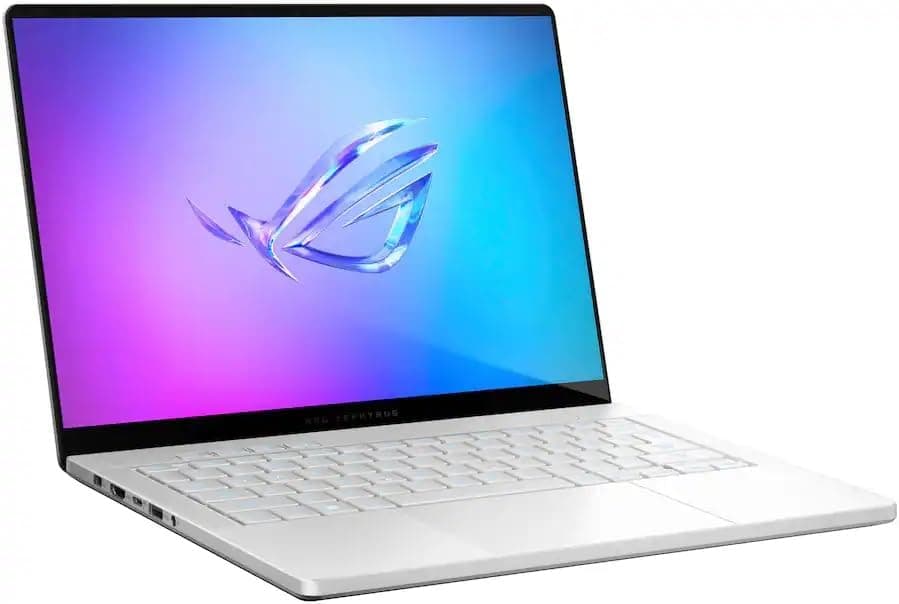
The useful question for a 14-inch gaming laptop is not whether it can replace a desktop. The Asus ROG Zephyrus G14 has to earn a different contract: bag weight, fan pitch, battery honesty, and a session that can start away from a wall socket. That is the frame for this Rog Zephyrus G14 review 2026. The published spec gives a starting point: 1.5 kg and a 73 Wh battery across the 2026 lineup. What matters is the shape of the test. A portable laptop should handle the two-way rail journey, a desk session, and a sofa session without turning every game into a power-management job.
Game Snapshot
| Manufacturer | Asus ROG |
| Model | Zephyrus G14 (2026, GA403 AMD/GU405 Intel variants) |
| Category | Portable gaming laptop |
| CPU | AMD Ryzen AI 9 465 (GA403) or Intel Core Ultra 9 386H (GU405) |
| GPU | NVIDIA GeForce RTX 5060 to RTX 5080 (varies by configuration) |
| Display | 14-inch 3K OLED, up to 1100 nits (Nebula HDR) |
| Battery | 73 Wh |
| Weight | Approximately 1.5 kg |
| Platforms | Windows portable gaming laptop |
| Price | Check price on Amazon |
| Rating | Not applicable (hardware) |
| Release Date | January 2026 (GA403); early 2026 (GU405) |
Build Quality and Design
At 1.5 kg, the G14 sits at the lighter end of the 14-inch gaming laptop category. That number matters because it is not carried alone. Add the charger, a controller, and external storage, and the bag cost still moves closer to carry viability than a heavier gaming machine. The question is whether the chassis holds up: lid stiffness, hinge stability, keyboard deck behaviour under a sustained load, and surface temperature after forty-five minutes.
The design question is restraint. The vent placement, rear-edge heat routing, and trackpad behaviour all matter because this is a lap device before it is a benchmark device. If the rear edge pushes heat into the screen hinge area, that changes how long the laptop remains comfortable on a sofa. If the keyboard deck stays steady under load, the device earns more than its thinness. The same rule shaped the Samsung T9 Portable SSD tested: portable gear has to earn its carried weight, not just its desk performance.

Performance and Software
The G14’s GPU range spans RTX 5060 to RTX 5080 depending on configuration, with the RTX 5080 variant carrying a 130W TGP. The useful result for carry purposes is not the highest uncapped number at the wall socket. It is the setting that holds a stable cap while keeping fan pitch in a fan note you register without it pulling focus. That is where portable pc review work differs from desktop testing.
In Armoury Crate, start with `Operating Mode > Silent` for battery sessions, then set Windows `Settings > System > Power & battery > Power mode` to `Best power efficiency`. For a plugged-in desk session, switch to `Operating Mode > Performance` and cap the game manually rather than leaving it uncapped. The simple metric is already useful: do not let a 14-inch chassis spend battery and heat on frames the panel and session do not need.
Software friction also counts. Windows gives the G14 a wider PC library than a Steam Deck OLED, but it also brings launcher updates, sleep behaviour, and audio routing into the review. The comparison with the Razer Blade 16 vs ASUS piece is the useful one: larger laptops can spend more heat to solve the same problem. The G14 has to solve it inside a smaller thermal envelope.

Daily-Use Experience
Battery life is the point where the G14 either becomes portable or becomes a small desktop with a hinge. The 73 Wh cell is a real capacity for this class, but the gaming figure depends on the profile and the title. The realistic measure needs three readings: light indie play, a capped modern game, and a heavier GPU load. Each maps to a different session. The light setting should cover a working day’s intermittent use. The capped modern setting should span a full commute and the return leg on a single charge. The heavy setting only has to justify itself when a socket is nearby.
The display also needs a travel test. A panel that reads clearly at a desk can still lose contrast beside a train window, especially when brightness management is doing the work. If the G14 is going to sit beside our Best Portable Monitor for Steam feature as portable kit, the panel has to be legible without pushing brightness so high that battery life collapses.
Docking and accessories are the quiet part of daily use. A small laptop often reduces the need for a dock, but a controller, SSD, and compact charger still decide whether the setup travels cleanly. Our Best ROG Ally X Accessories review is the same logic applied to a handheld: the useful accessory is the one that removes friction from the session rather than adding another thing to manage.

Value and Verdict
The Rog Zephyrus G14 worth it question turns on price relative to the confirmed carry performance. At £2,899 to £3,699 for the GU405 Intel variant in the UK, the G14 has to beat cheaper handheld-and-monitor combinations on more than raw performance. A lower-specced GA403 AMD configuration brings the entry price down while keeping the 1.5 kg chassis and 73 Wh battery. At that price range, the G14 becomes easier to recommend as the one portable PC that can write, browse, dock, and play without asking the buyer to carry two devices.
The honest verdict is conditional. If the tested battery figure spans a full commute and the return leg on a single charge at a sensible cap, the G14 earns its place in our Best Portable Gaming Laptop feature. If it only performs well plugged in, it belongs to a different reader. Raw laptop performance favours the G14. Commute reliability still has to be proved by the battery, thermals, and sleep behaviour against the retail unit.
Final Word
The G14 is strongest as an argument for one portable computer rather than a stack of smaller devices. At 1.5 kg with a 73 Wh battery, the published spec is competitive for the category. That argument holds if the gaming battery reading is honest and the fan curve stays civil under a capped game load. A thin chassis can win a desk test and lose the train test. Decision rule: if you want one Windows machine for work, travel, and capped PC gaming, the G14 is the right answer if the battery clears the commute test; if gaming away from power is the main use, a handheld remains the stricter device.