RETROSPECTIVE
Story of Seasons a Wonderful Life Retrospective
Story of Seasons: A Wonderful Life remains strange in a way that time has not smoothed away. It is slower, plainer, and more committed to consequence than many games that arrived after it. The valley matters because the player returns to it, and because returning changes what the same place means.

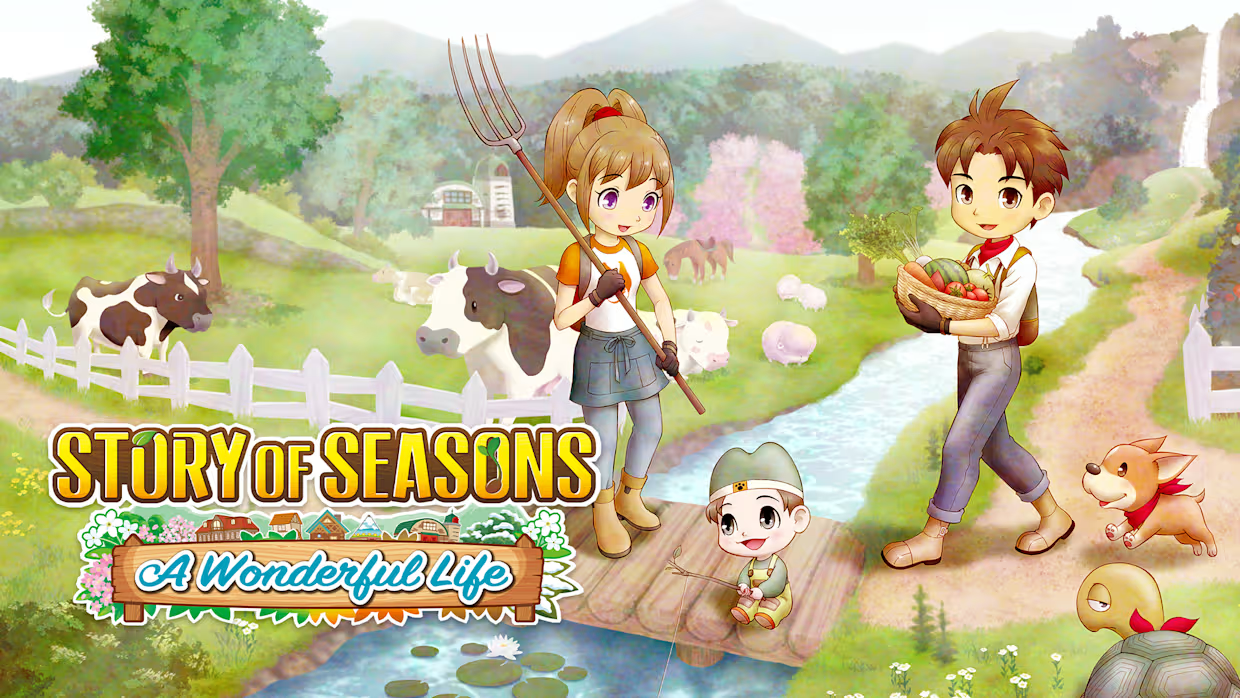
The path from the farmhouse to the river becomes familiar before it becomes useful. This is a game about time becoming visible. Story of Seasons: A Wonderful Life does not treat the farm as an efficiency puzzle, even when fields, animals, tools, and shipping box suggest that shape. It is interested in repetition as record: same morning walk, same doorway, same people ageing around the same village. For a story of seasons a wonderful life review in 2026, the question is not whether the remake feels old. It is whether its old-fashioned structure still earns its patience.
Game Snapshot
| Developer | Marvelous Inc. |
| Publisher | Marvelous (XSEED Games) |
| Release Date | 27 June 2023 |
| Price | Check price on Amazon |
| Rating | E (Everyone)/PEGI 3 |
| Genre | Farming life-sim |
| Length | Varies |
| Install Size | Varies by platform |
Presentation and World Design
Forgotten Valley is small in the correct way. The lanes do not offer much distance, but they offer return: the same bridge, the same bend by the water, the same houses set away from the path. The world does not need to be large because its argument is domestic.
The remake gives the valley a softened, rounded look, which can flatten some stranger texture. Even so, the best moments are plain and specific. Morning light catches on the field before the day has asked anything serious. The river sits beside the farm like a second clock, present enough to mark routine without becoming an activity list.
Compared with our Cattails Wildwood Story review, this is less interested in making a home through expansion. It asks whether staying in one place changes the place. That is a narrower claim, and a better one for this valley.

Gameplay and Combat
There is no combat here, and the absence matters because the game has other ways to structure attention. The player farms, fishes, digs, cooks, gives gifts, and learns where the day wants to fold. None of those actions is complicated alone. Their force comes from recurrence, which asks whether ordinary care can hold shape.
The farming loop is slower than many later life-sims. Crops do not exist only to accelerate money. Animals need a kind of regular attention that can feel almost ceremonial: the brush, the feed, the milk, the small pause before the next task. When the loop works, it respects the player’s afternoon. Two or three meaningful things fit inside a morning without the light feeling like a deadline.
The limitation is that some systems remain too opaque for their own quietness. Animal breeding, crop improvement, and certain gift routines can feel like knowledge the game expects the player to inherit rather than learn. That produces friction of a particular kind: not difficult work, but work without enough textual grace.
The comparison with our full Moonstone Island review is useful because both games care about ritual. Moonstone Island spreads attention across travel and collection. A Wonderful Life concentrates it until repetition becomes the subject. The loop is slow. That is the point.
Story of Seasons a Wonderful Life Retrospective
7.6/10
Buy on Amazon
Price and availability from Amazon
Story and Characters
The story is not the dialogue. It is the way the village moves through years. A Wonderful Life has one of the genre’s clearer structural ideas: the player marries, raises a child, ages alongside the valley, and watches a life-sim become a life story by accumulation.
That idea remains strong because it resists the usual comfort of endless reset. Seasons pass and do not fully return. People change by degrees. The child’s room becomes an argument about influence, inheritance, and routine. The game does not always write those pressures with delicacy, but it knows family should be more than a decorative endpoint.
This is where it sits close to our full Tiny Bookshop review: both games care about reading people through habits rather than speeches. It is also where our Wytchwood review makes a useful contrast. Wytchwood sharpens its folk-tale bite. A Wonderful Life lets the edge arrive quietly, after another year has gone.

Value and Longevity
The value here depends on whether the player wants accumulation or novelty. A Wonderful Life is not lavish with systems. It does not keep unfolding whenever older tasks settle. Instead, it asks the same field, family, and village to carry more meaning.
That makes it less generous in a content-counting sense than some newer life-sims, but more particular in its long stay. The player who wants constant expansion may find the later chapters too bare. The player who wants a game to mark the difference between a first spring and a later one will find the structure honest.
Our full Strange Horticulture review praised a game for trusting small acts to hold weight. A Wonderful Life asks for the same trust across years.
Technical Notes
Performance, install size, and patch state require confirmation. In play terms, the main technical question is whether the remake preserves routine continuity: quick loading into daily spaces, reliable saving, clear UI text, and an audio mix that lets the valley stay quiet without becoming empty. Nothing here needs spectacle. It needs not to interrupt the morning.
Final Word
Story of Seasons: A Wonderful Life remains strange in a way that time has not smoothed away. It is slower, plainer, and more committed to consequence than many games that arrived after it. Some systems feel like old furniture: useful, familiar, awkward in the room. But the central design claim still holds. The valley matters because the player returns to it, and because returning changes what the same place means. The path from the farmhouse to the river is the game keeping a record of attention.
Is it worth it in 2026?
It is worth it for players who want a life-sim about ageing, family, and repeated routines rather than constant expansion. The structure is slower and narrower than many modern farming games, which is not a flaw by itself. The scrutiny falls upon whether the player wants a game that lets ordinary time become the point.
Is it good for short sessions?
The day structure fits inside short sessions when the player accepts its pace. A morning of animal care, field work, and one village visit can feel complete without turning the session into a checklist. Longer sessions work too, but the game is often better when it is allowed to settle and then be put down.
Does it have combat?
Combat is not part of the design, which leaves the daily loop to carry the whole experience. The pressure comes from care, money, relationships, seasonal change, and knowledge that time is moving. That absence is one reason the game's best ideas are visible. It has nowhere else to hide them.
How does the remake compare with the original?
The remake gives the valley a softened, rounded look, which can flatten some stranger texture. The core structure remains the same: the player marries, raises a child, ages alongside the valley, and watches a life-sim become a life story by accumulation. The scrutiny falls upon whether the player wants a game that lets ordinary time become the point.
Is the game too slow?
The loop is slow. That is the point. A Wonderful Life is not lavish with systems. It does not keep unfolding whenever older tasks settle. Instead, it asks the same field, family, and village to carry more meaning. The player who wants constant expansion may find the later chapters too bare. The player who wants a game to mark the difference between a first spring and a later one will find the structure honest.