Where Chapter 3 staged its tension in a TV studio dark world governed by a character who understood he was losing his audience, Chapter 4 removes the intermediary entirely: the horror in this chapter is Kris themselves, and the game has been building that argument across three previous chapters without announcing it. Buy Deltarune on Amazon. The bullet-board reworks introduced here are the most mechanically demanding sequences in the series, and they earn that demand because the encounter architecture finally turns the teaching contract back on the player rather than forward through it.
Game Snapshot
Developer: Toby Fox/8-4
Publisher: Toby Fox
Release Date: 4 June 2025
Platforms: PC (Windows, macOS), Nintendo Switch, Nintendo Switch 2, PlayStation 4, PlayStation 5, Xbox
Price: Free with Chapters 1+2+3 bundle (£19.99/$24.99)
Rating: PEGI 7/ESRB E10+
Genre: Turn-based RPG/Narrative
Length: 4-7 hours main story; 10-14 hours completionist
Install Size: ~5 GB (full four-chapter bundle)
Presentation and World Design
The new dark world in Chapter 4 does not name itself in the first hour, which is not an oversight but a design decision: the game withholds the landmark vocabulary it has been building across the series because the geography here is not a location the party enters but a condition they discover themselves already inside. The architecture reads as a library before it reads as a threat, labyrinthine shelving visible at the periphery, catalogued but not legible, and the NPCs repeat fragments of dialogue that reference conversations the player has not had. That is not broken writing; it is the tonal register the chapter is working in from the first corridor.
The audio does the structural work Chapter 3’s audio did for Tenna’s breakdown, but here the compression runs in the opposite direction. Where Chapter 3 used dynamic layering to track a character’s deterioration, Chapter 4’s score grows more precisely composed as the narrative register tightens: the chapter’s quietest musical moment arrives in the encounter sequence that carries the most weight, and Toby Fox stages that silence as information rather than absence. The moment the ambient layers drop entirely is the moment the game is asking the player a question that the encounter design has been constructing toward for the full runtime.
Named landmarks in the dark world, once they resolve from the early ambiguity, are staged as orientation points that the encounter design then systematically removes from function. A landmark the player uses to navigate the first third of the chapter becomes inaccessible in the second third, and the geography does not explain the change. That is load-bearing design rather than decorative world-building: the inaccessibility is the argument.

Gameplay and Combat
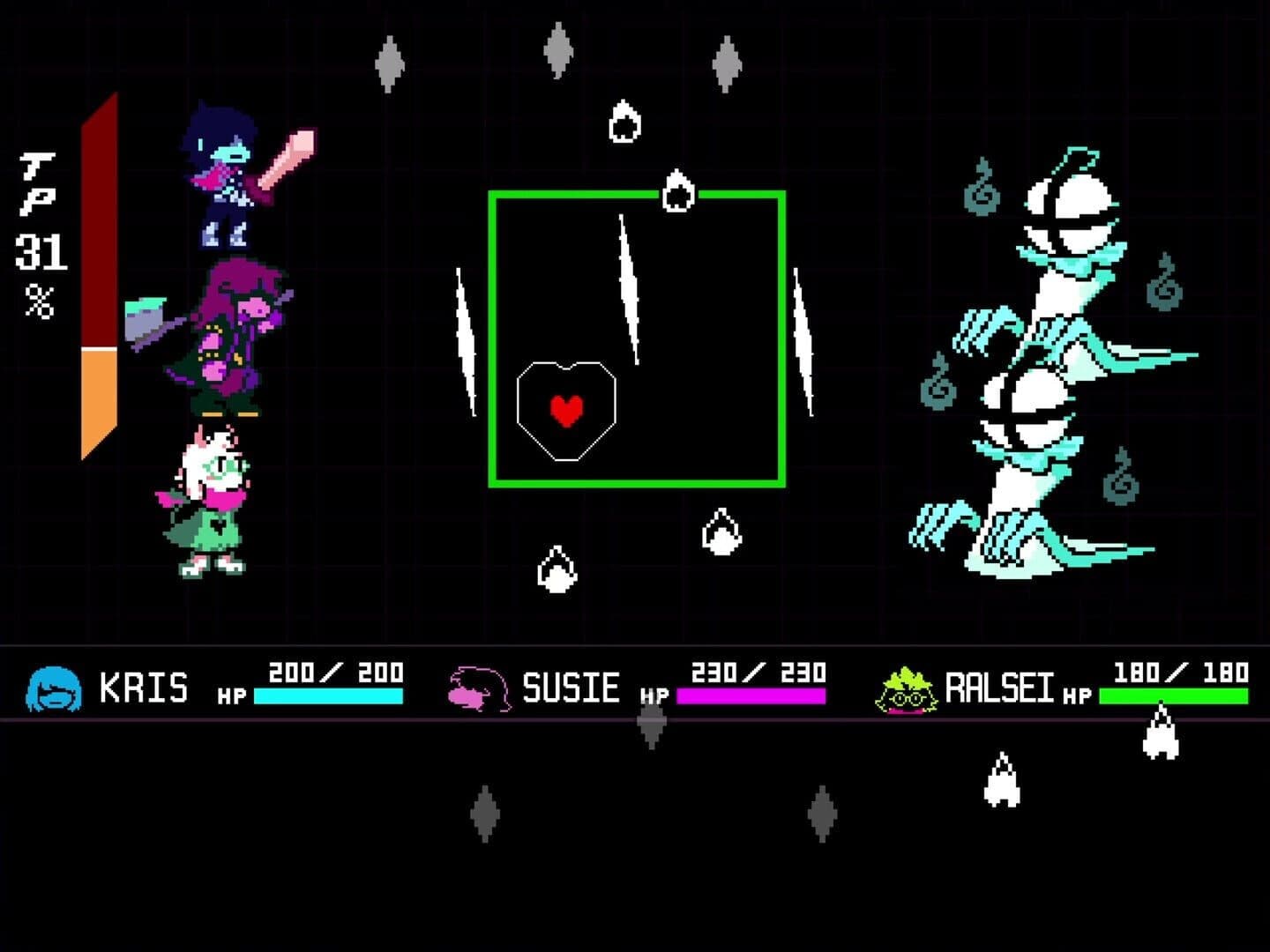
The bullet-board reworks are the chapter’s mechanical centrepiece, and they operate on a different logic than what Chapter 3’s Tenna encounter established. Tenna’s board manipulation was a test of learned vocabulary over instinctive visual response; the new board mechanics in Chapter 4 introduce what can only be described as a split-attentional requirement, where the player’s SOUL and the bullet field are operating in partially overlapping spatial registers. The board itself does not deceive here. The player’s own positioning within it does.
The major encounter sequences stage this through escalating ACT-and-FIGHT parity. The chapter’s primary boss fight, which the game does not name until its second phase, opens in a register the player will recognise from the series’ earlier pacifist economy, then reveals that the recognition was the trap: the ACT tree that appeared to resolve the encounter turns out to have been the escalation trigger. That is the chapter’s most precise design decision, and the moment it lands, the entire first act of the fight recontextualises itself as preparation rather than conclusion. The teaching contract holds: nothing in the second phase is introduced without a first-phase equivalent. The recontextualisation is the lesson.
Weird route mechanics in Chapter 4 are the most consequential in the series. A player carrying weird route state from Chapters 1 and 2 will encounter altered ACT options at specific intervals, one of which produces a combat resolution sequence that the normal route does not contain. The weird route does not produce an easier or harder encounter architecture; it produces a different encounter that stages the same structural argument through a different trajectory. Noelle’s presence in the weird route’s closing sequence is the chapter’s most precise narrative-through-mechanics delivery, and the game earns it by spending the previous three chapters constructing the specific cost she represents.
For minor enemies, the ACT economy continues the Chapter 3 pattern: some encounters resolve in a single action, others require escalating sequences. Chapter 4 narrows this gap relative to Chapter 3 by seeding two minor-encounter ACT trees that require multi-stage completion. The pacing benefit is direct: the gap between the teaching quality of the major encounters and the minor encounters is smaller here than in any previous chapter.

Story and Characters
The Knight identity question is not resolved in Chapter 4, and the chapter’s handling of that non-resolution is its most architecturally interesting narrative decision. What the chapter provides instead is a spatial argument: the Knight is seen in a context that eliminates three of the five plausible identity candidates from structural consideration, not through dialogue or revelation, but through the geometry of where they are and where they are not when a specific event occurs. A player who has been paying attention to the series’ spatial storytelling will understand what has been established. A player who has not will find the chapter’s close ambiguous in a way that is entirely intentional.
Kris and Susie’s dynamic carries more load in Chapter 4 than in previous chapters, partly because Ralsei’s role is redistributed: he is present for fewer encounter sequences in the chapter’s second half, and his absence is staged as a design choice rather than a structural gap. Susie’s ACT interactions with the chapter’s primary encounter carry the comic-to-serious tonal register the series has always run but at a sharper gradient here, and the specific line she delivers in the encounter’s second phase is the clearest instance in the series of Toby Fox routing character definition through combat mechanics rather than cutscene.
Noelle’s appearance in the weird route’s closing sequence has been discussed. The normal route equivalent stages the same thematic territory through Ralsei’s behaviour in the library dark world’s final corridor, where a character who has been the party’s consistent emotional anchor behaves in a way that the encounter architecture has been preparing the player to find legible rather than alarming. That the normal-route player may not find it alarming is itself the argument. The chapter says something structural about proximity and recognition without declaring what either means: the same method as Chapter 3’s shelter door, applied at greater depth.
Value and Longevity
Chapter 4 is included in the same £19.99/$24.99 four-chapter bundle as Chapter 3, and the value case remains what it was in the sister review: the two chapters together represent a substantial narrative and mechanical sequence for the price, with future additions confirmed as free updates to the same purchase. The four-chapter bundle is available on Amazon. For a reference point on what narrative RPG depth looks like at different price tiers, our Elden Ring 2026 review covers the upper end of the genre’s value spectrum; Chapter 4 holds its position at the lower end through density rather than length.
Chapter 4 is shorter than Chapter 3 in main-story terms, running 4-7 hours against Chapter 3’s 5-8. The weird route extension is more substantial here in absolute terms: players carrying weird route state will find that the closing sequence adds roughly two hours of encounter content the normal route does not contain. Completionist play that includes all ACT trees and the chapter’s two discoverable bonus sequences runs closer to 10-14 hours across Chapters 3 and 4 combined, which is the framing Toby Fox’s bundled release structure invites. For a longer comparative treatment of bundled chapter-release economics in narrative RPGs, see our Baldur’s Gate 3 versus Divinity Original Sin 2 breakdown.
Replayability is, as with Chapter 3, meaningful rather than incidental. The encounter whose first phase recontextualises as preparation plays differently on a second pass: the player reads the ACT escalation correctly from the first choice and the chapter’s teaching architecture becomes visible as structure rather than surprise.
Technical Notes
Chapter 4 inherits the RPG Maker MV infrastructure of the series and performs without reported issues across platforms. The bullet-board sequences that introduce the split-attentional mechanic are the most visually complex the engine has been asked to render in the series, and frame rate holds consistently across PC, Switch, and PS5 builds in those sequences. No post-launch patches have been required for the chapter’s technical performance.
The Windows and macOS builds behave as expected at the engine’s standard resolution. The Switch 2 build carries the cross-buy arrangement confirmed at launch, and the PS5 version continues to support save-file import from PS4. Install size for the full four-chapter bundle is approximately 5 GB, which remains compact relative to the content depth. No platform-specific performance discrepancies have been reported across the chapter’s full encounter set.
Final Word
The encounter whose first phase teaches ACT-as-preparation, then reveals that preparation in the second phase, is the clearest test case for what Deltarune Chapter 4 is doing. It is the same structural argument as the Tenna fight in Chapter 3, applied to a subject the series has been approaching for four chapters without naming: the relationship between player control and character agency, staged as a combat encounter rather than as dialogue. Nothing in the chapter’s close resolves cleanly. The Knight remains unidentified; Kris remains ambiguous; the library dark world’s inaccessible landmarks remain unexplained. That is not withholding for its own sake. The game has spent four chapters constructing a vocabulary for what that ambiguity means, and Chapter 4 is where the vocabulary arrives as the argument. Recommended for players who have completed Chapters 1 through 3 and want to understand what the series has been building toward structurally; the weird route is worth carrying if you carried it through Chapter 2, and the chapter earns the cost it asks for.
FAQ
Is Deltarune Chapter 4 worth playing?
Yes, particularly for players who have completed the preceding three chapters. Chapter 4 delivers the series’ most mechanically demanding bullet-board sequences in a primary encounter whose first phase recontextualises as preparation rather than resolution, a spatial argument about Knight identity that eliminates possibilities without confirming them, and a weird route closing sequence that stages its consequence through character and encounter rather than through narrative summary. At £19.99/$24.99 for the full four-chapter bundle with future additions confirmed free, the value case is stronger than Chapter 4 alone makes it.
How long is Deltarune Chapter 4?
The main story runs 4-7 hours depending on combat approach and ACT exploration. Players carrying weird route state from Chapters 1 and 2 will find the closing sequence adds roughly two hours of encounter content the normal route does not contain. Completionist play including all ACT trees and both bonus sequences runs closer to 10-14 hours across Chapters 3 and 4 combined. Chapter 4 is shorter than Chapter 3 in isolation; assessed alongside it as a paired release, the runtime is appropriate to what the chapter is doing.
How does Deltarune Chapter 4 compare to Chapter 3?
Chapter 3 is the more immediately satisfying chapter: the Tenna encounter is a cleaner piece of encounter design, and the chapter's tonal escalation from studio comedy to horror is more legible on a single pass. Chapter 4 is the more architecturally complex chapter: the primary encounter's ACT-as-escalation structure and the Knight spatial argument both reward second-pass engagement in ways Chapter 3 does not require. Chapter 3 is the better standalone chapter. Chapter 4 is the better conclusion to what the paid bundle is building toward.
Do I need to play Undertale before Deltarune Chapter 4?
Undertale is not a prerequisite for the mechanics or story. Chapter 4's encounter design is self-contained and its narrative operates on Deltarune's own terms. Players with Undertale context will recognise tonal and structural callbacks in how the game handles consequence and the treatment of specific characters, but those callbacks function as layers rather than foundations. A player new to both games should begin with Deltarune Chapter 1, which is available free.
What is the weird route in Deltarune Chapter 4?
The weird route is the moral-consequence path available to players who used the Snowgrave ability in Chapter 2. In Chapter 4, carrying that state unlocks altered ACT options at specific intervals and a closing encounter sequence that the normal route does not contain. Noelle's role in that sequence is the chapter's most structurally consequential weird route content in the series. The encounter architecture does not change between routes; the trajectory through it does, and the weird route earns its cost by staging the consequence through character behaviour rather than through summary.