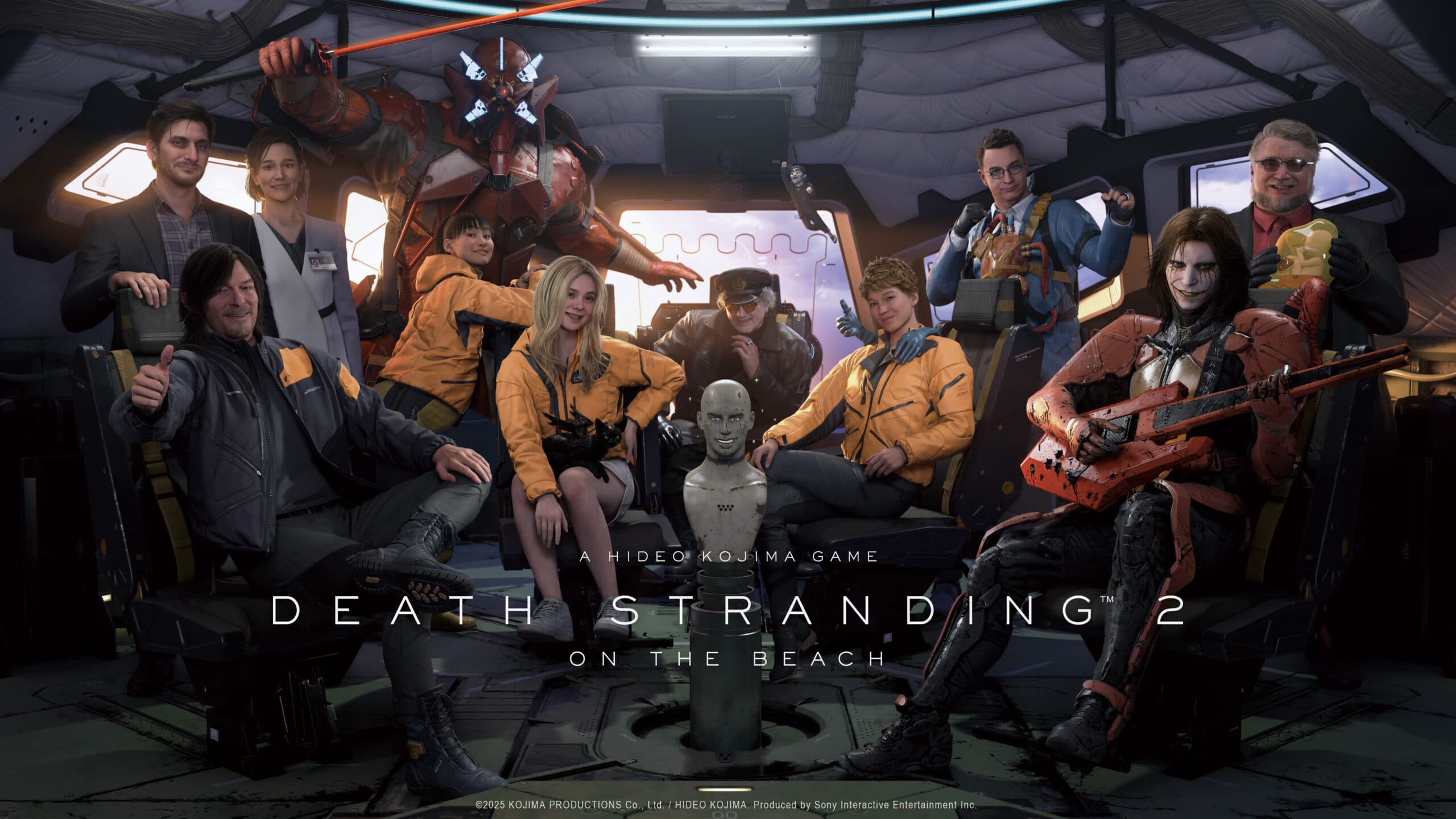
The second album is the hardest thing in any creative career, and the lineage call for Death Stranding 2: On the Beach has been forming since the moment Death Stranding 2 review discourse began accumulating ahead of the 26 June 2025 launch. Kojima Productions spent five and a half years after its 2019 debut deciding what it understood about its own design grammar, and that interval of reckoning is visible in every significant decision the sequel makes: which systems it deepens, which it trims, which lineage threads it picks up and finally pulls through to a clean resolution. The 2019 game divided an entire console generation on the question of whether porter-logistics movement could function as narrative architecture. The 2025 game answers that question with the authority of a studio that now knows exactly what it built and, more usefully, what it was trying to build. What follows is a review grounded in that lineage.
Game Snapshot
| Developer / Publisher | Kojima Productions/Sony Interactive Entertainment |
| Release Date | 26 June 2025 (PS5; PS5 Pro Enhanced day one) |
| Platforms | PS5 (PC expected 2026) |
| Price | £69.99 | $69.99 Standard, up to £179.99 | $199.99 Collector’s |
| Rating | PEGI 18 | ESRB M |
| Genre | Action/porter-logistics open-world |
| Length | 40-50 hours main, ~80 hours main + side |
| Install Size | ~80 GB |
Presentation: Decima at Its Third Iteration
The Decima Engine has an unusual biography in Kojima Productions’ hands. Guerrilla Games built it for Horizon Zero Dawn, refined it for Horizon Forbidden West, and licenced it to Kojima Productions in 2016, when the newly independent studio was assembling its first production pipeline from scratch. The 2019 Death Stranding was the first Decima game outside Guerrilla’s own catalogue, and its North American snowscape palette, its long grey light spilling across mountain passes and crater lakes, was the immediate evidence that Kojima’s team had understood what the engine could do with precipitation and terrain geometry. The decision to set Death Stranding 2 across Mexico and Australia carries the DNA of that original visual identity while making a clean structural argument: the world after the Death Stranding event is not only North America, and the Decima engine in its 2025 iteration is equipped to prove it.
Australia’s coastline and desert scrubland give the lighting engine a different assignment entirely: harsh noon light instead of oceanic grey overcast, red-orange ground that reads against the BT ecology in ways that make encounters feel spatially different from anything in the first game. Mexico’s highland plateaus bring a vertical drama to cargo traversal that the North American chapters never had. The character animation work on Sam Porter Bridges and the returning cast has moved substantially from the 2019 baseline: facial capture has more resolution, and the specific Decima-engine quality of skin and cloth interaction in direct sunlight is visibly more sophisticated than the snow-filtered rendering conditions the 2019 team was working with. The weather system, which in 2019 was primarily a threat mechanism that accelerated BT encounter probability, has expanded into a layered atmospheric simulation that affects both the environmental lighting and cargo physics in ways that make rain, wind, and temperature feel consequential at the design level rather than cosmetic.
This is Decima at its third iteration in Kojima Productions’ hands, and the visual confidence is earned rather than assumed. The engine lineage connects 2019 to 2025 as visibly as the porter-logistics design grammar does.

Sam Bridges and the Second-Album Voice Problem
The publishing window that brought Death Stranding 2 to market in June 2025 also brought a narrative challenge that the 2019 game never had to solve: Sam Porter Bridges is no longer a stranger. Norman Reedus played him as a reluctant, largely silent presence in 2019, a figure defined more by movement than by speech, more by cargo than by conversation. Five years is a long interval in a fictional timeline as compressed as Death Stranding’s, and the decision Kojima Productions made, to let Sam be older and less mute, to let Reedus deliver a performance with more register and more legibility, carries the DNA of the sequel’s overall argument about second-album problem-solving. The first album needed Sam to be withholding because the world was unknowable; the second album needs him to be present because the world, and the audience, already knows the basic shape of what he carries.
The narrative compression is the most significant structural change from the 2019 game, and the lineage call here is precise: Death Stranding 2019 had a thirty-hour stretch in its second act that functioned as an endurance test, a design that was partly intentional and partly a consequence of the studio’s first open-world production cycle. The 2025 game cuts that stretch without cutting the pacing philosophy that produced it. The Magellan, the world-spanning organisation Sam navigates in the sequel, is a narrative accelerant that the original’s BRIDGES structure never provided, giving the story cleaner chapter boundaries and a clearer sense of where each delivery sequence is building toward. Sam’s relationship with the Magellan and the characters within it gives Reedus more to work against scene by scene, and the result is a protagonist who carries the DNA of the 2019 version while resolving the silence problem that made him occasionally opaque.
The second-album voice problem has a genuine solution here. That it took the full publishing window interval to arrive at it is precisely what makes it legible as a solution rather than a patch.

The Porter-Logistics Design Grammar, Expanded
The lineage call at the centre of any Death Stranding 2 review is the porter-logistics design grammar itself, because the sequel’s entire argument stands or falls on what Kojima Productions decided to do with the movement system that divided the 2019 audience so cleanly. The original game’s central design achievement, that cargo balancing and terrain reading could be the primary mechanical language of an open-world game, was also its primary liability: players who found the movement system meditative found the whole game; players who found it repetitive found nothing else to fall back on. The 2025 game’s answer to that structural problem is not to abandon the design grammar but to deepen it at every load-bearing point.
Cargo balancing returns as the fundamental vocabulary, but the terrain it operates across is more varied in its demands. Mexico’s highland plateaus require approach angles that the flat North American steppeland never generated; Australia’s coastal rock formations introduce surface instability that interacts with wind and precipitation in ways that make the physics simulation feel less like a puzzle box and more like a genuine material environment. The terrain-reading skill that the 2019 game taught slowly, through repetition and failure, carries the DNA forward while assuming a player who has done the reading once and is now being asked to apply it in different conditions. This is the correct second-album move: not the same test again, but the same skill at higher resolution.
The expanded combat tools are the most visible publishing-window addition. Firearms play a larger role than in 2019, where ranged combat was available but clearly secondary to avoidance. The new sword carries the DNA of the BT encounter design from the original while introducing a timing-based engagement that rewards spatial awareness without replacing the fundamental logic of the porter as someone who would rather deliver than fight. The expanded BT encounter variety, which includes BT forms the 2019 game did not have and environmental BT behaviours tied to the new geographies, does not change the relationship between Sam and the Beach so much as it extends the vocabulary of that relationship into new registers.
The Magellan as world-system is the sequel’s structural lineage addition: where BRIDGES in 2019 was a network you rebuilt connection by connection across a single geography, the Magellan is an existing organisation you navigate across two geographies simultaneously, with its own internal politics and its own logic about what delivery means in a post-Death Stranding world. The lineage call is clear: 2019 proved the band could play this music, could sustain forty hours of porter-logistics design grammar without a conventional combat scaffold underneath it. Death Stranding 2 proves they have a second album to play, that the grammar extends, that the world the system describes is larger than the map the first game provided.
What the platform decision did to the audience who came to Death Stranding 2019 on PS4 and stayed is that they get a sequel that knows what they learned. The PS5 and PS5 Pro publishing window gives Kojima Productions hardware with enough physics and rendering headroom to let the cargo simulation run at the resolution the design grammar always implied, and the result is a game that rewards the investment of the first audience while remaining legible to players arriving through the sequel.

The Returning Cast and the Lou Question
Fragile’s return in Death Stranding 2, with Léa Seydoux reprising her performance, resolves a narrative thread the 2019 game left structurally open: what a character with Beach-adjacent capabilities looks like when she has five additional years of operational history in a world that has partially stabilised. The publishing window between the two games is not only a production interval; it is a fictional interval that Kojima uses deliberately, and Fragile in 2025 carries the DNA of the 2019 version while having lived through everything the ending of the first game implied she would face. Higgs, Troy Baker’s antagonist, returns with an expanded role that gives the sequel a more active adversarial presence than the 2019 game sustained across its full length.
Lou is the lineage question the sequel was always going to have to answer. The BB from 2019, Sam’s foetal companion in the pod, was the emotional core of the first game’s argument about connection across separation. Lou returning as a young child, visible and present in the world rather than sealed inside a capsule, changes the stakes of Sam’s porter work in ways that are not reducible to sentiment: the cargo he carries now includes a person who can see him carrying it, and that visibility is a different kind of accountability than the 2019 game could generate through a sealed pod. The lineage call here is structural: the BB was the emotional argument for why delivery mattered; Lou grown is the emotional argument for what delivery has built.
Tomorrow and Rainy, the new characters Kojima Productions introduces, occupy the space that new cast members always occupy in a second album: they carry the DNA of the character types the first game established while being given the room to be something the first album’s logic could not have contained. What the platform decision did to the audience expecting a self-contained sequel is that the new characters are legible without the 2019 context while being richer within it.

Performance: PS5 Pro Enhanced and What It Signals
PS5 Pro Enhanced from day one is a publishing-window statement as much as a technical specification. The PS5 Pro launched in November 2024 as Sony’s mid-generation hardware refresh, and the decision to build Death Stranding 2 around the Pro’s PSSR upscaling from launch rather than adding Pro support post-release signals a first-party publishing posture that the original Death Stranding, which released on base PS4, never had access to.
The Pro Enhanced mode targets 60fps with PSSR upscaling, using the Pro’s AI-accelerated spatial reconstruction to deliver image quality that the Pro’s native resolution budget could not sustain at 60fps through conventional rendering alone. The base PS5 modes split into 30fps quality and 60fps performance, the standard current-generation trade-off, with the Pro Enhanced mode functioning as the resolution ceiling that makes the quality mode’s image output feel like the intended presentation. The HDR implementation takes advantage of the Decima engine’s physically-based lighting pipeline in ways that are particularly visible in the Australia chapters, where noon sunlight on red-orange terrain requires a wider dynamic range than the North American snowscape palette the 2019 game was built around.
What the platform decision did to the 2025 audience, specifically the PS5 Pro audience that Sony was building toward from the November 2024 launch, is that Death Stranding 2 is one of the first titles to treat the Pro as a baseline rather than a premium add-on. The publishing window places it ahead of the Pro’s first full year, and that positioning is a design decision with commercial intent.
The Publishing Window: Sony First-Party in 2025
The publishing window context for Death Stranding 2 is not separable from Sony Interactive Entertainment’s first-party publishing identity in 2025. Kojima Productions’ relationship with Sony dates to 2016, when the newly independent studio signed its first-party publishing agreement, and the Death Stranding lineage carries the DNA of that agreement across two console generations: PS4 exclusive 2019, PS5 exclusive 2025, PC expected 2026 in the same pattern as the original.
The 2025 first-party slate positions Death Stranding 2 within a publishing window that also includes the October 2025 launch of Ghost of Yotei, Sucker Punch Productions’ Horizon-adjacent open-world sequel. The lineage call across the Sony first-party catalogue in this publishing window is a studio that has stabilised around lineage-confident sequels: Marvel’s Spider-Man 2 in 2023 proved the Insomniac sequel formula, Ghost of Tsushima’s sequel in 2025 extends the Sucker Punch formula, and Death Stranding 2 extends the Kojima Productions formula. What the platform decision did to the 2025 Sony audience across this publishing window is that the first-party catalogue reads as a set of established design grammars being extended rather than a set of new bets being placed.
The Helldivers 2 publishing window in early 2024 demonstrated that Sony’s first-party label could carry a live-service multiplayer game to mass-market success; Death Stranding 2 occupies the opposite end of the catalogue, the auteur single-player experience with a specific and non-mass-market design grammar. The publishing window places both in the same first-party ecosystem, and the coexistence is the point: Sony’s first-party identity in 2025 carries the DNA of a publisher that can hold both ends of the spectrum without one end subordinating the other.
Final Word
The Magellan revelation in Death Stranding 2‘s second act is the moment that settles the second-album question, because it is the moment when the porter-logistics design grammar and the narrative architecture converge on a single argument about what delivery means when the world that commissioned the delivery has changed. Sam Bridges standing in Mexico’s highland terrain, older, carrying cargo that includes a growing Lou and a set of political stakes the 2019 game could only plant and not harvest: this is what five and a half years of a studio reckoning with its own design grammar produces when the reckoning is honest.
Death Stranding 2 is for players who found the 2019 game’s patience rewarding and want to discover what that patience was building toward. It is for players who bounced off the 2019 game’s second-act length and want a version of the same design philosophy with better compression. It is not for players who want conventional open-world combat as the primary engagement mode, because the porter-logistics design grammar still governs everything and the expanded combat tools are extensions of that grammar rather than replacements. The platform decision, the PS5 Pro publishing-window positioning, means the best possible version of this game is available from day one to the audience Sony built the Pro for, and that the lineage call from 2019 to 2025 can now be read as a complete statement.
FAQ
Is Death Stranding 2 worth playing in 2026?
Death Stranding 2: On the Beach is worth playing in 2026 for any player who can engage with a porter-logistics open-world game on its own terms; the PC release expected in 2026 will bring the Decima engine's third Kojima Productions iteration to a new audience at what should be a reduced post-launch price, and the narrative arc from 2019 to 2025 reads as a complete two-part argument that is more satisfying in retrospect than it was during the 2019 debate about whether the first game justified its runtime.
Do I need to play the original Death Stranding first?
Playing the original Death Stranding before Death Stranding 2 will substantially deepen the sequel's narrative stakes, particularly around Lou's transformation from sealed BB to young child and the returning roles of Fragile and Higgs, whose histories carry weight that a newcomer will register but not fully feel; that said, Kojima Productions has built enough lineage context into the sequel's early chapters that a player arriving without the 2019 experience will find the Magellan's world legible and the porter-logistics design grammar teachable from first principles.
How long is Death Stranding 2?
Death Stranding 2: On the Beach runs approximately 40-50 hours for the main delivery route across Mexico and Australia, with the full Magellan network and side delivery structure extending to approximately 80 hours for players who engage the complete content offering; the main-story compression relative to the 2019 game's structure is one of the sequel's significant design improvements, and the 40-hour estimate represents a substantially tighter narrative pace than the original's equivalent run.
What is PS5 Pro Enhanced?
PS5 Pro Enhanced designates that Death Stranding 2 uses the PS5 Pro's PSSR (PlayStation Spectral Super Resolution) AI upscaling to deliver 60fps performance at a higher image quality ceiling than the base PS5's 60fps performance mode; the Pro Enhanced mode is available from day one at launch rather than as a post-release patch, which reflects Sony's first-party publishing decision to treat the November 2024 hardware refresh as a baseline target for its 2025 catalogue.
Will Death Stranding 2 come to PC?
Death Stranding 2: On the Beach is confirmed for PC release in 2026, with no specific date announced as of the PS5 launch in June 2025; this follows the same publishing-window pattern as the original Death Stranding, which launched as a PS4 exclusive in November 2019 and arrived on PC via Steam and Epic Games Store in July 2020, approximately eight months after the console release.