REVIEW
8.6· Great
Unpacking Game Review 2026: Still the Best Wordless Story in Games
Our Unpacking game review in 2026 asks whether Witch Beam's BAFTA winner still holds up. The answer: no other game tells a life story through a sock drawer.

Opening
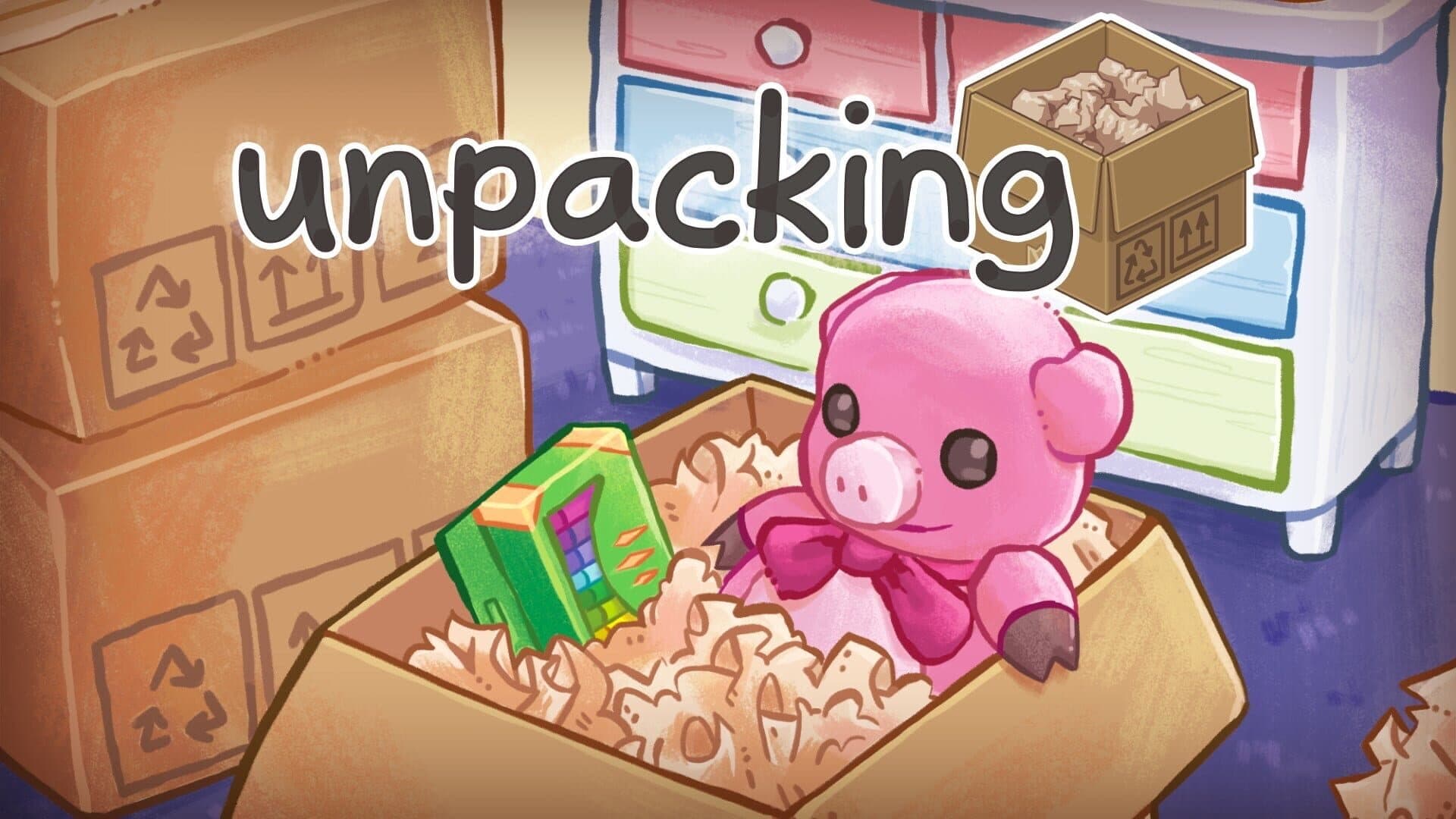
Most games about human lives give you a protagonist, a voice, a name, a face. Unpacking gives you a cardboard box. Objects alone can carry a life story. Four years since Witch Beam’s BAFTA-winning puzzle arrived on PC and Switch, nothing released since has told a human narrative through household items with the same discipline or clarity. The case for playing Unpacking in 2026 is not nostalgia.
Game Snapshot
| Developer | Witch Beam |
| Publisher | Humble Games |
| Release Date | 02 November 2021 (PC/Switch/Xbox); 10 May 2022 (PS4/PS5) |
| Platforms | PC (Windows/Mac/Linux), Nintendo Switch, PS4, PS5, Xbox One, Xbox Series X/S, iOS, Android |
| Price | £16.99 | $19.99 |
| Rating | PEGI 3 | ESRB E (Everyone) |
| Genre | Zen puzzle / narrative |
| Length | ~3.5 hours (main story); ~4–6 hours (completionist) |
| Install Size | ~1 GB |

Unpacking has no HUD, no score counter, and no level select screen. What it has is a sequence of rooms rendered in clean pixel art: a child’s bedroom in 1997, a university room in 2004, a shared flat in 2007, a standalone home by 2018. Each one is a precise domestic geography that the player fills from scratch. Witch Beam’s art direction keeps the palette warm and legible without tipping into greeting-card comfort. The objects are detailed enough to be identifiable: a particular console indicates the era, a framed photo changes hands across the years, a stuffed pig never gets unpacked into a box labelled ‘his stuff’. These are not abstract symbols. They are a life.
Each item produces a distinct audio response when placed: books thud softly onto shelves, crockery clinks, a glass star chimes. The composer Jeff van Dyck’s soundtrack shifts its register room by room, carrying emotional weight without ever becoming obvious. It is the rare game where muting the audio would genuinely impoverish the experience.
The domestic environments are not especially large, but they do not need to be. Every level offers enough room complexity (kitchen shelving with spatial rules, bathroom cabinets with purpose-specific logic) to make the act of placement feel considered rather than automatic. The challenge is always gentle. Unpacking is a puzzle in the loosest sense: items cannot be stacked arbitrarily, most cannot go on the floor, and functional spaces enforce plausible arrangement. The result is a flow state, not a stress response.
Gameplay and Combat

There is no combat in Unpacking, and that is precisely the point. The game's mechanical vocabulary is intentionally minimal: pick up an item, find a location, place it. Repeat for approximately three and a half hours across eight moves spanning 1997 to 2018. That description sounds repetitive. The execution is not.
The spatial puzzle logic gives each placement a quiet satisfaction. A bookshelf has room for six items; you have nine to place. A wardrobe opens to reveal clothing rails and a top shelf with distinct proportions. Kitchen cabinets group by function. These constraints make every decision feel purposeful rather than arbitrary, and the system is consistent enough that players quickly develop intuitions about what belongs where. The occasional item that refuses placement everywhere tells you something has been overlooked, and discovering that you had the bedroom wrong all along (because something goes next to the bed, not on the desk) is the game's closest equivalent to an aha moment.
The storytelling emerges entirely from the act of placement. No cutscene explains what happens between 2010 and 2012. The objects do the work: a wedding photo that appears, then does not; a degree certificate that moves from room to wall to box; a childhood toy that persists through every single move. Witch Beam gave an interview to Game Developer describing how they ensured every one of the 1,000-plus objects contributed to the narrative, and that intention is visible in the result. Nothing is filler. The pixel art is not decoration; it is the script.
There is no fail state. Items placed incorrectly produce a mild audio cue and return to the player's hand. The pace never accelerates. Unpacking is a game you can set aside mid-level and return to without penalty.
Unpacking Game Review 2026: Story and Characters

The unnamed protagonist never speaks, never appears on screen, and never explains herself. The game trusts its objects entirely, and after twenty minutes, that trust turns out to be well-placed. Players piece together a life through the specific and the accumulated: what she reads, what she keeps, what she replaces, what she leaves behind. The narrative architecture is built around eight moves (eight distinct domestic spaces), and each one shifts the context of everything placed before it.
This approach earns the BAFTA Best Narrative award it received at the 2022 ceremony. The closest comparison in recent memory is what Clair Obscur: Expedition 33 achieves through performance and dialogue, but the instruments are completely different. Clair Obscur earns emotion through spectacle. Unpacking earns it through a chicken plushie that travels through every box for twenty years.
The narrative is not without structural decisions that some players find frustrating. Because nothing is explained, the story requires active attention. Players who treat the game as a pure spatial puzzle and do not look at what they are placing will miss most of what is happening.
Value and Longevity

Unpacking takes approximately three and a half hours to complete the main story, with completionist runs extending to four to six hours. At £16.99/$19.99, the arithmetic is unfavourable if measured in hours per pound alone. That is the wrong frame. The correct one is impact per hour, and on that measure Unpacking scores as well as anything in the best cosy games of 2026.
For players on Xbox Game Pass, Unpacking is included in the subscription, which eliminates the price question entirely. The game arrived on Apple Arcade as Unpacking+ in April 2026, broadening access further across iOS and macOS devices. No paid DLC or expansions have been released; the experience is complete as shipped.
The game has no replay value in the conventional sense. Once the story is known, subsequent runs are spatial puzzles without the narrative discovery that makes the first playthrough distinct. That is the honest trade-off. It is not a game for returning to repeatedly; it is a game for experiencing once with full attention. Whether that justifies the price depends entirely on how highly a player values the specific thing Unpacking does. For anyone interested in what interactive storytelling is capable of, and this sits prominently in every serious cosy games list for PS5 in 2026, the answer is yes.
Technical Notes
Unpacking runs without issue on every platform where it has launched. The PC version requires modest hardware, the Switch version performs cleanly in both docked and handheld modes, and the PS4/PS5 versions released in May 2022 matched the established quality of both.
The mobile versions (iOS/Android, August 2023) received positive notices for touch controls. The Unpacking+ Apple Arcade launch in April 2026 extended access without changes to the core content. There are no platform-specific enhancements, no DualSense implementation, and no performance modes. The game is technically simple. No platform version has aged poorly.
Accessibility options are limited: no documented colourblind mode and no audio description option. The experience requires visual distinction between objects and spaces.
Final Word
Unpacking is a three-and-a-half-hour game about the particular weight of a cardboard box that contains everything you own. Witch Beam's wordless portrait of a life is still unmatched in its discipline: the chicken plushie that travels from a child's bedroom shelf to every subsequent home is a more effective piece of characterisation than most games manage in forty hours. Skip it only if you want mechanics and challenge above all else; this is a game for looking, not for conquering. For everyone drawn to what a puzzle game can do when it removes the puzzles and keeps only the poetry, Unpacking in 2026 is worth every penny and every minute of its compact runtime. It belongs on any list of the best Switch 2 games for cosy play and sits comfortably alongside the best PS5 games of 2026 in terms of sheer craft.
8.6
Great
SpawningPoint Verdict
Review summary
Unpacking is a 2021 zen puzzle game developed by Witch Beam in Brisbane, telling the story of an unnamed woman's life across eight homes spanning 1997 to 2018 through the household objects she packs and unpacks. The placement mechanic is simple: pick up an item, find a space, listen for the right audio cue. Its defining feature is placing over 1,000 carefully designed items at the centre of every narrative beat, with no dialogue, text, or cutscenes. The pixel art and sound design are clean and purposeful rather than technically ambitious. No documented performance issues or significant bugs have been reported across any platform version. It won BAFTA Game of the Year and Best Narrative in 2022. At £16.99/$19.99, with no DLC and limited replay value, it suits players who value emotional precision over content volume.