REVIEW
6.8· Mixed
PS5 Pro Review 2026: Impressive Power, Uneven Value
Our PS5 Pro review tests PSSR 2.0 upscaling, GPU gains, and real-world value at £789.99/$899.99. Should you upgrade or wait? Here is our verdict.

Opening
Sony built a console that outmuscles most mid-range gaming PCs, then released it into a library that barely notices. The PS5 Pro is a hardware answer waiting for a software question. Sixty compute units, PSSR 2.0 upscaling, and doubled ray tracing throughput push enhanced titles like Marvel’s Spider-Man 2 and Kingdom Come: Deliverance II into territory the standard PS5 cannot reach, yet the majority of the catalogue runs identically on both machines. At £789.99/$899.99 after successive price hikes, with no disc drive in the box, the Pro asks buyers to pay a premium for gains that range from transformative to invisible depending on what they actually play.

Product Snapshot
| Brand / Model | Sony PlayStation 5 Pro (CFI-7000 series) |
| Category | Mid-generation enhanced home console |
| UK Price | £789.99 (as of April 2026; launched at £699.99 in November 2024) |
| US Price | $899.99 (as of April 2026; launched at $699.99 in November 2024) |
| Release Date | 7 November 2024 |
| CPU | 8-core AMD Zen 2, up to 3.85 GHz (High CPU Frequency Mode) |
| GPU | Custom AMD RDNA-based, 60 compute units, up to 2.35 GHz, 16.7 TFLOPS (Sony rated) |
| RAM | 16 GB GDDR6 + 2 GB DDR5 (system) |
| Storage | 2 TB custom SSD (1.89 TB usable) |
| Display Output | 4K, 1440p, 1080p, 8K; VRR and 120 Hz support; HDMI 2.1 |
| Key Features | PSSR upscaling (upgraded to 2.0 in March 2026), 2x ray tracing speed, Game Boost, Wi-Fi 7 |
| Disc Drive | Not included; optional attachment at £99.99/$79.99 (sold separately) |
| Connectivity | Wi-Fi 7, Bluetooth 5.1, Gigabit Ethernet, 3x USB 3.2 Gen 2, 1x USB 2.0 |
| Weight | 3.1 kg (6.8 lbs) |
| Dimensions | 388 x 216 x 89 mm |
| Warranty | 1-year manufacturer warranty (Sony standard) |
| Best Alternatives | Xbox Series X, Standard PS5 Slim, Gaming PC (mid-range) |
Design and Build
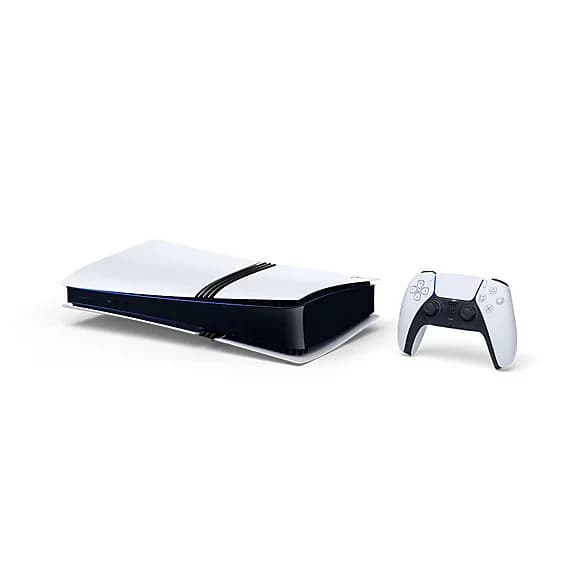
The PS5 Pro borrows the Slim’s cleaner lines rather than the original PS5’s polarising sail-like panels. Three dark horizontal stripes run across the centre section, giving the console a subtler identity than its predecessor. At 388 x 216 x 89 mm and 3.1 kg, it sits between the original PS5 and the Slim in overall footprint, compact enough for most entertainment centres without dominating the shelf.
The finish is matte white with black accents, consistent with the current PlayStation design language. Build quality is solid: clean seams, no flex, and no audible rattling from internal components.
The omission defines the product. Sony ships the PS5 Pro as a digital-only machine, with the optional disc drive attachment sold separately at £99.99/$79.99. For physical media collectors, that pushes the true cost closer to £890/$980. Stock shortages for the disc drive have persisted since launch, which compounds the frustration. Digital-only is a design position, not an oversight, but it is one that adds cost and inconvenience for a significant portion of the audience.
PS5 Pro Performance: GPU, PSSR, and Ray Tracing
The GPU is where Sony spent its budget. Sixty compute units (up from 36 on the base PS5) and a clock speed of up to 2.35 GHz deliver what Sony claims is 45% faster rendering. The CPU remains the same 8-core AMD Zen 2 architecture, though a High CPU Frequency Mode pushes it to 3.85 GHz for a roughly 10% uplift. That ceiling matters: CPU-limited titles running at 30 fps on the base console will not automatically jump to 60 fps on the Pro.
The headline technology is PlayStation Spectral Super Resolution (PSSR), Sony’s machine learning upscaler. In titles that support it, PSSR reconstructs a higher-resolution image from a lower internal render, similar in principle to NVIDIA’s DLSS. The upgraded PSSR 2.0, rolled out via a March 2026 system update, improves image stability and fine detail clarity across supported titles.
The results vary by game. Marvel’s Spider-Man 2 introduces a Performance Pro mode combining 4K resolution, ray tracing, and 60 fps, a meaningful leap from the standard console’s forced choice between fidelity and frame rate. God of War Ragnarok runs its quality-tier visuals at a locked 60 fps. Kingdom Come: Deliverance II hits an upscaled 2160p at 60 fps with PSSR handling the heavy lifting. These are genuine showcases.

Then there is Alan Wake 2, which renders internally at 864p before PSSR reconstructs a 4K output at 60 frames per second. The output is playable and visually improved, but a sub-1080p base resolution exposes PSSR’s current limitations in extremely demanding scenes.
Ray tracing runs at twice the speed of the standard console, and the improvement is visible in reflections, ambient occlusion, and lighting across enhanced titles. Context matters here: console optimisation means those comparisons are not direct equivalents, but they illustrate where the Pro sits in the broader hardware landscape.
The upgrade is real. The consistency is not.
Display and Visual Quality in Our PS5 Pro Review
The PS5 Pro supports 4K output at up to 120 Hz with variable refresh rate (VRR), 1440p, 1080p, and a nominal 8K mode. In practice, 8K output remains a specification-sheet feature rather than a practical one: no PS5 game renders natively at 8K, and the handful of media applications that support it do not justify buying a display for the purpose.
VRR support is where the Pro’s GPU headroom pays off. Titles that fluctuate between 60 and 120 fps on the standard PS5 hold steadier frame rates on the Pro, and VRR smooths the remaining variance. For buyers with a 4K 120 Hz VRR-capable television, the improvement is tangible. Our console buying guide by player type covers which display features matter most for each setup. For those on older 4K 60 Hz panels, the gains are limited to resolution and visual fidelity rather than frame rate smoothness.
PSSR 2.0 delivers its strongest results in first-party titles where Sony controls the implementation. Third-party support remains inconsistent, and image quality varies noticeably between studios. The upscaler is promising. It is not yet a universal solution.
Storage and Connectivity
The 2 TB internal SSD provides 1.89 TB of usable space, double the base PS5’s effective storage. Load times remain comparable to the standard console, as both use the same custom SSD architecture. Double the capacity matters. With modern titles routinely exceeding 100 GB, the extra room is welcome rather than luxurious, and heavy downloaders will still reach capacity within a year.
Expansion via an NVMe M.2 slot remains an option for buyers who need more. Three USB 3.2 Gen 2 ports and one USB 2.0 port handle external drives and peripherals.
Wi-Fi 7 support is a forward-looking inclusion. For households already running Wi-Fi 7 routers, the lower latency benefits competitive gaming scenarios and faster downloads. For the majority still on Wi-Fi 6 or 6E networks, the practical difference today is negligible. The feature earns its place on the spec sheet but not yet in most living rooms.
Cooling, Noise, and Power
Sony’s revised CFI-7100 model, shipped from late 2025, optimises the APU for roughly 4% lower power draw and a measured 2 dB reduction in fan noise compared to launch units. Under sustained gaming loads, the PS5 Pro draws approximately 228-230 W in demanding titles, a modest bump from the standard model’s 215-218 W in comparable scenarios, delivering up to 35% more graphical performance for around 5.5% more power.
Fan noise sits at approximately 32 dB at the home screen, rising to around 43 dB after extended play sessions with ray tracing enabled. The console runs warm but not hot, and thermal management keeps sustained performance stable without throttling. Efficiency is the quiet win here. The revised model is noticeably quieter than launch hardware, though neither version is silent under heavy load.

Who It’s For/Who Should Skip It
Buy it if:
– You are purchasing your first PlayStation 5 and want the strongest version available, with 2 TB storage and future-proofed features like PSSR and Wi-Fi 7
– You own a 4K 120 Hz VRR display and play PS5 Pro Enhanced titles where the GPU improvements are most visible
– You prioritise visual fidelity in first-party PlayStation exclusives and accept the premium for the best console experience in those specific games
Skip it if:
– You already own a PS5 and primarily play titles without Pro enhancement patches (Elden Ring, for instance, still lacks one), as you will see no meaningful difference for nearly £800
– You game on a 1080p display, where PSSR upscaling and the resolution improvements are largely wasted
– You want a disc drive included at the listed price, as the additional £99.99 plus potential stock-hunting frustration pushes the total cost towards £890
Alternatives
Standard PS5 Slim (Digital Edition): At roughly half the Pro’s current price, the Slim runs the same games, plays the same media, and accesses the same library. For buyers who do not own a 4K 120 Hz display or do not play graphically demanding titles, the Slim remains the sensible choice. Our guide to whether PlayStation is still worth it in 2026 covers the broader value question.
Xbox Series X: Microsoft’s flagship offers comparable performance in multiplatform titles, includes a disc drive, and provides Game Pass as a strong value counterweight. The trade-off is a smaller exclusive library.
Mid-range gaming PC (RTX 5060 Ti / RX 9060 XT): Independent benchmarks place the PS5 Pro’s rendering output in the same bracket as these desktop GPUs. A similarly priced PC build offers broader functionality, mod support, and a larger game library, though it requires more setup and maintenance than a console.
Verdict
The PS5 Pro is the console equivalent of buying a sports exhaust for a car that spends most of its time in second gear. The hardware ceiling is genuinely higher: PSSR 2.0 upscaling, faster ray tracing, and a beefier GPU make enhanced titles like Clair Obscur: Expedition 33 and Spider-Man 2 look and run better than anything the base PS5 can achieve. But the majority of the library does not tap that ceiling, and repeated price hikes have pushed the cost to a point where the improvement-per-pound calculation favours patience. For first-time PS5 buyers with a capable display, the Pro is the obvious pick. For existing owners weighing an upgrade, the answer depends on how many of the best PS5 games you play that actually use what the Pro offers.

FAQ
Is the PS5 Pro worth it in 2026?
The PS5 Pro delivers its clearest value to newcomers choosing their first PlayStation and pairing it with a 4K display. For those already gaming on a standard PS5, the calculus shifts: it depends how many Pro-patched titles sit in your regular rotation. The enhanced catalogue has grown past 100 games and PSSR 2.0 sharpens the visual payoff, but at the current asking price the cost still outpaces the improvement for anyone treating this as an incremental step up.
What is the difference between PS5 and PS5 Pro?
The core gap is GPU horsepower: the Pro carries 60 compute units against the standard model’s 36, enabling faster rendering, doubled ray tracing, and PSSR-driven upscaling. Storage doubles to 2 TB, and Wi-Fi 7 replaces Wi-Fi 6. The processor remains Zen 2 with a modest clock bump. Where Pro-enhanced patches exist, the visual and frame rate jump is clear; where they do not, both consoles perform identically.
Does the PS5 Pro have a disc drive?
Sony omits the optical drive entirely from the PS5 Pro’s chassis. A detachable add-on supporting 4K Ultra HD Blu-ray, standard Blu-ray, and DVD is available for just under £100/$80, though stock has been inconsistent ever since the console launched. Physical media buyers should confirm availability before purchasing, as the accessory regularly sells out at major retailers.
Can the PS5 Pro run games at 4K 60fps?
Several flagship titles already hit a reconstructed 4K output at 60 frames per second via PSSR, including God of War Ragnarok and Ratchet and Clank: Rift Apart. The console renders at a lower internal resolution and upscales the final image using machine learning. True native 4K at 60 fps is reserved for lighter titles, and games bottlenecked by the Zen 2 processor at 30 fps on the standard model remain locked there on the Pro as well.
What is PSSR on PS5 Pro?
PSSR (PlayStation Spectral Super Resolution) is an AI-powered upscaler built into the PS5 Pro’s hardware. It takes a lower-resolution frame produced by the GPU and reconstructs a sharper, higher-resolution output in real time, serving the same role as DLSS on the PC side. The 2.0 revision, pushed via a March 2026 firmware patch, tightened temporal stability and reduced shimmer on fine geometry. Sony has confirmed that most upcoming Pro-optimised releases will integrate the technology at launch.
Is the PS5 Pro quieter than the PS5?
Under casual use the PS5 Pro sits in the low 30s dB range, roughly matching the PS5 Slim at idle. Sustained graphically intensive sessions push fan output into the low 40s dB, audible but not intrusive in a typical living room. The later-revision hardware (CFI-7100) trims a couple of decibels off the original manufacturing run, making the current retail units noticeably quieter than day-one stock.
Should I wait for PS6 instead of buying a PS5 Pro?
The PlayStation 6 has not been officially announced as of April 2026, and typical PlayStation generational cycles suggest a successor is likely several years away. If you need a console now and want the best PlayStation experience available, the Pro delivers it. If your current PS5 runs the games you play without issue, waiting is the lower-risk financial decision, particularly given the Pro’s current pricing.
How many games support PS5 Pro enhancements?
The Pro-optimised catalogue has crossed the 100-title mark as of early 2026. First-party highlights include The Last of Us Part I, Gran Turismo 7, and Horizon Forbidden West, while notable third-party entries span Baldur’s Gate 3, Alan Wake 2, and Final Fantasy VII Rebirth. Sony has indicated that most forthcoming major releases will ship with Pro-specific visual modes built in.
6.8
Mixed
SpawningPoint Verdict
Review summary
The PlayStation 5 Pro delivers a measurable generational step within the PS5 family: a larger GPU, PSSR-driven upscaling, doubled ray tracing speed, 2 TB storage, and Wi-Fi 7. Enhanced titles, now numbering past 100, benefit from sharper visuals and steadier performance, with flagship showcases reaching reconstructed 4K at smooth frame rates. The unchanged Zen 2 CPU limits gains in processor-bound software, and the bulk of the PlayStation library sees no difference between the two consoles. At close to £800/$900 following repeated price increases, with the optical drive sold as an add-on, value is the Pro’s persistent weakness. Newcomers seeking the strongest PlayStation experience have the simplest decision. Current owners face a more conditional calculation, determined entirely by the games in their rotation.