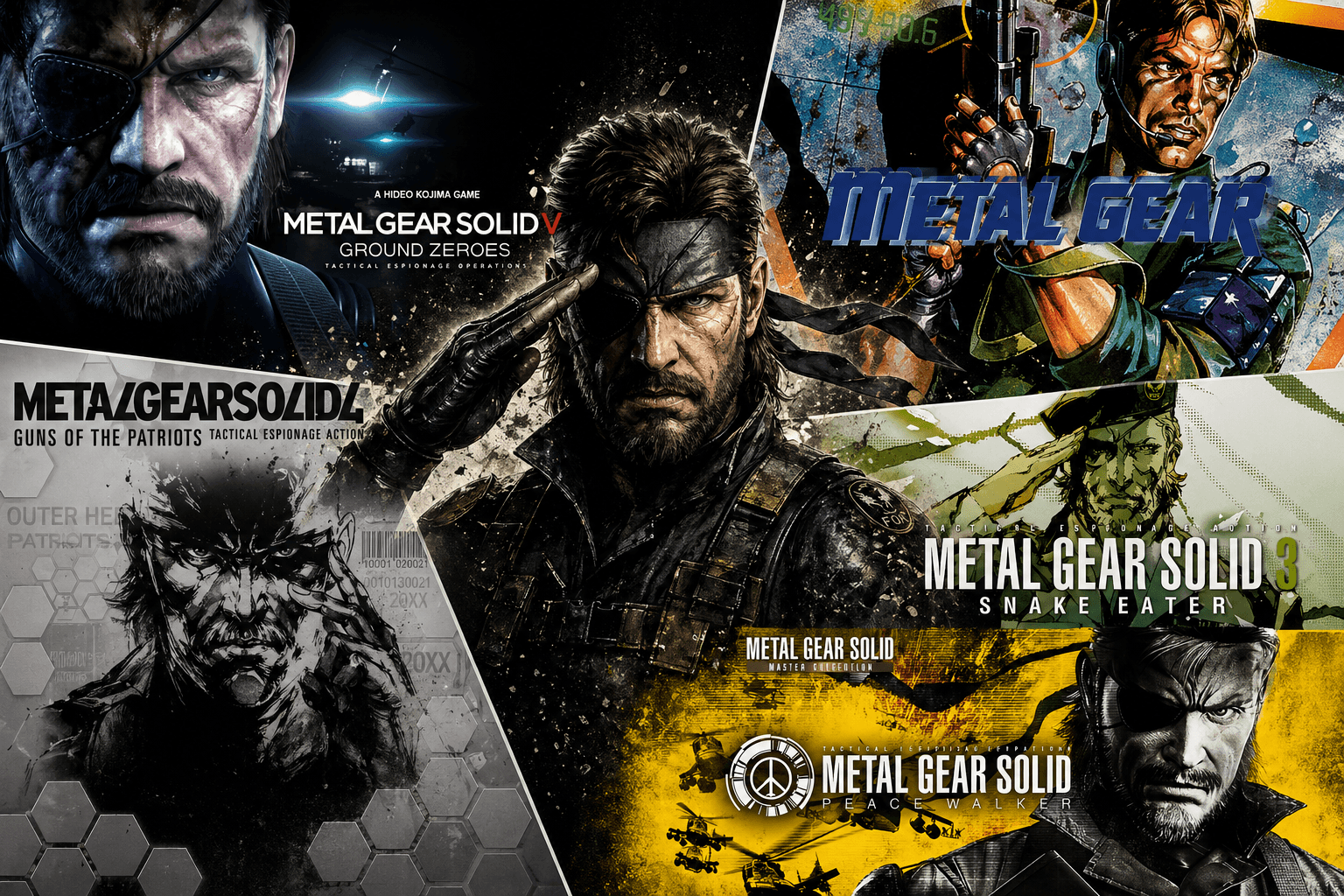
The stealth genre exists because a hardware constraint forced a designer to build something he had not planned. Kojima’s MSX2 could not render enough enemies for a conventional action game, so he built one about not being seen. That accident structured three decades of design: eleven entries, each staging a different argument about evasion, narrative stakes, and how far a stealth game can push its own form. This ranking covers every mainline entry from the least essential to the most fully realised, with the recommended play order and where to start.
Metal Gear Solid Games in Order: Recommended Play Order
Release order (recommended): Metal Gear (1987), Metal Gear 2: Solid Snake (1990), Metal Gear Solid (1998), MGS2: Sons of Liberty (2001), MGS3: Snake Eater (2004), MGS4: Guns of the Patriots (2008), Peace Walker (2010), MGSV: Ground Zeroes (2014), MGSV: The Phantom Pain (2015), Metal Gear Solid Delta: Snake Eater (2025).
Release order is the structurally correct choice because MGS2’s protagonist switch is a design argument that only lands once MGS1 has set it up. Chronological story order makes the Big Boss timeline clearer but dissolves that architecture before you encounter it.
For newcomers on current hardware, Metal Gear Solid Delta: Snake Eater is the practical entry point: a prequel requiring no prior series knowledge, rebuilt in Unreal Engine 5 with modernised controls. Understand that it is a preservation exercise, not a reinvention.
Metal Gear Solid Games in Order: Full Rankings Table
| Rank | Title | Year | Platforms | Best For |
| 11 | Metal Gear Survive | 2018 | PS4, Xbox One, PC | Completionists only |
| 10 | Metal Gear Solid V: Ground Zeroes | 2014 | PS4, Xbox One, PC | Prologue to MGSV |
| 9 | Metal Gear | 1987 | MSX2 (via Master Collection) | Historical context |
| 8 | Metal Gear 2: Solid Snake | 1990 | MSX2 (via Master Collection) | Pre-Solid systems archaeology |
| 7 | Metal Gear Solid: Peace Walker | 2010 | PSP, PS3 HD, PC | Connecting MGS3 to MGSV |
| 6 | Metal Gear Solid 4: Guns of the Patriots | 2008 | PS3 | Series closure, cinematic payoff |
| 5 | Metal Gear Solid V: The Phantom Pain | 2015 | PS4, Xbox One, PC | Stealth sandbox depth |
| 4 | Metal Gear Solid Delta: Snake Eater | 2025 | PS5, Xbox Series X, PC | Modern hardware entry point |
| 3 | Metal Gear Solid | 1998 | PS1 (via Master Collection) | Cinematic stealth foundation |
| 2 | Metal Gear Solid 2: Sons of Liberty | 2001 | PS2 (via Master Collection) | Narrative architecture |
| 1 | Metal Gear Solid 3: Snake Eater | 2004 | PS2 (via Master Collection, Delta) | The complete argument |
11. Metal Gear Survive

Survival-Crafting/Konami Digital Entertainment/2018
Metal Gear Survive removes the thing that makes Metal Gear Metal Gear. The Fox Engine performs well here, the enemy encounter loop has functional bones, and a player coming with no prior attachment to the series might find a passable survival-crafting game. That is not what this is for. The series argument across ten mainline entries is that stealth: the management of information, the staging of patrol routes, the tension of a sightline, is the vocabulary. Survive replaces that vocabulary with hunger metres, thirst gauges, and tower-defence waves against crystalline zombies in an alternate-dimension setting.
The design contract is with a different franchise. Konami produced something that runs on Metal Gear infrastructure whilst declining to make a Metal Gear game. A player looking for the series’ characteristic intelligence about evasion, about the space between the guard’s cone of vision and your position, will not find it here. The Fox Engine provides the only continuity with what came before.
Skip unless completionism is the explicit goal.
10. Metal Gear Solid V: Ground Zeroes

Stealth Action/Kojima Productions/2014
Ground Zeroes is the correct proof of concept for the wrong commercial decision. Camp Omega is a single open map, and every design choice on that map demonstrates that the Fox Engine’s stealth architecture scales to open-area mission design without losing its core intelligence. The sightline geometry, the patrol rhythms, the way the game responds to environmental disturbance: all of it holds under the increased spatial freedom the open structure provides. The opening sequence, with Big Boss infiltrating Camp Omega under rain and searchlights, stages its encounter design with genuine confidence.
The problem is proportionality. Ground Zeroes charges a premium price for a single mission and a handful of side operations. The content available, even accounting for the secondary objectives and hard mode challenge runs, does not justify the purchase as a standalone product. In retrospect, understood as the opening chapter of a longer experience rather than a discrete release, the design quality is easier to appreciate. Standalone, the commercial decision casts a shadow over what is genuinely impressive stealth encounter work.
Play it paired with The Phantom Pain rather than alone.
9. Metal Gear

Action-Stealth/Konami/1987
The design argument behind every entry on this list originates here. Kojima’s MSX2 hardware could not render the enemy density a conventional action game required, and the constraint produced something the action genre had not attempted: a game built around not being detected. Line-of-sight detection, environmental interaction, the basic spatial logic of stealth as a system: all of it is present in embryonic form in 1987. That the genre has spent thirty-five years elaborating on this foundation is not trivial.
As a playable game in 2026, Metal Gear is primarily a historical document. The NES port most Western players encountered first was a significantly altered version; the MSX2 original, accessible via the Master Collection, reveals a more coherent philosophy than that port suggested. The underlying logic of each encounter points directly toward what Metal Gear Solid would construct eight years later in 3D. Worth understanding as context; difficult to recommend as an experience.
Play via Master Collection Vol. 1 for the MSX2 original.
8. Metal Gear 2: Solid Snake

Action-Stealth/Konami /1990
Metal Gear 2 is the undervalued entry in the series, and it is undervalued because most Western players did not have access to it until the Master Collection made it broadly available. Released exclusively on MSX2 in Japan, it remained an obscure reference point for nearly two decades whilst its innovations were attributed to the 3D entries that followed. The radar system, the crawling mechanic, the guard AI that reacts to footprints and environmental noise: all of it is here, in a 1990 MSX2 game, at a level of systems sophistication that the platform barely suggests is possible.
The boss encounter design is the specific achievement. Each fight is staged with dramatic architecture that its hardware limitation does not soften: the confrontations carry genuine weight, and the narrative framing around soldier identity and nuclear deterrence connects directly to what Snake Eater would build into its emotional climax fourteen years later. The controls and top-down perspective constrain the experience, but the underlying systems design points unambiguously at MGS1’s vocabulary. This is not archaeology for completionists; it is the blueprint.
Play via Master Collection Vol. 1 alongside Metal Gear for the complete pre-Solid context.
7. Metal Gear Solid: Peace Walker

Stealth Action/Kojima Productions/2010
The hardware compromise is real and the design achievement is real, and Peace Walker holds both simultaneously without either cancelling the other. Kojima Productions produced a full Metal Gear experience on a PSP, and the primary stealth encounter design mostly holds: patrol routes, sightlines, the spatial logic of infiltration across open mission areas. The PSP’s single analogue stick forced camera and aiming compromises that the HD remaster on PS3 partially addressed but did not fully resolve, and a player coming directly from the console entries will feel that friction immediately.
What Peace Walker contributes to the series argument is structural. Mother Base management, personnel recruitment via Fulton extraction, the Outer Ops deployment layer: all of it is the scaffolding that The Phantom Pain would build its sandbox on five years later. The cooperative mission design, where up to four players share a single infiltration, gave the series a social encounter dimension it had not previously attempted. Big Boss’s character development between the events of Snake Eater and The Phantom Pain is handled with care; the story earns its timeline position.
Peace Walker is connective tissue. It bridges the series’ most personal entry (MGS3) with its most mechanically ambitious one (MGSV), and it does so whilst introducing the management systems that would become the franchise’s final structural innovation.
Play via Master Collection Vol. 2 for the best available version, ideally with a co-op partner.
6. Metal Gear Solid 4: Guns of the Patriots

Stealth Action/Kojima Productions/2008
Metal Gear Solid 4 is a game where the encounter design and the narrative architecture are pulling in different directions, and which one you experience more is a function of what you came for. The stealth encounter work in the first two acts is among the best in the series. The Middle East war zone of Act One, with its shifting battlefield factions and the mechanic of using active combat as cover for infiltration, stages encounters the series had not attempted: stealth within open firefights, where the enemy AI is occupied elsewhere and the player can read the geometry differently as a result. The OctoCamo system, which adapts Snake’s camouflage index dynamically to any surface contact, is the most technically sophisticated stealth mechanic Kojima shipped before The Phantom Pain.
The cutscenes are where the design contract changes. Several exceed thirty minutes. The game is structurally committed to resolving every thread from three prior entries: Liquid Ocelot’s arc, the Patriots’ AI network, the return to Shadow Moses as encounter space and emotional callback. That the game stages all of it is a genuine achievement; that it stages it across runtime that tests the patience of anyone primarily here for stealth is the accurate caveat. The microwave corridor in Act Four is a different kind of staging: a no-control endurance sequence that the game earns because of the narrative weight it has built. MGS4 is the most indulgent entry Kojima made and also, at specific moments, the most emotionally precise.
Play on PS3; there is no current-generation version.
5. Metal Gear Solid V: The Phantom Pain

Open-World Stealth/Kojima Productions/2015
No Metal Gear game stages its encounters with the spatial intelligence The Phantom Pain does. The Fox Engine’s open-world stealth architecture allows each mission to function as a systems puzzle with a wide range of viable solutions, and the sandbox is honest about that range: the same infiltration objective is completable via a dozen different approach angles, each of which the game has accounted for in its patrol routing, sightline geometry, and environmental response logic. The buddy system structures the tactical vocabulary: D-Horse for cross-map traversal and vehicle disruption, D-Dog for enemy detection and item location, Quiet for long-range suppression that the player can position independently. Each companion changes the spatial options without simplifying the underlying encounter.
Mother Base management provides a meta-game layer that connects to mission outcomes: research tiers determine equipment availability, Fulton extraction feeds base capability, and the day/night cycle with dynamic weather creates organic variation across dozens of hours of replay.
The story is where the encounter design’s coherence has no equivalent. Kojima’s departure from Konami during development left Chapter 2 incomplete: missions are recycled rather than new, narrative threads introduced in Chapter 1 dissolve without resolution, and the absence of a designed ending produces a specific, recognisable feeling of a work abandoned rather than concluded. The Afghanistan and Africa environments are among the most thoughtfully designed open stealth maps in the genre. The game they contain is the series’ finest stealth engine. The story they were built to carry is not there.
For the complete experience, The Definitive Experience bundles Ground Zeroes and The Phantom Pain together.
4. Metal Gear Solid Delta: Snake Eater

Stealth Action/Bluepoint Games/2025
Delta answers a specific question: does MGS3’s encounter design hold when rebuilt in Unreal Engine 5 with modernised controls and a free camera? The answer is yes, with qualifications. Bluepoint’s remit was preservation rather than reinvention, and they executed that remit with technical discipline. Tselinoyarsk’s jungle environments, which the original PS2 hardware could only approximate, are now fully realised: the foliage density, the light filtering through canopy, the spatial depth of a stealth environment where the camouflage index is the primary mechanic. The visual renovation makes the game’s core argument clearer than the original’s hardware could express: that stealth in natural environments is a different cognitive exercise from stealth in built ones.
The encounter sequences that defined MGS3 are intact. The Ocelot fight in Dolinovodno, which functions as a vocabulary tutorial staging the CQC system against a combatant who can respond to it in kind. The Fear encounter in the forest canopy, which uses vertical space and camouflage index together in ways the series would not revisit. The End’s marathon sniper duel across multiple maps, which stages patience and environmental reading as a sustained encounter arc rather than a single fight. These sequences hold under modernised presentation because the design logic was sound; the remake does not have to compensate for weakness in the original material.
The qualifications are about legacy mechanics preserved alongside the encounter design. Certain camera and control decisions from 2004 remain functional but friction-generating in 2025, and Bluepoint’s commitment to fidelity means those frictions are conserved rather than resolved. SpawningPoint scored Delta 8.6 out of 10, noting the visual ambition alongside the preserved legacy friction. The remake earns its ranking by making MGS3’s quality accessible on current hardware, even as it declines to improve on the original’s structure where improvement was available.
Play on PS5 for the current hardware experience. The Master Collection provides the original for those who want the unmodified version.
3. Metal Gear Solid

Stealth Action/Konami Computer Entertainment Japan/1998
Metal Gear Solid did not invent stealth on 3D hardware. It proved that stealth on 3D hardware could carry a Hollywood-calibre narrative and that the two, encounter design and storytelling, could reinforce each other rather than compete. Shadow Moses structures its environments as encounter spaces first and narrative stages second, and the two functions overlap throughout: the DARPA Chief interrogation teaches how torture mechanics work; the Sniper Wolf fights in the snowfield use the same vista as the game’s most emotionally weighted confrontations; the Psycho Mantis sequence weaponises the controller port itself as a design statement about fourth-wall encounter staging.
The boss roster is the game’s most sustained argument. Each encounter teaches a mechanic and makes a narrative point simultaneously. Revolver Ocelot’s fight in the torture chamber calibrates the player’s understanding of the game’s stamina system whilst establishing Ocelot as a character who controls the terms of every interaction. The Sniper Wolf confrontations on the snowfield use weather and environmental geometry to stage a sustained long-range fight that the game uses twice, with deliberately different emotional framing each time. The Cyborg Ninja sequence, which recontextualises the entire facility as a horror-register encounter space for several minutes before returning to the stealth framework, demonstrates how a boss fight can serve as genre punctuation.
Codec conversations introduced character depth through audio alone, at a runtime that would be impractical in any visual format. The transition from MSX2 top-down to PlayStation 3D was not simply a graphical upgrade: it was a reimagining of how spatial awareness, narrative weight, and encounter staging could occupy the same space. That the game still works as a stealth experience in 2026, and not simply as a historical artefact, is evidence that the encounter design was correctly calibrated from the start.
Play via Master Collection Vol. 1. The original presentation is part of the argument.
2. Metal Gear Solid 2: Sons of Liberty

Stealth Action/Konami Computer Entertainment Japan/2001
The highest-rated entry in the series is also the one that required the longest reappraisal to understand correctly. Sons of Liberty’s launch created genuine outrage: players expecting to continue Solid Snake’s story were handed Raiden, a deliberately inexperienced protagonist designed to make the player feel manipulated. The backlash confirmed that the design was working. Kojima structured the bait-and-switch at every level, from the marketing (which featured Snake throughout) to the encounter architecture (which gives Raiden the same mechanical vocabulary Snake had, making the substitution feel wrong in ways the player cannot immediately articulate). The manipulation was the point. The game about information control and manufactured identity manufactured an identity crisis in its own audience.
The gameplay refined everything MGS1 established. First-person aiming became more precise; environmental interaction expanded; the guard AI received significant upgrades that rewarded careful patrol observation rather than reactive corridor play. The Big Shell facility, a network of offshore struts and connecting corridors, stages its encounters with a spatial intelligence that rewards map-reading and patience in ways the linear Shadow Moses could not. The Fatman boss encounter on the Shell 1 core roof, where a bomb-disposal objective layers over a direct fight, stages two mechanical vocabularies simultaneously. The Vamp sequences in the flooded holds use verticality and water physics as encounter variables in ways the series would not return to.
The Arsenal Gear sequence, in which an AI describes curating information to shape public behaviour, reads in 2026 less like science fiction than like a description of the infrastructure that now exists. That the game staged that argument in 2001, as encounter design and narrative simultaneously, is the reason the critical reappraisal has been total.
Play via Master Collection Vol. 1 after completing MGS1. The bait-and-switch requires the first game’s setup to function.
1. Metal Gear Solid 3: Snake Eater

Stealth Action/Kojima Productions/2004
Snake Eater earns its position not through scale or mechanical ambition but through a quality rarer than both: focus. Where MGS2 constructed an elaborate deconstruction and MGS4 committed to comprehensive narrative closure, Snake Eater tells a contained story about one soldier, one mission, and one betrayal, and it stages every encounter in service of that story rather than alongside it.
The Cold War setting strips the franchise’s technological vocabulary down to its physical essentials. The radar is gone, replaced by active sonar that must be manually deployed. Nanomachines are replaced by a survival viewer that tracks food, stamina, and injuries that require manual treatment: setting a dislocated shoulder with a wall, cutting out tranquilliser rounds with a knife before they affect stamina capacity. The camouflage index governs every approach to every encounter: Tselinoyarsk’s jungle is a dynamic stealth environment where the light, the foliage density, and the player’s movement speed all interact with the index in real time. Kojima forced the player to engage with the environment on its own terms, and the result is the most tactile stealth encounter framework in the franchise.
The boss sequence is the sustained argument. Ocelot in Dolinovodno calibrates the CQC system through a fight that teaches it without explaining it. The Fear’s encounter in the forest canopy sequences vertical space and camouflage mechanics together in a way that has no parallel elsewhere in the series. The End stages a sniper duel across multiple maps, where reading environmental geometry and movement patterns takes an hour at the game’s expected pace: not a test of reaction speed, but of patience and spatial observation. The Cobra Unit is the most coherent boss roster in the franchise, each encounter staging a different mechanic and a different argument about what soldiers are made of.
The Boss is the reason this game holds its position. The White Flower field ending is staged with the restraint that only arrives when a designer trusts the material: no score swells until the silence has done its work, and the player understands exactly what they have done and what it cost. That understanding is what Snake Eater is for.
Play via Metal Gear Solid Delta: Snake Eater on PS5 for current hardware, or the original via Master Collection Vol. 1 for the unmodified version.
FAQ
What order should I play Metal Gear Solid games?
Release order is the structurally correct approach for most players: Metal Gear Solid (1998), MGS2: Sons of Liberty (2001), MGS3: Snake Eater (2004), MGS4: Guns of the Patriots (2008), Peace Walker (2010), then MGSV: Ground Zeroes and The Phantom Pain (2014-2015). This sequence preserves the narrative architecture Kojima built across each sequel, particularly MGS2's deliberate protagonist subversion, which requires MGS1's setup to function as designed. Chronological story order is an alternative that makes the Big Boss timeline clearer but dissolves the bait-and-switch at the series' core.
Which Metal Gear Solid game should I start with?
Metal Gear Solid Delta: Snake Eater (2025) is the practical starting point for newcomers on current hardware: it is a chronological prequel requiring no prior series knowledge, and Bluepoint's Unreal Engine 5 rebuild provides modernised controls and a free camera. Players who want to experience the series as it was designed should start with Metal Gear Solid (1998) via the Master Collection, which preserves the intended narrative progression and lets MGS2's subversion land correctly. Avoid starting with Metal Gear Solid 2 or Metal Gear Solid 4, both of which depend on prior entries for their arguments to register.
What is the best Metal Gear Solid game?
Metal Gear Solid 3: Snake Eater is the series' strongest entry. Its Cold War setting stripped the franchise's technological vocabulary down to physical essentials: no minimap, survival mechanics in place of nanomachines, and a camouflage index that governs every approach. The boss roster is the franchise's most coherent, each encounter staging a distinct mechanic and a distinct argument about what soldiers are made of. MGS2 holds the higher aggregate score, but the sustained critical consensus and retrospective reassessment places Snake Eater at the summit because the encounter design and narrative argument are more fully integrated there than anywhere else in the series.
How many Metal Gear Solid games are there?
The mainline series comprises eleven entries: Metal Gear (1987), Metal Gear 2: Solid Snake (1990), Metal Gear Solid (1998), MGS2: Sons of Liberty (2001), MGS3: Snake Eater (2004), MGS4: Guns of the Patriots (2008), Metal Gear Solid: Peace Walker (2010), MGSV: Ground Zeroes (2014), MGSV: The Phantom Pain (2015), and Metal Gear Solid Delta: Snake Eater (2025). Metal Gear Survive (2018) is a mainline release in publishing terms, though its departure from the series' stealth design philosophy makes it difficult to place alongside the Kojima-directed entries.
Is Metal Gear Solid Delta the same as MGS3?
Metal Gear Solid Delta: Snake Eater is a full rebuild of the 2004 PS2 original in Unreal Engine 5, developed by Bluepoint Games. The story, mission structure, and boss encounters are preserved faithfully. The controls, camera system, and visual presentation are thoroughly modernised. The design philosophy is preservation: Bluepoint made the original's encounter architecture legible on current hardware without reinventing it. SpawningPoint [reviewed Metal Gear Solid Delta](https://spawningpoint.com/metal-gear-solid-delta-snake-eater-ps5-review-a-faithful-jungle-reboot-with-modern-friction/) at 8.6 out of 10, noting both the visual achievement and the legacy friction that fidelity-first preservation carries.