QD-OLED flagship
OLEDContrast
Best when black level, response time, and HDR contrast matter more than room brightness.
- ready
- PS5 Pro
- ready
- Xbox
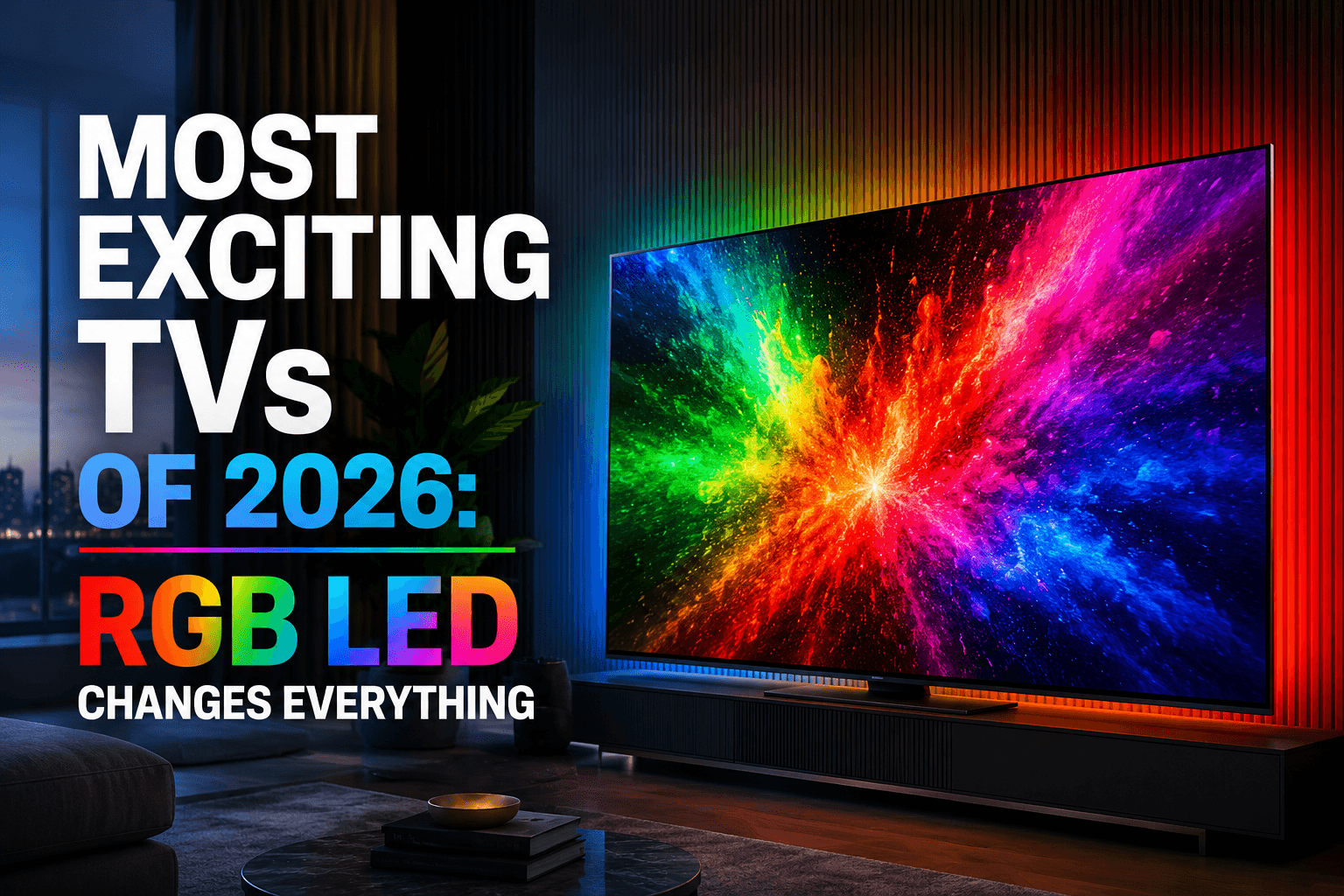
The display on the other side of your PS5 Pro is not a passive screen. It is an active constraint. Every television in this guide is tested against a specific question: does it deliver what a PS5 Pro, Xbox Series X, or Switch 2 actually sends down an HDMI 2.1 cable, and does it do that without compromising the picture quality that makes those consoles worth owning? Five manufacturers have simultaneously retired white LED backlighting for 2026. The shift changes what the OLED versus RGB LED decision actually means for the console buyer.
Standard LCD televisions use a white LED backlight filtered through colour layers to produce the image. White light contains all wavelengths; filtering it down to red, green, and blue wastes energy and limits colour accuracy. RGB LED backlighting replaces that white source with dedicated red, green, and blue emitters, producing purer primary colours without filtering losses.
The practical consequence for gaming is measurable. Samsung’s Micro RGB TVs are certified for the full BT.2020 colour space, a broadcast and gaming standard that no consumer white-LED LCD has previously reached. When a PS5 Pro title is authored in a wide-gamut pipeline and the TV cannot reproduce those colours accurately, what you see is a desaturated approximation of what the developer intended. RGB LED closes that gap. LG’s Micro RGB evo adds over 1,000 local dimming zones, which directly affects how HDR highlights behave in a dark gaming environment without blowing out surrounding regions.
TCL claims 10,000 nits and 20,000 local dimming zones for its SQD mini-LED variant. That figure requires independent measurement before it is accepted, but even at 60 to 70 per cent of the claimed figure, the sustained-window brightness would exceed anything previously available in a gaming context. The caveat on brightness claims applies across the category: peak nit figures are measured in small HDR windows under controlled conditions. Sustained full-screen brightness during a long gaming session runs materially lower. The vendor figure and the realistic figure are not the same number.
OLEDContrast
Best when black level, response time, and HDR contrast matter more than room brightness.
RGB LEDBrightness
The safer route for sunlit rooms and long static HUD sessions.
C/B tierBalance
The practical buy when 120Hz, VRR, and HDMI coverage matter more than gallery design.
The honest answer is that it depends on your room and your content.
Where OLED wins: OLED’s per-pixel contrast is structurally unbeatable by any backlit technology. Each pixel emits independently and can switch off entirely, producing genuine black levels. In a dark gaming environment, that per-pixel precision means the Milky Way in a space-exploration title does not glow faintly over a black sky. It is black. The LG G6 and Samsung S95H both deliver this. The LG C6 at its larger sizes delivers the same tandem-OLED architecture as the flagship G6 at a lower price point.
Where RGB LED wins: RGB LED surpasses OLED in peak sustained brightness and achieves similar colour-gamut coverage at larger sizes. The TCL X11L at £6,199/$7,000 for the 75-inch version offers brightness that no OLED can match. The Samsung Micro RGB R95H brings BT.2020 colour accuracy and 144Hz gaming support to a 65-inch panel. In a living room with afternoon sunlight coming in from one side, the RGB LED panels hold HDR highlights where OLED’s 2,700 to 4,500 nit ceiling starts to compress.
The decision rule for gaming: If you play primarily in a controlled dark environment and value per-pixel contrast for horror, narrative, and cinematic titles, OLED is the right technology. If your main display is in a bright room and you play a wide range of content including sports, racing, and open-world games in mixed ambient light, the new RGB LED panels offer brightness and colour coverage that are no longer a compromise.
| Feature | Why it matters | Buyer note |
|---|---|---|
| HDMI 2.1 | 4K/120 and VRR paths | Check port count |
| VRR | Smooths uneven console modes | Treat as essential |
| Game mode | Input lag and processing | Confirm per input |
| HDR brightness | Highlight impact | Match to room |
The minimum requirement for a current-generation console setup is HDMI 2.1 bandwidth. Without it, 4K at 120Hz is not possible, and neither is Variable Refresh Rate (VRR) support, which eliminates screen tearing during frame-rate fluctuation. Auto Low Latency Mode (ALLM) also requires HDMI 2.1 and automatically activates game mode when a console handshake is detected, cutting input lag without manual menu navigation.
Every television in this guide ships with at least one HDMI 2.1 port. The specification to verify is whether the ports you actually use are full-bandwidth 48 Gbps HDMI 2.1 rather than the limited 18 Gbps variant that carries the same label on some entry-level panels. Full-bandwidth ports are required for 4K 120Hz with HDR simultaneously. Some televisions ship with two full-bandwidth ports and two limited ports; placement matters for console connections.
PS5 Pro specifically: The PS5 Pro outputs 4K at 120Hz natively on supported titles and benefits from VRR to smooth frame delivery on titles that do not hold a locked frame rate. It also supports 8K output for future use, which requires HDMI 2.1. Any television in this guide handles the PS5 Pro’s current output spec; the forward-looking consideration is screen size, since the PS5 Pro’s image quality gains are most visible at 65 inches and above.
Xbox Series X: Identical HDMI 2.1 requirement. Xbox additionally supports Dolby Vision gaming, which provides per-scene HDR metadata rather than a static HDR tone map. The LG G6, C6, and Samsung S95H all support Dolby Vision gaming at 4K 120Hz.
Switch 2: The Switch 2 outputs 4K when docked via its HDMI 2.0 connection in specific titles. HDMI 2.0 limits output to 4K at 60Hz rather than 120Hz, which is the Switch 2’s practical ceiling in docked mode for most titles. Any television in this guide handles this without issue.

The S95H measures approximately 2,700 nits in the peak HDR window, roughly 35 per cent higher than last year’s S95F. In gaming terms, that sustained-window figure means HDR highlights in demanding titles such as Cyberpunk 2077 hold their intensity without compressing during extended bright-scene sequences. Glare Free coating is standard on the S95H and S90H, which reduces reflections in mixed-lighting gaming environments without the slight diffusion that some matte-screen coatings introduce.
Gaming support reaches 165Hz with VRR, which places this panel above the current console refresh ceiling and leaves headroom for connected PC gaming alongside console use. The S99H flagship is positioned above the S95H, peaking at approximately 4,500 nits in small HDR windows; pricing has not been confirmed, but QD-OLED flagship premiums have historically been significant.
Sizes: 55, 65, 77, 83 inches (S95H) Price: From £2,199/$2,499 (55-inch S95H); S99H pricing TBC

The G6 uses the second generation of LG’s Primary RGB Tandem architecture, which stacks two emitting layers for higher brightness without proportionally increasing power draw. The 20 per cent brightness increase over the G5 delivers a usable improvement in HDR gaming content where the G5 already performed well. Reflection Free Premium technology drops screen reflectance below 0.5 per cent, which is meaningful for lounge gaming setups where controlling ambient light completely is impractical.
Input lag in game mode is sub-1ms, which is consistent with the WRGB OLED class. Dolby Vision gaming at 4K 120Hz is supported, relevant for Xbox Series X users who have Dolby Vision-enabled titles in their library.
Sizes: 55, 65, 77, 83, 97 inches Price: From £2,199/$2,499 (55-inch); £2,999/$3,399 (65-inch); £3,999/$4,499 (77-inch); £5,799/$6,499 (83-inch)
The W6 is 9mm thin, mounts flush against a wall, and receives its 4K 165Hz signal wirelessly from LG’s Zero Connect Box. The only cable running to the panel is power. For gaming setups where cable management behind a wall-mounted display is the primary constraint, the W6 resolves that problem structurally rather than with cable trunking. The engineering achievement is real: a wireless 4K 165Hz signal with no visible latency or compression artefacts at gaming frame rates is not a given.
The practical variable for competitive or precision gaming is wireless latency. LG’s Zero Connect implementation performs well in controlled conditions; real-world environments with 5GHz Wi-Fi congestion require testing before committing. The W6 is the right choice for installation aesthetics in a living room gaming setup; it requires more verification for a dedicated gaming room where latency margins matter.
Sizes: 77, 83 inches Price: TBC (predecessor M5 at approximately £3,799/$4,299 for 77 inches)
The C6 is the realistic entry point for OLED gaming performance. At its 77 and 83-inch sizes, it uses the same dual-layer tandem OLED architecture as the flagship G6 at a price that is approximately £800/$800 lower per equivalent size. Smaller sizes (42 to 65 inches) use a standard WOLED panel, which remains a capable gaming display with sub-1ms input lag and full 4K 120Hz VRR support.
The C6 65-inch at approximately £1,499/$1,699 is the most compelling price point in the OLED category for console gaming. It delivers the core panel performance that makes OLED the right technology for a darkened gaming environment at a price that does not require flagship justification.
Sizes: 42, 48, 55, 65, 77, 83 inches Price: From approximately £1,249/$1,399 (42-inch) to £4,699/$5,299 (83-inch)
The B6 uses the new OLED SE panel, which breaks the 1,000-nit barrier for the first time in the entry-level OLED range. Previous B-series panels topped out at 700 to 800 nits, limiting HDR performance in gaming to a degree that required active management of game HDR settings. At 1,000 nits, the B6 delivers credible HDR gaming without manual compensation.
Sizes: Up to 83 inches Price: TBC (predecessor B5 launched at approximately £999/$1,100 for 55 inches)

TCL claims 10,000 nits, 20,736 local dimming zones, full BT.2020 gamut coverage, and 144Hz native refresh with Dolby Vision IQ. The X11L uses TCL’s SQD technology rather than pure RGB LED backlighting, achieving similar colour-gamut expansion through a different optical path. The nit figure demands scepticism until independent measurement is available. Even at 60 per cent of the claimed peak, the X11L would be the brightest consumer gaming display produced. The 20,000 dimming zones are the more immediately significant specification: they determine how well the panel controls local contrast during HDR gaming scenes with bright highlights against dark backgrounds.
For racing and open-world gaming in a sunlit room, the brightness headroom means HDR highlights remain distinguishable in environments where OLED panels begin to compress. The trade-off is that the SQD technology does not deliver OLED’s per-pixel precision; local dimming blooming is still a characteristic even at high zone counts.
Sizes: 75, 85, 98 inches Price: £6,199 / $7,000 (75-inch); £7,099 / $8,000 (85-inch); £8,899 / $10,000 (98-inch)

Samsung’s Micro RGB LCD is the first consumer panel certified for the full BT.2020 colour space. The 2025 debut was a single 115-inch commercial-scale model; the 2026 R95H brings the technology to 65, 75, 85, and 130-inch sizes with 4K at 144Hz, Glare Free coating, and HDR10+ Advanced. The Timeless Frame design mounts the screen within a metal border.
The gaming relevance of BT.2020 certification is specific: titles authored in wide-colour pipelines will reproduce their intended palette accurately on this panel. Whether that colour precision is visible in practice depends on the title and the HDR mastering. The open question is local dimming performance, which independent testing has not yet characterised at the game-content level.
Sizes: 65, 75, 85, 130 inches Price: TBC (the 2025 115-inch Micro RGB debut was approximately £24,899/$28,000; the 2026 R95H is targeting mainstream premium positioning)

Hisense is moving RGB LED technology into the mid-range faster than any other manufacturer. The UR9 and UR8 series bring RGB mini-LED backlighting to sizes from 55 to 100 inches with up to 180Hz panels and Dolby Vision 2 support. The flagship 116UXS adds a four-primary RGB evo system with a cyan emitter for expanded colour precision in the spectral range where human colour discrimination is most acute.
The honest figure on Hisense pricing rests on the outgoing U8 series, which landed around £1,099/$1,299 for the 65-inch. If the UR8 holds near that band, RGB backlighting enters the mainstream gaming TV budget this year. The trade-off is software: Hisense’s VIDAA platform and post-launch firmware support have historically tracked behind Samsung and LG. For gaming use, where smart TV platform quality matters less than panel and gaming-mode performance, this is a manageable cost.
Sizes: 55 to 100 inches (UR9/UR8); 116 inches (116UXS) Price: TBC (expect approximately £1,099/$1,299 entry for UR8 65-inch based on U8 series trajectory)
Sony’s 2026 releases to date are the Bravia 3 II and Bravia 2 II, mid-range and entry-level LCDs. The Bravia 3 II is notable for extending 4K 120Hz gaming support to a 43-inch size, which was previously unavailable at that screen size. For a secondary gaming display or a bedroom setup where size and price are the primary constraints, this is a practical addition to the category.
The premium play is unconfirmed. Sony has trademarked “True RGB” and supply chain reports indicate Bravia 9 II and Bravia 7 II models with RGB LED backlighting in sizes from 50 to 115 inches, potentially reaching 4,000 nits. Sony’s XR processor consistently delivers the category’s best motion handling and colour accuracy at the processing level. If the True RGB hardware delivers the gamut expansion that Samsung and LG’s panels demonstrate, Sony’s processing advantage applied to the same underlying technology could produce the best image quality available. That is the case for waiting. The risk is timeline: neither pricing nor confirmed availability has been announced.
Room brightness first. In a bright room, OLED’s per-pixel contrast advantage is reduced and RGB LED’s brightness ceiling becomes the deciding factor. In a dark or controlled room, OLED’s contrast performance is structurally unreachable by any backlit technology.
Console pairing. All televisions in this guide support the minimum HDMI 2.1 spec required for PS5 Pro and Xbox Series X at full output capability. Verify the port count: two full-bandwidth HDMI 2.1 ports are required if you are running both a console and a PC simultaneously.
Size before technology tier. A 77-inch LG C6 with tandem OLED at approximately £3,299/$3,699 delivers better picture quality per pound than a 55-inch flagship at a similar price. Buy the largest size your room accommodates, then choose the best technology within that size.
Wait or buy now. The LG C6, G6, and Samsung S95H are available now. Samsung’s Micro RGB, Sony’s True RGB, and Hisense UR9 are arriving throughout 2026. If the Sony Bravia 9 II pricing lands within range of the LG G6, it may be the better purchase for buyers who value processing quality over availability. If the decision is between the LG C6 now and waiting for an unconfirmed Sony model, the C6 is the right call.
The LG OLED evo C6 is the best gaming TV for most console setups in 2026, offering tandem OLED at its larger sizes with 4K 165Hz, VRR, ALLM, and Dolby Vision gaming support from approximately £1,249/$1,399. For buyers in bright rooms who prioritise sustained HDR brightness over per-pixel contrast, the Samsung S95H at £2,199/$2,499 for the 55-inch delivers the best QD-OLED gaming performance currently available.
OLED remains the best technology for gaming in a dark or controlled environment, where per-pixel contrast produces black levels no backlit panel can match. The 2026 RGB LED panels from Samsung, TCL, and Hisense close the colour-accuracy gap significantly and surpass OLED in peak sustained brightness, with RGB LED panels reaching 4,000 to 10,000 nits against OLED's 2,700 to 4,500 nit ceiling. In bright rooms, RGB LED is now a credible alternative rather than a compromise.
RGB LED backlighting replaces the white LEDs used in traditional LCD televisions with individual red, green, and blue LED emitters. White LEDs produce all wavelengths and require filtering to create colour, which wastes energy and limits colour accuracy. Dedicated RGB emitters produce purer primary colours without filtering losses, enabling wider colour gamut coverage up to 100 per cent BT.2020 and higher sustained brightness. Every major manufacturer has announced RGB LED models for 2026.
LG and Samsung lead on OLED gaming performance: the LG C6 and G6 deliver the widest Dolby Vision gaming support and consistent sub-1ms input lag across sizes; the Samsung S95H offers the best anti-glare performance and QD-OLED brightness. TCL leads on brightness at an accessible price via the X11L. Sony holds the best processing reputation but its premium RGB LED models are unannounced. Hisense offers the most affordable route into RGB LED backlighting, with the software trade-off being the honest cost.
The PS5 Pro is capable of 4K 120Hz output on supported titles and benefits from a screen that can receive that signal. A 4K 60Hz television will not utilise the PS5 Pro's full output capability; titles running at 120Hz will drop to 60Hz. The more impactful specification is VRR support: on titles that do not hold a locked frame rate, VRR eliminates screen tearing and produces a smoother result than a locked 60fps cap. Every television in this guide supports 4K 120Hz with VRR via HDMI 2.1.