REVIEW
7.8· Great
Nioh 3 PS5 Pro Review: Team Ninja’s Best Combat Yet
Our Nioh 3 PS5 Pro review covers the dual Samurai/Ninja combat, open-world shift, and technical performance. Team Ninja’s best game demands your attention.

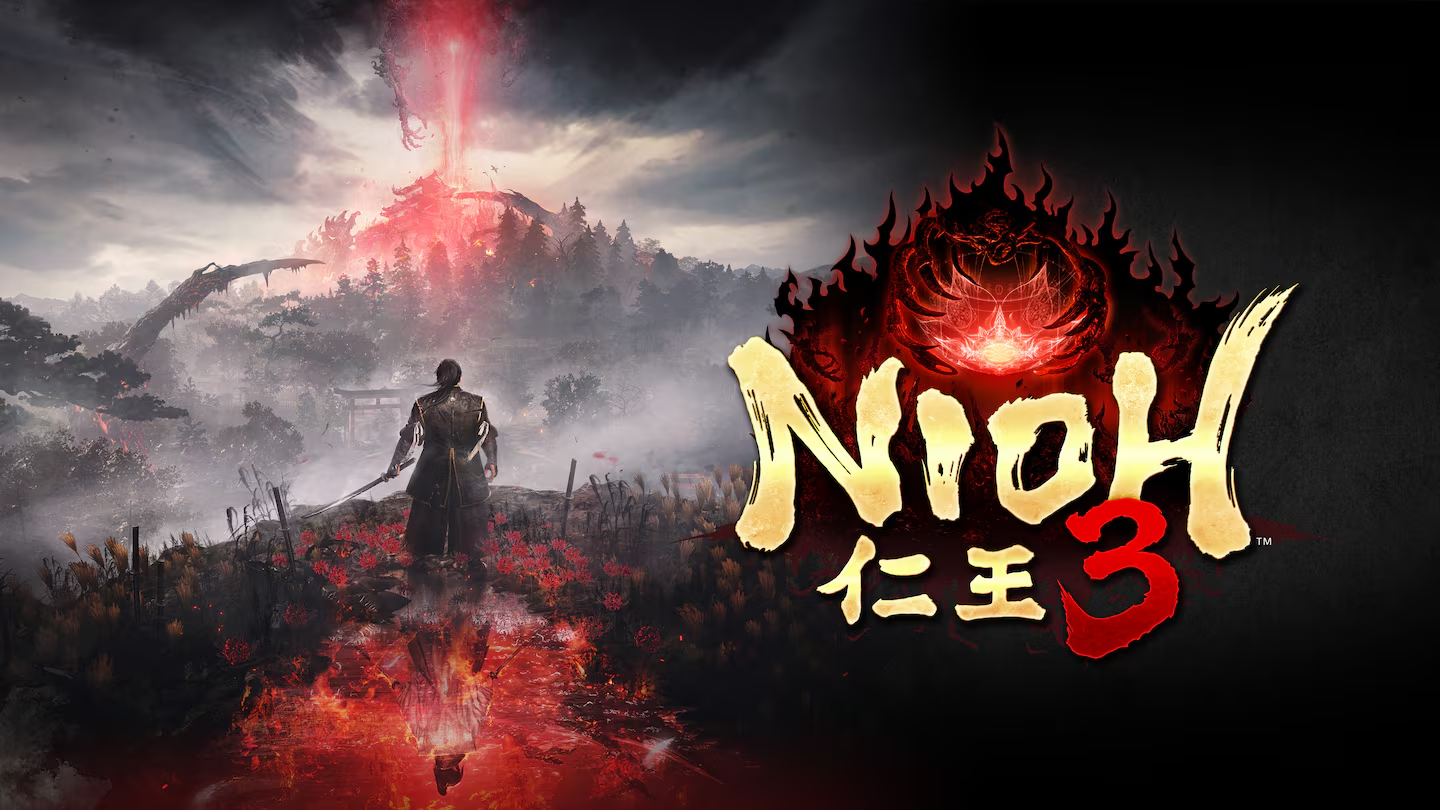
The deepest combat system on PS5 belongs to a game most people will never finish. Nioh 3’s dual Samurai/Ninja combat is the best melee action on PS5. Nothing else comes close. It is deeper than its predecessors, more flexible than its competitors, and built on lessons learned across three franchises (Nioh, Wo Long: Fallen Dynasty, Rise of the Ronin) that give the studio a fluency in moment-to-moment combat design that no other developer matches. The open-world shift works where it matters and stumbles where expected: dense zones that reward exploration filled with activities that sometimes feel copied from a checklist. On PS5 Pro, the Katana Engine delivers the action at 60 fps but shows its age in frame pacing and visual fidelity. The story is background noise. The combat is the story. At $69.99 on PlayStation Store, Nioh 3 is essential for anyone who has ever found satisfaction in timing a perfect parry.
Game Snapshot
| Developer / Publisher | Team Ninja/Koei Tecmo |
| Release Date | 6 February 2026 |
| Platforms | PlayStation 5 (timed console exclusive, 6 months), Windows (Steam) |
| Price | $69.99 (Standard)/$109.99 (Digital Deluxe) |
| Rating | PEGI 18/ESRB M (Mature 17+) |
| Genre | Action RPG, Soulslike |
| Length | Main story: ~30-45 hours; Main + side content: ~50-70 hours |
| Install Size | ~75 GB (PS5) |
Presentation and World Design
Nioh 3 abandons the mission-select structure of its predecessors for open zones, and the gamble pays off more than it does not. Each zone is large enough to consume fifteen to twenty hours of thorough exploration, mixing main story beats with 39 optional Myth side missions, hidden bosses, and environmental puzzles. The shift gives the series a modern feel without sacrificing the density that made its level design effective. Where Kingdom Come: Deliverance II uses its open world to simulate historical Bohemia, Nioh 3 uses its open zones to stage combat encounters across five Japanese historical periods, from the Warring States era through to the Bakumatsu.

The time-travel conceit spans 1190 to 1864, and each era brings distinct environmental identity: Heian-period shrines, Edo-period castle towns, Bakumatsu-era battlefields. The art direction is consistently strong. Yokai designs remain imaginative, and the visual spectacle during boss encounters, particularly the larger kaiju-scale fights, is genuinely impressive. The Katana Engine, however, shows its limitations. Technical analysis has flagged it as needing an upgrade, and the assessment is fair. Texture detail, lighting complexity, and draw distance sit below what Unreal Engine 5 and RE Engine titles deliver in 2026. The game looks good in motion. It does not look current in screenshots.
The open-zone activities are the weakest element. Points of interest follow a familiar rhythm: approach marker, clear enemies, collect reward. Reviews have called them entirely unoriginal, and the comparison to Ubisoft-style checklists is difficult to avoid. The zones are at their best when exploration leads to unmarked discoveries, a hidden boss, a shortcut that recontextualises the layout, a Myth mission that tells a self-contained story worth hearing.
Nioh 3: Gameplay and Combat
This is why Nioh 3 exists. The dual Samurai/Ninja system gives players two fundamentally different ways to engage with every encounter. Samurai builds on the series’ established Ki management framework: stance-switching, Ki Pulses that reward precise timing after combos, and a weight system that ties equipment choices to stamina recovery. Ninja introduces agility, evasion, dodge-silhouettes, stealth mechanics, and a Mist system that replaces Ki Pulse with a momentum-based flow state. Players can switch between styles freely, and the interplay between them opens build possibilities that the series has never offered. The depth is extraordinary.
The weapon variety is exceptional. Traditional melee spans katanas, odachi, tonfa, kusarigama, and more, now supplemented by flintlock rifles and dual blades. Guardian Spirits return with Living Artifact ultimate states that transform combat temporarily. The build customisation is best-in-class for the Soulslike genre. Every weapon type feels distinct, every build archetype viable, and the skill trees reward investment with meaningful capability shifts rather than incremental stat bumps.
Boss design remains Team Ninja’s signature strength. Multi-phase encounters demand pattern recognition, build awareness, and an understanding of when to press advantage and when to disengage. Some bosses are overtuned, difficulty spikes that feel designed for endurance rather than skill, and certain new mechanics are poorly explained for newcomers. Mid-tier enemies scale poorly in later zones, becoming damage sponges that test patience more than skill. The co-op system (up to three players in Expedition mode, summoned visitors for bosses) provides a meaningful pressure valve without trivialising the challenge. For players who found Clair Obscur: Expedition 33’s turn-based combat too measured, Nioh 3 is the opposite end of the spectrum: real-time, punishing, and exhilarating.
Story and Characters
Tokugawa Takechiyo’s journey spanning the game’s five eras, from 1190 to 1864, is driven by a time-travel conceit that serves the gameplay better than the narrative. His brother Kunimatsu’s descent into darkness, empowered by a sinister force, provides adequate motivation to move between eras but lacks the emotional specificity that would make the conflict feel personal. The story is serviceable. The characters are thinly sketched. Plot threads connect the eras through the guardian spirit Kusanagi, but the mythology is deployed as set dressing rather than drama.

This is consistent with the franchise’s history. Nioh has never been a narrative-driven series, and Nioh 3 does not change that. The Myth side missions occasionally deliver more engaging storytelling than the main quest, self-contained tales rooted in specific historical periods that benefit from their brevity. The voice performances are adequate without being memorable, and the cutscene presentation drops to 30 fps with inconsistent frame pacing regardless of gameplay mode, a technical limitation that undermines the few moments the narrative tries to land emotionally.
The contrast with narrative-first action RPGs, The Outer Worlds 2 for instance, makes clear what Nioh 3 prioritises and what it does not. For players who view story as the connective tissue between combat encounters, it does the job.
Value and Longevity
At $69.99, Nioh 3 delivers thirty to forty-five hours of main story content depending on skill level, with a thorough playthrough including side content reaching fifty to seventy hours. Two DLC packages are planned: the first by September 2026, the second by February 2027, both adding new stories and weapons. The co-op modes extend longevity for social players, and the build depth incentivises multiple playthroughs with different combat style configurations.
The commercial response has been strong: over one million copies sold by 20 February, with 88,045 peak concurrent Steam players at launch (double Nioh 2’s record). The franchise has now reached ten million cumulative sales. Genre enthusiasts need not hesitate. An aggregate score of 86 on PS5, with 94% of critics recommending, places it amongst the highest-rated Soulslikes since Elden Ring. For players unsure whether Soulslikes are for them, the co-op accessibility and Ninja style’s dodge-heavy mechanics make this the most approachable entry point the genre has produced. Players seeking story-first RPGs or action games without punishing failure states will find little here for them.

Nioh 3 PS5 Pro: Technical Notes
The Katana Engine runs Nioh 3 at 60 fps in Performance Mode on PS5 Pro with dynamic resolution, and the experience is smooth for the vast majority of play. Frame drops occur when the screen fills with enemies and particle effects, a scenario frequent enough to be noticeable but not ruinous. VRR is strongly recommended. Resolution Mode targets 4K at 30 fps with frame pacing issues flagged as problematic in technical analysis. All cutscenes are locked to 30 fps regardless of mode, with inconsistent frame pacing.
PS5 Pro improvements over base PS5 are marginal. The frame rate floor in Performance Mode is higher, but the ceiling is the same. There is no 120 fps mode, a regression from Nioh 2 Remastered which supported it. The engine needs the modernisation technical reviewers have called for. What carries the technical experience is the combat readability: despite the visual limitations, every attack animation, every dodge window, every Ki Pulse timing remains readable even in the densest encounters. Function over form.
Final Word
Nioh 3 is Team Ninja proving that a decade of iteration has not produced diminishing returns. The combat framework is Team Ninja’s finest achievement: it lets players switch between disciplined Ki management and fluid agility mid-encounter, building combos that feel improvised and devastating in equal measure. The open-world shift brings modern structure without losing the series’ density. The engine needs work. The story needs more. But the moment these systems converge, Ki Pulse timing feeding into a Ninja dodge cancel into a Guardian Spirit activation, the combat produces sequences that feel both improvised and inevitable, and that is all the justification Nioh 3 needs. It is the kind of game where muscle memory becomes art, where the controller disappears and only the rhythm remains. For anyone tracking the best PS5 games, Nioh 3 belongs on the list.

FAQ
Is Nioh 3 open world?
Nioh 3 uses an open-zone structure with large explorable areas, replacing the mission-select format of its predecessors. Individual zones can take fifteen to twenty hours to fully explore and contain side quests, optional challenges, and discoverable content. The game also retains some linear missions alongside the open zones. It is not a seamless open world like Elden Ring, but the exploration is substantially freer than Nioh 1 or 2.
How long is Nioh 3?
The main story takes approximately thirty to forty-five hours depending on skill level and exploration pace. Including significant side content (39 Myth missions plus optional bosses) extends the playtime to fifty to seventy hours. Completionist runs exceed seventy hours. Skill level is a significant variable: experienced Soulslike players will clear content faster.
Is Nioh 3 harder than Elden Ring?
Nioh 3 is broadly comparable to Elden Ring in difficulty but offers more accessibility options. The Ninja combat style offers a dodge-heavy, agility-first approach that lowers the difficulty floor. Co-op is available for the entire campaign (not just bosses), and build diversity allows players to tailor their approach. Reviews describe it as the most universal Soulslike experience to date, suitable for newcomers willing to invest in learning the systems.
Does Nioh 3 have co-op?
Nioh 3 supports co-op throughout the entire campaign, with Expedition mode for up to three players and a Summon Visitor system for boss fights. Co-op is available across all open zones and story missions. There is no competitive PvP mode at launch.
Do you need to play Nioh 1 and 2 before Nioh 3?
Nioh 3 features a new protagonist and standalone story, making it fully accessible without prior franchise experience. Returning players will recognise combat systems and lore elements, but the narrative is self-contained. The Samurai combat style carries forward from previous entries, while the new Ninja style is entirely fresh.
Is Nioh 3 on Xbox?
Not currently. Nioh 3 is a timed PlayStation 5 console exclusive for six months (until approximately August 2026). A PC version is available on Steam from launch. Xbox and Nintendo Switch 2 releases are possible after the exclusivity window but have not been confirmed.
What is the Ninja Style in Nioh 3?
A new combat style alongside the returning Samurai style. Ninja emphasises agility, evasion, and stealth, replacing Ki Pulse (Samurai’s signature mechanic) with a Mist system that rewards continuous movement. It uses dodge-silhouettes for invincibility frames and unlocks stealth approaches to encounters. Players can switch between Samurai and Ninja freely during combat.
Does Nioh 3 have DLC?
Yes. Two DLC packages are planned: the first releasing by September 2026, the second by February 2027. Both will add new stories and weapons. No further details have been confirmed.
How does Nioh 3 run on PS5 Pro?
Performance Mode targets 60 fps with dynamic resolution and is the recommended option. Frame drops occur during dense combat encounters, and VRR is strongly recommended for the smoothest experience. Resolution Mode targets 4K at 30 fps with frame pacing issues. Cutscene frame rate drops to 30 fps across all modes. There is no 120 fps option.
How well has Nioh 3 been received critically?
Nioh 3 holds an aggregate score of 86 for PS5 (85 on PC) with 94% of critics recommending. Individual scores range from 81 to a perfect 10, with the majority of major outlets scoring 8 or above. It is the highest-rated entry in the Nioh franchise.
7.8
Great
SpawningPoint Verdict
Review summary
Nioh 3 is Team Ninja’s action RPG spanning five Japanese eras from 1190 to 1864, introducing a dual-style melee system that splits between Samurai Ki management and Ninja agility, representing the deepest melee action on PS5. The Samurai style builds on the series’ Ki management framework whilst the Ninja style adds agility, stealth, and Mist-based momentum mechanics. An open-zone structure replaces the mission-select format, offering dense exploration with some formulaic activities. Boss encounters are consistently excellent. The Katana Engine delivers 60 fps gameplay on PS5 Pro but shows its age in visual fidelity and frame pacing. The narrative across five time periods provides adequate context without emotional depth. Over one million copies sold in two weeks confirm strong commercial performance. Two DLCs are planned through February 2027. Essential for Soulslike enthusiasts; the most accessible entry point the genre has produced.