ROUNDUP
What Order to Play Metal Gear Solid: Release vs Chronological
The best order to play Metal Gear Solid in 2026, covering release order, chronological order, and which games you can access on current platforms right now.

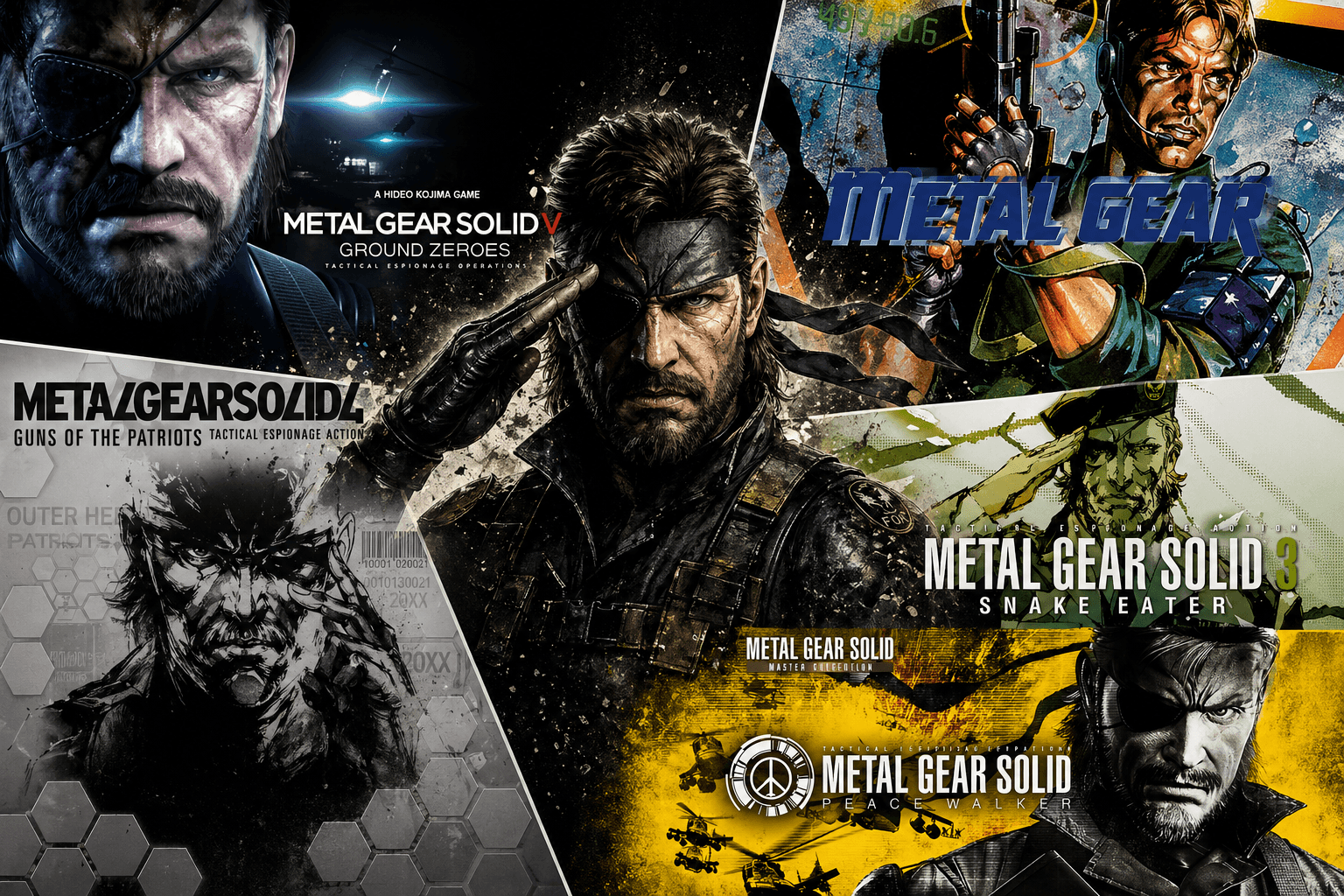
Release order is the correct sequence, and the reason it is correct is that Hideo Kojima built each entry on the assumption that the player had finished the one before. That is not a preference; it is a structural fact about how the series was designed across thirty years, from the 1998 PlayStation original through the 2025 remake. The lineage call Konami and Kojima made in 2001, when Metal Gear Solid 2 opened by directly mirroring its predecessor’s structure, paid forward into every subsequent instalment. Metal Gear Solid 3’s final salute in 2004 carries the DNA of the two games before it; Guns of the Patriots in 2008 closes threads from all four. In 2026, the harder question is not sequence but access. Two mainline entries remain locked behind legacy hardware until August, the rest are spread across three storefronts and two collection volumes, and the window in which the series finally becomes legible as a single body of work on current platforms is now visible.
Quick Answer
Play Metal Gear Solid in release order: MGS1, MGS2, MGS3, MGS4, Peace Walker, Ground Zeroes, then The Phantom Pain. This is the sequence Kojima designed and the one that preserves every twist, callback, and structural payoff across the saga. If you cannot access MGS4 or Peace Walker on current hardware, begin with Master Collection Vol. 1, which covers MGS1 through MGS3 on PS5, Xbox Series X/S, Switch, and PC, and return for Vol. 2 when it arrives on 27 August 2026, bringing Guns of the Patriots and Peace Walker to every modern platform for the first time.

What Order to Play Metal Gear Solid: Why Release Order Is Still Right
The reason release order remains the definitive sequence is that Kojima never built a Metal Gear Solid as a standalone work. Each entry in the series was designed with the previous one as a load-bearing precondition. Metal Gear Solid 2: Sons of Liberty, released in 2001, opens with a mission structure that directly mirrors the 1998 Shadow Moses prologue, and that mirroring is the first move in a thematic argument that only makes sense if the player has already completed what is being echoed. Metal Gear Solid 3: Snake Eater, a 2004 prequel set in 1964, carries the DNA of the first two entries at every level, from its dialogue callbacks to the weight its ending accumulates across things the player already knows. Metal Gear Solid 4: Guns of the Patriots, released in 2008, is the series in full culmination mode, closing narrative threads from every prior title in a sequence that presumes eighteen hours of investment in each predecessor.
Here is the full mainline release order:
– Metal Gear Solid (1998): 11 hours
– Metal Gear Solid 2: Sons of Liberty (2001): 13 hours
– Metal Gear Solid 3: Snake Eater (2004): 16 hours
– Metal Gear Solid 4: Guns of the Patriots (2008): 18.5 hours
– Metal Gear Solid: Peace Walker (2010): 18 hours
– Metal Gear Solid V: Ground Zeroes (2014): 2 hours
– Metal Gear Solid V: The Phantom Pain (2015): 45.5 hours
Total core campaign: roughly 124 hours.
The original Metal Gear (1987) and Metal Gear 2: Solid Snake (1990) are included in Vol. 1 and sit in the orbit around the mainline series as historical artefacts, but MGS1’s opening briefing recaps their critical plot points fully enough that skipping them costs atmosphere, not comprehension.
Playing in release order is not a convention. It is the shape the lineage was designed to take, and each instalment that demanded it paid the investment back in the form of narrative and mechanical depth the series would not otherwise carry.
Chronological Order: When It Makes Sense (and When It Does Not)
The Metal Gear timeline spans fifty years of in-game history, from 1964 to 2014. Chronological order follows Big Boss’s arc before Solid Snake’s:
1. Metal Gear Solid 3: Snake Eater (set in 1964) 2. Metal Gear Solid: Peace Walker (1974) 3. Metal Gear Solid V: Ground Zeroes (1975) 4. Metal Gear Solid V: The Phantom Pain (1984) 5. Metal Gear Solid (2005) 6. Metal Gear Solid 2: Sons of Liberty (2007/2009) 7. Metal Gear Solid 4: Guns of the Patriots (2014)
The problem with this sequence on a first encounter is that experience without history is a partial reading. Metal Gear Solid 3’s closing sequence, in which The Boss accepts her fate in 1964, derives its entire dramatic weight from the player already understanding, through three subsequent games played in release order, what that sacrifice costs across the decades that follow. Played chronologically first, that scene is a plot point. Played after Guns of the Patriots, it is the structural argument of the entire series made visible in a single moment.
The mechanical case against chronological order for newcomers is equally concrete: The Phantom Pain’s open-world stealth sandbox, built on fifteen years of iteration from 1998 to 2015, is the most sophisticated mechanical expression the series reached. Returning from that to the fixed-camera angles and limited movement set of the 1998 original after thirty hours in Afghanistan is a disorienting step backwards that affects how you receive the earlier titles, not because those titles are lesser work, but because the design vocabulary is so different that the contrast reads as regression rather than context.
Chronological order is a replay posture. It recontextualises familiar scenes and deepens the thematic threads between father and son across a timeline the player already understands. For a first encounter, it sacrifices too much of what those threads were built to deliver.

What You Can Actually Play Metal Gear Solid on in 2026
Most guides stop at the sequence. This one does not, because knowing the right order means nothing if the relevant titles are inaccessible on current hardware. Here is the honest picture of what the platform decisions Konami made across the last two decades have done to the audience who comes to the series in 2026.
Playable now on PS5, Xbox Series X/S, and PC
Master Collection Vol. 1 (also on Switch) covers MGS1, MGS2, and MGS3, alongside the original Metal Gear and Metal Gear 2. Every platform that matters in 2026 has access to the first three mainline entries.
Metal Gear Solid Delta: Snake Eater is available on PS5, Xbox Series, and PC. Delta is a ground-up remake rebuilt in Unreal Engine 5, and Konami’s approach mirrors what they did with Silent Hill 2: a faithful remake that modernises presentation whilst keeping the original’s structure intact. Within a release-order playthrough, Delta occupies the same position as the 2004 original. It is not a replacement for MGS3 in sequence terms, but it is the strongest entry point for players who need current-generation controls as a condition of engagement.
Metal Gear Solid V: Ground Zeroes and The Phantom Pain are available via backwards compatibility on PS5 and Series X/S, or natively on PC. The Definitive Experience bundles both.
Locked behind legacy hardware until 27 August 2026
The publishing-window decision Konami and Sony took in 2008 was that Metal Gear Solid 4: Guns of the Patriots would ship as a PlayStation 3 exclusive because the Blu-ray storage format was load-bearing for the volume of cutscene data the title required. That decision gated the most narratively terminal entry in the series to a single platform for the next eighteen years, which is the reason the 27 August 2026 Master Collection Vol. 2 arrival carries the significance it does: it is the first moment Guns of the Patriots is available to anyone who did not own a PS3.
What the platform decision did to the audience across those eighteen years is measurable. A generation of players who came up on PS4 and PS5 reached The Phantom Pain, which is set in 1984, without access to the 2008 instalment set in 2014. The chronological and narrative gap that created is the defining access problem the series has carried since 2008.
Peace Walker carries a parallel trajectory. Released on PSP in 2010, it arrived on PS3 and Xbox 360 via the HD Collection in 2011, making it accessible to console players who had never owned a PSP, but it remained absent from any current platform until Vol. 2. Both titles join every modern platform simultaneously in August 2026.
Until then: if you start today, you can run MGS1 through MGS3 uninterrupted and then move directly to MGSV. Guns of the Patriots and Peace Walker require either a working PS3 or PSP, or waiting until late August.
The Best Starting Point for Absolute Newcomers
Start with Metal Gear Solid (1998) if you can tolerate controls designed for a twenty-eight-year-old hardware set. The 1998 original was built as the franchise’s introduction, establishing every major character, thematic concern, and structural device the series carries forward. Vol. 1 puts it on every current platform for a modest outlay, and it remains the clearest argument for why the lineage that followed was worth building.
Start with Metal Gear Solid Delta: Snake Eater if you need modern controls and current-generation presentation as a condition of engagement. Delta’s Cold War storyline is self-contained enough to work as an entry point, but the callbacks it makes to Shadow Moses and the Tanker Incident are part of the record it assumes you already have. A player coming to Delta first will encounter those references as atmosphere rather than as structural payoffs, which means returning to the 1998 original remains necessary for the Solid Snake arc to carry its full weight.
Do not start with Metal Gear Solid V: The Phantom Pain. Its open-world architecture and deliberately fragmented narrative framing are the product of the design lineage that three prior generations of the series built, and playing it first means encountering the outcome without the cause. The Phantom Pain’s Big Boss is legible because Peace Walker’s Big Boss and Metal Gear Solid 3’s Naked Snake are already part of the player’s history. Without that history, The Phantom Pain is the most mechanically sophisticated entry in the series and the least comprehensible as a story.
One entry is sufficient to determine whether the lineage is worth following. If the first ten hours of MGS1 hold you, the catalogue they connect to will too.

Which Metal Gear Solid Games You Can Skip Without Missing the Core Story
Not every entry is essential to the main narrative record. Here is what you can omit without losing the thread.
Skip: Metal Gear and Metal Gear 2: Solid Snake (1987/1990). Both are included in Vol. 1, and they are structurally important artefacts in the lineage that produced the 3D series, but MGS1’s opening briefing recaps every critical plot point they establish. Playing them later, once curiosity about the origin of the design vocabulary is earned, is the right framing.
Skip: Metal Gear Solid: Portable Ops (2006). Semi-canonical at best, and Peace Walker treads the same narrative and mechanical territory more effectively, with the additional weight of Kojima having considered it part of the core saga.
Skip on a tight schedule: Metal Gear Solid V: Ground Zeroes. This prologue to The Phantom Pain runs roughly two hours across its single mission. It enriches the transition, but The Phantom Pain opens with enough contextual material that a story recap video covers the same ground. If the time is available, play it; if not, the gap is manageable.
Do not skip: MGS1, MGS2, MGS3, MGS4, Peace Walker, or The Phantom Pain. Each entry carries plot threads, character disclosures, and design lineage that the next instalment builds on directly. Removing any of the six leaves visible gaps in the story that no recap or summary adequately bridges.
Six games. Roughly 122 hours. That is the minimum viable path through a saga that spans five decades of Cold War paranoia, nuclear deterrence, and the inheritance of identity across cloned soldiers and surrogate fathers.