Tiny Glade does not tell the player what to build. It offers a meadow, a set of stone-and-timber tools, and the quiet permission to begin. There is no quest, no currency, no failure state, no day cycle ticking toward a deadline. The argument the game is making is structural: that a creative sandbox earns its gentleness not by removing obstacles but by never requiring them in the first place. Whether that argument holds is the question this review is trying to answer.
Game Snapshot
| Developer | Pounce Light |
| Publisher | Pounce Light |
| Release Date | 23 September 2024 |
| Platforms | PC |
| Price | £11.99 | $14.99 |
| Rating | PEGI 3 | ESRB E |
| Genre | Cosy sandbox/Castle-builder |
| Length | Open-ended |
| Install Size | ~2 GB |
Presentation and World Design
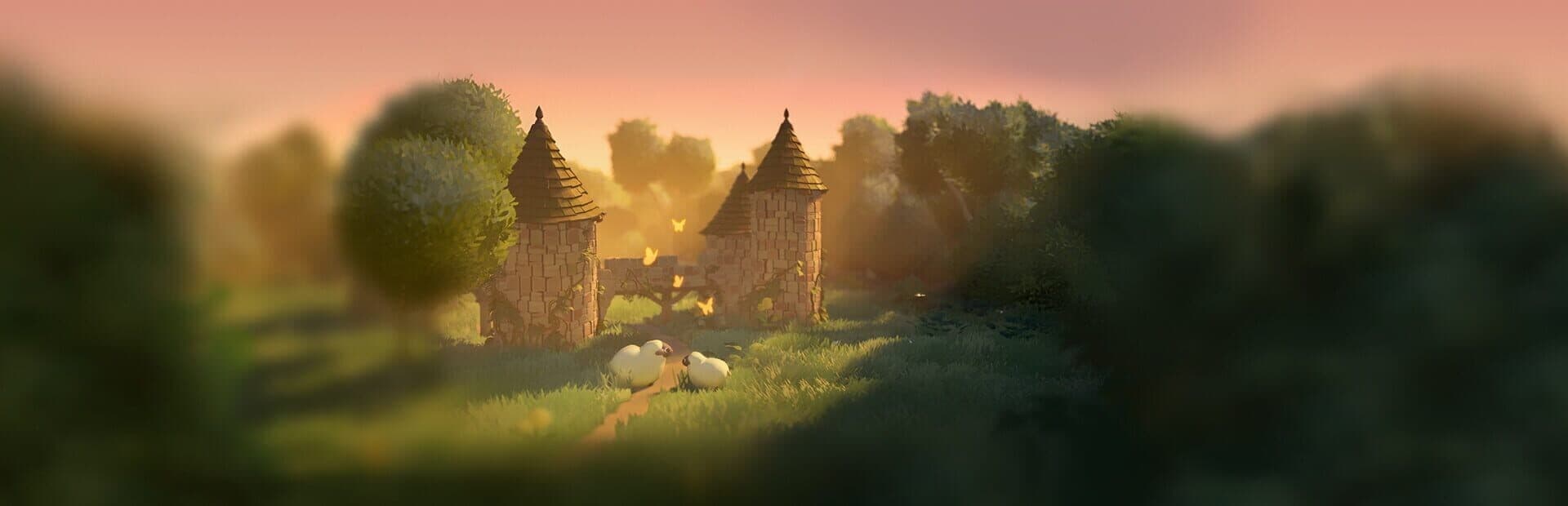
The glade in Tiny Glade has a quality of late afternoon light that the game never overexplains. The illumination arrives at an angle that changes with the season, and the shadows the player’s walls cast are long in autumn and shorter in summer, which is a small formal decision and the correct one. The colour palette is warm without being saturated: sandstone and pale timber, soft grass, the particular grey-green of a moss-covered stone that has been rained on. Nothing insists on itself. The game trusts the eye to settle where it wants.
The seasonal system runs on its own clock, which the player can accelerate or slow. Autumn brings a warm amber to the treeline and scattered leaves on the paths; winter silences the palette and puts snow on the battlement ledges; spring returns colour in a way that the player notices before the game labels it. The weather states follow without announcement: rain arrives, the stones darken, puddles collect between flagstones, and the ambient layer shifts from wind to the particular percussion of water on different surfaces. A tower in rain sounds different from a tower in morning sun, which is how the game earns its atmosphere. It attends to the details before the player does.
The illustrative art style sits somewhere between a picture book and a model village: not photorealistic, not aggressively stylised, but precise in its textures in a way that gives the finished structures a sense of material weight. A wall built from rough stone looks rough. A window arch in pale limestone looks pale. The game renders the player’s decisions with enough fidelity that the work of building feels considered rather than abstracted.

Gameplay and Combat
There is no combat. The verb set in Tiny Glade is narrow and it is the correct width: place a wall segment, raise or lower terrain, add a window, a door, a lantern, a flower box, a path. The tools work by inference rather than instruction. A wall segment placed next to another adjusts to meet it. A tower base generates battlements at the top. A path laid toward a building finds the door. The game watches what the player is trying to do and assists without announcing that it is doing so, which is the small structural courtesy that separates a well-designed creative tool from one that merely allows.
The loop is meditative in the way that a garden is meditative, which is to say that it is not passive. There are decisions to make and most of them are spatial: where a wall should end, how a courtyard should open, whether a bridge serves the structure or just completes a symmetry. The game offers no opinion on these questions. It does not have a scoring system, a tutorial that evaluates the player’s choices, or a final-reveal moment where the finished glade is assessed. The player builds until the building is done, and the definition of done is the player’s own.
This is a formal risk. A game with no win condition offers the player no guaranteed satisfaction arc, and the player who needs external structure to feel productive will find Tiny Glade asks more of their own creative instinct than they may wish to supply. That is not a flaw in the design. It is the game being honest about what it is. The meditative loop earns itself for the player who finds the placing of a window arch in the right wall, in the right season, with the right light, sufficient. The loop is open-ended. That is the point.
The seasonal controls are the only mechanic that approaches a system rather than a tool. Advancing the season changes the light and the ambient layer and the behaviour of the small creatures, rabbits and birds and fireflies, that populate the glade. These creatures arrive without instruction and depart the same way, which is the game’s quietest design decision: something lives here because the player made a space for it, and the game noticed.

Story and Characters
Tiny Glade has no story. This is accurate and also slightly incomplete. A creative sandbox with no win condition and no narrative scaffold is, in one reading, a game with an absence. In another reading, it is a game that trusts the player to supply the narrative from the decisions they make: the walled garden that turns into a small keep, the bridge that leads to a tower the player built to see over it, the path worn from a gate to a well that exists because the space required it. The story is in the arrangement of the glade, and the glade is the player’s.
The small creatures that arrive, rabbits in the grass, birds on the ledges, fireflies in the evenings, carry a lightness that is consistent with the form. They are not characters. They are the game’s way of confirming that the space is inhabited. A structure that has been built with enough intention attracts them, not as a mechanic but as a consequence, and the player who notices that the rabbits prefer the shadowed side of a low wall in the afternoon has paid the kind of attention the game is designed to reward.
Tiny Glade belongs to the same register as Dorfromantik: games that make meaning out of placement rather than event, where the player’s investment accrues through the accumulation of spatial decisions rather than through narrative revelation. The form is not for every player. For the player it suits, the absence of story is not a gap. It is the correct structural choice.

Value and Longevity
At £11.99, Tiny Glade is correctly priced for what it is. The cost of entry buys a creative tool of genuine quality, unlimited in duration and self-directed in scope. The player who builds three glades over a weekend and leaves satisfied has had a good return on twelve pounds. The player who builds thirty glades across a year and still finds things to try has had a better one. The game does not have a content ceiling in the conventional sense, because the content is generated by the player’s own decisions.
The limitation is honest. Tiny Glade is a single-player, single-mode experience with no procedural content, no campaign, no community-challenge layer, and no seasonal event structure. The glade is the glade. The player who has exhausted their own creative ambition within the tool’s vocabulary will find that there is nothing else the game adds. Whether that ceiling arrives in a weekend or a year depends on how much the player brought to the building.
For the player who finds creative sandboxes sustaining over time, the longevity here is substantial. The seasonal controls alone extend the life of an existing glade: a structure built in summer looks different enough in winter to read as a new argument about the same space. That quality of the game, its willingness to reframe the player’s own work without requiring new work, is part of the value proposition that the price point does not immediately suggest. Cozy Grove on Switch 2 offers a different model of sustained cosy longevity, one with daily tasks and a seasonal cadence the game controls, and the comparison is useful: Tiny Glade hands the cadence to the player entirely, which is either liberating or disorienting depending on what the player brings to the glade.

Technical Notes
Tiny Glade runs without incident on a mid-range gaming laptop, which is the correct outcome for a game of this kind. The frame rate holds steadily across all seasonal states including the rain effects and the firefly evening sequences. Load times are brief. The save system is reliable and unobtrusive: the game writes the glade’s state regularly without requiring the player to manage it, which is the kind of save behaviour that only becomes visible when it is absent. No crashes or progression-blocking issues were encountered across the sessions played. Steam Deck compatibility is confirmed at the Verified tier, which means the game runs in handheld mode without manual configuration, and the shorter session structure of handheld play suits the glade-building loop well.
Final Word
The thing Tiny Glade earns, in the end, is a particular quality of a quiet evening: the feeling of having made something without having been told what to make. The moment that holds is a winter one, a small stone keep with snow on the battlements and lanterns lit in the courtyard below, a rabbit in the shadow of the gate arch, the ambient layer down to almost nothing except wind and the settle of the cold. The player built this. The game held the space for it. That division of labour, unhurried and without evaluation, is the form the game is arguing for, and the argument is correct.
FAQ
Is Tiny Glade worth buying?
Tiny Glade is worth buying at its current price for players who find creative sandboxes sustaining. At £11.99 the game offers a building tool of genuine quality with no content ceiling in the conventional sense: longevity is tied to the player's own creative investment. Players who need external structure, win conditions, or campaign progression to feel a game is worth their time will find the open-ended form asks more than they wish to supply. Players who find the placing of a window arch in the right wall, in the right season, sufficient will find this worth considerably more than twelve pounds.
How long is Tiny Glade?
Tiny Glade has no fixed length. The game is an open-ended creative sandbox with no campaign, no win condition, and no content ceiling determined by the developer. A player who builds one glade over a weekend and leaves satisfied has had a complete experience. A player who returns across months and seasons will find the tool accommodates continued use. The seasonal controls allow existing glades to be revisited in different light and weather, which extends the perceived duration of a single creation without requiring new work from the player.
Is Tiny Glade coming to Switch?
As of publication, Tiny Glade is a PC-only release with no announced Switch port. The game is available on Steam and is confirmed Steam Deck Verified, which means it runs well in handheld mode without manual configuration. Players who want a cosy castle-building experience on Nintendo Switch may find the building-adjacent loop of [Dorfromantik](https://spawningpoint.com/dorfromantik-review-2026/) a reasonable point of comparison, though the two games have different approaches to player-directed creative freedom.
What do you actually do in Tiny Glade?
In Tiny Glade the player shapes a glade: placing wall segments, towers, windows, doors, paths, lanterns, flower boxes, and terrain to build a small castle or settlement in a natural landscape. The building tools work by inference, adjusting automatically to the player's intentions, and the game offers no assessment of the results. The seasons change, creatures arrive and depart, the weather shifts the ambient layer, and the glade accumulates the record of the player's decisions. There is no objective and no failure state. The work is the building, and the building is its own reward.
How does Tiny Glade compare to Townscaper?
Both Tiny Glade and Townscaper are creative sandboxes without win conditions, built around the pleasure of arrangement rather than the satisfaction of completion. Townscaper is grid-based and procedural: the player places coloured blocks and the game generates architecture from the pattern. Tiny Glade is more spatially deliberate, offering a wider vocabulary of elements and more direct control over the form of each structure. Tiny Glade also has a seasonal system, weather states, and small ambient creatures that Townscaper does not. Both earn their gentleness by restraint rather than assertion; the player who has exhausted one will likely find the other worthwhile.