REVIEW
8.4· Great
Tiny Bookshop Review: The Cosy Sim That Reads People, Not Markets
Tiny Bookshop review: neoludic's cosy bookshop sim matches books to personalities, not profit margins. Now on PS5 and Xbox Game Pass. Is it worth £16.99?

Opening
Most management games ask the player to optimise a supply chain. Tiny Bookshop asks the player to read a person. The question is never what sells but who needs what. That distinction separates neoludic’s seaside bookselling sim from every other shop-management title in an oversaturated cosy genre, and it is why over 500,000 players have recommended it since the August 2025 PC and Switch launch. The kind of design that trusts the player to read the customer rather than the spreadsheet.
Game Snapshot
| Developer | neoludic games |
| Publisher | Skystone Games / 2P Games |
| Release Date | 7 August 2025 (PC, Switch); 10 April 2026 (PS5, Xbox Series X/S) |
| Platforms | PC (Windows/macOS/Linux, Steam Deck Verified), Nintendo Switch, PlayStation 5, Xbox Series X/S |
| Price | £16.99 / $19.99 (also on Xbox Game Pass from 10 April 2026) |
| Rating | PEGI 12 / ESRB Teen |
| Genre | Narrative management sim |
| Length | Main story: ~16 hours; Main + sides: ~21 hours; Completionist: ~31 hours |
| Install Size | ~500 MB |

Presentation and World Design
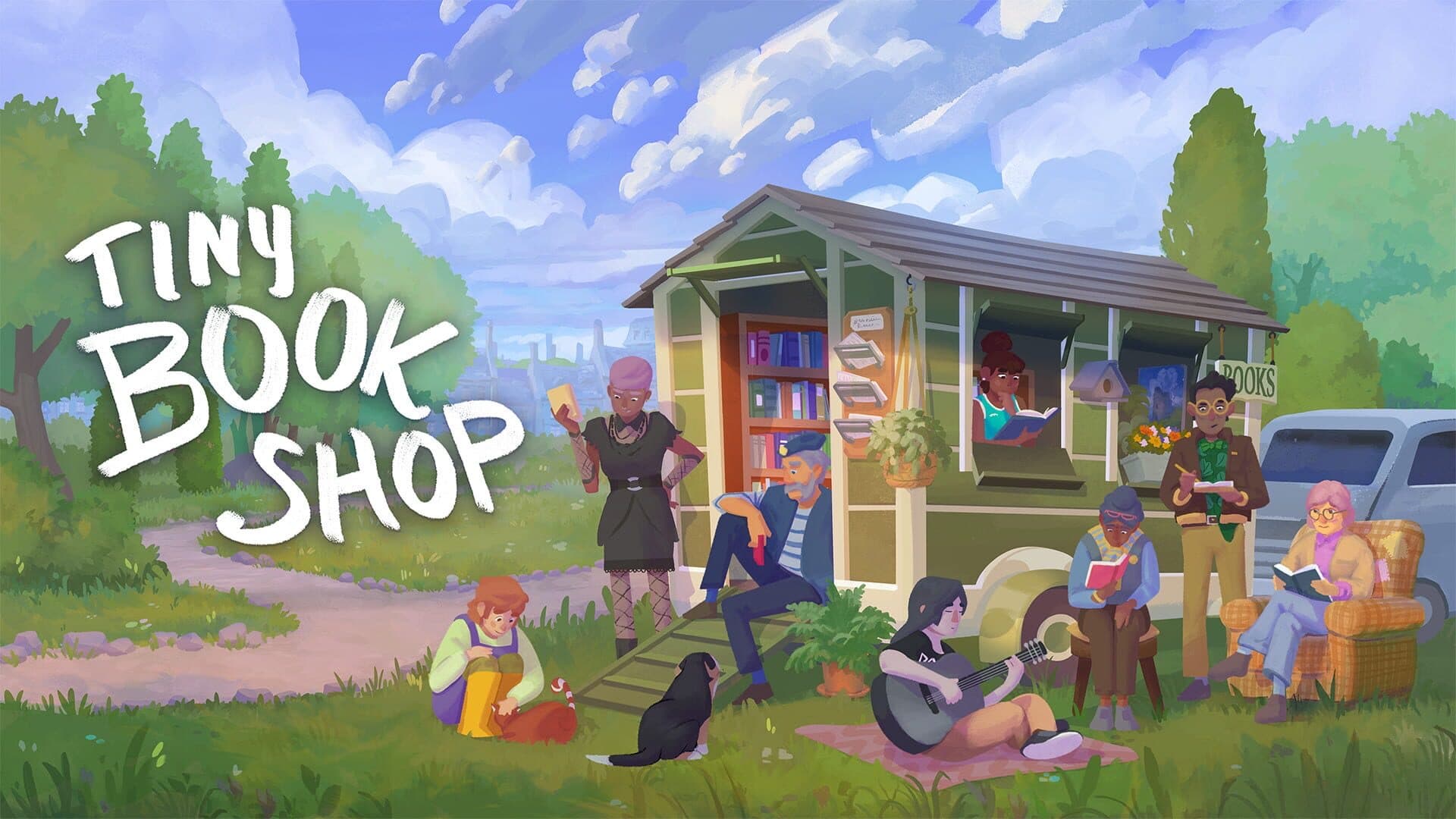
The seaside town in Tiny Bookshop has weather a player can hear before they can see, and the bookshop’s interior catches the light from outside in a way the game never makes a feature of.
The art style favours simplicity over spectacle. Seasonal changes cycle through the town, and each new location, from the seafront to the market square, carries its own visual atmosphere and distinct customer base. The environment is small, but it never feels thin.
The audio earns attention through texture. The painterly approach and the acoustic score share the same logic: nothing here is trying to impress, and that restraint creates a reliable calm.
The shop trailer itself, the mobile bookshop parked at a new location each day, is the game’s primary canvas for personalisation. Decorations are selected during the daily planning phase and affect sales in functional ways, not just aesthetic ones: shelves and display items shift the shop’s genre weighting, so a choice of decor is also a stocking decision. It is a small mechanic, but it gives the environment a purposeful quality that distinguishes Tiny Bookshop from cosy games where decoration is purely cosmetic.

Tiny Bookshop: Gameplay and the Art of Matching

The daily loop runs in a planning phase followed by the shop day itself. Before opening, the player selects books from a pool of available titles across seven genres and arranges them on a maximum of 40 shelf spaces, alongside decorative items and any seasonal additions. The planning phase draws on the previous day's end-of-session breakdown, which tracks genre popularity by location and individual customer requests, rewarding a player who pays attention rather than randomises stock.
The recommendation mechanic is the part the designer got right. Customers describe what they are looking for in personality terms rather than genre labels: one wants something that makes them feel less alone, another is chasing the sensation of a storm at sea. Matching the right book asks the player to read the synopsis of each available title and cross-reference it with the request. Every title in the game is real, drawn from a catalogue that spans literary fiction, manga, crime, and comics, and the synopses are accurate. It is a different proposition from the number-focused systems in most management games, and it earns comparison with the narrative depth found in Venba, where the game's mechanics are inseparable from its emotional subject matter. The game trusts that its players can make genuine literary connections rather than following genre tags mechanically. In practice, this creates moments of minor satisfaction that accumulate across a playthrough.
The roguelite-adjacent structure, a fresh set of available books each day drawn from a randomised newspaper delivery, prevents inventory from becoming predictable. Returning customers and community events add modifiers that shift the day's dynamic, and stocking decisions carry forward across the week. The seven days per week, four weeks per season structure gives the loop a rhythm that suits short sessions: each day takes roughly five minutes of real time, making the game genuinely compatible with the portable play pattern the Switch and Steam Deck versions encourage.
The primary complaint is pacing. Milestones in the community storylines arrive slowly, and the interest curve can flatten around the ten-hour mark before the final acts of each resident's narrative deliver. The RNG element in the daily book pool also occasionally frustrates: if the titles available do not cover a customer's niche request, there is no workaround. The game's no-fail-state philosophy (even accumulating debt does not end the run) moderates this, but the randomness sits in tension with the careful matching the game otherwise asks of the player. Occasionally it tips into slack.
Story and Characters

The eight main residents of Bookstonbury are the reason to play. Tilde is a retired bookshop owner whose relationship with the player's shop carries a particular emotional weight: she gave up the thing the player is building. Klaus is a musician seeking historical grounding for a composition. Fern is an aspiring journalist. Harper is a teenager looking for something to hold onto. Each arc unfolds through a journal system that tracks interactions and unlocks new narrative layers as friendship deepens, and the writing knows when to be quietly funny and when to leave space for something more affecting. Character depth is not uniform across all eight, but the stronger arcs are genuinely well-constructed.
The real-book mechanic extends into the character work. Recommending a particular novel to Klaus does not just fulfil a quest marker; the game acknowledges which book the player chose and why in subsequent conversations. The specificity is rare for the genre. Community events, a beachside bonfire, a street market, an unexpected musical performance, tie individual storylines to the life of the town as a whole, and these moments give Bookstonbury a coherence that single-character-focused life sims sometimes lack. It is a quality shared with Tales of the Shire, where the village as a whole is the emotional subject rather than any one resident. A stray dog encountered during one of the community sequences can be adopted, and this small detail functions as a reliable marker of the game's tonal range: warm without being saccharine, low-stakes without being empty.
For a game whose core pleasure is the satisfaction of a well-made match, the narrative payoffs work best when they arrive with a sense of occasion. The strongest arcs deliver that. A few of the secondary residents do not. Not all eight are equal.
Tiny Bookshop Review: Value and Longevity

At £16.99 / $19.99, Tiny Bookshop sits well below the mid-tier price bracket for a game that offers 16 to 21 hours of substantive content with 31 hours available for completionists. Xbox Game Pass subscription holders gain access from the PS5/Xbox launch date of 10 April 2026, making this the most accessible entry point for new players, though the Switch version, the right fit for the game's short-session loop, remains a valid option. The physical edition includes a digital soundtrack, a digital artbook, and an exclusive physical bookmark, which is a small but characterful addition for collectors.
Replayability is modest. Once the eight main arcs are resolved, there is no New Game+ or escalating challenge mode. The appeal on a second run would be discovering books and making different matches, which suits some readers and not others. For anyone already engaged with the best cosy games on Switch 2 in 2026, Tiny Bookshop earns a place in that list on originality alone. The management genre as a whole has produced a range of takes on the shop-running format in recent years; for a direct-genre comparison, the best cosy games of 2026 feature places Tiny Bookshop among the most particular entries of the period.
Technical Notes
The PC version at launch ran cleanly. The PS5 and Xbox releases on 10 April 2026 carry across the full feature set without platform-specific technical enhancements or DualSense integration notes confirmed at time of writing. A minor text error ("Introcution" instead of "Introduction") noted in the PC version at launch is the most visible polish issue.
The game was briefly removed from the Nintendo Switch eShop during a ratings dispute involving a single word of in-game text before being restored promptly. No gameplay content was altered. The incident is a footnote. The best unhurried games on PS5 in 2026 list places Tiny Bookshop in a strong field on the platform; its technical presentation is competent and unambitious in equal measure, which suits a game whose entire appeal rests on what happens on the page rather than how it renders.
Final Word
Tiny Bookshop works because it is interested in something particular, and that specificity is what the quiet genre too often trades away for broadly pleasant vibes. Recommending Dracula to a teenager who describes wanting something that makes the world feel larger, then seeing that choice acknowledged in a later conversation, is a small pleasure with an outsized return. The pacing asks patience in the middle hours, and the RNG book pool will occasionally leave a customer's request unanswerable. For PS5 players who have worked through the considered catalogue and are looking for something that respects their reading intelligence, this is worth the afternoon. Skip it if mechanical escalation is needed to stay engaged; the loop is deliberately gentle and that quality is non-negotiable. Stay if the idea of a bookshop by the sea, eight people whose stories unfold through what the player puts on the shelf, and a dog who may or may not follow them home sounds like exactly enough.
FAQ
Is Tiny Bookshop worth playing in 2026? Tiny Bookshop is worth playing in 2026 for a reader who wants a narrative management sim grounded in matching books to people rather than maximising profit. At £16.99 the main story runs sixteen hours, with completionist content reaching thirty-one. Xbox Game Pass subscribers receive access from the 10 April 2026 console launch at no additional cost.
How long is Tiny Bookshop? Tiny Bookshop runs approximately sixteen hours for the main story, twenty-one hours with side content, and thirty-one hours for completionists. The pace asks patience in the middle hours as the customer pool and book stock expand, with the strongest moments arriving once the player understands the matching logic and can anticipate which titles will land with which characters.
What platforms is Tiny Bookshop on? Tiny Bookshop is available on PC (Steam, with Steam Deck Verified status), Nintendo Switch, PlayStation 5, and Xbox Series X/S. The PC and Switch versions launched on 7 August 2025; the PS5 and Xbox releases followed on 10 April 2026. Xbox Game Pass includes the game on Xbox and PC from the console launch date.
Is Tiny Bookshop on Xbox Game Pass? Tiny Bookshop is available on Xbox Game Pass on Xbox and PC from 10 April 2026, the date of the PS5 and Xbox Series X/S launch. Game Pass access removes the £16.99 price barrier for subscribers, making it the most accessible entry point for a reader unsure whether the slow-pace matching design suits them.
Useful Links
Summary
Tiny Bookshop is a narrative management sim developed by neoludic games and published by Skystone Games and 2P Games. It launched on PC (Steam Deck Verified) and Nintendo Switch on 7 August 2025, with PS5 and Xbox Series X/S releases following on 10 April 2026, and is included on Xbox Game Pass from the console launch. The main story runs sixteen hours, with side content extending to twenty-one and completionist play reaching thirty-one. At £16.99 the game offers substantive content well below the mid-tier price bracket. The trailer-bookshop premise, the eight-character customer pool with stories that unfold through book recommendations, and the painterly art with acoustic score give the game a specificity uncommon in the gentle genre. A reader who wants fast progression or pure economic optimisation will find the pace wrong. A reader who wants a thoughtful matching sim will find a game without rivals.
8.4
Great
SpawningPoint Verdict
Review summary
Tiny Bookshop is a narrative management sim from neoludic games, set in the fictional seaside town of Bookstonbury. Players run a mobile second-hand bookshop, matching real books across seven genres to customers based on personality and emotional need rather than sales optimisation. A planning phase, daily shop session, and seasonal community events structure the loop, with eight character storylines unfolding through a journal system. The book-matching mechanic, where real synopses inform recommendations, is the genre's most original take on the shop-running format. Pacing flattens in the middle stretch before the final resident arcs resolve. At £16.99 / $19.99, with day-one Xbox Game Pass access on the PS5/Xbox launch, it is one of the cosy genre's most defensibly distinctive releases.