FEATURE
How Tariffs and Pricing Changes Shaped Console Gaming After 2025
Tariffs and price increases reshaped console gaming after 2025. We explain how Xbox, PlayStation and Nintendo were affected, and why pricing influenced the console rankings.

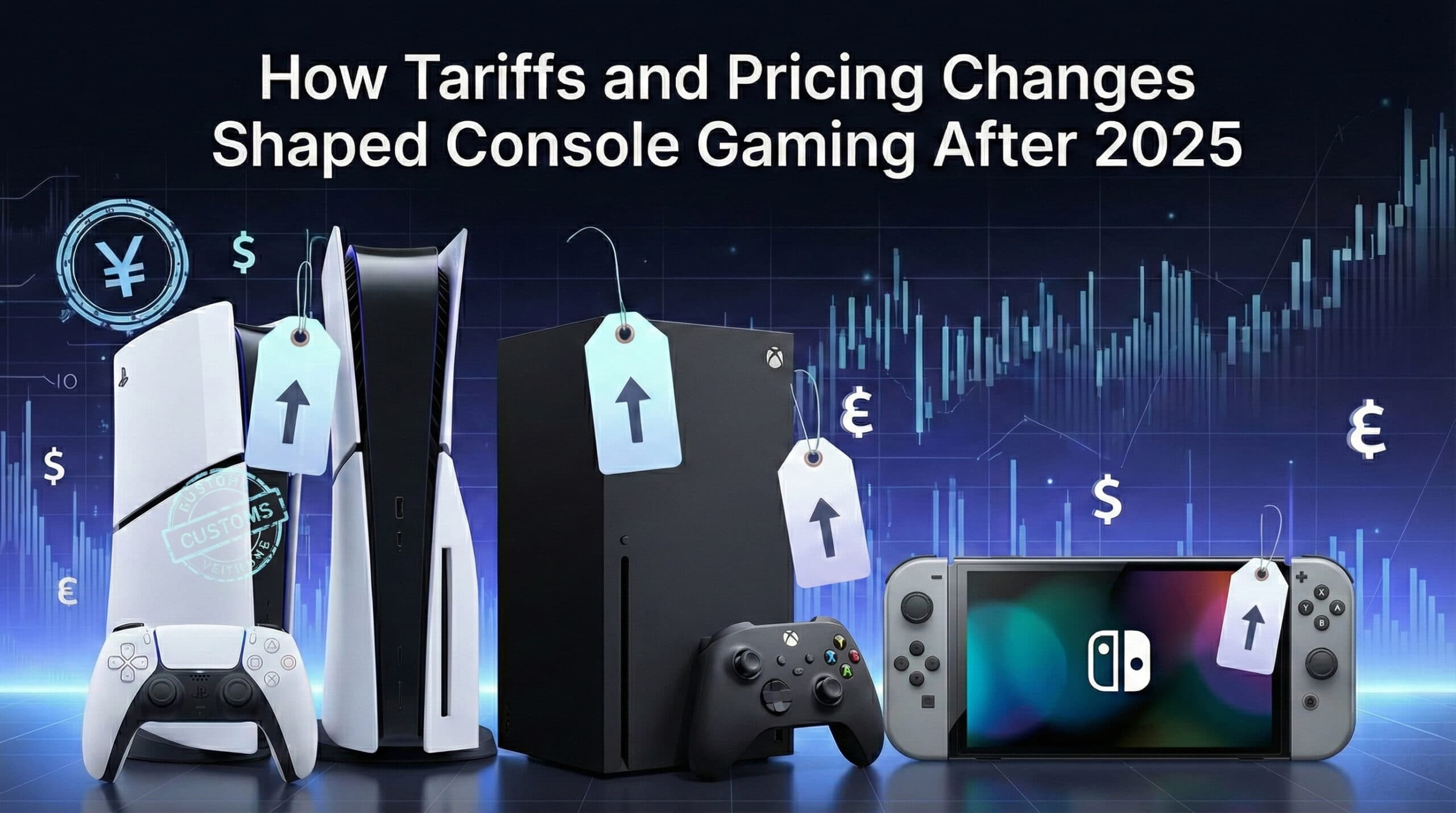
The November 2024 PS5 Pro launch at £699 established something precise before the broader tariff conversation had fully arrived: Sony had decided the upper tier of its audience could be asked to pay significantly more than the generation's original entry point. By June 2025, when Nintendo launched the Switch 2 at £395.99 with first-party software repriced to £67.99, a structural realignment was visible across every platform. The 2025 tariff regime, built around a band of import duties reaching into the 15-25% range on hardware components and assembled consumer electronics, did not create that realignment alone. It accelerated decisions that each platform-holder had already begun making, and it made those decisions legible in pricing in a way that platform strategy alone rarely does. The pricing reset that followed is now part of the record. What the tariff regime did to each platform decision, and therefore to each platform's audience, has shaped the category through 2026 in ways worth tracing carefully.
Why pricing mattered more after 2025
The generation that began in November 2020 had already matured by the time the tariff bands tightened. Each platform carried an established user base, a multi-year software library, and a replacement cycle that was, by 2024, starting to move. Into that environment, a structural cost increase on manufactured hardware created a specific kind of pressure: platform-holders could absorb it internally, pass it to the audience, redistribute it through accessory and software pricing, or some combination of all three. The choice each one made is the lineage call that either paid off or complicated the relationship with the audience it had already built. In a mature generation, cautious buyers looking at upgrade decisions weigh total ecosystem cost, not just console price. What the 2025 pricing reset made clear is that every platform-holder has a theory about how much its audience will follow it upward, and not all of those theories have proven equally well-calibrated.
Xbox: the value narrative under pressure
Xbox Series X launched in November 2020 at £449.99 and $499.99. By 2025, the post-tariff adjustment pushed the Series X to approximately £499.99 and $549.99 in major markets, a moderate increase relative to the generation's arc. Series S held the entry-tier position it was designed for, remaining the more accessible hardware in the range. The structural argument for Microsoft's pricing response is cleaner when you trace the lineage: Microsoft's cross-device ecosystem decision, visible as far back as 2014 when Xbox One launched with a vision of unified Windows and console experience, carries the DNA of treating the subscription as the primary product and hardware as the delivery mechanism.
Game Pass Ultimate's tier restructure across the 2025-2026 window is the publishing-window response to the tariff reset. Rather than defending a specific hardware price point, Microsoft distributed the cost of access across a subscription model that had already trained a significant portion of its audience to measure value monthly rather than per-purchase. What the platform decision did to the audience is that the tariff-driven hardware price increase landed more quietly inside a subscription ecosystem than it would have in a traditional retail-purchase model. Xbox in 2026 has more on how that subscription architecture has held under subsequent pressure. Xbox Series X pricing can be tracked on Amazon.
PlayStation: the premium ladder
PS5 launched at £449.99 and $499.99 in November 2020. The PS5 Pro arrived in November 2024 at £699 and $699, a premium positioning that preceded the full 2025 tariff cycle by several months and established the upper tier independently of tariff pressure. By 2025, the standard PS5 adjusted to approximately £499.99 and $549.99 across major markets, with the Slim variant serving as a form-factor refresh at the generation's mid-point. Sony's premium-ladder strategy is the lineage call here: rather than raising the entry price uniformly across the range, Sony expanded the upper tiers and anchored the generation's perceived value ceiling at £699 before the tariff adjustment was even fully felt.
The consequence of what that platform decision did to the audience is a narrower premium user base at the top of the range and a more porous lower boundary. Sony's PC-port acceleration through 2024 and into 2025 and 2026 is the parallel publishing-window response: a strategy of releasing first-party titles to PC within an 18 to 24 month window of console launch, which generates secondary revenue from an audience that has partially migrated to PC without entirely abandoning PlayStation ecosystem loyalty. That acceleration was underway before the tariff bands tightened, but the post-2025 pricing environment gave it additional justification as a hedge against hardware audience contraction at the premium end. Is PlayStation still worth it in 2026 addresses that audience question directly. Current PS5 and PS5 Pro pricing is available on Amazon.
Nintendo: stability and the lineage call
Switch 2 launched in June 2025 at £395.99 and $449.99. The Mario Kart World bundle launched at £429.99 and $499.99, delivering approximately £30 and $50 of saving against the separate purchase price. First-party software pricing moved to £67.99 and $79.99 from the original Switch's £49.99 and $59.99 baseline, a meaningful step-up that Nintendo framed around the increased development cost of hybrid-console software at the new platform's specification level.
The lineage call is the argument Nintendo has made consistently since 2017: that predictable hardware pricing and clear product identity are competitive advantages in themselves, particularly during periods of broader market turbulence. The thread from the Switch's original launch positioning in March 2017 as a £279.99 home-portable hybrid runs through the Switch 2's 2025 launch without the kind of mid-generation premium-tier expansion that Sony pursued. Where Sony built upward, Nintendo held the structural pricing band stable and moved the per-software cost instead. Whether that trade-off served Nintendo's audience better than a hardware price hold with software costs unchanged is the part of the record still being written; first-party title attach rates across the first year of Switch 2's life will make that call clearer. Switch 2 models and bundles are available on Amazon.
Publisher responses across the 2025 reset
The platform-holders' pricing decisions set the frame, but publishers had to calibrate their own responses to the same structural cost environment. EA and Ubisoft both adjusted regional pricing in major European markets through 2025, with the divergence between dollar-denominated and sterling-denominated pricing narrowing slightly from the decade's earlier pattern of UK consumers absorbing a significant premium. Take-Two's position is the most visible question mark: GTA 6 is scheduled for November 2026, and the reported pricing figure of approximately £65 and $80, attributed to industry tracking by Henderson and others, has circulated without official confirmation. If those figures prove accurate, GTA 6 would land as the highest-priced standard release in Rockstar's history and would function as a de facto industry ceiling test, establishing whether the post-2025 tariff environment has genuinely shifted what the mass market will accept as a new standard release price.
Microsoft's post-acquisition management of Activision Blizzard King titles introduced a different publishing-window question: which catalogue titles remain positioned as Game Pass inclusions and which are sold at premium price points alongside the subscription. That boundary will continue to shift through 2026 as the subscriber base and per-title revenue data mature. Who won console gaming in 2025 provides the broader competitive ranking that contextualises those publisher decisions.
How pricing influenced the 2025 rankings
The causal chain connecting each platform's tariff response to its 2025 competitive position is not complex once the pricing decisions are mapped against the generation's existing trajectory. Microsoft's subscription-first response meant that the tariff-driven hardware cost increase was partially absorbed by an audience already oriented to monthly rather than per-purchase measurement. Sony's premium-ladder response meant that the PS5 Pro's £699 positioning arrived before the tariff bands had fully tightened, giving Sony a revenue buffer at the top of the range while the standard tier adjusted more modestly. Nintendo's software-pricing step-up meant that Switch 2's launch revenue model accounted for the higher development cost directly, without requiring a hardware price that would have pushed the platform's entry point above the region where the Switch had historically operated most effectively.
None of those responses were reactive to the tariff environment in isolation. Each one reflected a longer strategic posture that the tariff environment made more visible and more consequential.
Where the reset still moves through 2026
The structural shifts from the 2025 pricing reset are not yet fully resolved. Regional pricing convergence, particularly between sterling and dollar-denominated markets, continues to be renegotiated across platform-holders and major publishers. The premium-tier versus accessibility-tier audience split that Sony's ladder strategy and Nintendo's software-price step-up both contributed to is now a more defined feature of the category than it was at the generation's start. GTA 6's November 2026 launch will function as the clearest single data point on whether the post-2025 cost environment has genuinely shifted mass-market price tolerance or whether a £65 to £80 ceiling remains the point at which a significant portion of the audience pauses rather than follows. Publishing-window decisions for major 2027 titles are already being made inside that uncertainty, which means the tariff regime's consequences extend further into the planning cycle than the pricing adjustments themselves might suggest.
What this means for buyers in 2026
For buyers in 2026, the practical consequence of the 2025 pricing reset is that the cost of entry varies more clearly by platform tier than it did at the generation's start. The choice between platforms is now also a choice between different theories of what an audience owes a platform-holder, and what it receives in return. The best console to buy in 2026 maps those trade-offs against specific buyer profiles, with the full pricing ledger as it currently stands across Xbox, PlayStation, and Nintendo.