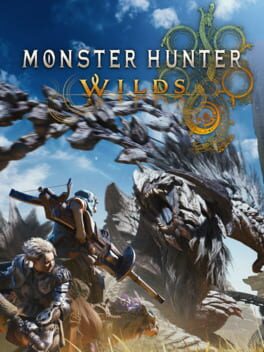
Monster Hunter Wilds does not rebuild the contract; it sharpens it. What Capcom’s Production Studio 6 has constructed across the Forbidden Lands is the clearest argument the series has made in fifteen years for why this particular encounter loop is the right one: you read the monster, you learn its attack cycle, you close the distance at the moment the opening appears, and the system rewards the player who has built that literacy over the player who has simply kept swinging. The Monster Hunter Wilds review question is not whether the hunt works. It works. The question is what Focus Mode and the wound system actually argue, whether the biome design is doing structural encounter work or set-dressing, and whether five apex monsters across five major environments constitute an escalation or an inventory. They constitute an escalation. The evidence follows.
Game Snapshot
| Field | Detail |
| Developer / Publisher | Capcom (Production Studio 6) |
| Release Date | 28 February 2025 |
| Platforms | PS5, Xbox Series X/S, PC (Steam) |
| Price | £59.99 | $69.99 Standard; up to $99.99 Deluxe | Premium |
| Rating | PEGI 16 | ESRB T (Teen) |
| Genre | Monster Hunter/Action-RPG |
| Length | ~50 hours (main); 100+ hours (endgame + Title Updates) |
| Install Size | ~75 GB |
Presentation: The Forbidden Lands as Architecture
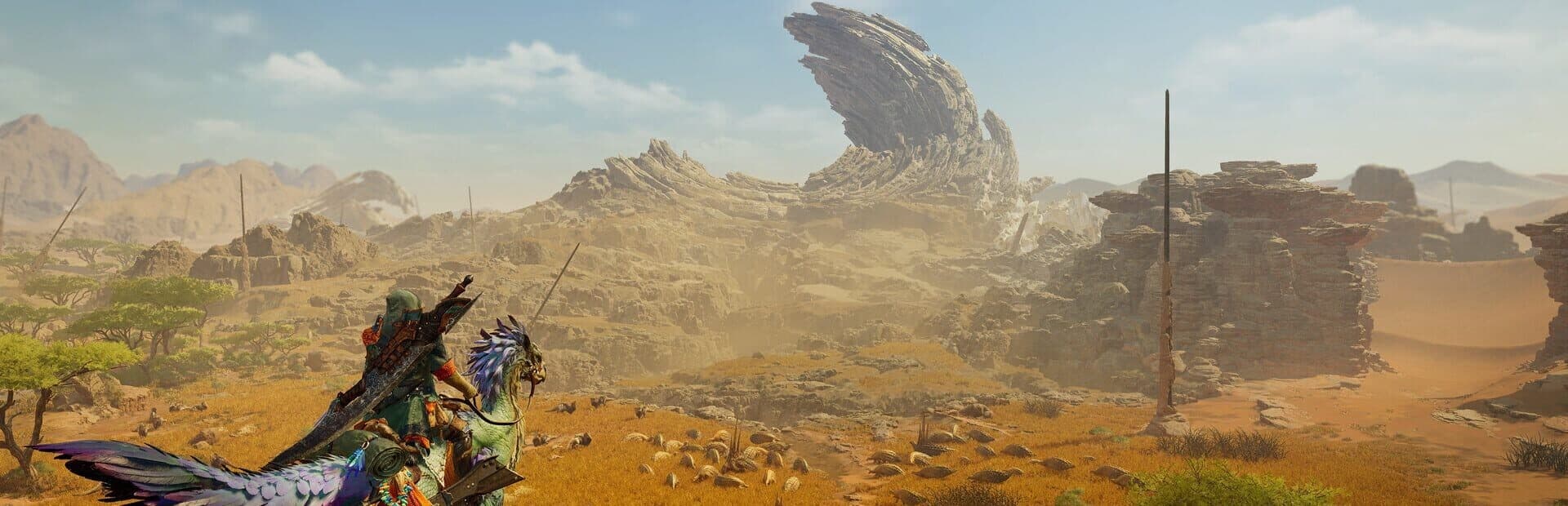
The Forbidden Lands are five biomes, and the biomes are doing encounter work that the series has rarely attempted at this scale. The Windward Plains function as the game’s tutorial environment in a structural sense: the sightlines are long, the terrain is navigable, and the Doshaguma packs use the open ground to establish what herd-encounter choreography looks like before the harder environments close that geometry down. The Scarlet Forest reduces those sightlines significantly; the canopy and the red bioluminescent undergrowth remove depth information that the open Plains terrain provided freely, which changes what the player can read about incoming Uth Duna attacks before they land. The Oilwell Basin takes this further: the slick surfaces and the vertical shafts of the Basin are load-bearing constraints on the Nu Udra encounter, not art-direction choices applied over a neutral space.
Wyveria and the Iceshard Cliffs operate similarly. The ice geometry of the Cliffs is not merely atmospheric; it establishes the ground-surface conditions that shape the Jin Dahaad encounter’s movement economy. The player who has read the Cliffs as a space before the fight is better positioned than the player who arrived at the encounter without that spatial mapping.
The weather system, which shifts biome states dynamically across Sandstorm, Fallow, and Inclemency phases, changes encounter conditions in ways that are legible once the player has seen each phase. Inclemency in the Windward Plains does not simply make the fight look different; it changes the attack priority of the monsters in it, which the player can learn and act on. That is weather used as design.

The Hunt System: Focus Mode, Wounds, and What They Argue
Focus Mode is the hunt system’s new central argument: it creates a precision-targeting layer over the existing damage loop and asks the player to decide, during every fight, when the precision investment is worth the mobility cost. The argument is honest because the choice is genuine. Staying in Focus Mode narrows the player’s dodge window; exiting it loses the wound-building pressure. The fight becomes a sequence of managed commitments rather than a continuous output loop, and that distinction matters for what the system teaches.
The wound mechanic is the structural consequence of sustained Focus Mode use: repeated precision strikes on a weak-point accumulate wound-state until a wound opens, and wound-targeting deals substantially increased damage. The contract the system offers is legible: focus long enough to open the wound, then capitalise on the window before the monster’s attack cycle closes it. The question is whether the monster’s attack vocabulary has been telegraphed clearly enough to make that timing readable, and for the named apex encounters it consistently has been.
What the wound system argues most clearly is that Monster Hunter Wilds is staging encounters around the concept of earned openings rather than sustained pressure. The Charge Blade and Long Sword players who have been finding their own openings since World are given a more explicit accounting system for what they were already doing; the Hammer and Great Sword players who depend on large openings get a mechanic that rewards the same patient positioning their weapon schools have always required. The system is not a new contract: it is a more legible version of the contract the series has always offered.
The Seikret mount replaces the Palamute functionally but does something the Palamute did not: it integrates into the hunt-positioning loop rather than sitting outside it. The Seikret carries the player to a target’s location, but the dismount timing affects the opening position of the hunt. A player who arrives from a higher elevation has a different set of initial approach options than one who arrives at ground level. That integration is a small detail with a genuine encounter-design consequence.
The stagger economy, which is the shared currency of all 14 weapon types, remains the load-bearing system underneath the new additions. Focus Mode and wounds are arguments built on top of the stagger foundation; they do not replace it. A player who understands how accumulated stagger state produces exploitable windows, who can read the difference between a monster’s recovery animation and a feint, has the vocabulary the new systems reward. A player who does not is given more explicit signals to build it.
Performance on PS5 is stable throughout. Frame-time holds across the major arena encounters, including the Zoh Shia climax sequence, which is the heaviest visual load the game places on the hardware. Nothing here requires a footnote that affects the encounter-design assessment.

Weapon Types and How the Moveset Reads
The 14 weapon types carry their lineage from World and Rise with meaningful refinements and no regressions. The Long Sword’s Iai Slash counter window has been tightened relative to Rise, which is the correct decision for an encounter-design environment where telegraphs are more readable: a generous counter window in a readable-fight system produces a weapon that is too rewarding for too little investment. The tighter window asks the player to actually read the overhead before committing.
The Charge Blade’s Savage Axe mode finds a more productive role in Wilds than it had in World, because the wound system creates explicit targets for the mode’s burst damage that the player can plan around. The parry window on the Guard Point counter remains among the tightest in the weapon catalogue; the fight needs to have been read carefully enough that the player knows which attack is coming before it arrives. Against the named apex encounters, that information is available. The moveset reads.
The Insect Glaive’s aerial repositioning is the most changed in mechanical terms: the Kinsect system has been simplified without losing its core identity, and the aerial attacks have been brought into tighter alignment with the wound-building pressure of Focus Mode. A player who has not committed to aerial positioning in previous Monster Hunter entries will find the Glaive’s strengths more accessible here; a player who built their toolkit in World’s aerial-Glaive meta will find the simplified Kinsect management a reduction in complexity they may not welcome.
The Hunting Horn’s buff-support role has been clarified: the instrument mechanic produces more legible feedback about which buffs are active, which makes the weapon more readable to players learning it and does not diminish what experienced players were already doing. The Long Sword, Great Sword, and Charge Blade are the weapons this review’s encounter-analysis sections focus on, because they represent the clearest expressions of the wound-system argument. The remaining eleven weapon types are not diminished by this selection; they are the game’s acknowledgement that the contract can be held across a wide range of play styles.
Named Monsters: Five Apex Encounters
Doshaguma stages the encounter as a herd-architecture problem before it stages it as a solo-fight problem, and that sequencing is the correct instructional order. The pack hunts cooperatively: smaller Doshaguma create flanking pressure while the alpha repositions. The player who has been managing pack composition, prioritising the smaller threats before they create positioning problems, arrives at the alpha solo-encounter with a cleaner spatial map than the player who rushed the alpha immediately. The encounter argues that Monster Hunter Wilds is interested in the space before the fight, not just the fight.
Rey Dau is the game’s clearest expression of what Focus Mode is for. The electric flagship’s weak-points are the target the wound system is designed to hit, and the encounter stages itself around teaching the player to read the overhead attack that creates the window for sustained Focus Mode application. Once the moveset reads, the rey dau encounter becomes a structured exercise in commitment and recovery: commit to the wound-building sequence during the opening, exit before the tracking sweep closes the gap, re-enter when the next opening appears. The stagger economy is explicit here in a way that rewards the player who has been building it consciously.
Uth Duna earns the cost of the Scarlet Forest’s reduced sightlines. The water-tendril attacks are telegraphed through audio cues and subtle pre-attack animations that the sightline reduction forces the player to learn rather than see from a distance. The fight is staged for close-range engagement, and the Scarlet Forest’s geometry is the constraint that produces that staging requirement. A player who has been reading the forest environment before the hunt encounters Uth Duna with a spatial model that is already partially correct.
Nu Udra in the Oilwell Basin is the mid-campaign apex encounter that most clearly demonstrates how biome geometry shapes attack vocabulary. The tentacle sweeps use the Basin’s vertical space in ways that require the player to track elevation as well as lateral positioning, and the oil-surface ground state introduces a friction variable that the moveset reads differently across wet and dry ground. The encounter design accounts for that variable: the attacks that are punishable on dry ground are the attacks that are unsafe to punish on oiled surfaces, which is the correct level of encounter specificity for a game in this series.
Jin Dahaad in the Iceshard Cliffs is the game’s best-staged named encounter: the ice architecture creates elevation options that the fight’s attack vocabulary is designed to use, and the phase transition in which Jin Dahaad moves deeper into the Cliffs’ interior changes the arena geometry in a way that recontextualises the approach options established in the first phase. Everything the player learned about Jin Dahaad’s attack cycle in phase one remains true and is now applied to a space that rewards different positioning. That recontextualisation is encounter design as argument.

Story and the Forbidden Lands Frame
The Forbidden Lands’ narrative is staging itself around an ecological mystery rather than a villain, and the distinction produces a story that is more interesting as world-building than as dramatic structure. Alma functions as the player character’s liaison to a research expedition investigating the Forbidden Lands’ ecosystem, and the ecological framing gives the narrative a logic that connects the biome design to the story in ways the series has not consistently achieved. The Zoh Shia encounter’s climactic role is prepared by the ecological argument rather than arriving as an arbitrary final boss: the game has been building toward what the Forbidden Lands’ apex predator ecology means for the region, and Zoh Shia is the answer to that question.
The weakness in the narrative is structural rather than dramatic: the pacing of the middle-act story beats stalls in the Oilwell Basin section, where the ecological mystery’s answers are supplied too quickly relative to the encounter-design escalation the game is simultaneously building. The story catches up with the encounters in the Iceshard Cliffs section and the Wyveria conclusion, but the mid-campaign rhythm unevenness is the one place where the game’s two concurrent arguments, the hunt system and the world’s ecological frame, pull against each other rather than reinforcing.
What the narrative routes through systems is more interesting than what it says directly: the ecosystem relationships visible in the field, the predator-prey hierarchies the player observes before engaging, are doing world-building work that the cutscene dialogue covers with less efficiency.
Endgame, Title Updates, and the Hunter’s Pass Question
The endgame content in Monster Hunter Wilds is the hunt loop operating at a higher encounter-design register, and it functions correctly. High-Rank hunts tighten the attack vocabulary’s timing requirements and add attack combinations the base-rank encounters withheld, which is the correct escalation structure: the teaching is complete before the test is made harder. The Arch-Tempered variants introduced through Title Updates 1-3 operate at the outer edge of what the moveset economy can sustain, and they are the right target for endgame players who have built their vocabulary across the full hunt catalogue.
The Mizutsune and Lagiacrus returns through Title Update content are both staged correctly: neither is transplanted into the Forbidden Lands’ encounter design without adjustment, and both use the wound system in ways that read like designed choices rather than retrofits. Lagiacrus in particular benefits from the Focus Mode mechanic, because the electrical weak-point positioning is exactly the kind of sustained precision commitment the mechanic was built to reward.
The Hunter’s Pass question is a value-for-time calculation rather than a design-integrity question. The base game’s content, the five major biomes, the fourteen weapon types, the apex encounter roster, and the endgame High-Rank structure, is complete without the pass. The pass adds cosmetic progression and the hunter pass seasonal content track. It does not affect the encounter design. Whether the premium pricing is appropriate at £59.99 standard is answered by the main-campaign length and the endgame roster: roughly 50 hours of designed content before the endgame opens, and a well-populated endgame that has grown across three title updates at the time of this review. The value holds. The premium editions are cosmetic additions to a complete purchase.

Final Word
The Jin Dahaad fight, in the moment the phase transition changes the Iceshard Cliffs’ geometry and the player realises that the first phase’s positioning vocabulary has been recontextualised rather than discarded, is when Monster Hunter Wilds confirms its argument. The hunt system has been building toward exactly that kind of payoff since the Windward Plains introduced Doshaguma’s herd architecture: every encounter has been teaching the player to read a more specific version of the same vocabulary. The difficulty is earned because the teaching is honest.
The game is for players who are prepared to build that vocabulary across the full encounter roster; the entry point is more accessible than World’s was, and the system scales correctly toward the Arch-Tempered endgame. Players who want to understand what an encounter-design loop looks like when it has been refined over fifteen years of iteration: this is the current answer. Players whose interest in action-RPGs is primarily narrative will find the story competent and the hunt loop occasionally slower than their patience for it. The contract is clearly stated from the opening hunt.
FAQ
Is Monster Hunter Wilds worth it in 2026?
The base game delivers roughly 50 hours of main-campaign content followed by a populated High-Rank endgame that has grown across three Title Updates since launch. The Arch-Tempered variants and the Mizutsune and Lagiacrus returns have added material the endgame players are using actively. At standard pricing, the value-for-time calculation is straightforward: the hunt system is the most refined version of the series' core loop, and the content volume supports extended engagement for players who commit to it.
What is Focus Mode in Monster Hunter Wilds?
Focus Mode is a precision-targeting layer that the player activates during a hunt to concentrate strikes on a specific weak-point. Sustained Focus Mode use on a weak-point builds wound state until a wound opens; wound-targeting deals significantly increased damage. The trade-off is reduced mobility while Focus Mode is active, which narrows the player's dodge window. The mechanic creates a genuine commitment-versus-mobility decision in each encounter rather than incentivising continuous output.
Do I need to play Rise or World before Wilds?
No prior Monster Hunter entry is required. Wilds introduces its hunt vocabulary from the opening sequence and builds the encounter complexity gradually across the five Forbidden Lands biomes. A player new to the series will find the opening biome's sightlines and encounter pacing calibrated to the series' core concepts before the more demanding apex encounters arrive. Prior Monster Hunter experience with the 14 weapon types will produce faster vocabulary-building; it is not a prerequisite.
How does Monster Hunter Wilds compare to World?
World established the open-environment hunt loop and the quality-of-life systems that made the series accessible beyond its traditional audience. Wilds builds on that foundation with Focus Mode and the wound system, which add a precision layer that World's encounter design did not have. The Forbidden Lands' biome design is more encounter-integrated than World's Wildspire Waste or Ancient Forest: the terrain actively shapes attack vocabularies rather than serving as navigable backdrop. Wilds is the more architecturally ambitious game; World's encounter roster remains deeper.
Is the Hunter's Pass worth buying?
The Hunter's Pass adds cosmetic progression and the seasonal content track; it does not affect the encounter design, the weapon roster, or the endgame structure. The base game is complete without it. Players who engage with seasonal content tracks in live-service games and value cosmetic customisation will find the pass offers appropriate returns for that investment. Players who are primarily interested in the hunt system have no functional reason to purchase beyond the standard edition.
8.9
Great
SpawningPoint Verdict
Review summary
Monster Hunter Wilds is the most architecturally coherent entry the series has produced. The Forbidden Lands' five biomes do not merely house encounters; they shape the attack vocabularies of the apex monsters assigned to them, and the encounter sequence across those biomes constitutes a genuine escalation from Doshaguma's herd choreography to Jin Dahaad's phase-transition recontextualisation. Focus Mode and the wound system add a precision-commitment layer to a stagger economy the series has refined for fifteen years, and the 14 weapon types are the most legible they have been in that span. The Story's mid-campaign pacing is the one place where the dual arguments of hunt system and ecological narrative pull against each other. The endgame and Title Update additions have grown the content substantially since launch. The contract is clearly stated. It holds.