REVIEW
9.2· Outstanding
Mario Kart World Review 2026: Nintendo’s Open-World Kart Racer for Switch 2

The thing the rainbow road does, in this game, is sit at the edge of an actual landscape rather than float inside a void. You can see the bridge from the field below it, before the race ever calls you to drive it. That single design choice, presumably invisible to most players, is what Mario Kart World is built around: a racer that has decided its tracks should belong to a place, not the other way round. Nintendo has been pointing at this idea since Mario Kart 8 first borrowed gravity from F-Zero. With World, on Switch 2, it has finally arrived. The result is the kind of design that respects the player’s afternoon: a racer you can dip into for forty minutes without feeling shortchanged, and one that quietly rewards the longer evening when you have it.
Game Snapshot
| Field | Value |
| Developer | Nintendo EPD Production Group No. 9 |
| Publisher | Nintendo |
| Release Date | 05 June 2025 |
| Platforms | Nintendo Switch 2 |
| Price | £66.99 | $79.99 |
| Rating | PEGI 3 | ESRB E (Everyone) |
| Genre | Kart racing, open world |
| Length | Indefinite; Grand Prix cups run roughly four hours, Knockout Tour and Free Roam scale to the player |
| Install Size | Approximately 23 GB |
Presentation and World Design
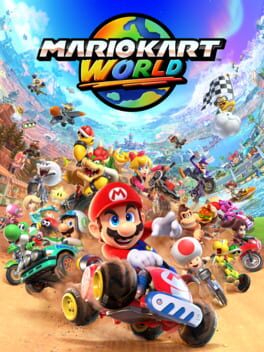
The most noticeable thing about World, on a first afternoon with it, is that the tracks are connected. Not in the loading-screen sense of being adjacent menu entries, but in the literal sense: the road from one course continues, after the finish line, into the road that becomes the next one. The geography is one place. Knockout Tour, the elimination mode that strings six courses into a single run, builds its whole structure on that fact, and the structure only works because the world it is moving through holds together as terrain.
The art direction is unmistakeably Nintendo. Bright primary colour, exaggerated proportion, landmarks readable from a long way off. What is new here is the layering: a field that you race across in one event is the same field you can wander into during Free Roam, and the lighting registers the change. The morning of a Grand Prix has a different palette to the late-afternoon ambient of a wander. The game never calls attention to this. It simply does it.
No single biome overstays its welcome. The desert opens out into a coastal stretch, the coast turns into an alpine pass, the pass drops into a wooded valley, and each of these transitions is a real transition rather than a menu cut. The dedicated photo function, which lets the player capture group shots with friends during online sessions, sits in the world rather than over it. It is a small feature, easy to miss in a feature list, and it is one of the clearest signals that the developers understood what they had built. The world is the work. The races are how you visit it.

Gameplay and Combat
Mario Kart‘s drift-and-boost is intact, which matters first because nothing the game does elsewhere would survive a broken core. The drift still rewards the held-charge mini-turbo. The item economy still tilts the lobby through blue shells and bullet bills. The eight-racer fundamentals are recognisable inside the first lap of any cup. That is the floor the rest of the design stands on, and the floor is solid.
What changes is the shape of the track. Without enclosing walls, the wide shoulders let the kart carry corner-exit speed into ground the older Mario Karts would have ruled out of bounds. The lines are looser. The race rewards the player who notices the shortcut across the meadow, but does not punish the player who stays on the asphalt; both are reading the same geography differently. This is the kind of design that trusts the player to find their own register. The result is a racer that breathes more than its predecessor did.
Knockout Tour is the standout. Six connected courses, eight racers at the start line, two eliminated at each checkpoint, one winner across roughly fifteen minutes of continuous play. It strips patience away in a different sense to Grand Prix’s cup structure: the threat is not a bad finish in one race, it is a slow stretch across any of six in sequence. The mode asks for a kind of pacing the genre has not asked for before. By the third or fourth round it is clear that the design has earned the format, not borrowed it.
Free Roam is the inversion. No timer, no leaderboard, no win state. The player drives because the landscape is there to be driven through, and the game has set up enough ambient detail, photo spots, the small variation in road surface across the seasons, to make the driving its own occupation. The two modes share the same handling and ask opposite things of it. One demands precision under elimination stakes; the other rewards aimless attention. Both are at home in the same world.

Story and Characters
There is no story. The familiar roster is selectable from the menu, the karts are personalised in the familiar way, the cups are won and the trophies appear in their cabinet, and that is the extent of the narrative apparatus. Mario, Luigi, Peach, Bowser and the wider cast each carry small handling differences. None of them carry an arc.
This is the right call for the game World is, which is a racer about a place. The setting is doing all the storytelling. The transition from coast to alpine pass is not annotated; the player crosses it and registers the change in light, weather and palette, and the game trusts the player to do that work without commentary. The narrative is the rhythm of moving through the world. The narrative is the rhythm itself.
Free Roam reinforces this. Drive far enough off the racing line and you will find the small landmarks the developers have placed there: a particular tree at the edge of the field, the bend in the river by the village, the wind turbine on the alpine ridge that looks different at sunrise to how it looks at dusk. The game does not direct the player to these places. It simply makes them, and lets the noticing happen, and counts on the noticing as the form of attention the game most wants from its audience.

Value and Longevity
The longevity question is honestly answered. Grand Prix mode, played through every cup at 150cc, takes roughly four to six hours. Knockout Tour scales differently: a single run is fifteen minutes, but the structure produces variation across runs that does not exhaust in the way of a fixed cup, and the lobby diversity online keeps the format alive past dozens of sessions. Free Roam has no completion state. It is more a place than a thing to finish.
The launch price sits at the upper end of the platform, which is the conversation it should provoke rather than the conversation that ends the question. Mario Kart 8 Deluxe held its asking price across years for the obvious reason: there were no peers, and the gameplay rewarded the kind of return that flattens cost-per-hour to a low number. World will likely do the same on Switch 2. The variety across the connected world, the genuine novelty of Knockout Tour, the fact that Free Roam is the kind of thing one wanders into for ten minutes that becomes forty: this is the structure of a game that gets returned to rather than completed.
Online lobbies support up to eight racers. There is no in-game spend asking for additional money once the cartridge is purchased. The longevity case is straightforward.

Technical Notes
The game runs without incident on Switch 2 in handheld mode across the sessions played: stable frame rate, clean transitions between connected courses, audio mix held across all the weather variants. Resolution and frame-rate targets are not the substance of this review because, in this context, they are not the substance of the experience. Performance in a Mario Kart is the absence of a problem, and the absence is in good order.
Docked play shows the same composure. Load times between menu and Grand Prix start are short. The save system writes reliably across sessions. The only mild note is that Free Roam’s ambient music layer can feel thin in the alpine biome compared to the coastal stretches, which is a small mixing observation rather than a structural fault.
Final Word
There is a stretch of road in this game, between what used to be Mushroom Bridge and what used to be Wario’s Stadium in the older games, where you can see both places from the seat of the kart at the same time, in different light. The first time you drive it, in Knockout Tour, you do not have time to register what you are looking at. The second time, in Free Roam, you slow down and you notice. Mario Kart World has built the kind of design that rewards both kinds of attention without making either choice the wrong one. It is the cleanest argument for the Switch 2’s existence the platform currently has. It is also the kind of game that will sit on the short list of games this year that felt genuinely generous with their time. That distinction is the correct one, and this game lands on the right side of it.
FAQ
Is Mario Kart World worth buying on Switch 2?
It is, with one caveat. Mario Kart World is the game the Switch 2 was waiting for: a first-party flagship that uses the hardware to do something the older platform could not, which is hold a single connected world together across every mode. The caveat is the launch price, which sits at the upper end of the platform's range. For players who already know they will return to it across the year, the cost-per-hour will flatten quickly. For players who finished Mario Kart 8 Deluxe and never went back, the maths is harder.
What is Knockout Tour in Mario Kart World?
Knockout Tour is the elimination mode where eight racers start a six-course run and two are cut at each checkpoint. It rewards consistency across courses rather than a single strong race, which is a different kind of pressure to the Grand Prix structure. The mode plays for roughly fifteen minutes per run, and its design earns the format by the third or fourth session: it does not feel like a Grand Prix with a punishment layer on top. It feels like its own format, built into the connected geography Mario Kart World is built around.
How does Free Roam work in Mario Kart World?
Free Roam lets the player drive across the entire connected world with no race, no timer, no leaderboard and no win condition. The dedicated photo function lets players capture group shots at scenic spots during online sessions, which gives the mode a quiet social register. It is closer to a wander than a race. The connected geography means you can drive from a coastal stretch to an alpine pass without a menu cut, and the lighting and palette register the change as you go. Whether this mode lands for an individual player depends on whether the player wants the kind of attention that drives slowly through a landscape, or the kind that wins a cup.
Is Mario Kart World the best Mario Kart?
It is the most ambitious one, and on a first season's playing it sits at the top of the series. Mario Kart 8 Deluxe held the series-best position for years on the strength of polish and content depth; World takes a different route, building its argument on connected world design and the new Knockout Tour format rather than on a long DLC roadmap. Whether it holds across the years depends on what Nintendo does with post-launch content. On the evidence available at launch, this is the most structurally interesting Mario Kart the series has produced.
How does Mario Kart World compare to Mario Kart 8 Deluxe?
World is a Mario Kart 8 Deluxe with a different design instinct. The drift-and-boost core is recognisable inside the first lap of any cup, and returning players will find the handling familiar. What is new is the world holding together as a place, the wider shoulders that let lines breathe, the Knockout Tour format, and the Free Roam mode that turns the racing geography into a wander. Players who already own Deluxe and play it monthly will find World worth the upgrade for the new modes; players who play Mario Kart twice a year will find the case harder to make at launch price.
9.2
Outstanding
SpawningPoint Verdict
Review summary
Mario Kart World is the racer Nintendo has been pointing at since Mario Kart 8 first borrowed gravity from F-Zero, and on Switch 2 it has finally arrived. The connected world is the central design argument: every track belongs to a single place, the Knockout Tour elimination format earns the structure by the third session, and Free Roam turns the racing geography into a wander with no timer and no leaderboard. The drift-and-boost core is intact. The art direction reads at speed without losing its palette. The launch price is steep, and the long tail of return play across modes is the honest answer to it. This is the most structurally interesting Mario Kart the series has produced.