The best carpet cleaner in the robot vacuum category does not mop. The Dyson 360 Vis Nav earns its price on suction alone. Two years and six firmware updates after a launch marred by erratic navigation, the hardware that was always extraordinary finally has software to match. The 22,000 Pa suction, full-width brush bar, and HEPA filtration were never in doubt; what has changed is that the robot now navigates reliably, docks consistently, and avoids obstacles rather than charging through them. This Dyson 360 Vis Nav review 2026 asks the question every returning shopper has: is the most powerful robot vacuum worth its price when it still ships without a mop or auto-empty dock? On carpet and hard floors, the answer is yes. Conditions apply.
Product Snapshot
| Brand / Model | Dyson 360 Vis Nav |
| Category | Robot vacuum |
| UK Price | £1,399.99 RRP; from £649.99 (discounted retailers) |
| US Price | $1,199.99 RRP; ~$999 (with manufacturer rebate) |
| Release Date | Australia: May 2023; UK: 2023; US/Canada: 19 March 2024 |
| Suction Power | 65 AW/22,000 Pa |
| Motor | Dyson Hyperdymium, up to 110,000 rpm |
| Battery Life | Up to 65 minutes |
| Charge Time | 1 hour 55 minutes |
| Dustbin | 0.5 L |
| Brush Bar | 11.8-inch full-width triple-action |
| Navigation | 360-degree panoramic fisheye camera + 26 sensors |
| Filtration | Lifetime HEPA (99.99% of particles to 0.1 microns) |
| Cleaning Modes | Auto, Quick, Quiet, Boost |
| Noise Level | Quiet: 58 dB/Auto: ~65 dB/Boost: 72 dB |
| Dimensions | 330 x 320 x 99 mm/~13 x 12.6 x 3.9 inches |
| Weight | ~5 kg/~11 lbs |
| Smart Home | MyDyson app, Amazon Alexa, Google Assistant |
| Mopping | None |
| Auto-Empty | None |
| Colours | Blue/Nickel |
Design and Build
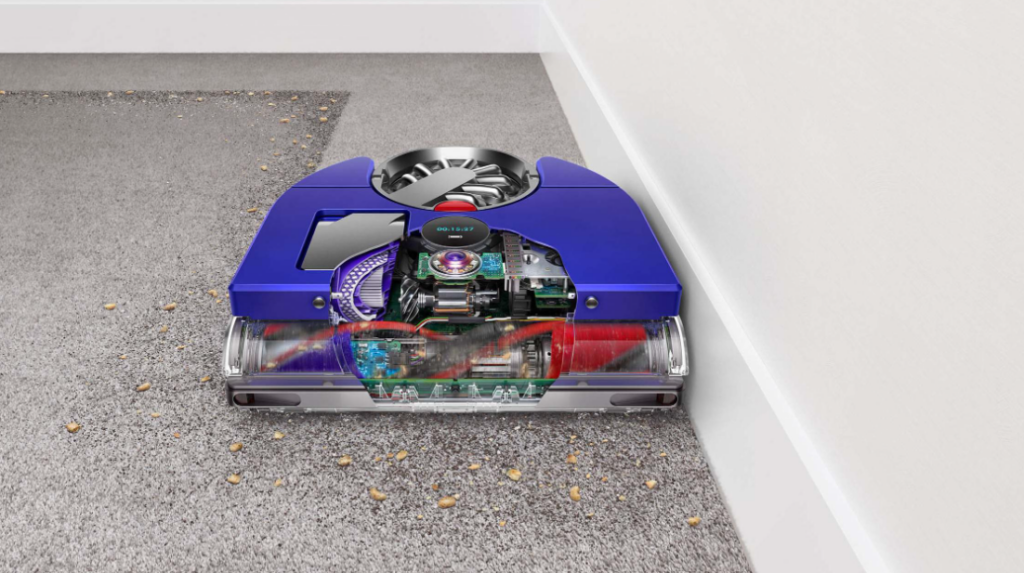
The 360 Vis Nav is a serious-looking machine. Its D-shaped body in Blue/Nickel is more industrial than charming, and that suits it. The flat front edge is functional: it lets the robot push flush against skirting boards and into corners where round robots stop short. The extending side duct, which channels suction along the robot’s edge rather than relying on a spinning brush, is one of the more considered design decisions in this category.
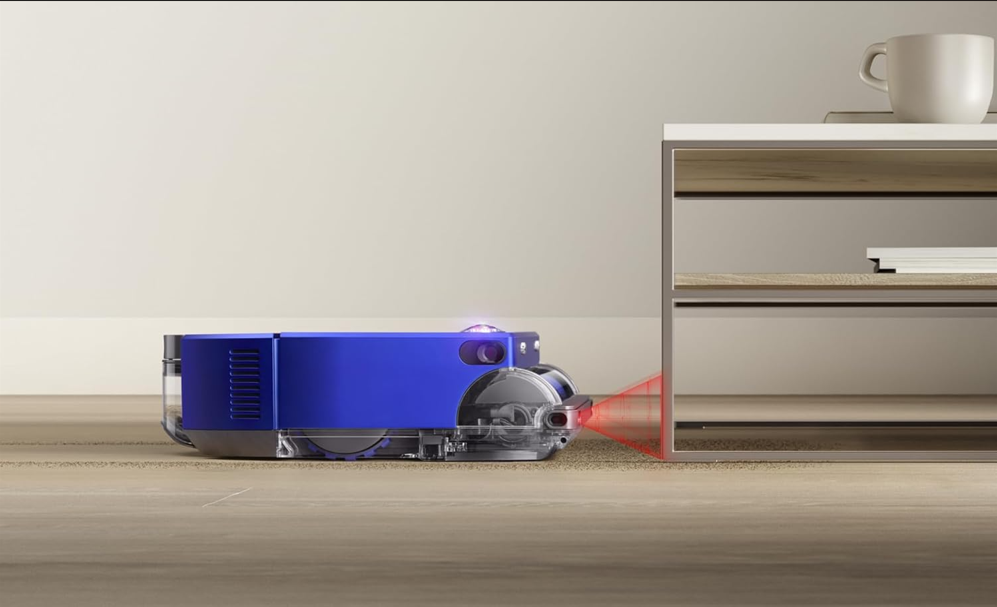
At 99 mm tall and 5 kg, it is not a subtle presence. It will not pass under furniture below that clearance, which rules it out for some rooms entirely. The build quality is premium throughout. Nothing flexes. Nothing rattles.
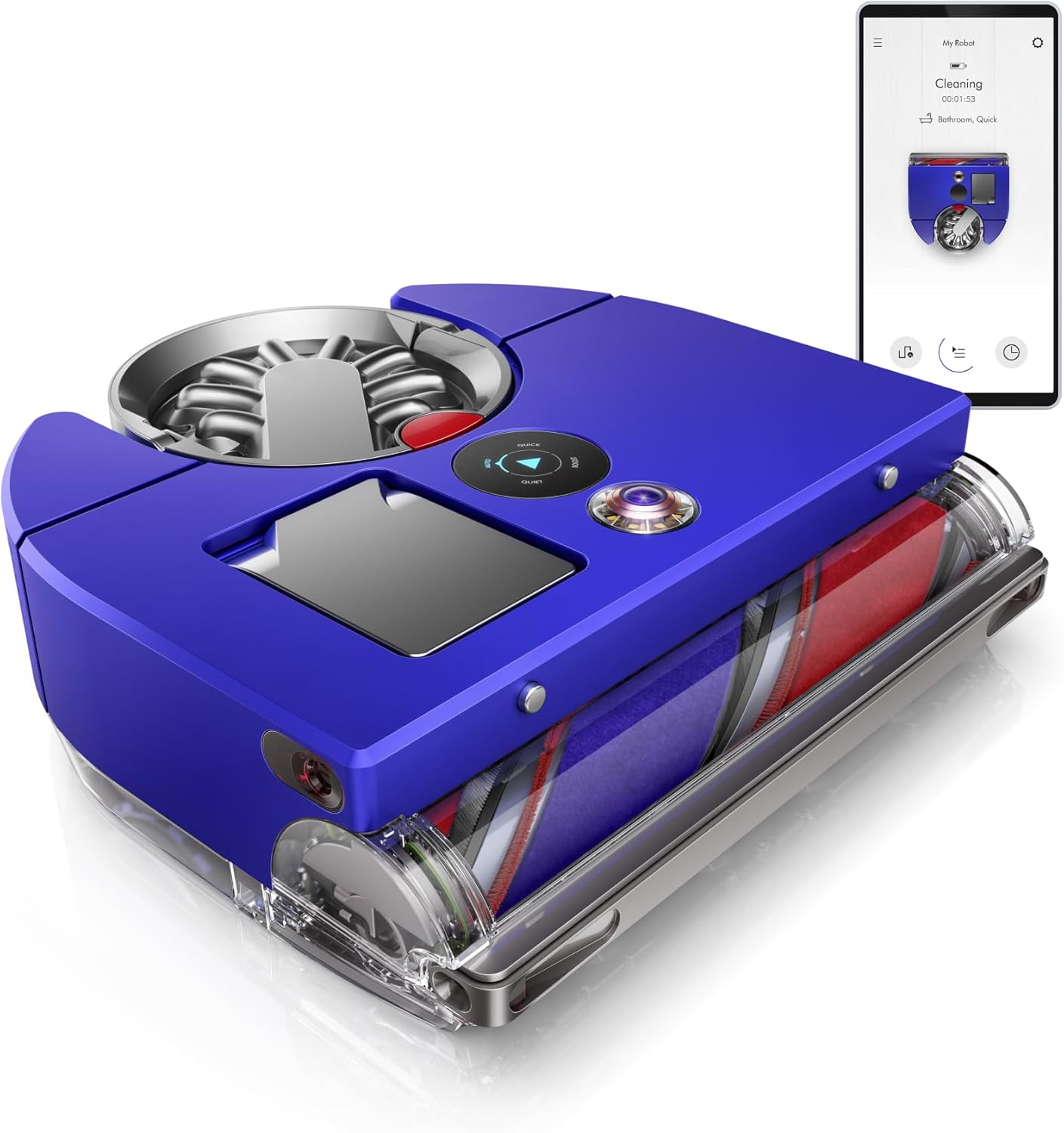
The full-width 11.8-inch brush bar is the standout feature visible in any product photo, and it is a key reason why the 360 Vis Nav tops our best robot vacuums for carpet 2026 roundup. It covers more floor per pass than any competing robot’s narrower brush arrangement. The brush bar is user-serviceable, the dustbin empties with a single press, and the HEPA filter is a lifetime unit that requires no replacement. Maintenance is genuinely simple, which matters when the robot lacks a self-emptying station to reduce bin contact frequency.
The Wall Dok is compact and tidy. A second Dok for multi-floor homes is sold separately. The robot’s 360-degree panoramic camera sits at the top of the unit, scanning continuously as it moves.
Setup and Day-to-Day Usability
Setup is straightforward. Download the MyDyson app, connect the robot to Wi-Fi, and it maps your home on its first run. The mapping process is slower than LiDAR-based competitors, but it is reliable. Once a floor plan is established, the app presents a room layout you can divide into named zones, assign cleaning modes per zone, and schedule runs by room, day, and suction level.
The touchscreen on the robot itself shows battery level, current mode, and basic status. It is clear and responsive. Clean time estimates in the app are accurate once the robot has learned the space.
Day to day, the experience is quiet in Quiet mode (58 dB) and noticeably loud in Boost (72 dB). Auto mode at around 65 dB is the working compromise for most homes. The robot covers approximately 50 square metres per hour, which is slower than LiDAR competitors. For larger homes, the 65-minute battery means a recharge-and-resume mid-clean is likely. The robot handles this automatically.
The half-litre dustbin needs attention roughly every one to two days in a typical household. Without auto-empty, that contact is unavoidable. For models that handle this step for you, see our best self-emptying robot vacuums guide.
Performance: Dyson 360 Vis Nav Review 2026 Test Results
This is where the 360 Vis Nav separates from every competitor. The numbers are not close.
On medium-pile carpet with fine sand debris, the 360 Vis Nav achieved 98 per cent pickup in a single pass. For context, the Roomba s9+ measured 91 per cent in equivalent testing; the Shark AI Ultra, 87 per cent. Consumer Reports awarded the 360 Vis Nav a top rating in carpet cleaning, making it the only robot vacuum to achieve that distinction in their testing. On kitty litter, it recorded 96.5 per cent pickup. On hard floor edge cleaning with coffee grounds, 94 per cent captured versus 78 per cent for comparable robots using spinning side brushes. Vacuum Wars recorded its highest-ever crevice pickup score during their test run.
The mechanism behind these figures is the Hyperdymium motor running at up to 110,000 rpm, producing 22,000 Pa of suction that Dyson claims is approximately double any other robot vacuum on the market. Combined with the edge-to-edge brush bar that agitates carpet fibres across the entire cleaning path, the result is deep-clean performance on carpet that no competitor currently matches.
One genuine caveat: very large debris, such as cereal or food scraps, can be blown sideways by the airflow rather than captured. The robot is optimised for fine to medium particles. It is not a sweep-up substitute for larger mess.
Features and Firmware
The 360 Vis Nav launched with significant navigation limitations. Dyson has addressed them systematically across six firmware releases between 2023 and April 2024.
The most substantive updates cover: smoother motion around obstacles, improved reversing from narrow spaces, faster edge navigation, more reliable dock return, increased zone coverage, and enhanced Wi-Fi connectivity. Firmware RB03PR.01.08.004 introduced maintenance alerts via the MyDyson app. RB03PR.01.08.006.5079, the current version, delivered the most comprehensive navigation improvements: more intelligent path planning, better obstacle avoidance, and improved return-to-dock reliability.
The current firmware (check your version in the MyDyson app under robot settings) represents a substantially different product from the one launched in 2023. Navigation is no longer the robot’s weak point. It is functional. It is not class-leading. Camera-based SLAM navigation is inherently less precise than LiDAR. Some users still report phantom walls or occasional missed spots after major furniture moves. These are edge cases in post-patch use, not the consistent navigation failures that defined early reviews.
The app’s scheduling tools are capable: per-room scheduling, selectable suction modes per zone, and no-go area mapping. The on-robot touchscreen adds a degree of direct control without requiring a phone.
Connectivity and Compatibility
The 360 Vis Nav connects to the MyDyson app over 2.4 GHz Wi-Fi. The app supports room mapping, zone scheduling, no-go area placement, power mode selection by zone, clean time estimates, and maintenance notifications. Amazon Alexa and Google Assistant voice control are both supported for basic commands: start cleaning, stop, return to dock, and room-level targeting where the skill supports it.
There is no Matter support. There is no Apple HomeKit compatibility. If smart home integration is a priority, our smart home hub guide covers the current landscape. For buyers deep in the Apple ecosystem or using a Matter-based smart home controller, the 360 Vis Nav sits outside that network. It integrates only through its own app and the two major voice platforms.
The lack of HomeKit is a meaningful omission for a robot at this price in 2026, when Matter-enabled robot vacuums are increasingly available from competitors. It is not a functional barrier for most buyers, but it narrows the smart home integration story to Amazon and Google only.
The robot updates automatically. When idle on the dock and connected to Wi-Fi, firmware installs without user action. No manual firmware management is required.
Reliability, Support, and Warranty
Dyson covers the 360 Vis Nav with a 2-year limited hardware warranty and lifetime customer support via phone and chat (US: 1-866-MY-DYSON; UK: Dyson support portal). Spare parts are available directly from Dyson and carry their own 12-month guarantee. Dyson is still patching. The firmware update cadence through 2024 and 2025 demonstrates active software support. The user rating on Dyson.com sits at 3.4 out of 5 from just under 1,000 ratings, reflecting mixed early-adopter sentiment alongside the post-patch improvement. For buyers purchasing now, the active firmware history is the relevant signal.
Who It’s For / Who Should Skip It
Buy it if:
– Your home has substantial carpeted areas and you want the best possible robot vacuum for them. Nothing else comes close on deep-pile carpet at any price.
– You have allergies or respiratory sensitivities and need HEPA-grade filtration confirmed by test data, not marketing copy. Our best robot vacuums for allergies guide compares filtration standards across the category.
-Your floors are hard surfaces with tight edges and corners where a D-shaped robot with an extending side duct genuinely outperforms circular alternatives.
– You do not mop and do not need auto-empty. If both are absent from your priority list, the compromises vanish.
– You are purchasing at the discounted price. At £649.99 or around $999, the value equation is considerably stronger than at RRP.
Skip it if:
– Mopping is part of your floor care routine. The 360 Vis Nav is vacuum-only. Every major competitor at this price includes a mop.
– You want hands-free bin management. There is no auto-empty dock and Dyson has not announced one.
– Your home exceeds roughly 50 square metres of open floor. The 65-minute battery requires recharge-and-resume, and the slower navigation speed extends total clean time meaningfully.
– You are fully committed to Apple HomeKit or a Matter controller. It does not connect.
Alternatives
Roborock S8 MaxV Ultra (~$1,099-$1,399/~£900-£1,100): Vacuums and mops, with an auto-empty and auto-wash dock included in the base configuration. LiDAR navigation is faster and more precise. Suction at 10,000 Pa is roughly half the Dyson’s output. On hard floors, the difference is minimal. On deep carpet, the Dyson wins on cleaning data. If mopping is a requirement and carpet cleaning performance is not the priority, this is the more complete machine.
Dreame X40 Ultra Complete (~$1,519-$1,899/from £549 on sale): Heated mopping at 158 F, auto-empty, a liftable mop to avoid carpet contamination, and an extending side brush. At 12,000 Pa it is still below the Dyson’s suction. For households that mop regularly and vacuum hard floors primarily, the Dreame’s feature set is broader. At RRP it is more expensive. UK sale prices have brought it below £600.
Ecovacs Deebot X2 Omni (~$1,499/~£1,299): Square design provides corner coverage similar to the Dyson’s D-shape. Vacuums and mops, auto-empty, hot water mop wash. Suction at 8,000 Pa is significantly lower than the Dyson. For mixed floor homes with a tile or wood majority and area rugs rather than wall-to-wall carpet, the Ecovacs offers a more complete daily cleaning routine.
Verdict: Dyson 360 Vis Nav Review 2026
The Dyson 360 Vis Nav in 2026 is a different product from the one that launched in 2023. Firmware has earned it back. The navigation is reliable. The obstacle avoidance works. What remains is the most powerful carpet cleaner in the robot vacuum category, a full-width brush bar that no competitor has matched, and HEPA filtration that is factory-tested rather than claimed. The limitations are fixed and stated honestly by Dyson: no mop, no auto-empty, 65-minute battery. At RRP those omissions are hard to accept. At the discounted prices available in 2026, ranging from £649.99 to around $999, the 360 Vis Nav makes a clear case for the buyer whose floors are carpeted, whose priorities are suction and filtration, and who vacuums rather than mops. On that brief, nothing else wins.
Where to Buy
Browse more home tech coverage in the Spawning Point tech section. For a direct comparison with the leading hybrid model, see our Roborock S8 MaxV Ultra review.
FAQ
Is the Dyson 360 Vis Nav worth the price?
The Dyson 360 Vis Nav is worth the price at the discounted rates available in 2026 (from around £649.99 / $999), provided you vacuum primarily and do not require mopping or auto-empty. At full RRP of £1,399.99 or $1,199.99, the value calculation is harder: every major competitor offers more features for the same money. The cleaning performance on carpet is unmatched. The missing features are real. Price determines which of those facts matters more to you.
Is the Dyson 360 Vis Nav good on carpet?
The Dyson 360 Vis Nav is the highest-rated robot vacuum for carpet cleaning currently available. It achieved 98 per cent pickup on medium-pile carpet with fine sand debris in single-pass testing, the highest score in its category. Consumer Reports awarded it a top carpet cleaning rating, the only robot vacuum to achieve that distinction in their evaluations. The full-width 11.8-inch brush bar and 22,000 Pa suction deliver performance on deep-pile carpet that no competitor currently matches. If carpet cleaning is the primary requirement, this is the correct choice.
Does the Dyson 360 Vis Nav mop?
The Dyson 360 Vis Nav does not mop and has no wet cleaning capability. It is a vacuum-only robot. There is no mopping attachment, no wet cleaning function, and no auto-empty dock available. This is the product’s most significant limitation at its price point: every major competitor in this category, including the Roborock S8 MaxV Ultra, Dreame X40 Ultra, and Ecovacs Deebot X2 Omni, includes mopping capability. If wet cleaning matters to you, the Dyson is not the right robot.
How long does the Dyson 360 Vis Nav battery last?
Dyson rates the battery at up to 65 minutes. In practice, battery life varies by mode: Boost mode consumes power more rapidly and will reduce run time below 65 minutes. In Auto mode, the robot manages suction dynamically, preserving battery on bare floors and increasing power on carpet. For homes exceeding roughly 50 square metres, the robot will need to pause and recharge before finishing. It manages this process on its own, returning to dock, topping up, and resuming where it left off without user input.
Dyson 360 Vis Nav vs Roborock S8 MaxV Ultra: which is better?
The Dyson 360 Vis Nav is the better carpet cleaner; the Roborock S8 MaxV Ultra is the more complete all-surface machine. The Dyson delivers nearly double the suction (22,000 Pa versus 10,000 Pa) and is the superior carpet performer by a measurable margin. The Roborock mops, empties itself, washes its own mop pad, and uses LiDAR for faster, more precise navigation. For homes with significant carpeted areas and no mopping need, the Dyson is the better cleaner. For mixed-floor homes where mopping is part of the routine, the Roborock is the more complete product.
Has Dyson fixed the 360 Vis Nav navigation problems?
Dyson has fixed the major navigation problems through six firmware updates shipped between 2023 and April 2024, addressing the issues identified in early professional reviews. The current firmware (RB03PR.01.08.006.5079) delivers more intelligent path planning, improved obstacle avoidance, faster edge navigation, and more reliable dock return. Navigation is no longer the robot’s defining weakness. It is functional and accurate for most home layouts. It is not class-leading compared to LiDAR-based competitors, and occasional phantom walls or missed spots after major furniture moves are still reported in edge cases.
Does the Dyson 360 Vis Nav have a self-emptying dock?
The Dyson 360 Vis Nav does not have a self-emptying dock. The included Wall Dok is a charging station only. There is no self-emptying station available for this robot, and Dyson has not announced one. The 0.5 L dustbin requires manual emptying, typically once every 24 to 48 hours depending on floor type and pet presence. For buyers who prioritise hands-free bin management, this is a genuine limitation. The main competitors at this price point, including the Roborock S8 MaxV Ultra and Dreame X40 Ultra, include self-emptying stations as standard.
How loud is the Dyson 360 Vis Nav?
The Dyson 360 Vis Nav ranges from 58 dB in Quiet mode to 72 dB in Boost, with Auto mode at roughly 65 dB. Quiet mode is comparable to a normal conversation at close range. Boost is noticeable in the same room. Most buyers will use Auto mode for daily cleaning, where 65 dB is audible but not disruptive in a separate room. Boost mode is best scheduled when the home is unoccupied. For comparison, most robot vacuums operate in the 60-70 dB range; the Dyson is at the louder end in its highest power setting.
Is the Dyson 360 Vis Nav good for pet hair?
The Dyson 360 Vis Nav is one of the strongest robot vacuums for pet hair, achieving 96 per cent efficiency in carpet pet hair removal testing, and the 11.8-inch brush bar agitates and lifts embedded pet hair from carpet fibres more effectively than narrower brush systems. The lifetime HEPA filter captures 99.99 per cent of particles down to 0.1 microns, including pet dander and allergens. For households with pets and carpeted floors, it ranks among the top performers in its category. The brush bar is user-serviceable and hair-wrap is manageable without tools.
Can the Dyson 360 Vis Nav clean multiple floors?
The Dyson 360 Vis Nav supports multi-floor cleaning with an additional Dok (sold separately). The robot stores one floor map by default. A second Wall Dok for a different floor allows the robot to be carried between levels, dock, and operate with a saved map for each floor. The MyDyson app manages floor plans for both. The additional Dok pricing is not listed in all markets; check Dyson.co.uk or Dyson.com at time of purchase. The robot does not navigate stairs autonomously, so carrying it between floors is required.
What is the Dyson 360 Vis Nav suction power?
The Dyson 360 Vis Nav generates 65 AW of suction, measured at 22,000 Pa. This is produced by the Dyson Hyperdymium motor running at up to 110,000 rpm. Dyson claims approximately double the suction of any other robot vacuum currently on the market. Testing data supports this: the nearest major competitor in suction output is the Dreame X40 Ultra at 12,000 Pa, followed by the Roborock S8 MaxV Ultra at 10,000 Pa. The performance difference is most meaningful on deep-pile carpet, where suction directly affects embedded debris removal.
Dyson 360 Vis Nav vs Roomba: which should I buy?
For carpet cleaning, the Dyson wins by a significant margin. In testing, the Roomba s9+ achieved 91 per cent pickup on medium-pile carpet versus 98 per cent for the 360 Vis Nav. The Roomba has better ecosystem integration, longer-established navigation, and in combo models, mopping capability. At comparable price points, the Dyson outcleans the Roomba on carpet. If carpet performance is the deciding factor, choose the Dyson. If you need mopping, a self-emptying station, or want iRobot’s Imprint Smart Mapping ecosystem, the Roomba Combo j9+ is the closer comparison.
How often do you need to empty the Dyson 360 Vis Nav?
Plan on emptying the bin every 24 to 48 hours under normal conditions; frequency depends on floor type, pet presence, and how often the robot runs. Dyson states it can hold up to 14 days of debris under optimal conditions, but that figure reflects light use on hard floors. In practical daily use, particularly with pets or heavy carpet coverage, every-other-day emptying is realistic. Without a self-emptying station, manual bin contact is unavoidable. The bin releases with a single push and empties without touching the debris.
Does the Dyson 360 Vis Nav work in the dark?
The Dyson 360 Vis Nav navigates reliably in the dark. The 360-degree panoramic camera includes sufficient sensitivity for low-light navigation, and the robot’s 26 sensors provide obstacle detection independent of light conditions. Multiple reviewers confirmed reliable navigation in dark rooms. This is a practical advantage for running the robot overnight or in rooms with blackout curtains. The camera-based navigation does not require additional lighting to function. LiDAR-based competitors are inherently light-independent; the 360 Vis Nav’s camera system handles low-light environments well without meaningful degradation in navigation quality.
Is the Dyson 360 Vis Nav better after the firmware update?
The Dyson 360 Vis Nav is substantially better after firmware updates. The releases through 2024 and 2025 addressed the most common complaints from early professional reviews: erratic navigation, unreliable dock return, inconsistent obstacle avoidance, and poor reversing from narrow spaces. The latest firmware (RB03PR.01.08.006.5079) represents the sixth major update since launch. Tech Advisor retested the robot post-patch and raised their score. The hardware was always the product’s strength. The firmware has made the navigation reliable enough that the hardware can deliver on its potential consistently rather than occasionally.
Please note that some links in this article are affiliate links. If you found the coverage helpful and decide to pick up the game, or anything else for your collection, through one of those links, we may earn a commission at no extra cost to you. We use this approach instead of filling Spawning Point with intrusive display ads, and rely on this support to keep the site online and fund future reviews, guides, comparisons and other in-depth gaming coverage. Thank you for supporting the site.