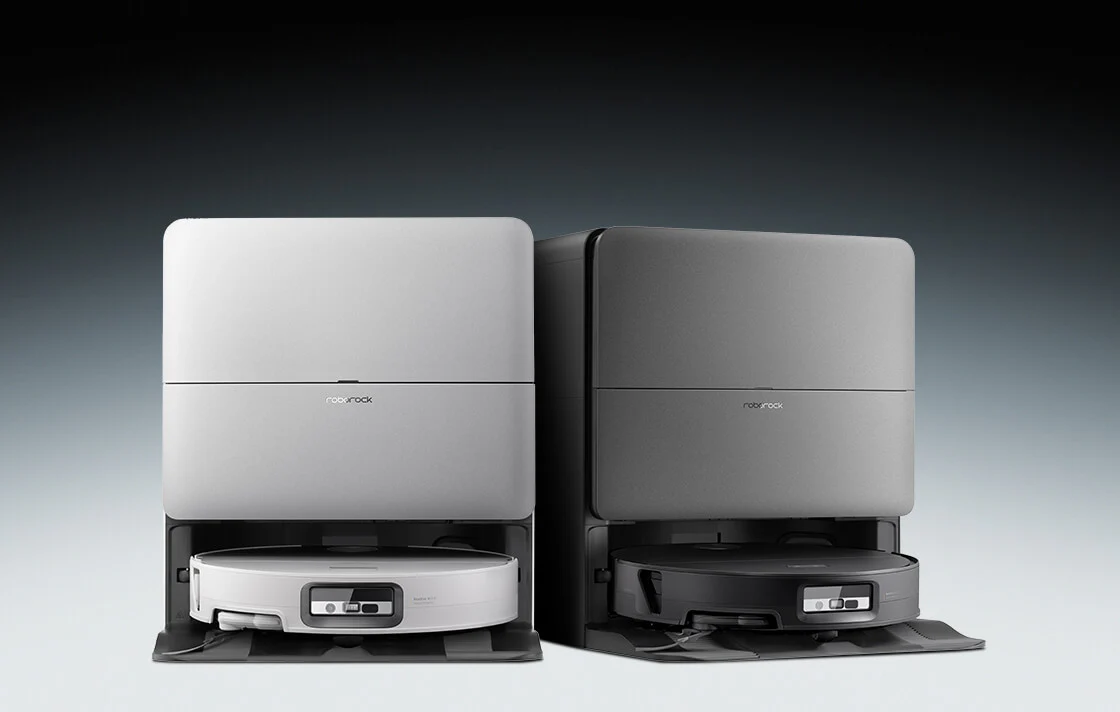
The dirty strip along every skirting board in your home exists because no robot mop could reach it. The Roborock Saros 20 Sonic eliminates it. Built on the same 36,000 Pa platform that earned the Saros 20 a place in our top 5 robot vacuums for 2026 roundup, the Sonic variant replaces dual spinning mops with a single D-shaped VibraRise 5.0 pad that vibrates 4,000 times per minute and extends beyond the chassis for genuine zero-millimetre wall contact. The threshold climbing is equally remarkable: 88 mm across double-layer door sills. At £1,299/$1,599.99, this is Roborock’s answer to buyers who wanted flagship vacuuming power paired with a mop system that scrubs rather than smears.
Product Snapshot
| Brand/Model | Roborock Saros 20 Sonic |
| Category | Premium robot vacuum and mop |
| UK Price | ~£1,299 (Saros 20 pricing; Sonic variant expected similar or slightly higher) |
| US Price | ~$1,599.99 MSRP (Saros 20 pricing; Sonic variant expected Q2 2026) |
| EU Price | EUR 1,499 (confirmed) |
| Release Date | Announced CES 2026 (January 2026); rolling out April to June 2026 |
| Suction Power | 36,000 Pa (HyperForce digital motor) |
| Mopping System | VibraRise 5.0 Sonic: D-shaped vibrating pad, 4,000 vibrations/min, 14N downward pressure |
| Main Brush | DuoDivide dual anti-tangle (0% tangling rate, hair up to 40 cm) |
| Side Brush | FlexiArm Arc (extends to edges, corners, skirting boards up to 2 cm) |
| Navigation | RetractSense (retractable LiDAR) + StarSight Autonomous System 2.0 |
| Obstacle Avoidance | Reactive AI 3.0 (triple structured light + RGB camera, 300+ objects) |
| Threshold Climbing | AdaptiLift Chassis 3.0: single 45 mm, double-layer 88 mm |
| Battery | 6,400 mAh, ~180 min (quiet mode), ~150 min charge |
| Robot Height | 7.95 cm (retractable LiDAR turret) |
| Dock | RockDock: 100 degrees C mop wash, 55 degrees C hot air drying, auto detergent, self-cleaning |
| Dock Capacity | 2.5 L dust bag, 4.0 L clean water, 3.0 L dirty water |
| Self-Empty Interval | Up to 65 days |
| Smart Home | Alexa, Google Home, Siri, Matter |
| Best Alternatives | Dreame X60 Max Ultra, Ecovacs Deebot X11 OmniCyclone, Roborock Saros 20 (standard) |
Design and Build
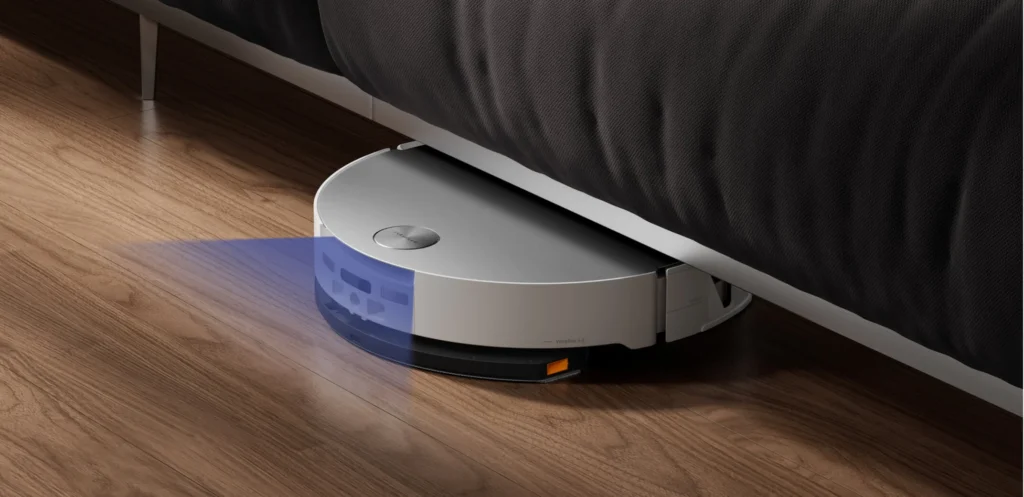
The Saros 20 Sonic is defined by two engineering decisions: a retractable LiDAR turret and an extendable mop pad. The RetractSense system pulls the LDS tower flush with the chassis when passing under low furniture, achieving a 7.95 cm profile that clears most sofas and bed frames. That matters. A robot vacuum that cannot reach under a sofa cleans around it, and dust accumulates in precisely the spaces you cannot see.
Build quality is premium throughout. The DuoDivide main brush uses a twin-roller mechanism that Roborock rates at 0 per cent hair tangling for strands up to 40 cm. The FlexiArm Arc side brush extends outward to sweep along skirting boards and around furniture legs, reaching surfaces up to 2 cm above floor level. At roughly 5 kg for the robot and 10.4 kg for the dock, neither component is compact. The RockDock requires meaningful floor space, which is a genuine consideration for smaller flats and kitchens.
The dock itself handles mop washing at 100 degrees C, hot air drying at 55 degrees C, automatic detergent dispensing, and dust channel drying. It is comprehensive. It is also bulky. For homes where the dock must sit in a visible living area rather than a utility cupboard, size is worth measuring before purchase.
Cleaning Performance: Roborock Saros 20 Sonic Review
The 36,000 Pa suction figure places the Saros 20 Sonic amongst the most powerful consumer robot vacuums available. That number is meaningless without context: what it translates to is effective deep-carpet cleaning, reliable fine-dust pickup on hard floors, and strong performance with pet hair. The DuoDivide brush agitates carpet fibres across the full cleaning path whilst the anti-tangle mechanism prevents hair wrap, which is the single most common maintenance frustration in this category. For households with pets, this matters more than raw suction numbers. Our best robot vacuums for allergies guide covers filtration considerations if allergen control is a priority.
The mopping system is where the Sonic variant diverges from the standard Saros 20. The VibraRise 5.0 pad vibrates at 4,000 cycles per minute with 14N of downward pressure, roughly 1.75 times the force of previous Roborock models. The D-shaped pad extends beyond the robot’s body to reach walls and corners with no gap whatsoever. On sealed hard floors with dried-on residue, sonic vibration combined with consistent pressure outperforms the spinning disc approach used by its non-Sonic sibling, which reviewers noted left surfaces ‘a little streaky and patchy’.
Edge reach is the win. The honest limitation: vibrating pad technology, across the industry, still trails roller-based mopping systems in direct scrubbing tests. The Dreame X60’s roller mop applies cleaning solution differently and scrubs with more mechanical force. For buyers whose primary concern is mopping performance above all else, the Sonic’s extendable reach and edge contact are genuine advantages, but the pad technology itself is not the strongest available.
Navigation and Obstacle Avoidance
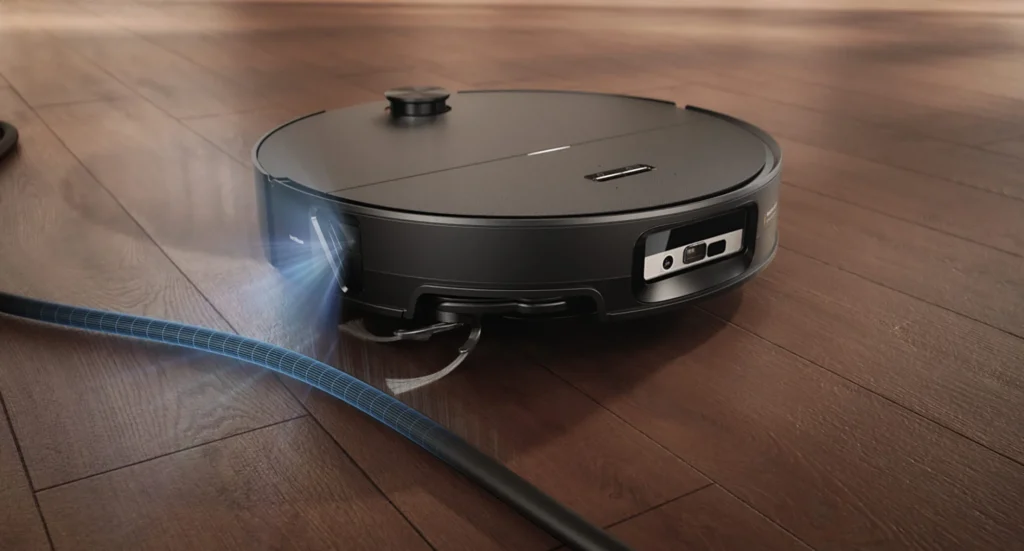
Reactive AI 3.0 combines triple structured light sensors with an RGB camera to identify and avoid over 300 object types. The VertiBeam side-mounted sensor handles wall detection independently, allowing the robot to track along surfaces without bumping. In practice, reviewers describe navigation as reliable and intelligent: furniture is mapped accurately, room transitions are smooth, and the robot demonstrates genuine learning behaviour through SmartPlan 3.0, which adapts cleaning patterns to household habits over time.
The RetractSense navigation system pairs retractable LiDAR with a 100-degree rear-view sensor. LiDAR-based mapping is faster and more precise than camera-only systems, and the retractable design means you do not sacrifice navigation quality for the sub-8 cm profile. The robot supports 2.4 GHz and 5 GHz Wi-Fi, which eliminates the connectivity frustrations that plague cheaper models restricted to 2.4 GHz networks.
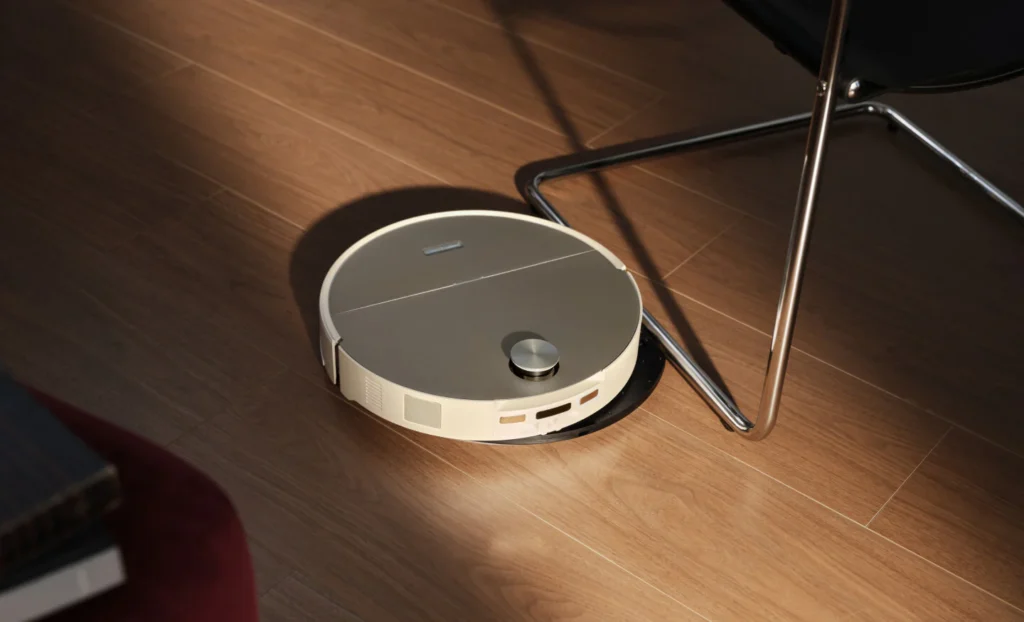
Cables remain the blind spot. Despite the advanced obstacle recognition, multiple reviewers report that stray drawstrings and thin cords still occasionally cause problems. AI avoidance handles shoes, pet bowls, and toys reliably. Low-contrast objects on similar-coloured floors remain a challenge across the category, not just for Roborock.
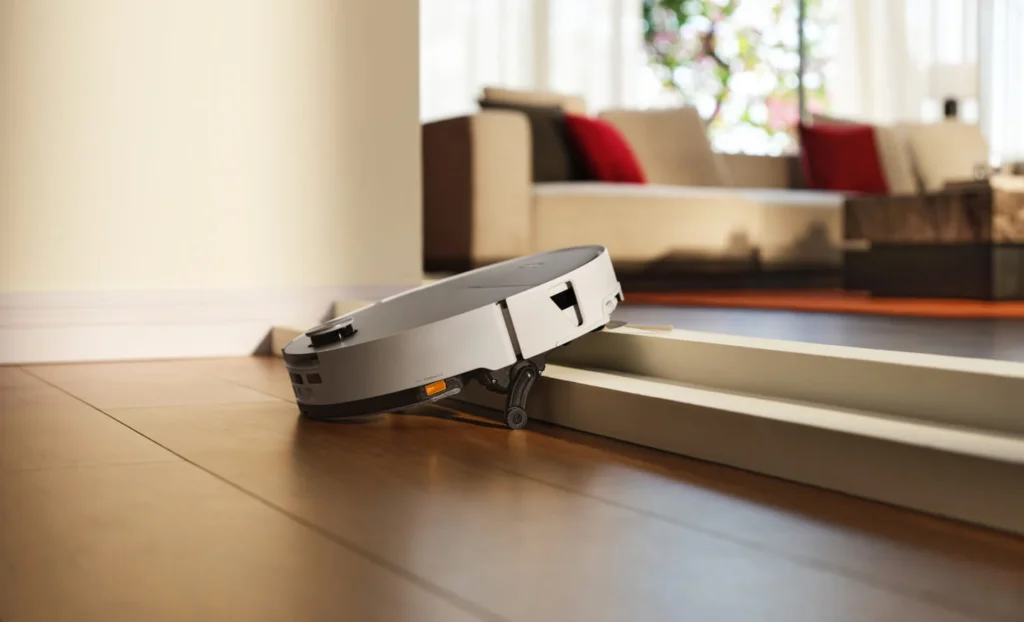
The Threshold-Climbing Feature: Roborock Saros 20 Sonic Review
This is the specification that separates the Saros 20 platform from nearly everything else on the market. The AdaptiLift Chassis 3.0 clears single thresholds up to 45 mm and double-layer thresholds (a raised sill followed by a second step) up to 88 mm combined. Nothing else comes close.
The buyer outcome is specific. If your home has solid wood or tile floors separated by substantial door sills, most robot vacuums simply stop at the threshold and clean one room. The Saros 20 Sonic crosses them. For period properties, older builds with raised transitions, or homes with accessibility ramps and uneven flooring between rooms, this capability transforms the robot from a room-by-room tool into a whole-home cleaner. Our Dyson 360 Vis Nav review highlights what happens when a powerful robot cannot transition between rooms: you carry it manually. The Saros 20 Sonic avoids that limitation entirely.
Carpet handling extends to pile depths up to 3 cm. The mop pad auto-detaches or lifts when the robot detects carpet, preventing cross-contamination between wet and dry surfaces. The system is automatic and requires no user intervention once configured in the app.
App and Smart Features
The Roborock app is the control centre, and reviewers consistently describe it as one of the strongest in the category. Zone planning, per-room cleaning strategies, independent water flow and vibration settings, scheduling, and do-not-disturb modes are all present. SmartPlan 3.0 auto-learns household routines and adjusts cleaning strategy accordingly.
The granularity is a double-edged feature. Thirty water flow levels is a level of control that most buyers will never explore, and several reviewers flagged it as unnecessarily complex. The app does not need simplifying so much as better defaults: most users will benefit from leaving settings on automatic and adjusting only when results are unsatisfactory.
Smart home integration covers Alexa, Google Home, Siri Shortcuts, and Matter protocol. Matter support is the forward-looking inclusion: it connects the Saros 20 Sonic to broader smart home ecosystems without relying solely on manufacturer-specific integrations. For buyers building a smart home hub setup, Matter compatibility is increasingly the baseline expectation.
The ‘Hello Rocky’ voice wake word is convenient in theory. Expect false triggers. It occasionally activates during normal conversation, starting a cleaning run unprompted. Disabling it in the app takes seconds.
Maintenance and Running Costs
The self-emptying dock handles the majority of ongoing maintenance. The 2.5 L dust bag accommodates up to 65 days of debris before replacement. Replacement bags are a recurring cost, though a modest one compared to the upfront price. The 4.0 L clean water and 3.0 L dirty water tanks reduce the frequency of manual refills to roughly once per week for most households, depending on mopping frequency and home size.
Boiling-temperature mop washing and heated air drying address hygiene concerns that cheaper docks with cold-water rinse cycles cannot match. Auto detergent dispensing removes one more manual step. Ownership stays hands-off. Budget for dust bag replacements and occasional mop pad swaps, both available through the Roborock accessories store. The DuoDivide brush’s anti-tangle design reduces the need for manual hair removal, which in practice eliminates one of the most tedious ownership chores for robot vacuum buyers.
Who It’s For/Who Should Skip It
Buy it if: – Your home has substantial door thresholds or raised transitions between rooms and you want a robot that crosses them autonomously. No competitor matches 88 mm clearance. You have mixed flooring (carpet and hard floors) and want a single machine that vacuums carpet at flagship suction levels whilst mopping hard surfaces to the edge of the wall. – You own pets and want zero-tangle brushes paired with strong suction for embedded hair. The DuoDivide system eliminates the weekly brush-cleaning ritual.
Skip it if: – Mopping performance is your absolute top priority and you want the most aggressive scrubbing available. Roller-based systems from Dreame and Narwal apply greater mechanical force to dried-on stains. Our Dreame head-to-head comparison explores that trade-off in detail. – Budget matters more than features. The Ecovacs Deebot X11 OmniCyclone at around £849/$899 offers bagless operation, high airflow, and native HomeKit for roughly 35 per cent less. – Your home is compact with no thresholds and minimal furniture clearance challenges. The Saros 20 Sonic’s headline features solve problems that smaller, flatter homes may not have.
Alternatives
Dreame X60 Max Ultra Complete (~$1,499.99/~£1,199): Retractable LiDAR and threshold-climbing legs (51 mm clearance). Dual omni-scrub pads with 40 degrees C heated mopping offer stronger scrubbing than the Saros 20 Sonic’s vibrating pad. Slightly lower suction at 35,000 Pa. The trade-off: less threshold clearance and no extendable edge mop. For buyers who mop more than they vacuum, the Dreame is the closer fit.
Ecovacs Deebot X11 OmniCyclone (~$899/~£849): Highest recorded airflow in the category (38 CFM) despite a lower 19,500 Pa suction figure. Bagless PureCyclone dock eliminates ongoing bag costs. Native HomeKit support. At roughly half the Saros 20 Sonic’s price, the X11 is the value proposition for buyers who do not need extreme threshold climbing or edge mopping. Our Ecovacs X11 vs X12 comparison covers the upgrade path.
Roborock Saros 20 (standard) (~$1,599.99/~£1,299): Identical platform with dual rotating mop pads instead of the sonic vibrating pad. Available now on Amazon US. If you prefer rotational mopping over sonic vibration and want the same 36,000 Pa suction and 88 mm threshold climbing, the standard model is the established option with more user reviews and broader availability.
Verdict: Roborock Saros 20 Sonic Review
The Saros 20 Sonic is the kind of machine you deploy in a multi-room home with awkward thresholds and mixed flooring, then largely forget about for two months until the dust bag indicator lights up. The AdaptiLift chassis crosses door sills that strand every competitor. The retractable LiDAR lets it vanish under low-clearance furniture where taller rivals cannot follow. The extendable sonic mop pad meets walls with zero clearance, cleaning edges that spinning discs leave untouched. These are not incremental improvements. They are specific solutions to specific problems that have persisted across this category for years. The price is substantial, the dock is large, and vibrating pad mopping does not match the best roller systems on baked-on grime. For buyers whose homes present the obstacles this robot was built to overcome, the Saros 20 Sonic justifies its premium. Browse more home tech coverage in the SpawningPoint tech section.
Where to Buy
- Roborock Saros 20 on Amazon US (standard model; Sonic variant expected Q2 2026)
- Roborock Saros 20 Sonic official product page
FAQ
Is the Roborock Saros 20 Sonic worth the price?
The Roborock Saros 20 Sonic justifies its premium for homes with specific challenges: raised thresholds between rooms, mixed flooring, or furniture low enough to strand taller robots. At around £1,299/$1,599.99, it occupies the premium ceiling. The 88 mm threshold climbing, retractable LiDAR, and extendable sonic mop address problems that cheaper models simply cannot solve. For smaller, single-floor homes without these obstacles, the Ecovacs X11 OmniCyclone at roughly half the price delivers strong cleaning results.
What is the difference between the Roborock Saros 20 and Saros 20 Sonic?
The mopping system is the only meaningful difference. The standard Saros 20 uses dual rotating microfibre mop pads with FlexiArm edge extension and variable 8-13N pressure. The Sonic variant replaces these with a single D-shaped VibraRise 5.0 pad operating at 4,000 vibrations per minute with fixed 14N downward pressure, extending for flush wall contact. Both share the same 36,000 Pa suction, AdaptiLift Chassis 3.0, RetractSense navigation, and dock. Choose the Sonic for intensive edge scrubbing; choose the standard for broader rotational coverage.
Can the Roborock Saros 20 Sonic climb door thresholds?
The Roborock Saros 20 Sonic handles individual sills as high as 45 mm and stacked double-layer thresholds totalling 88 mm using AdaptiLift Chassis 3.0. This is the highest threshold clearance in the consumer robot vacuum category. Standard residential door sills sit between 15 mm and 20 mm; older properties can reach 40 mm. The Saros 20 Sonic clears all of these autonomously, enabling genuine multi-room cleaning across uneven floor transitions.
How does the Roborock Saros 20 Sonic compare to the Dreame X60?
The Saros 20 Sonic offers higher suction (36,000 Pa versus 35,000 Pa), greater threshold clearance (88 mm versus 51 mm), and a slimmer profile (7.95 cm versus approximately 8.2 cm). The Dreame X60 counters with omni-scrub mopping pads heated to 40 degrees C, which deliver stronger scrubbing pressure on dried residue. Both feature retractable LiDAR. The Roborock wins on obstacle clearance and edge mopping reach. The Dreame wins on raw mopping scrubbing power.
Does the Roborock Saros 20 Sonic work with Alexa and Google Home?
The Saros 20 Sonic connects to every major voice assistant and the Matter smart home standard. Voice commands cover start, stop, return to dock, and room-level targeting. Matter bridges the robot into unified home automation setups without depending solely on Roborock’s own app. That includes native Apple Home integration, which most competing robot vacuums still lack.
Is the Roborock Saros 20 Sonic good for pet hair?
The Saros 20 Sonic ranks amongst the most capable robot vacuums for pet hair removal. The DuoDivide dual anti-tangle brush manages hair as long as 40 cm with a claimed 0 per cent tangling rate. At 36,000 Pa, suction is sufficient to extract embedded hair from medium-pile carpet. The Reactive AI 3.0 system includes intelligent pet recognition with real-time tracking and remote viewing through the app. The 65-day self-empty interval keeps owners from handling collected hair and dander for weeks at a stretch.
How slim is the Roborock Saros 20 Sonic and can it fit under my sofa?
The robot measures 7.95 cm tall with the LiDAR turret retracted. RetractSense lowers the navigation sensor into the body when the robot detects low overhead clearance, allowing it to slide beneath furniture that blocks taller competitors. Most standard sofas sit 10-15 cm off the floor. At under 8 cm, the Saros 20 Sonic clears furniture that would block robots with fixed turrets typically measuring 9.5-10.5 cm in height.
Does the Roborock Saros 20 Sonic mop and vacuum at the same time?
The Saros 20 Sonic coordinates vacuuming and mopping as part of a single cleaning run, though the dock handles mop washing independently between passes. On carpet, the pad retracts or disengages to prevent wet contamination. On hard floors, the robot vacuums and applies the sonic mop simultaneously. The system manages transitions between surface types without user input, switching between vacuum-only and vacuum-plus-mop modes based on floor detection.
How loud is the Roborock Saros 20 Sonic?
The Saros 20 Sonic is quiet during cleaning but noticeably louder during dock self-emptying and water pumping cycles. Roborock has not published exact decibel figures for the Sonic variant. For reference, the Saros 10 measures 52 dB during mopping and 72 dB during dock self-emptying. Reviewers note the Saros 20 platform produces more dock noise than the Roborock Qrevo Curv 2 Flow. In quiet mode, the robot itself is unobtrusive; dock maintenance cycles are best scheduled when you are in another room.
What is the battery life of the Roborock Saros 20 Sonic?
The 6,400 mAh battery delivers approximately 180 minutes of runtime in quiet mode. Charge time is roughly 150 minutes (2.5 hours). For most homes under 150 square metres, a single charge completes a full vacuum-and-mop cycle. Larger homes may require a recharge-and-resume mid-clean, which the robot handles automatically: it returns to dock, charges, and picks up where it stopped.
Does the Roborock Saros 20 Sonic have a self-emptying dock?
The included RockDock is a comprehensive self-maintenance station. It auto-empties dust into a 2.5 L bag (rated for roughly two months between replacements), washes the mop pad with 100 degrees C hot water, dries it with 55 degrees C hot air, dispenses detergent automatically, and self-cleans its internal channels. Clean water (4.0 L) and dirty water (3.0 L) tanks keep manual refills to a weekly cadence for typical households.
Is the Roborock Saros 20 Sonic available in the UK?
The Saros 20 Sonic is rolling out globally between April and June 2026. The standard Saros 20 launched in the UK in April 2026 at £1,299. The Sonic variant’s UK availability and exact pricing have not been confirmed as of early April 2026. EU pricing is confirmed at EUR 1,499. Check the official Roborock product page for the latest regional availability.
Summary
The Roborock Saros 20 Sonic is a premium robot vacuum and mop pairing a 36,000 Pa HyperForce motor with VibraRise 5.0 sonic mopping (14N pressure, flush wall contact) and AdaptiLift Chassis 3.0 for double-layer threshold clearance up to 88 mm. A retractable LiDAR system keeps the profile at 7.95 cm for under-furniture access. The RockDock provides boiling-temperature pad cleaning, heated drying, auto dust emptying (65-day capacity), and self-maintenance. Matter, Alexa, Google Home, and Siri are all supported. Priced at approximately £1,299 $1,599.99, the Saros 20 Sonic targets households with mixed flooring, raised thresholds, and low-clearance furniture. Vibrating pad mopping lags behind roller-mop competitors on persistent marks. Threshold climbing and edge reach are category-leading.
Please note that some links in this article are affiliate links. If you found the coverage helpful and decide to pick up the game, or anything else for your collection, through one of those links, we may earn a commission at no extra cost to you. We use this approach instead of filling Spawning Point with intrusive display ads, and rely on this support to keep the site online and fund future reviews, guides, comparisons and other in-depth gaming coverage. Thank you for supporting the site.