Opening
A damaged cookbook is a better game mechanic than almost anything a AAA studio released in 2023. Venba earns its 90-minute runtime. Visai Games’ narrative cooking game follows Venba, a Tamil immigrant mother in 1988 Toronto, reconstructing her own mother’s recipes from a handwritten book whose pages have been smudged, torn, and blurred by time and ocean crossings. Each puzzle is a memory problem: the instructions are incomplete, the illustrations are the only guide, and the act of cooking correctly is the act of remembering. Three years after release, this small, precise game still occupies a space no other title fills: an immigrant parent’s story told from the parent’s perspective, where food is the medium and cultural continuity is the stakes.
Game Snapshot
| Dev/Publisher | Visai Games |
| Release Date | 31 July 2023 |
| Platforms | PC (Windows, macOS), PlayStation 5, Nintendo Switch, Xbox One, Xbox Series X/S |
| Price | £11.99 | $14.99 |
| Rating | PEGI 7 |
| Genre | Narrative cooking puzzle |
| Length | ~1–2 hours (main story); ~2.5 hours (completionist), based on TrueAchievements data |
| Install Size | ~2 GB |
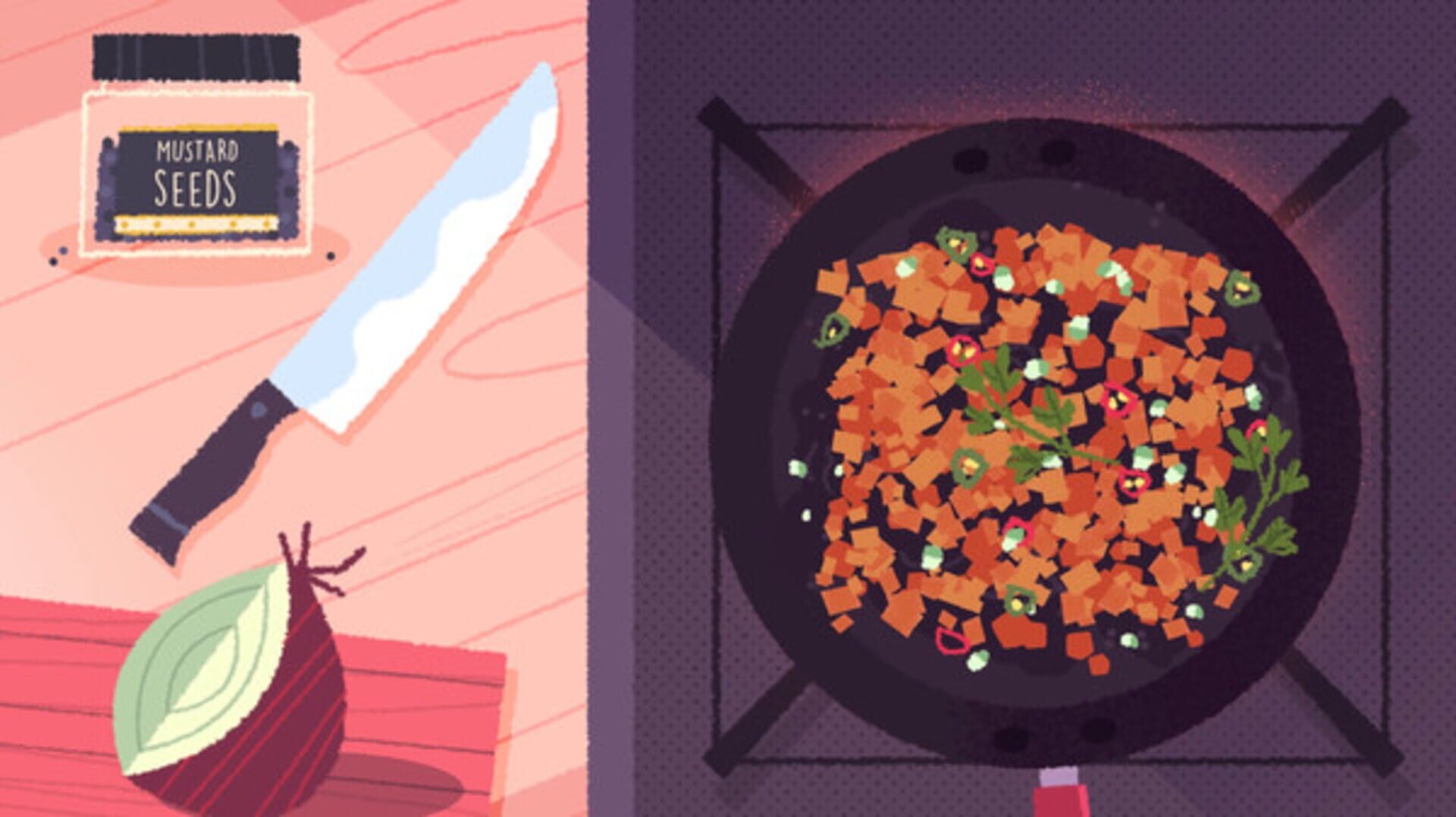
Venba does not attempt photorealism and is better for it. The aesthetic lands somewhere between a children’s picture book and a graphic novel, which suits the subject matter. This is a story told in sharp emotional shorthand rather than elaborate environmental detail, and the art direction commits to that register throughout.
The soundtrack, composed by Alpha Something, pays homage to Tamil cinema music across several decades. The score integrates live instrumentation and vocal performances, including a track performed by Deva, the famed Indian film composer. The sizzle of a pan, the rhythm of grinding spice, the particular knock of a wooden spoon against a pot. These details are not decoration. They carry cultural weight that the visual style alone cannot.
The game’s chapter structure moves through time, each section covering a different moment in the family’s life in Canada. The transitions are clean and purposeful. There is no open world, no map, no inventory system. What exists is exactly what the story requires.
Gameplay and Venba Review 2026: Cooking as Reconstruction

The cooking sequences are the mechanical core of Venba, and they work because they are genuinely puzzles rather than guided sequences. Venba’s mother’s cookbook has been damaged, leaving gaps in the instructions. Players must read what remains, interpret the illustrations, and reconstruct the correct order and method for each dish. The ingredients animate onto a surface and must be placed, timed, or combined correctly. Wrong choices do not penalise heavily, but the correct sequence produces a completed dish that unlocks a memory and advances the story.
No entry asks for reflexes or extended problem-solving. The challenge is interpretive: reading partial instructions and inferring the rest from visual cues. Each recipe covers a different Tamil dish, and the developers prepared and cooked every one of them before rendering the process in-game. That authenticity is perceptible. The dishes feel specific because they are.
Outside the kitchen, Venba includes dialogue exchanges and brief exploration sections that develop the family dynamic. The son, Kavin, gradually adopts the name Kevin and shifts towards English at home. They carry meaning precisely because they do not explain themselves. For context on where Venba sits in the broader landscape of short, emotionally focused indie games on PS5, it occupies an unusually specific niche.
The controls are simple and fully accessible across platforms. There is no mechanical complexity that would gate a narrative-focused player from reaching the story. That is the correct decision for a game of this scope and intent.
Venba Review 2026: Story and Characters

The central argument of Venba is that the immigrant parent’s story is the more interesting one. As lead developer Abhi noted, most media about the diasporic experience focuses on second-generation children, but it is the parents who left their country in their forties or fifties and built a new life in an unfamiliar language. Venba’s story follows that premise. The protagonist navigates visa paperwork, rejection letters citing a lack of ‘relevant Canadian experience’, and the steady erosion of daily Tamil practice as Canadian routines replace them. It is a narrower scope than the broad immigrant narratives found across the best cosy games of 2026, alongside other short-form gems like A Short Hike, and that narrowness is precisely what makes it effective.
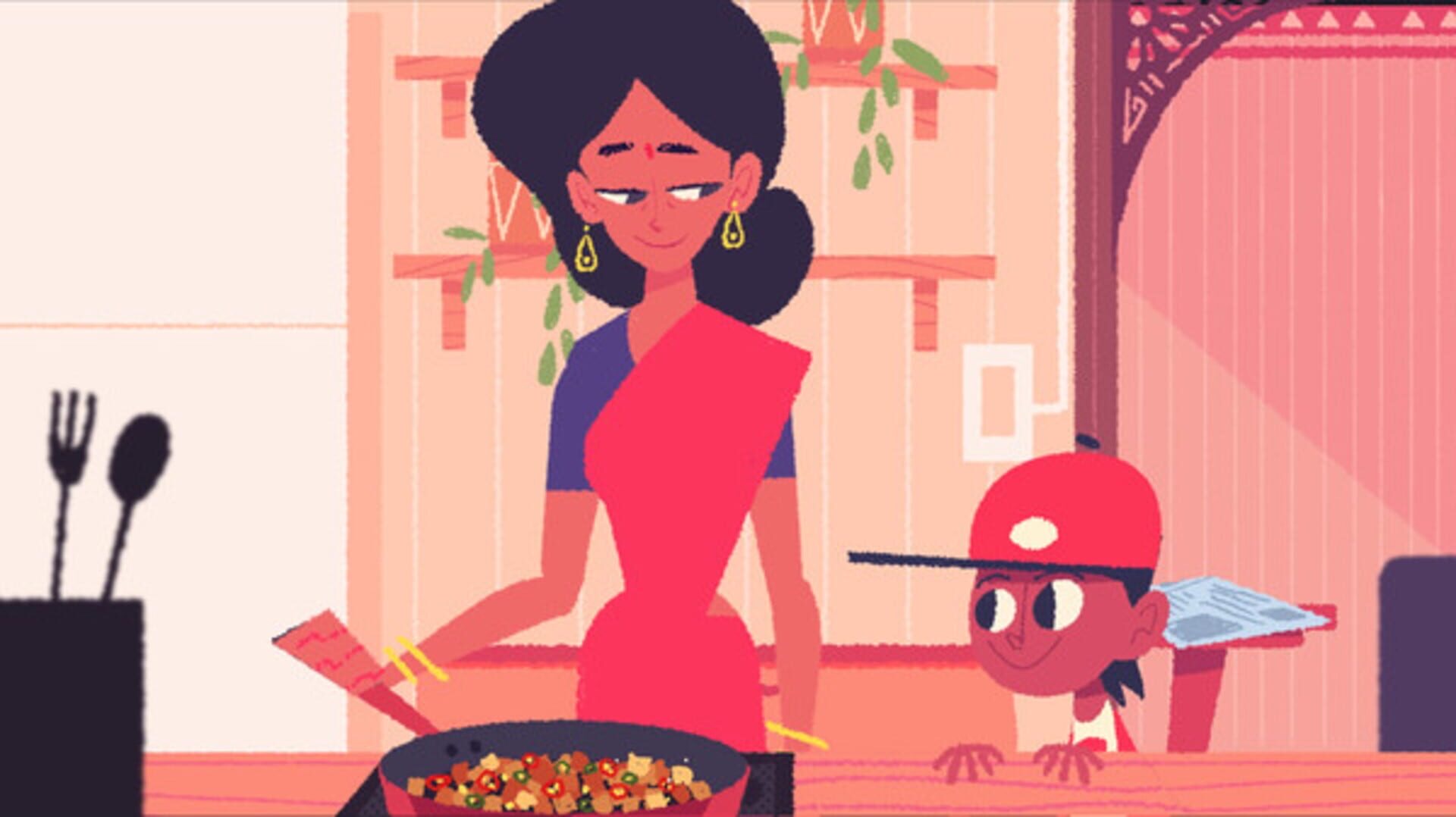
The story spans decades in a handful of chapters. Kavin’s arc is the secondary narrative, and it is handled with restraint. He is not a villain or a victim. He is a child doing what children do: adapting. The tragedy, such as it is, accumulates quietly. By the time the game reaches its final chapter, the distance between mother and son is a condition rather than a crisis, and the register of that loss is more affecting for being understated.
Venba’s relationship with her husband Paavalan is warm and specific. Their dialogue suggests a shared history and a mutual adjustment to displacement that the cooking sequences reflect: she is the keeper of cultural memory, he the practical one managing the household’s foothold in a new country. Neither character is sketched lightly.
The game does not resolve its tensions neatly, and it does not try to. The damaged cookbook is never fully restored. Some recipes are reconstructed, others remain incomplete. That structural choice mirrors the thematic content with a precision that most narrative games never approach.
Value and Longevity
Venba runs approximately one to two hours for a standard playthrough, with a completionist run reaching around two and a half hours. At £11.99/$14.99, the price reflects that scope honestly. This is not a game that attempts to justify a larger price tag with padding. It is exactly as long as it needs to be, and the case for that brevity is structural: the story is about loss, incompleteness, and the things that cannot be recovered. A longer game would argue against its own themes.
These assessments hold in 2026. Nothing about the game has dated because nothing about the game was ever dependent on technical novelty.
Replayability is limited, as one would expect. There are no branching paths, no alternative endings, and no mechanical systems to master. A second playthrough would take less than an hour. The game is best understood as a single, complete experience rather than a replayable loop. For players considering platform options, Venba’s Switch version suits portable, single-session play particularly well, and our best Switch 2 games guide includes similarly scoped indie titles worth pairing with it.
Technical Notes
Venba runs cleanly across all platforms. On PC, the game is optimised to the point of running at 60fps on decade-old hardware with minimal battery drain, as documented by multiple community reports including a Steam Deck test that completed the game in 130 minutes at a 3-watt TDP setting. For players weighing Venba against more technically demanding indie alternatives from the same period, our best cosy games PS5 2026 guide covers titles across a wider technical range.
The game does not feature multiple graphics modes, performance toggles, or platform-specific enhancements. It does not need them. The art style is flat and 2D; the technical requirements are minimal; the experience is consistent across hardware. No post-launch patches have introduced new content, and no DLC has been released. The version available in 2026 is identical to the 2023 launch version. That stability is a feature of the game’s scope. It launched complete and has remained so.
Final Word
Venba does one thing and does it with an accuracy that is difficult to argue against. Skip it if runtime is your metric; ninety minutes at full price requires a different calculation than forty-hour open worlds. For players who want something that trades scale for focus, Venba is the answer, and our best cosy games Switch 2 2026 guide includes similar scope titles for portable play.
Please note that some links in this article are affiliate links. If you found the coverage helpful and decide to pick up the game, or anything else for your collection, through one of those links, we may earn a commission at no extra cost to you. We use this approach instead of filling Spawning Point with intrusive display ads, and rely on this support to keep the site online and fund future reviews, guides, comparisons and other in-depth gaming coverage. Thank you for supporting the site.