Opening
A medieval city builder made by a single developer should not have sold three million copies in its first year of early access. Manor Lords did. Two years on from that April 2024 launch, the answer to whether Slavic Magic's solo-dev ambition has grown into the game those sales implied is a cautious but genuine yes. December 2025's Major Update 5 reworked core food and economic systems, overhauled castle construction, and introduced two new game modes: Duel and Fractured Realm. That update marks the clearest point at which Manor Lords feels structurally coherent rather than structurally promising. It is still an early access title, carrying that status visibly: some systems remain incomplete, the version 1.0 roadmap extends well beyond what is playable, and the tactical battle system lacks the depth the genre's dedicated titles provide. What has solidified is everything else, and in 2026 that is enough.
Game Snapshot
| Developer | Slavic Magic (Greg Styczeń) | |
| Publisher | Hooded Horse | |
| Release Date (Early Access) | 26 April 2024 | |
| Platforms | PC (Steam Early Access); Xbox Game Pass (PC) | |
| Price | £34.99 | $39.99 (Steam); included with Xbox Game Pass |
| Rating | ESRB Teen | |
| Genre | Medieval city-builder / real-time tactics | |
| Install Size | ~16 GB |
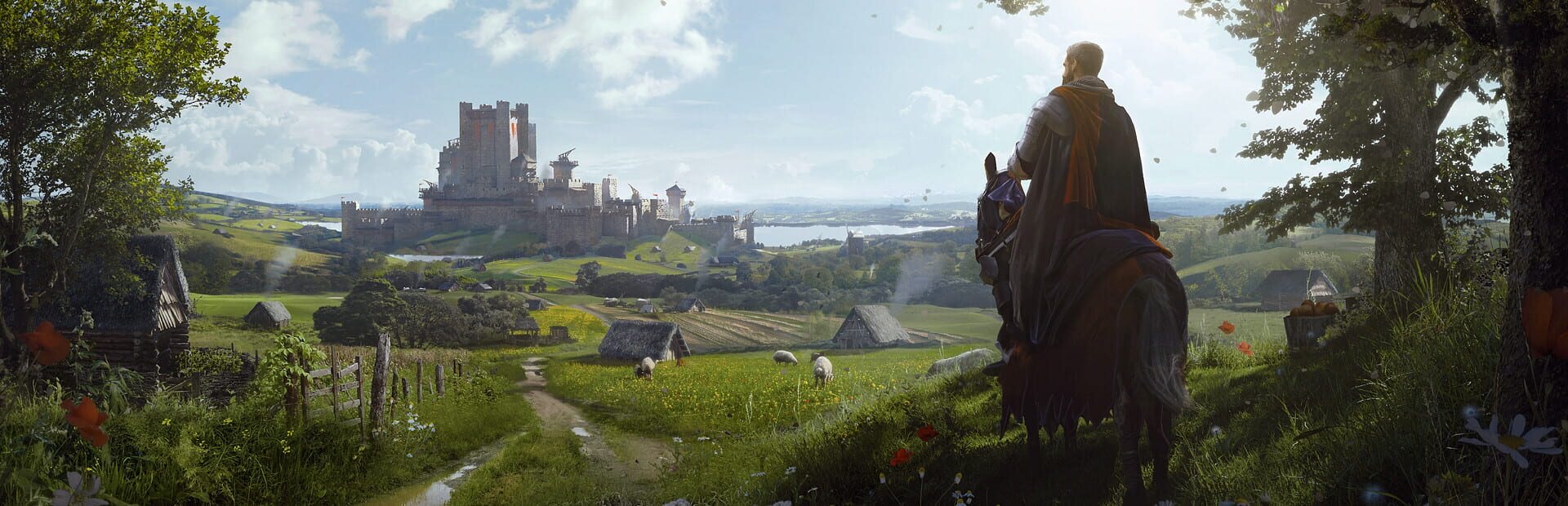
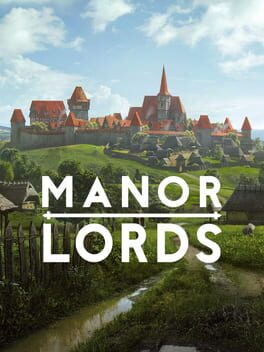
Manor Lords achieves something few city builders manage: the world it generates looks hand-assembled rather than procedurally deposited. Villages grow organically along roads and plot boundaries, with buildings orienting themselves to follow the terrain and street patterns the player lays down. A blacksmith placed near the market square reads as a blacksmith placed near a market square, not a sprite dropped onto a grid. The visual coherence is remarkable for a solo development.
The art direction draws from medieval European illustration, with muted ochre fields, dark timber framing, and seasonal colour shifts that mark winter, spring, and harvest cycles. Autumn is the most visually confident season: the canopy foliage shifts to amber whilst the fields stubble into brown and the first frost hazes the map's edges. These are not cosmetic flourishes. The seasons drive resource scarcity and agricultural timing, making the visual cues functional as well as atmospheric.
December 2025's Major Update 5 introduced four new maps: Devil's Hill, Jagged Cliffs, Divided, and Lake Lemm. Each offers different terrain constraints that alter how settlements expand and where military engagements develop. The variety extends the game's visual range considerably beyond the launch selection. Castle construction received a full overhaul: walls, gates, and towers now upgrade to a second tier of complexity, with modular placement replacing the fixed upgrade path. The fortifications now look like fortifications rather than placeholders.
For players tracking the best games of 2026 across platforms, Manor Lords occupies a distinct register: unhurried and grounded, closer in atmosphere to the best cosy games on PC than to the dense information displays of genre rivals.
Manor Lords Review 2026: Gameplay and Combat
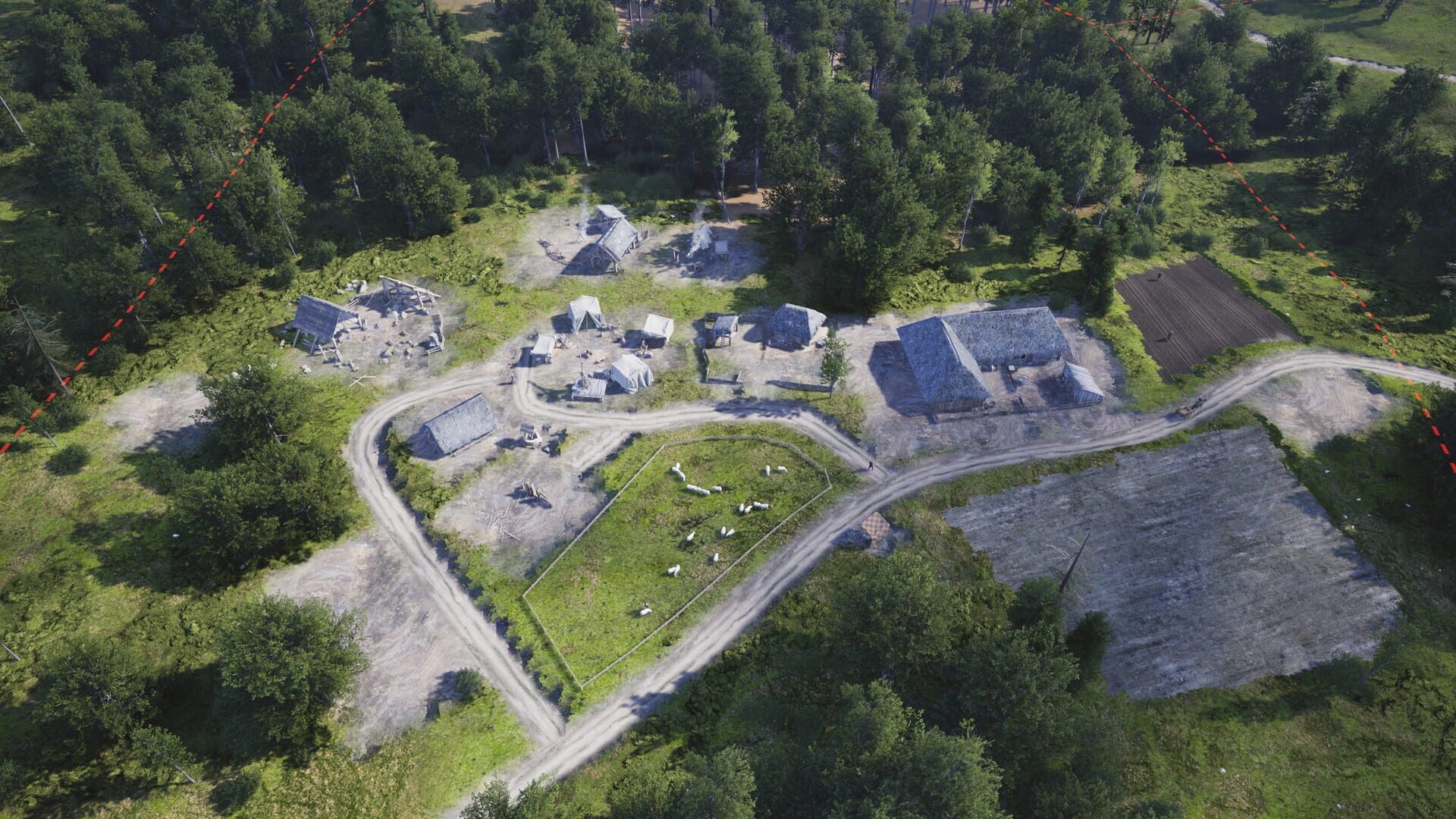
Manor Lords builds its city management around organic plot growth rather than the fixed-tile systems most city builders use. Burgage plots, the residential and commercial units that form each settlement, expand along the roads the player draws, with each plot able to host a family and a cottage industry. A plot adjacent to a field can become a grain producer; one near the forester becomes a firewood supply. Settlements develop their own spatial logic rather than snapping into predetermined layouts.
Economic chains have deepened considerably since launch. Major Update 5 expanded food production with distinct meat categories: mutton, chevon, pork, beef, chicken, and small game each require different production chains, and the choice of which livestock to prioritise carries genuine downstream consequences for approval ratings and trade income. Mushrooms returned as a foraged resource. New stoneworking buildings, a quarry, stonemason, and lime kiln, provide dressed stone and mortar for advanced construction, extending the building progression into territory that was previously absent.
Supply chains are the game's strongest intellectual hook. Lumber feeds construction and fuel. Clay feeds pottery and brick. Grain feeds bread but also feeds ale through the malting house. Tracking where a shortage originates requires backwards-tracing through several production nodes, and the Records view added in 2025 makes that process genuinely readable. Production and consumption data are now displayed per resource and per region, removing the opacity that frustrated the launch version.
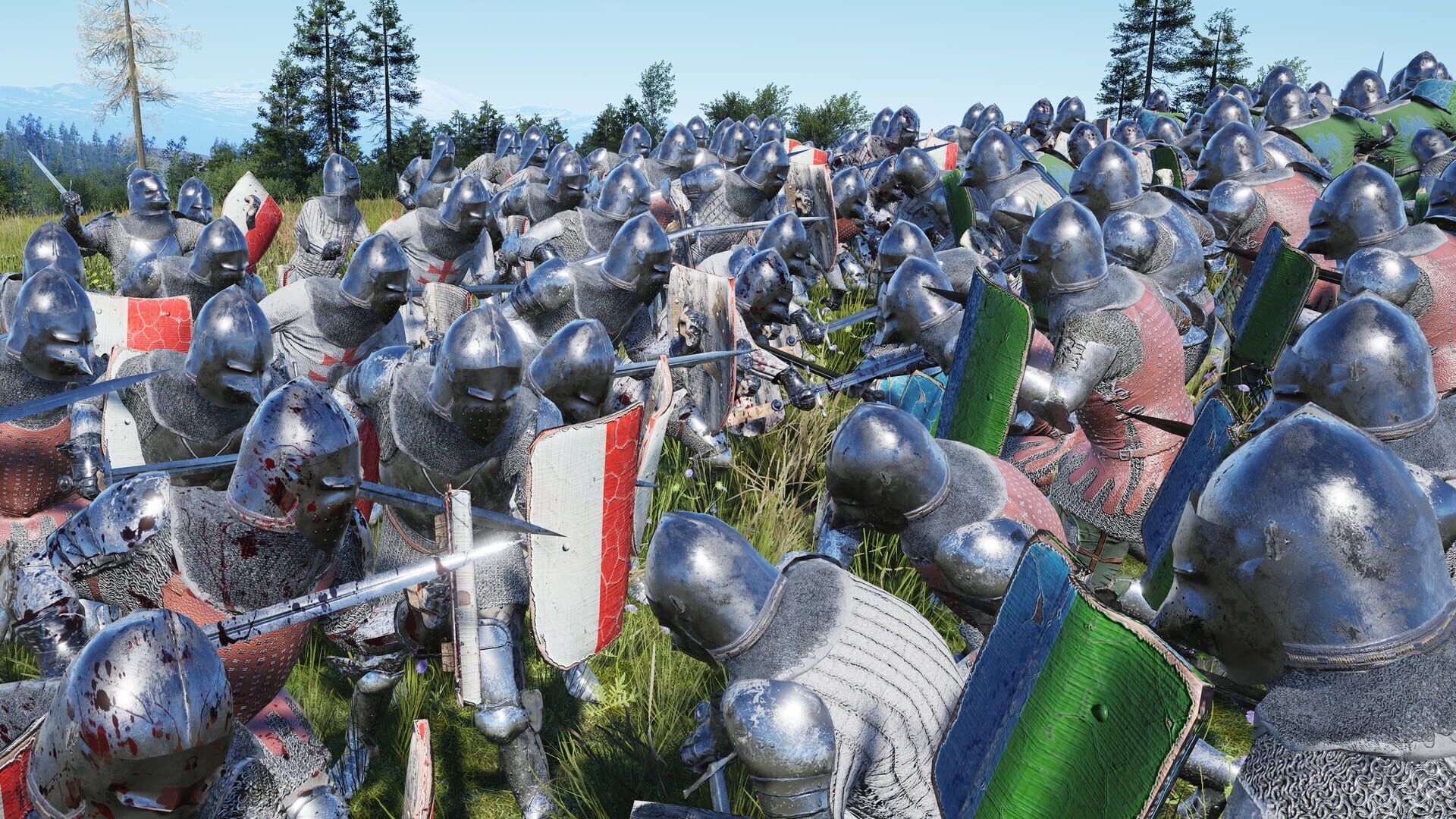
Tactical battles pit drafted militia, hired retinue, and mercenaries against bandit camps and rival lords. Formations, flanking, morale, fatigue, and weather all factor in. Battles are atmospheric. They are not yet strategically demanding in the way the roadmap implies: siege mechanics, cavalry, and gunpowder artillery remain planned for later updates, and their absence is felt when a bandit camp falls after a brief melee exchange. The two new game modes, Duel and Fractured Realm, expand the competitive framing without resolving the underlying tactical depth question.
The best cosy games on Switch 2 share an unexpected quality with Manor Lords: both reward sustained attention over reactive play. The comparison holds only in the game's early stages, but it is not wrong.
Story and Characters
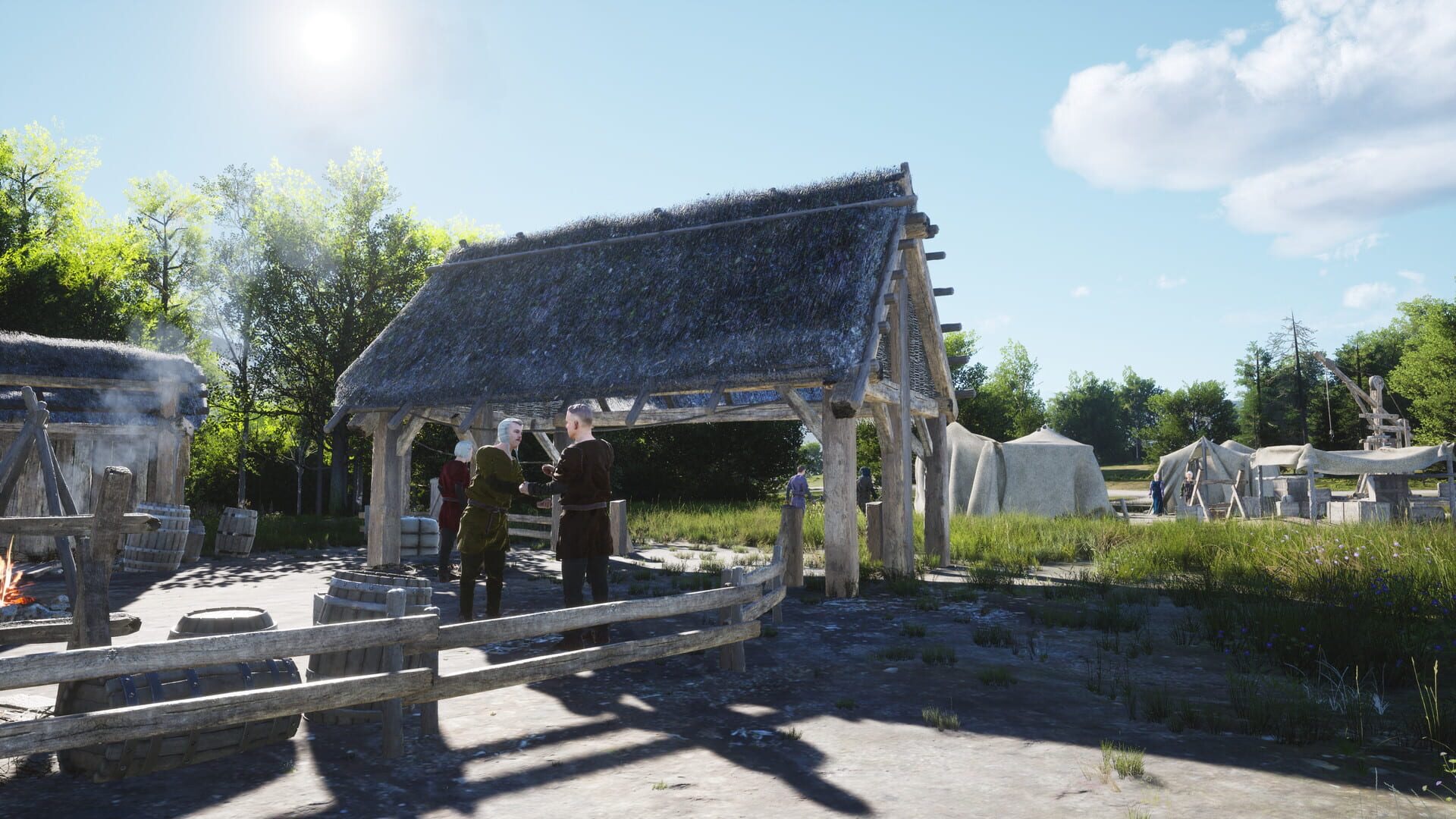
Manor Lords has no characters in the conventional sense and no authored narrative. The player governs a lord with a title and a coat of arms; the peasants have functions and approval ratings; the rival lords are AI agents with territorial ambitions. What the game has instead is situational drama: a grain shortage tipping into a famine warning three weeks before harvest, or a bandit warband arriving as the first snow falls whilst half the militia is occupied with construction.
Situational drama is the emotional register. Regional approval, driven by food variety, fuel access, housing quality, and proximity to amenities, creates tension that rewards sustained attention. A settlement at high approval communicates its health through visual density: market stalls filling, the tavern busy, paths active. A settlement at fifty per cent reads quieter, more fragile. No dialogue is needed. The systems carry the meaning.
The lord's progression is the game's closest equivalent to character development. Development points unlock regional bonuses and military specialisations across a progression tree. Build a mercantile region and trade routes matter more; invest in military infrastructure and the retinue becomes a genuine offensive asset.
For players drawn to games where narrative emerges from systems rather than scripts, Manor Lords occupies familiar territory.
Value and Longevity
The game is structurally repeatable: different map types, difficulty settings, and development priorities produce meaningfully different playthroughs, and the Duel and Fractured Realm modes add competitive variation.
Steam user reviews stand at 87 per cent positive overall, with 79 per cent positive in recent reviews as of early 2026, indicating the update cadence has maintained player goodwill. The value case is sound at £34.99 / $39.99. Xbox Game Pass inclusion on PC makes it accessible at no incremental cost for subscribers, removing the purchase risk entirely.
For players who prefer a finished product, waiting for version 1.0 remains the rational position. One developer's production schedule means update intervals are uneven, as the long pause in 2025 demonstrated. Players who have already worked through the best Switch 2 games of 2026 and want something with more systemic weight on PC will find Manor Lords occupies a useful middle ground between cosy sim and dedicated strategy title.
Technical Notes
Manor Lords runs on a single developer's schedule. Update cadence has been irregular: after a strong initial pace, a pause running from January to October 2025 reflected the scale of the core systems rework. Styczeń communicated the reasoning openly. The pace is one developer's pace.
Version 0.8.050, released December 2025, is the most content-substantial update since launch. Save backups are recommended before applying major updates, and mods should be disabled during installation to avoid crashes. Performance is solid on mid-range hardware. The 16 GB install size is modest by current standards. No documented accessibility options extend beyond standard Windows display settings. The community-facing patch notes are methodical, making it easy to track what each version addresses. Players who purchase now are buying into an ongoing development process, with cavalry, advanced siege mechanics, and additional territorial features still on the roadmap. Full release is not yet scheduled.
Final Word
Manor Lords in April 2026 is a city builder that has earned its reputation, even if the version 1.0 that will complete it is still being made. The kind of game where a frost warning three days before harvest sends the player through five production nodes to diagnose a firewood shortage, and the recovery requires linked decisions across three different buildings in sequence. It is not yet the fully realised medieval strategy game the roadmap describes. What it is, right now, is an unusually coherent early access release with a clear trajectory, a price that reflects the journey's incompleteness, and a world worth spending time in before the gates are fully built.
Manor Lords is worth buying in 2026 for players comfortable with early access titles still in active development. Major Update 5 in December 2025 expanded food production systems, overhauled castle construction, and added new maps and game modes, making this the most complete and stable version since launch. For Xbox Game Pass subscribers, the game is accessible at no incremental cost, making the decision straightforward.
Since launch, Manor Lords has received five major updates adding new buildings and resources, a reworked food and economic system with distinct meat and fish categories, a full castle fortification overhaul with modular upgrades, two competitive modes against the AI, four new maps, and meaningfully improved rival territory expansion. A Records view for tracking production and consumption per region, and a reworked approval system, have substantially improved the readability of the simulation.
Manor Lords is available on Xbox Game Pass for PC, included in the standard subscription at no additional cost. The Game Pass version receives the same updates as the Steam release. Availability on Xbox Series X/S console via Game Pass has not been confirmed during the early access period.
Sandbox mode without victory conditions extends indefinitely. Most players report twenty to fifty hours in a first playthrough, with subsequent runs shaped by different maps and development priorities.
Manor Lords does not currently have multiplayer. The game is a single-player experience. The Duel and Fractured Realm modes added in December 2025 are contests against AI opponents, not other players. Online multiplayer has not been announced as part of the version 1.0 roadmap.
Please note that some links in this article are affiliate links. If you found the coverage helpful and decide to pick up the game, or anything else for your collection, through one of those links, we may earn a commission at no extra cost to you. We use this approach instead of filling Spawning Point with intrusive display ads, and rely on this support to keep the site online and fund future reviews, guides, comparisons and other in-depth gaming coverage. Thank you for supporting the site.