FEATURE
Why Nintendo Won Console Gaming in 2025
Nintendo won console gaming in 2025 by focusing on clarity, hybrid play and consistent first-party output. Here’s why that strategy worked.

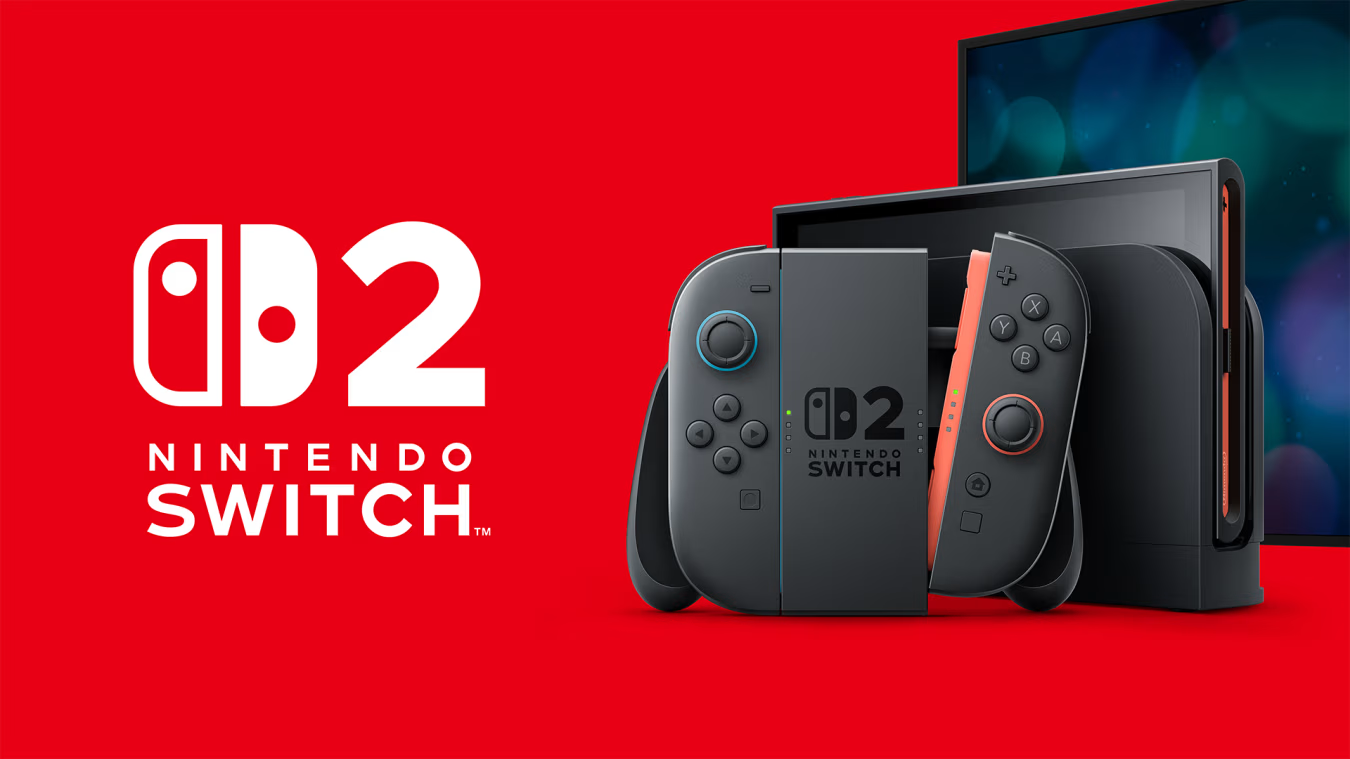
The best-selling console of 2025 had the same screen resolution as a device released eight years earlier. Nintendo won anyway. It won by doing the opposite. The company focused on a narrow, confident vision of what its console should be and executed it with clarity. While Sony and Xbox both had strong individual strengths, Nintendo was the only brand whose strategy felt immediately understandable to the broadest range of players.
This article explains why Nintendo finished top of the console rankings in 2025, and how its approach set it apart from PlayStation and Xbox. For the full brand-by-brand breakdown, this analysis supports our main Who Won Console Gaming in 2025 feature.

A successful console generation reset
The launch and early momentum of Switch 2 gave Nintendo something its competitors lacked in 2025: a generational reset. New console launches do more than sell hardware. They reset public attention, reframe brand narratives and give players a reason to re-engage.
Switch 2 modernised Nintendo’s baseline without abandoning the hybrid concept that made the original Switch so successful. Performance improvements were meaningful but measured, and they served game design rather than dominating the conversation. This balance helped Nintendo avoid the confusion that often accompanies mid-generation refreshes.
Players knew exactly what Switch 2 was and why it existed. It was a console you could play anywhere, with fewer compromises than before. That clarity was one of the strongest drivers behind Nintendo’s 2025 success.
Hybrid play as a core identity, not a feature

Nintendo’s biggest advantage remains its commitment to hybrid play as a first-class concept. Switch 2 is not a home console with portability added on, nor is it a handheld stretched to work on a television. It is designed from the ground up to move between contexts.
This matters because it removes friction. Players do not need to decide where a game belongs. They can start a session docked, continue it handheld, and resume later without changing settings or relying on network quality.
For readers weighing their own buying decision, this philosophy is explored further in our Best Console to Buy in 2025 guide.
First-party consistency over spectacle
Nintendo’s first-party output in 2025 did not rely on constant blockbuster releases. Instead, it maintained a steady cadence of games designed to be broadly appealing, mechanically readable and well-suited to the hardware.
Where PlayStation often frames releases as premium events and Xbox emphasises access through subscriptions, Nintendo focuses on consistency. That approach builds trust. Players buy into the platform knowing they will regularly receive games that work well on the system they own.
This consistency also supports the hybrid model. Games are designed with handheld play in mind, rather than being scaled down after the fact.

A simpler value proposition than its rivals
One of the most underappreciated reasons Nintendo won in 2025 is how easy it is to explain its value proposition. You buy a Switch 2, you buy games, and you play them wherever it suits you.
By contrast, PlayStation’s premium ladder requires players to understand the difference between PS5 models, accessories and optional hardware. Xbox’s value emerges over time through subscriptions and ecosystem commitment.
Nintendo’s offer is more immediate. This simplicity resonated in a year where pricing sensitivity was a real constraint in 2025 consumer electronics purchasing.
How Nintendo compared to PlayStation and Xbox
PlayStation remained the strongest premium home-console brand in 2025. PS5 and PS5 Pro deliver excellent performance and a refined experience, but they also ask players to commit to a higher-cost ecosystem.
Xbox continued to offer unmatched library access and long-term value, particularly for players who engage deeply with subscriptions. However, pricing changes and messaging complexity made it harder to recommend as the default console.
Nintendo did not outperform its rivals in every technical category. It outperformed them in clarity, accessibility and confidence.
Commercial momentum and cultural presence
Beyond hardware and games, Nintendo benefited from cultural momentum. A new console generation naturally drives conversation, but Nintendo sustained that attention by keeping its messaging focused and its output steady.
Switch 2 was visible in everyday gaming culture again: on commutes, in family settings, and in shared living spaces. This visibility reinforced Nintendo’s position as the most approachable console brand of the year.

Buying context and affiliate considerations
For readers considering joining the Nintendo ecosystem, Switch 2 remains the most flexible entry point into console gaming in 2025. It suits a wide range of play styles without requiring additional devices or subscriptions.
Current Nintendo Switch 2 models and bundles are available via Amazon here.
Final verdict: why Nintendo finished on top
Nintendo won console gaming in 2025 by delivering the clearest, most cohesive platform vision. It did not need to outspend or out-spec its rivals. It needed to give players confidence that the console they bought would fit naturally into their lives.
That confidence, combined with hybrid flexibility and consistent first-party support, is why Nintendo finished ahead of PlayStation and Xbox. For the complete breakdown of how the big three stacked up, this article sits alongside our full Who Won Console Gaming in 2025 analysis.