Opening
Your living room carpet is on fire, the wallpaper is upside down, and someone just painted the bathroom floor instead of the walls. Six years after its December 2019 launch, Tools Up remains one of the most reliably chaotic couch co-op experiences available. It never reached the mainstream visibility of Overcooked, but it carved out a niche among groups who wanted the same frantic energy applied to a different premise. The question now is whether that premise still holds. With an Ultimate Edition bundling all DLC released in early 2024, and the co-op genre thriving on modern hardware, revisiting The Knights of Unity’s renovation sim reveals both genuine charm and clear limitations. The blueprint had promise. The execution needed another coat.
Game Snapshot
Developer: The Knights of Unity
Publisher: All in! Games
Release Date: 3 December 2019
Platforms: PC, PS4, Xbox One, Nintendo Switch
Price: £15.99 / $19.99
Rating: PEGI 3
Genre: Co-op party / simulation
Length: ~4-6 hours (campaign), ~8-10 hours (all stars)
Install Size: ~1.5 GB
Presentation and World Design
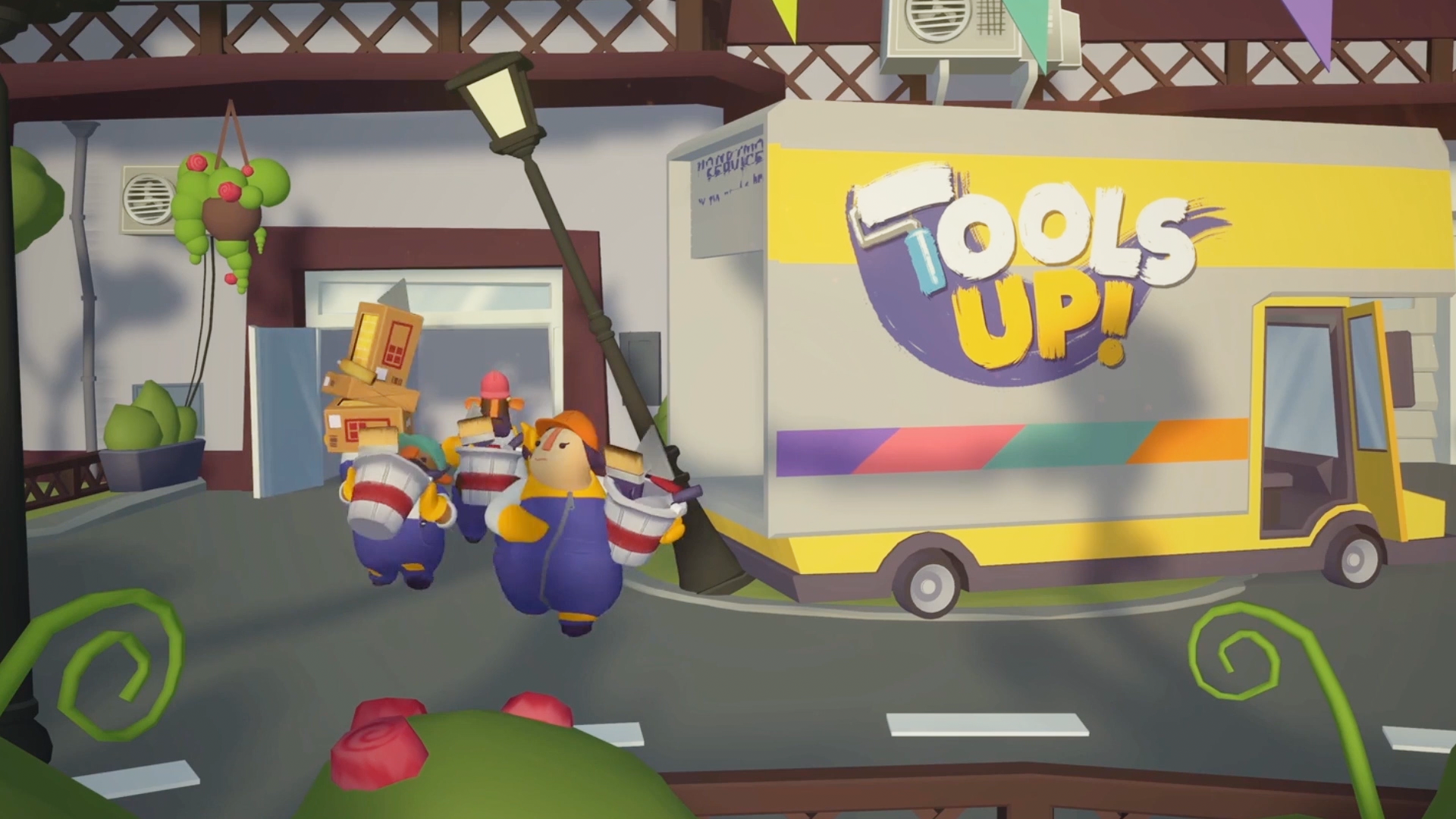
Tools Up takes place inside a towering apartment building, with each floor representing a new level. The visual style is bright, rounded, and deliberately toylike. Characters resemble chunky figurines with oversized heads, and the apartments themselves use bold primary colours that make task identification straightforward at a glance. It works for readability. It does not inspire.
The environments lack variety in the early hours. Living rooms, kitchens, and hallways blend together when the colour palette stays this narrow. Later levels introduce hazards like ice patches, moving furniture, and multi-floor layouts that force more creative navigation, but the visual identity never evolves beyond its initial impression. Compare this to the genre’s best entries and the gap in environmental storytelling becomes apparent.
The Garden Party DLC, available in the Ultimate Edition, does improve matters. Three seasonal episodes move the action outdoors into gardens, patios, and tunnels. Spring levels burst with greenery. Autumn stages scatter leaves across work surfaces. These forty-five additional levels bring welcome visual diversity, though the core aesthetic remains firmly in budget territory. Music is cheerful and inoffensive, looping without grating but never memorable. For those exploring party games on Nintendo’s latest hardware, our best cosy games on Switch 2 list covers stronger visual offerings in the genre.
Gameplay and Combat
The core loop borrows directly from the Overcooked template. Each level presents a blueprint showing what needs doing: paint these walls, lay that carpet, move this furniture, clean up the mess. Players grab tools, carry materials, and race against a timer to complete tasks in the correct order for maximum star ratings. Communication is everything. Coordination is rare.
Up to four players share one screen locally, and the fun scales directly with player count. Solo play is functional but joyless, a critical flaw given the absence of online multiplayer. Two players find a manageable rhythm. Three creates productive chaos. Four produces screaming. The game knows this and designs its later levels around the assumption that someone will be carrying paint past someone laying carpet, leaving footprints across freshly finished floors. The resulting mess requires cleanup, which costs time, which costs stars.
Controls are deliberately imprecise. Picking up objects, placing them accurately, and navigating tight corridors with oversized items produces slapstick comedy by default. The problem is that imprecision sometimes crosses from funny into frustrating. Dropping a paint bucket on the wrong tile, then struggling to pick it up again whilst a teammate walks through the spill, stops being amusing after the fifth occurrence. The control scheme lacks the refined weight that makes Overcooked’s chaos feel intentional rather than accidental.
Level design improves steadily. Early apartments are simple rectangles. Later stages introduce conveyor belts, rotating rooms, and split-level layouts that demand genuine strategy. The difficulty curve is fair, though the jump between two-star and three-star completion can feel steep. Check our full reviews archive for comparisons with other party titles in the genre.
Story and Characters
Story is minimal by design. A brief setup frames the apartment building as your workplace. You renovate floors, earn stars, and climb higher. There is no narrative arc, no character development, and no motivation beyond the next blueprint. The characters themselves are interchangeable cosmetic choices with no unique abilities or dialogue.
This is not a criticism so much as a statement of scope. Tools Up never pretends to offer narrative depth. It exists purely as a mechanical sandbox for cooperative chaos. The absence of character-specific traits does feel like a missed opportunity, though. Giving each renovator a specialty (faster painting, stronger carrying, tidier cleanup) would have added strategic depth to team composition without requiring narrative infrastructure.
The humour lands through situation rather than scripting. Watching a friend carry a sofa into a wall for thirty seconds while you desperately try to finish painting before the timer expires generates stories that the game itself never needs to tell. That emergent comedy is the real narrative. For story-driven alternatives, our reviews section has plenty of options worth exploring.
Value and Longevity
The base campaign offers roughly thirty levels across the apartment building, completable in four to six hours with a cooperative group. Chasing three-star ratings on every level extends that to eight or ten hours. The Garden Party DLC adds three episodes of fifteen levels each, effectively doubling the content.
The Ultimate Edition bundles everything for a modest price, making it the clear recommendation over buying piecemeal. At £15.99 for the base game, the value proposition is reasonable but not exceptional. The lack of online multiplayer significantly limits longevity for anyone without regular access to local co-op partners. There is no solo content worth revisiting, and no procedural generation to vary repeat attempts.
Compared to Overcooked 2, which offers online play, a more polished core, and a larger community, Tools Up struggles to justify itself as anything other than a secondary option. It fills a specific gap: you want couch co-op renovation chaos and nothing else on the market provides that exact flavour. That gap is real, but narrow. For more party game recommendations, browse our guides section.
Technical Notes
Performance is stable across all platforms. The simple visual style means no hardware is stressed. Load times are brief, frame rates hold steady, and no bugs were encountered during this revisit. The 1.5 GB install size is negligible.
The absence of online multiplayer remains the most significant technical limitation. In 2019, local-only co-op was already a debatable choice. In 2026, it is a genuine barrier to recommendation. The Ultimate Edition did not add online play, which suggests it is a permanent omission. Controller support is solid, and the game is fully playable with any standard gamepad. No accessibility options are available.
Final Word
Tools Up occupies a strange position in the co-op party genre. It does one thing well: it generates hilarious chaos when four people share a sofa and a screen. The renovation theme is fresh, the level design improves meaningfully over its runtime, and the Garden Party DLC adds welcome variety. But the absence of online multiplayer, the lack of character differentiation, and the visual blandness keep it firmly in the shadow of its obvious inspiration.
Six years on, it remains a solid second-choice party game. If your group has exhausted Overcooked and Moving Out, Tools Up offers a few evenings of genuine fun. Just do not expect it to become the main event. The blueprint was good. The finishing touches never arrived. More co-op recommendations are available across our best PS5 games list for those seeking something with more polish.
FAQ
Can you play Tools Up online with friends?
Tools Up only supports local couch co-op for up to four players on one screen. There is no online multiplayer mode in either the base game or the Ultimate Edition, which remains the title’s most significant limitation. If online co-op is essential, Overcooked 2 or Moving Out provide similar chaotic party gameplay with full online support across all platforms.
How many levels are in Tools Up including DLC?
The base game contains approximately thirty levels spread across an apartment building. The Garden Party DLC adds three seasonal episodes (Spring, Summer, and Autumn) with fifteen levels each, totalling forty-five additional stages. The Ultimate Edition bundles all content together, giving roughly seventy-five levels in total, enough for eight to ten hours of cooperative play.
Is Tools Up fun with only two players?
Tools Up functions with two players and delivers a manageable, moderately entertaining experience at that count. However, the game is explicitly designed for maximum chaos with three or four participants. Two-player sessions lack the overlapping mistakes and accidental sabotage that generate the best moments. Solo play is technically possible but not recommended, as the timer pressure without a partner removes the core appeal entirely.
Is Tools Up appropriate for young children?
Tools Up carries a PEGI 3 rating with no violence, language, or mature themes of any kind. The bright visuals, simple controls, and cooperative structure make it an excellent choice for families with young children. Reading the blueprint requires some spatial reasoning, so children under six may need guidance from an older player. The lack of fail-state punishment means younger players can participate without frustration.
Useful Links
Summary
Tools Up is a local co-op party game from The Knights of Unity that applies the Overcooked formula to home renovation. Up to four players share a screen, racing against timers to paint walls, lay carpet, move furniture, and clean up each other’s messes. The chaos is genuine and frequently hilarious with a full group, though imprecise controls sometimes frustrate. The Garden Party DLC adds forty-five outdoor levels across three seasonal episodes, and the Ultimate Edition bundles everything at a fair price. No online multiplayer, bland visuals, and zero narrative hold it back from the genre’s top tier. A solid second-choice party game. Score: 6.9/10.
Please note that some links in this article are affiliate links. If you found the coverage helpful and decide to pick up the game, or anything else for your collection, through one of those links, we may earn a commission at no extra cost to you. We use this approach instead of filling Spawning Point with intrusive display ads, and rely on this support to keep the site online and fund future reviews, guides, comparisons and other in-depth gaming coverage. Thank you for supporting the site.