Opening
Gothic cosy is now a recognisable genre, and Strange Horticulture made it one. Four years on, with a PS5 port, a mobile release, and a standalone sequel behind it, it remains the best example in the category. When Bad Viking’s herbalist puzzle launched on PC in January 2022, it arrived without a label to explain it; the 2026 library of gothic-cosy games is large enough that Strange Horticulture can finally be assessed on its own terms, and the assessment is clear. No other puzzle game in the sub-genre has matched its herbalist identification mechanic, where every correct plant selection carries narrative weight the system earns rather than declares, and no other game in the category has threaded a satisfying organisational loop through an occult mystery with the same discipline.
Game Snapshot
| Developer | Bad Viking |
| Publisher | Iceberg Interactive |
| Release Date | 21 January 2022 (PC); 28 July 2022 (Switch); 22 November 2022 (macOS); August 2023 (Xbox One, Xbox Series X/S); 23 February 2024 (PS5); 26 March 2024 (iOS, Android) |
| Platforms | PC (Steam, GOG), macOS, Nintendo Switch, PlayStation 5, Xbox One, Xbox Series X/S, iOS, Android |
| Price | £11.99 / $14.99 |
| Rating | PEGI 7 / ESRB Everyone 10+ |
| Genre | Occult puzzle / botanical mystery |
| Length | ~5.5–6 hours (main story); ~9 hours (completionist), based on HowLongToBeat |
| Install Size | ~1 GB (PC) |
Strange Horticulture Review 2026: Presentation and World Design
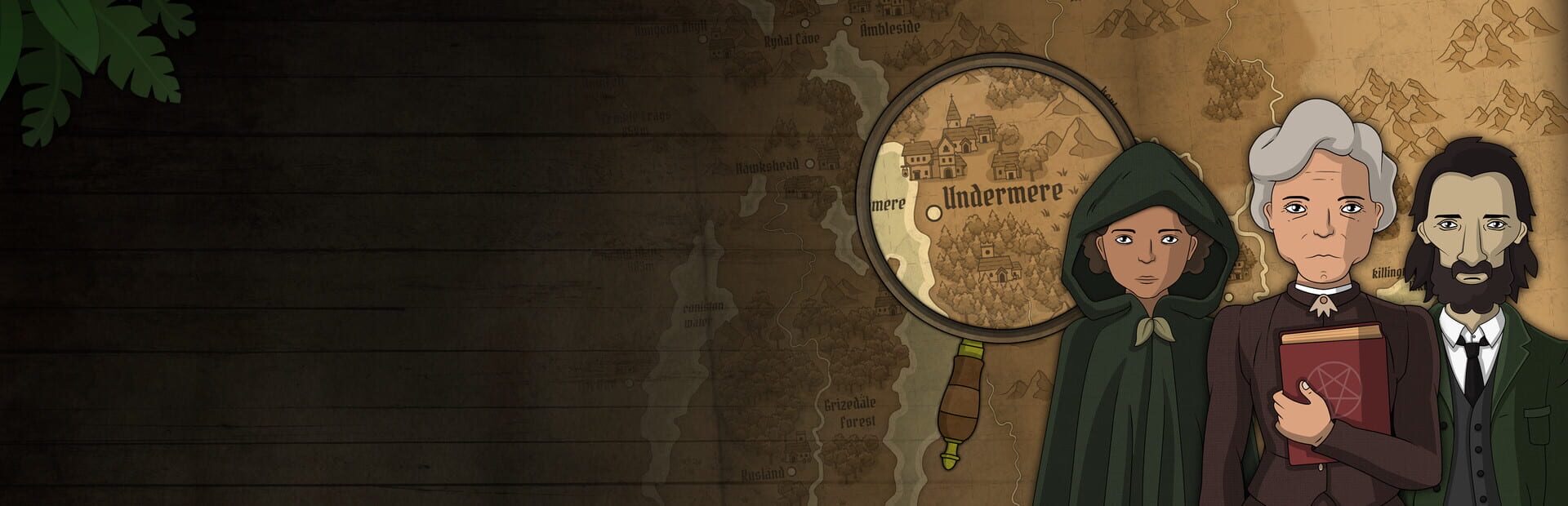
Strange Horticulture does not move fast. The game is set almost entirely behind the counter of a Victorian herbalist shop in the fictional market town of Undermere, a place surrounded by hag-infested forests and rugged mountains. The visual presentation is hand-drawn and deliberately muted: ink and watercolour suggest a world that is beautiful on the surface and quietly wrong underneath. Every surface in the shop is covered with jars, dried flowers, loose leaves, and handwritten notes; the effect is one of layered clutter that rewards close reading rather than casual browsing. The atmosphere is the work.
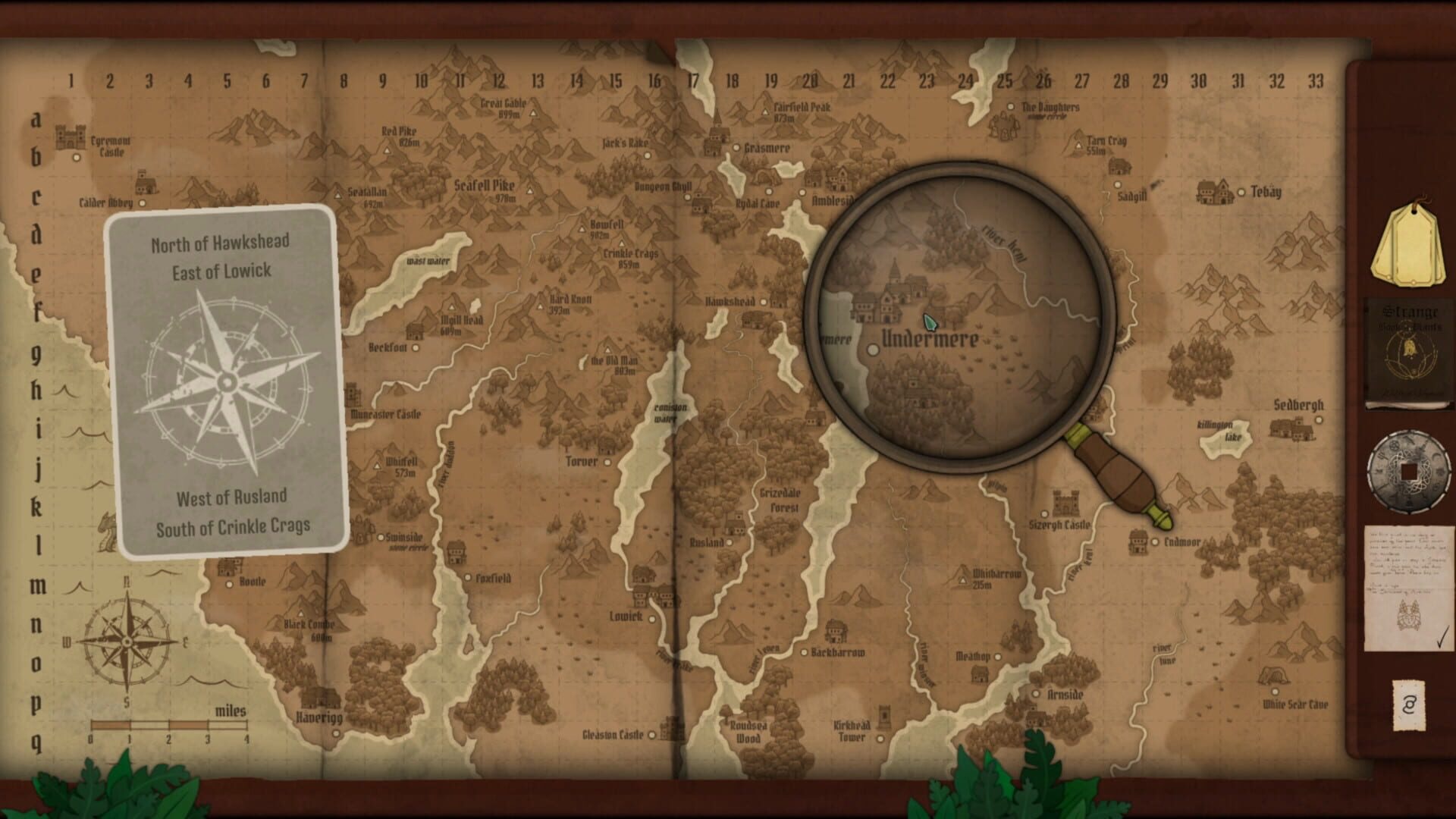
The world expands outward through a hand-drawn map that the player annotates over the course of the game. Customers describe locations; clues in letters and journal entries point to sites on the map; the player marks these by hand, building a record that grows denser as Undermere’s secrets accumulate. It is a navigation system disguised as an activity, and it works precisely because the map feels personal rather than functional. Unlike objective markers or fast-travel menus, the annotated map requires interpretation. The sense of exploration it produces from a game that barely leaves a single room is one of Strange Horticulture’s quieter achievements.
The art direction does not attempt technical showcase. There are no animations beyond the turning of pages and the drawing of tiles. The music is low and atmospheric. Sound design covers the creak of a shop door and the scratch of a pen without requiring a dynamic audio system. The result is a game that sits closer to an interactive graphic novel than a traditional puzzle title, and that restraint is a precise choice rather than a budget limitation. One accessibility note: the game’s cursive handwriting can be replaced with a standard font via the settings menu, a considered addition for players with dyslexia or visual processing differences. For players deciding which platform to play it on, our 2026 console guide covers the current hardware landscape across Switch, PS5, and Xbox.
Gameplay and the Strange Horticulture Mechanic
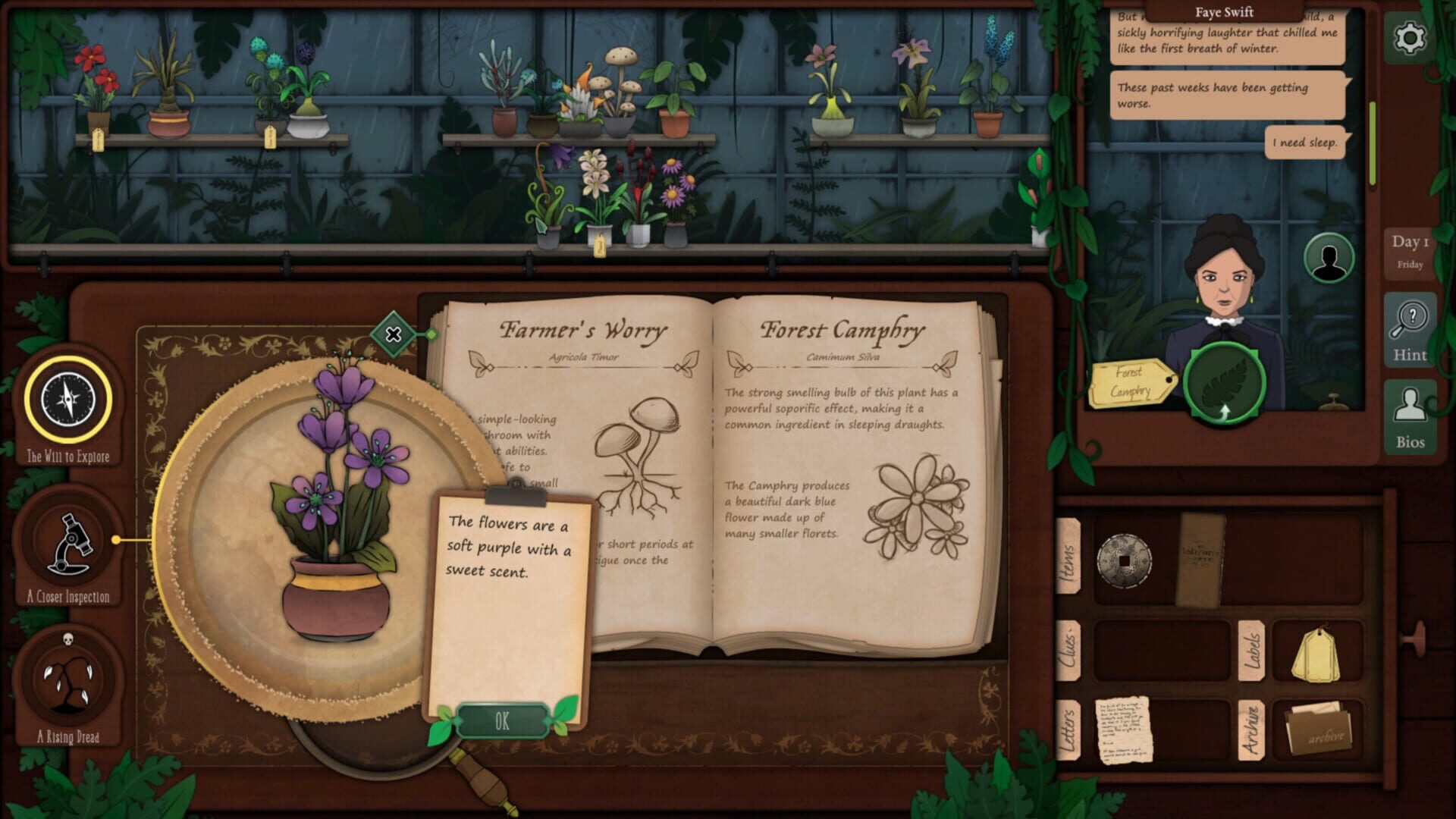
The core loop places you as the proprietor of Strange Horticulture, inheriting the shop and its botanical encyclopaedia from a recently deceased grandfather. Customers arrive one at a time with requests that range from the mundane to the cryptic. A herbalist customer might ask for something to help them sleep; the encyclopaedia describes each plant’s properties in period-appropriate detail; cross-referencing the description against the shop’s available stock produces the correct selection. The encyclopaedia is the puzzle. The mechanic is the act of reading it.
This sounds simple and is, until it is not. Midway through the game an alchemy system introduces compound preparations, requiring the correct combination of two plants rather than a single identification. A separate set of customers asks for remedies that require map consultation as well: find the location, identify what grows there, deduce what a customer might need from it. The system layers without becoming a different game. Each new mechanic extends the same core act of botanical deduction rather than replacing it.
The narrative consequence of each plant selection is where the design becomes genuinely interesting. Giving the correct plant advances a customer’s story thread; giving the wrong one, or a plant with harmful properties, opens a different path. The game tracks eight possible endings shaped by these choices, four broadly positive outcomes and four harmful ones. The consequences are not flagged in advance. A customer who asks for a plant to help someone sleep might be describing insomnia or something else entirely, and the encyclopaedia entry for the plant you select will not tell you which it is. The ambiguity is the design.
PC Gamer gave Strange Horticulture 90/100, and the praise centred specifically on this quality: the game trusts the player to read carefully and accepts that trust will sometimes be misplaced. A first playthrough will likely produce a mixed outcome; returning with the encyclopaedia complete and the town’s secrets mapped produces a meaningfully different result. The six-hour runtime accommodates multiple runs without outstaying its welcome. The alchemy mid-section is the game’s one structural wobble: the compound preparation puzzles introduce a wider margin for error in a way that briefly makes the loop feel less precise than the pure identification work. It does not derail anything. It unsettles the rhythm for a chapter.
Story and Characters
Strange Horticulture’s story is delivered through accumulation rather than exposition. You learn about Undermere through the customers who enter the shop: a widow seeking comfort, a concerned neighbour, a figure connected to an occult society that predates the town’s founding. No single conversation delivers the plot; the full picture assembles across a playthrough the way a herbalist’s notebook fills with cross-referenced observations.
The occult mystery involves a cult, a murder, and an entity the townspeople refer to only in oblique terms. The writing handles this with enough restraint that the horror never tips into the explicit. Undermere sits in the tradition of Victorian gothic literature where the supernatural is inferred from physical symptoms, unusual requests, and small inconsistencies in testimony, rather than stated directly. The atmosphere holds because the writing discipline holds.
The Horticulturist has no dialogue and no defined personality. The player’s character is a presence expressed entirely through selection: which plant to give, which map location to mark, which customer to help or withhold from. This structure gives the narrative branching its weight. The eight endings, confirmed in the game’s encyclopaedia of outcomes, are not the result of dialogue choices or moral alignment meters. They follow from botanical decisions made in a shop. The distance between cause and effect is the emotional engine. The structure is the story.
The game was nominated for Excellence in Design at the 2022 Independent Games Festival, a recognition that reflected the specific quality of how the identification system and the narrative system interlocked. That interlocking is the reason Strange Horticulture remains a reference point for its sub-genre four years after release, and why the sequel Strange Antiquities, which trades plants for artefacts but keeps the same identification structure, received positive reviews from Rock Paper Shotgun on arrival in September 2025. For a game that approaches gothic atmosphere from an entirely different angle, Resident Evil Requiem on PS5 shows how horror and atmospheric precision can scale to a larger canvas.
Value and Longevity
Strange Horticulture runs approximately five and a half to six hours for a first playthrough, according to HowLongToBeat. A completionist run aimed at all eight endings and every botanical entry takes around nine hours. At £11.99 / $14.99, the hourly rate is modest even by indie standards, though the short runtime means the price-per-hour comparison matters less than whether the experience is the right kind of compact.
It is. Strange Horticulture is not a game that benefits from being extended. The mystery sustains six hours precisely because it does not overstay them. A second playthrough with full encyclopaedia knowledge takes roughly three hours and produces a different outcome without retreading the same content mechanically. The short runtime is a structural decision, not a cost-cutting one.
The Metacritic aggregate of 83/100 across 11 reviews understates the game’s critical standing somewhat: Polygon placed it on their Best Games of 2022 list, and PC Gamer’s 90/100 made it one of the highest-rated puzzle releases of that year. The platform expansion from PC through Switch, Xbox, PS5, and mobile across 2022 to 2024 confirms a sustained audience rather than a launch-week spike. For players who complete Strange Horticulture and want to continue in the same setting, Strange Antiquities (September 2025) is a standalone sequel set in Undermere’s antique shop with the same publisher and identification structure. For a broader comparison with games in the same cosy-but-dark space, our best cosy games guide places Strange Horticulture in the category’s longer conversation.
Technical Notes
Strange Horticulture runs without incident on every platform it has been ported to. The minimal system requirements, around 1 GB of install space and processing demands from nearly a decade ago, mean technical performance is not a live question on any hardware. No performance modes are relevant: the game targets no specific frame rate or resolution and asks nothing of the hardware beyond basic 2D rendering. For players buying a puzzle or cosy game as a first title on a new platform, our Switch 2 games guide covers the portable options that pair well with this type of short-session play.
The PS5 version, released in February 2024, and the mobile versions from March 2024, add no platform-specific features. No haptic implementation, no DualSense effects, and no touch-specific mechanics beyond the tap-to-select that replaces a mouse click on iOS and Android. The mobile port handles reasonably; the handwritten map annotation, which requires precision, is slightly more comfortable with a stylus than a fingertip on smaller screens.
Accessibility is covered by the cursive font toggle and the inherent low-pressure structure: no time limits, no fail states, and no content locked behind reflex-based mechanics. The game’s text density, particularly the encyclopaedia entries, is the primary accessibility consideration. The text is readable at standard screen sizes across all platforms, though players with significant visual impairment will find no text-scaling option beyond system-level settings. Post-launch, no significant patches have been necessary: the game launched in a stable state and has remained there. The technical experience is uniform across platforms.
Final Word
Strange Horticulture is a game about a shop that is also about consequence. The moment that crystallises it comes when a customer’s request, read carefully against the encyclopaedia, resolves into an answer you are not entirely certain is correct, and you give the plant anyway. Whether that was the right choice will not be confirmed for several chapters, if at all. That specific quality, the gap between act and outcome measured in pages of a botanical reference book, is what no other game in its category has replicated. For anyone drawn to cosy games on PS5 and Switch who has not played Strange Horticulture, 2026 is an easy year to find it at a discount across every platform. Skip it only if you need mechanical pace: at six hours, the game moves at the tempo of an evening reading, not a gaming session.
Strange Horticulture is worth buying in 2026 at £11.99 / $14.99, particularly for players who want a short, replayable puzzle experience with a genuine occult mystery. The main story runs approximately five to six hours, with a full eight-ending exploration taking around nine hours across multiple playthroughs. The arrival of the sequel Strange Antiquities in September 2025 has renewed interest in the original and makes this an ideal entry point to the series.
Strange Horticulture takes approximately five and a half to six hours to complete in a single playthrough, according to HowLongToBeat. Completionist runs covering all eight endings and every encyclopaedia entry extend to around nine hours. The compact runtime is a deliberate structural choice rather than a content gap: the mystery is calibrated precisely to fit the playtime, and a revisit once you know the plant catalogue and the town's secrets takes around three hours with a different outcome.
Strange Horticulture has eight endings: four that resolve the Undermere mystery constructively and four that do not. Which ending you reach depends primarily on the plants you give to key customers, with no moral alignment system and no consequence flags in advance. Most first playthroughs produce a mixed result; revisiting with a completed encyclopaedia allows more deliberate navigation. No single ending is the "correct" one.
Strange Horticulture is suitable for most players who would describe themselves as disliking horror, with some caveats. The game's horror register is Victorian gothic rather than jump-scare or gore: the supernatural is suggested through customer testimony and cryptic text rather than visual threat. PEGI rates it 7, ESRB rates it Everyone 10+, and the most unsettling content in certain endings is described in text rather than depicted. Players sensitive to occult themes or textual descriptions of violence in specific endings should note those exist.
Strange Horticulture released on PS5 on 23 February 2024. The port performs cleanly and includes the full base game with all botanical encyclopaedia entries and all eight endings. No PS5-specific features such as DualSense haptics or adaptive triggers are implemented. The game is also available on Switch, Xbox, iOS, and Android, making it accessible on every major current platform.
Strange Antiquities, the standalone sequel developed by Bad Viking and published by Iceberg Interactive, released on PC and Nintendo Switch on 17 September 2025. It is set in Undermere's antique shop rather than the horticulture shop, replacing plant identification with artefact identification using the same encyclopaedia and map mechanics. Rock Paper Shotgun cited it as one of their favourite puzzle games of 2025. No PS5 or Xbox version has been announced as of April 2026.
For more gothic and supernatural cosy picks, see our best cosy games guide for 2026. For PS5-specific cosy picks, see our PS5 cosy games hub.
Please note that some links in this article are affiliate links. If you found the coverage helpful and decide to pick up the game, or anything else for your collection, through one of those links, we may earn a commission at no extra cost to you. We use this approach instead of filling Spawning Point with intrusive display ads, and rely on this support to keep the site online and fund future reviews, guides, comparisons and other in-depth gaming coverage. Thank you for supporting the site.