
TL;DR: Score: 8.1/10 — Marvel’s Spider-Man: Miles Morales remains a standout early showcase for PS5, even years later. Insomniac refines its open-world formula into a shorter, character-focused tale that foregrounds Miles’ culture, community and distinct move set. A snow-covered New York, excellent animation and flexible performance modes make exploring the city a joy, while Venom powers and camouflage give combat and stealth fresh wrinkles.
Marvel’s Spider-Man: Miles Morales arrives as a focused follow up to Insomniac’s 2018 Spider-Man, pitched closer to Uncharted: The Lost Legacy than a full-blown sequel in scope. On PS5 it doubles as a tech showpiece, using ray tracing, high frame rate modes and the DualSense controller to sell a snowy New York at Christmas.
The big question, several years and one true sequel later, is whether Miles’ standalone debut still feels essential. The answer depends on what you value. This is a tighter, more personal story with some of the series’ best character work and combat, wrapped around a campaign that burns bright and then ends before fatigue can set in. If you expect another 30 hour epic, you may be disappointed. If you want a concentrated hit of superhero spectacle, it still lands.
Game Snapshot
Developer: Insomniac Games Publisher: Sony Interactive Entertainment Release Date: 12 November 2020 (PS5 launch, 19 November 2020 in UK/EU) Platforms: PS5, PS4, PC Price: £49.99/$49.99 RRP on PS Store (often discounted at retail) Rating: PEGI 16 | ESRB Teen Genre: Action adventure, superhero Length: 8-12 hours (main story), 15-20 hours (story + side content and trophies) Install Size: ~ 50 GB on PS5 (approx 50.7 GB at launch, varies with patches)Presentation and World Design
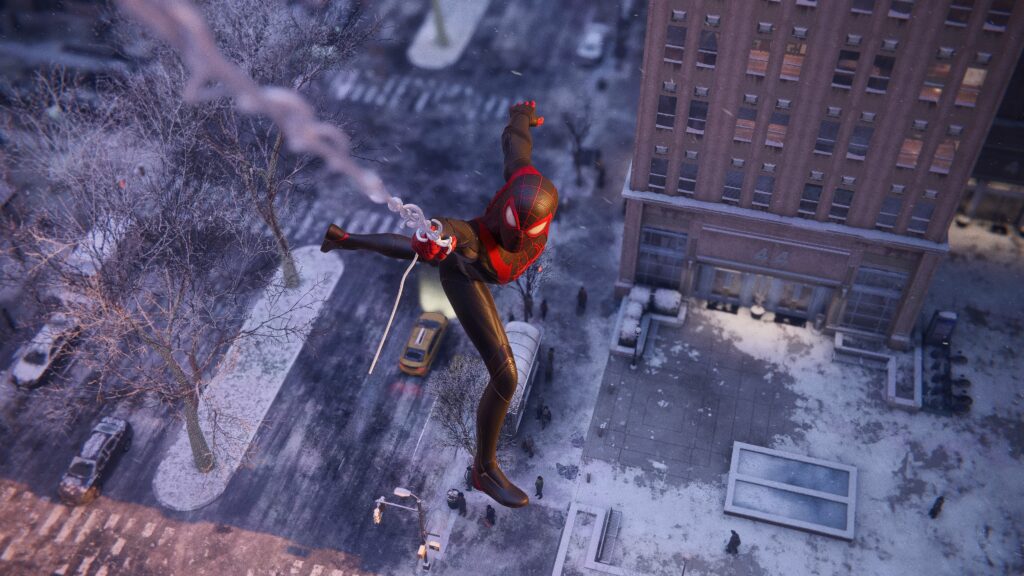
Insomniac’s New York remains one of the most convincing open cities in games, and the winter makeover gives it a distinctive flavour compared with Peter’s autumnal adventure. Blankets of snow, festive lights and low winter sun bounce around the skyscrapers, especially in the ray traced quality modes where glass, car bodies and puddles all reflect the world with convincing depth. On PS5, Miles Morales runs in multiple modes, including native 4K with ray tracing at 30 frames per second and performance options that prioritise 60 frames per second with cut-down visual bells and whistles. In practice, the performance modes are where the game sings, marrying fluid animation with rapid traversal so swinging feels silky and responsive. Harlem, now Miles’ home neighbourhood, receives particular attention, with murals, markets and street life that underline his cultural roots. The world layout largely mirrors the 2018 map, so returning players will know the city’s rough shape, but weather, lighting and smaller touches prevent it from feeling like a lazy reuse. The presentation is also backed by strong cinematic work and a punchy soundtrack that mixes orchestral swells with contemporary beats to reflect Miles’ personality.Gameplay and Combat
Moment to moment, this is still the same blend of traversal, third-person brawling and light stealth that defined the first game. The big shift is Miles’ unique move set. In addition to standard web strikes and dodges, he wields bio-electric Venom powers that act as crowd-control tools and boss breakers, plus a short-duration camouflage that opens up new stealth options. Combat retains the free-flow feel of Insomniac’s system, built around juggling enemies, launching into the air, and reacting to incoming attacks with timely dodges and counters. Venom strikes add a satisfying extra layer, letting you slam armoured foes, launch groups, or bridge into aerial combos that would be painful to pull off as Peter. Enemies are tuned to demand use of these tools, with Underground troops and Roxxon guards sporting shield types or tech that respond differently to each power.
Stealth encounters are familiar yet more flexible thanks to camouflage. You can still clear out rooftop arenas by webbing enemies to walls and lamps, but invisibility means you can be a bit bolder, reposition in the open, or escape a bad call without resetting the entire encounter. The DualSense adds subtle texture with tension on the triggers as you swing and nuanced rumble for Venom surges or subway vibrations, although it is more accent than game-changer.
Combat retains the free-flow feel of Insomniac’s system, built around juggling enemies, launching into the air, and reacting to incoming attacks with timely dodges and counters. Venom strikes add a satisfying extra layer, letting you slam armoured foes, launch groups, or bridge into aerial combos that would be painful to pull off as Peter. Enemies are tuned to demand use of these tools, with Underground troops and Roxxon guards sporting shield types or tech that respond differently to each power.
Stealth encounters are familiar yet more flexible thanks to camouflage. You can still clear out rooftop arenas by webbing enemies to walls and lamps, but invisibility means you can be a bit bolder, reposition in the open, or escape a bad call without resetting the entire encounter. The DualSense adds subtle texture with tension on the triggers as you swing and nuanced rumble for Venom surges or subway vibrations, although it is more accent than game-changer.
Story and Characters
Miles Morales is at its best when it narrows its focus to family, neighbourhood and the growing pains of a young hero trying to define himself next to an already beloved Spider-Man. Set shortly after the first game, the story follows Miles as he finds his feet in Harlem while Peter heads away, leaving him as New York’s only Spider-Man for a stretch. The central conflict between Roxxon Energy and the Underground is serviceable corporate-versus-activist fare, but it is elevated by the personal relationship between Miles and Phin, his childhood friend turned antagonist. Their history gives the drama weight, and the script takes time to explore how grief, anger and exploitation can push smart young people into dangerous places. Side characters, from Miles’ mum Rio to his uncle Aaron, add texture and give the story more of a grounded, domestic rhythm than Peter’s broader superhero thriller. The arc is compact and largely predictable if you know superhero tropes, yet it lands emotionally. Performances are strong across the board, and the finale finds a satisfying balance between city-levelling spectacle and very human consequences.
Value and Longevity
The most contentious part of Miles Morales is its length. A focused run that mixes story missions with a light dusting of side content will wrap up in roughly 10 to 12 hours, and even a 100 per cent clear sits closer to 15 to 20 hours. That is significantly shorter than the 2018 game, and at launch price it understandably raised eyebrows. Viewed today, with frequent discounts and inclusion in PlayStation Plus Extra, the value proposition is easier to swallow. There is meaningful side content in the form of app-based requests, activity tokens, combat challenges and collectibles, and a New Game Plus mode that encourages a second run with new abilities and suits. Still, if you judge value strictly by hours per pound, this is a premium-priced, mid-length adventure rather than an enormous time sink. The upside is that very little of Miles Morales feels bloated. The pacing is brisk, the mission variety respectable, and the campaign ends before repetition sets in, which makes it a strong candidate for revisiting when you fancy a quick web-slinging fix.Technical Notes
On PS5, Miles Morales is highly polished. The quality mode delivers native 4K with ray traced reflections and dense city detail at a steady 30 frames per second, while performance modes target 60 frames per second, with optional ray tracing, reduced resolution and some pared-back crowd density and effects. Load times are essentially instant when fast travelling or restarting missions thanks to the SSD. Performance is generally excellent, with only minor hitches in busy scenes, and Insomniac has patched the game since launch to improve stability and add the performance RT mode. The PS5 version also benefits from HDR, 3D audio and DualSense use, though the latter is less showy than in something like Astro’s Playroom. Accessibility options cover difficulty, QTE simplification and some visual aids, but they are not as extensive as more recent Sony first-party releases.Final Word
Marvel’s Spider-Man: Miles Morales is not trying to outdo the scale of Insomniac’s full Spider-Man entries. Instead it carves out a more intimate slice of superhero life, focused on culture, community and a young hero learning who he is without his mentor. On PS5 it still feels like a showcase, with fast loading, flexible performance modes and excellent audio-visual polish. If you demand sprawling runtimes it may feel slight, but judged as a concentrated adventure it holds up very well. For new PS5 owners it remains one of the best ways to test the console’s strengths while enjoying a confident, charming take on Miles Morales.
FAQ
Q. Do I need to play Marvel’s Spider-Man (2018) before Miles Morales? A. It helps, but it is not essential. Miles Morales recaps the key beats of the first game and stands on its own as an origin-style story for Miles. You will, however, appreciate character relationships and some returning faces more if you have played the original. If you plan to play both, the Ultimate Edition that bundles Spider-Man Remastered and Miles Morales is an efficient route. Q. How long does it take to finish Miles Morales on PS5? A. Expect around 8 to 12 hours for a run that mixes story missions with some side activities. Rushing the main story can bring that under 10 hours, while aiming for 100 per cent completion and trophies typically pushes playtime into the 15 to 20 hour range. New Game Plus and higher difficulties offer reasons to replay if you enjoy the combat. Q. Which performance mode is best on PS5? A. For most players the 60 frames per second performance RT mode is the sweet spot, combining smooth motion with ray traced reflections and a strong sense of detail. The 30 frames per second quality mode offers crisper native resolution and more stable ray tracing, but swinging and combat feel less responsive. If you have a VRR display you can experiment freely knowing both modes are well optimised. Q. Is Marvel’s Spider-Man: Miles Morales difficult? A. Miles Morales offers a range of difficulty options, from story-focused to more punishing settings. On standard difficulty it is approachable, with generous checkpoints and forgiving dodge windows. You can adjust difficulty at any time, and accessibility settings allow tweaks to QTEs and input demands, making it suitable for a wide range of skill levels.
Support Spawning Point
Please note that some links in this article are affiliate links. If you found the coverage helpful and decide to pick up the game, or anything else for your collection, through one of those links, we may earn a commission at no extra cost to you. We use this approach instead of filling Spawning Point with intrusive display ads, and rely on this support to keep the site online and fund future reviews, guides, comparisons and other in-depth gaming coverage. Thank you for supporting the site.
Please note that some links in this article are affiliate links. If you found the coverage helpful and decide to pick up the game, or anything else for your collection, through one of those links, we may earn a commission at no extra cost to you. We use this approach instead of filling Spawning Point with intrusive display ads, and rely on this support to keep the site online and fund future reviews, guides, comparisons and other in-depth gaming coverage. Thank you for supporting the site.