Opening
A tile-placement puzzle with no failure state should not hold your attention for sixty hours. Dorfromantik does exactly that. Toukana Interactive’s hex-grid builder arrived on PC in 2022, took the Deutsche Computerspielepreis for Best Debut and Best Game Design, and has now, with the PlayStation and Xbox releases of August 2025, reached every major platform for the first time. That makes 2026 the natural moment to ask whether a game built entirely around arrangement and pattern rather than tension and conflict still has something to offer. It does: a quietly structured loop that uses biome unlocks, quest chains, and procedurally generated tile stacks to give meditative building a surprisingly durable skeleton. The question is not whether Dorfromantik is relaxing. The question is whether relaxing is enough.
Game Snapshot
| Developer / Publisher | Toukana Interactive |
| Release Date | 28 April 2022 (PC full release); 29 September 2022 (Switch); 14 August 2025 (PS4, PS5, Xbox One, Xbox Series X/S) |
| Platforms | PC (Steam, GOG), Nintendo Switch, PlayStation 4, PlayStation 5, Xbox One, Xbox Series X/S |
| Price | ~£7.99 / $9.99 (varies by platform) |
| Rating | PEGI 3 / ESRB Everyone [TK: not confirmed in available sources] |
| Genre | Puzzle / strategy (tile placement) |
| Length | ~5–6 hours (main campaign to first completion); ~18–19 hours (main + side quests); completionist 58–61 hours (HowLongToBeat) |
| Install Size | ~500–650 MB (PC); [TK: console install size unconfirmed] |
Presentation and World Design in Dorfromantik 2026
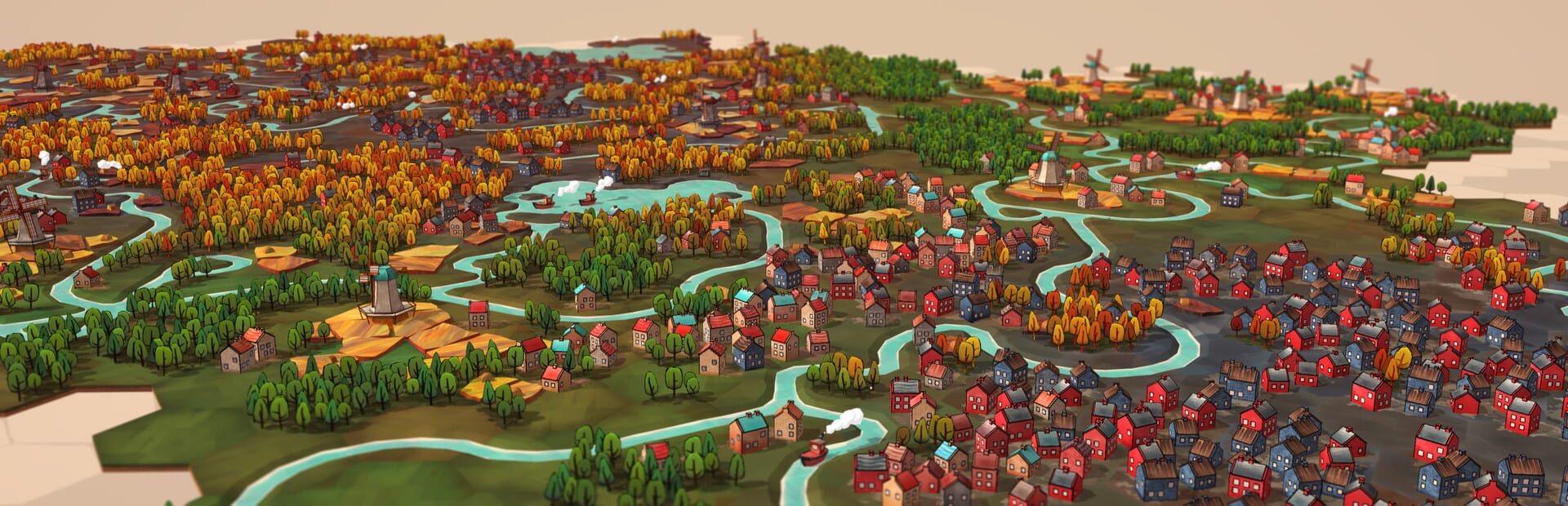
Dorfromantik does not ask you to manage a narrative or react to a threat. It asks you to look. Each session begins with a blank hexagonal grid and a procedurally generated stack of tiles depicting one of six terrain types: forest, field, village, water, railway track, and barren land. The visual language is storybook-soft, a palette of muted greens, earthy yellows, and pale blues that suggest a Central European landscape seen through the filter of a childhood summer. Toukana’s roots in the HTW Berlin design programme are visible in every graphic decision: the tile art is clean, the animations minimal, and the overall impression is one of deliberate, competent restraint.
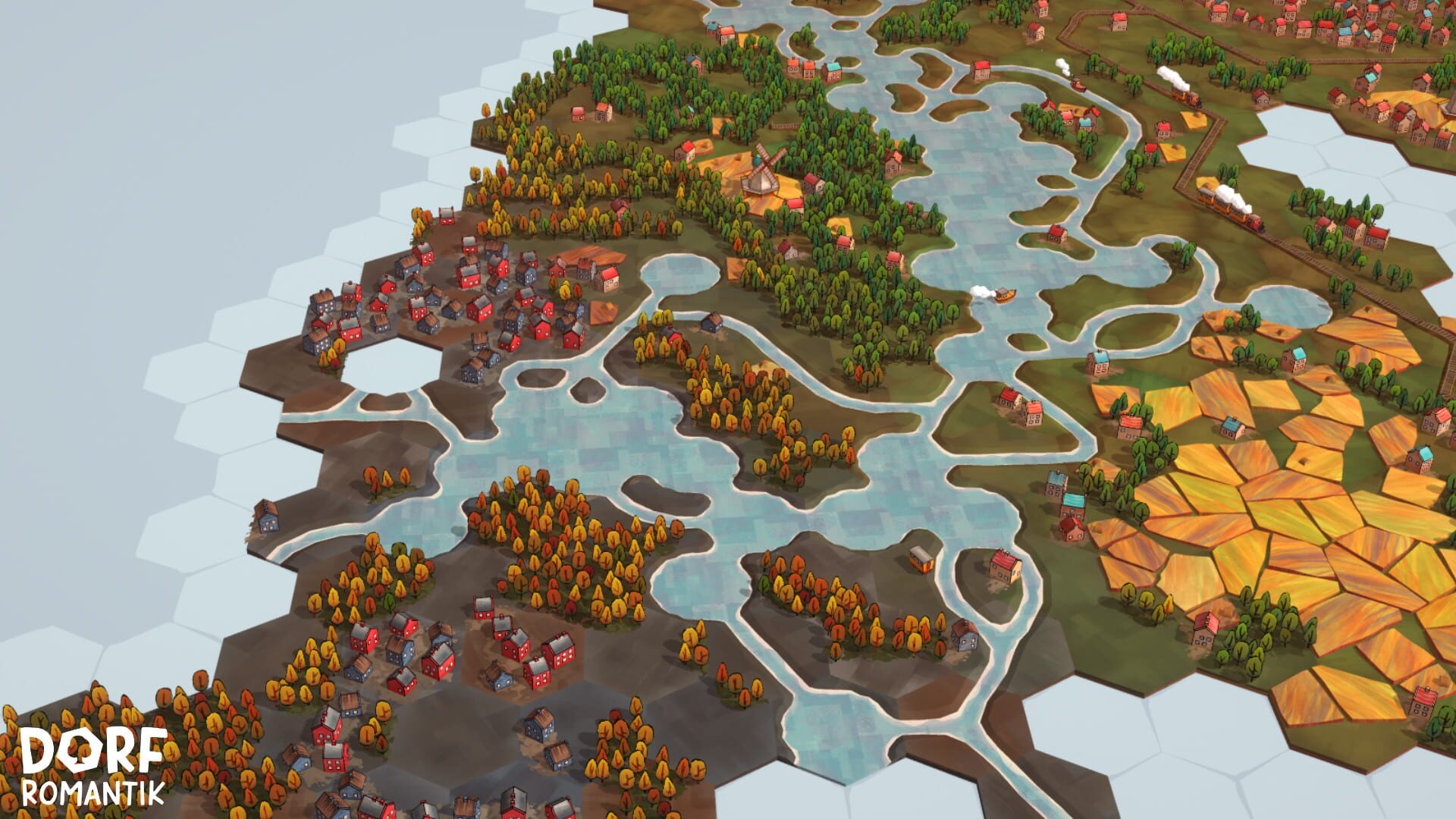
The biome system extends this aesthetic across the campaign. Completing in-game achievements unlocks alternative visual styles, from a cherry blossom variant introduced with the Switch release to seasonal winter and autumn themes, each applying a consistent colour rework to the full tile set. The world grows from one corner outward as you place tiles, and the effect of watching a landscape take shape is the game’s clearest achievement. A river that connects several tiles creates a flowing channel; a ring of forest around a village produces a contained glade; a railway line threading through farmland establishes something that reads, from a distance, like an actual countryside. The biomes are unlocked progressively rather than available from the start, giving each new visual style the quality of a small reward rather than a cosmetic option.
The interface is stripped to near-nothing. A tile queue sits in one corner, a score counter in another, and quest indicators float above active objective tiles. There is no map, no minimap, and no UI clutter. For a puzzle with this level of aesthetic intent, that clarity is the right call. The sole navigational friction is the absence of camera tools: you can pan and zoom, but on larger screens with expansive boards, tracing the edge of a biome group requires scrolling that the console versions handle adequately but not gracefully. For a broader view of puzzle games that use restraint well, our best cosy games guide covers the category’s strongest current options.
Gameplay and Dorfromantik 2026: The Core Loop
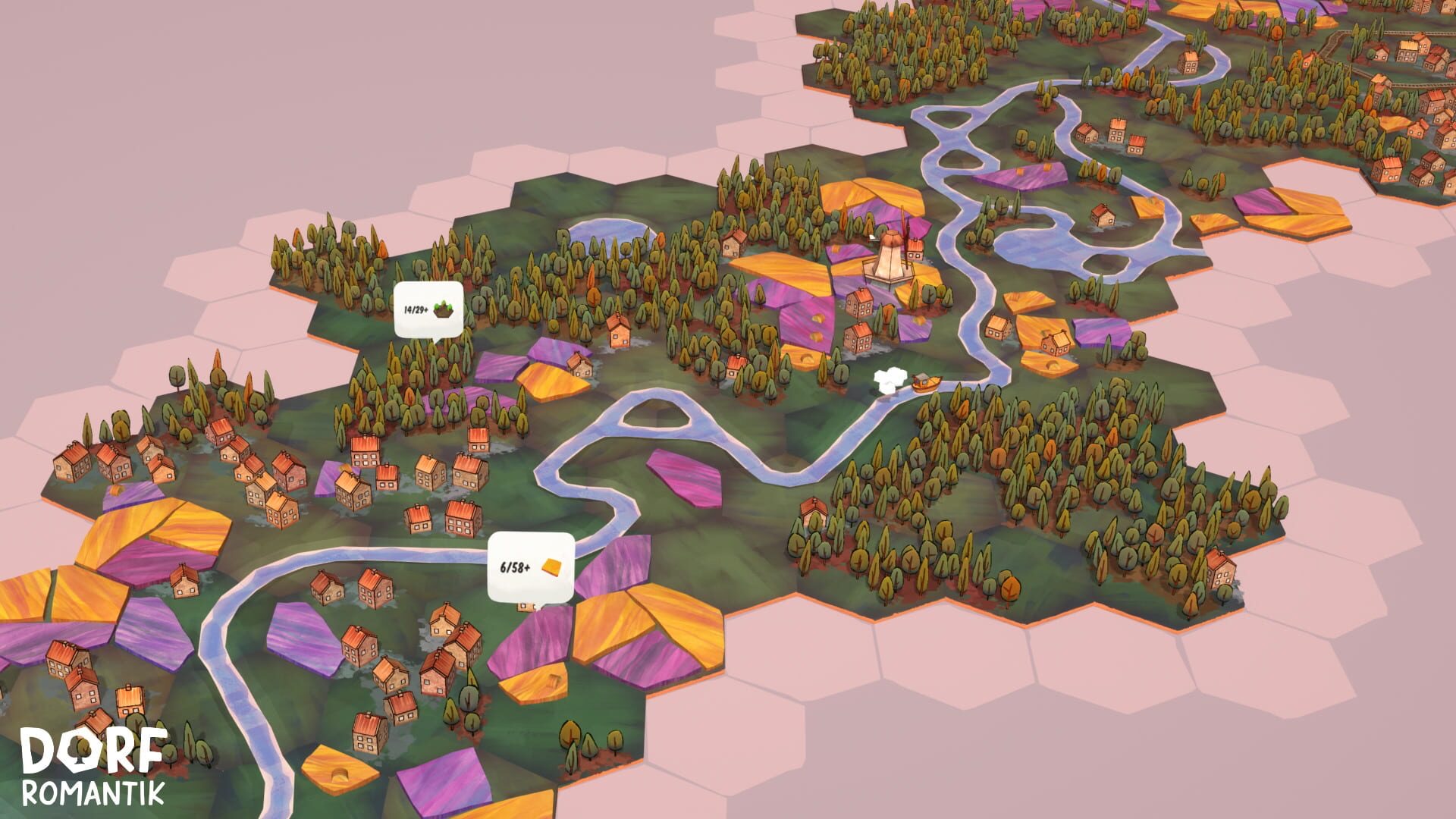
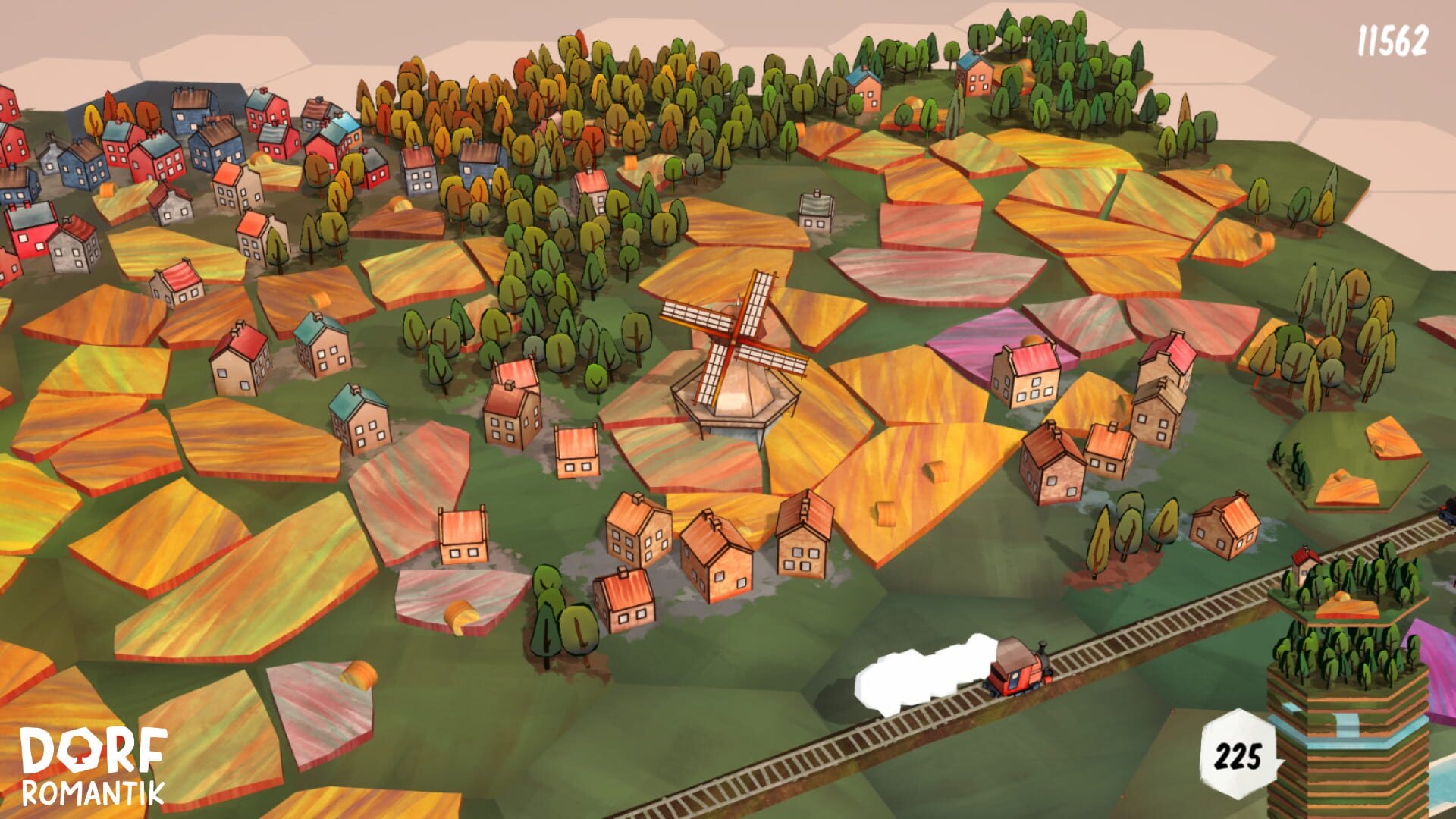
The fundamental action is simple: draw the top tile, choose a placement slot at the edge of the existing board, rotate it to fit, and place it. Points come from matching terrain edges between adjacent tiles: a forest tile whose edges all border other forest segments scores more than one placed in isolation. Quests appear when specific tiles are drawn. The windmill, for instance, requires its tile to border a set number of grain fields; the locomotive needs a completed railway circuit of a given length. Fulfil the quest before your tile stack runs dry and you receive additional tiles, extending the session.
That quest system is where the strategic layer lives. Dorfromantik is not stressful, but it is not thoughtless either. A misplaced river tile can close off a water group prematurely; a railway track angled incorrectly orphans the locomotive quest from its target loop. The game rewards spatial awareness and the patience to hold a placement in mind whilst scanning the board for the right slot. The gap is real. The difference between a casual and a skilled run is visible in the numbers, and that visible gap keeps experienced players returning to improve.
Classic Mode operates this way, with a finite tile stack and score as the measure of success. Creative Mode removes all limits: no stack, no quests, no score, just an open canvas for building. Quick Mode compresses a session into a shorter burst, useful for the fifteen-minute slot the game was designed to fill. Custom Mode lets players define their own rulesets and share them, though the community tooling is more evident on PC than on consoles. Monthly Challenges offer a fixed tile sequence, creating a shared leaderboard puzzle for those who want competition in a game otherwise devoid of it. The modes suit different temperaments without contradicting each other.
The console versions, arriving in August 2025 after three years on PC and Switch, translate cleanly to a controller. Tile rotation maps to the shoulder buttons, placement to a face button, and the cursor movement responds without lag. Nintendo Life’s Switch review noted the game as a natural companion for short sessions, and the same applies to a PS5 or Xbox: it loads in seconds, can be paused mid-placement without consequence, and demands no onboarding reminder after a week away. The one genuine weakness is that Creative Mode on console lacks the PC version’s precision for players attempting elaborate geometric layouts, but this matters only to a small subset of the audience. For anyone comparing Dorfromantik’s pick-up-and-play format against the broader Nintendo library, our best Switch 2 games guide places it in category context.
Story and Characters
Dorfromantik has no story. There are no characters, no dialogue, no cutscene. The world it builds exists only as landscape. This is not a failing; it is the design. The game belongs to a tradition of meditative software closer to the digital toy than the narrative game, and by that measure it succeeds entirely. The progression system provides emotional shape in the absence of narrative: unlocking a new biome after a long campaign run, or finally completing a windmill quest that has been blocking a run for twenty minutes, generates a satisfaction that approximates narrative reward without requiring any of narrative’s machinery.
The Deutsche Computerspielepreis jury’s decision to award Best Game Design in 2021 rather than Best Narrative reflects this honestly. The craft here is systemic and visual, not literary. Players seeking a story, a world to inhabit emotionally, or characters to follow will not find them. Players seeking a precisely calibrated loop that respects their attention and rewards patience will find exactly that.
One consequence of the no-story structure is that accessibility is unusually broad. Nothing in Dorfromantik gates progress behind mechanical skill; the Creative Mode removes even the scoring pressure. A player who has never engaged with a puzzle game can build a landscape and feel the satisfaction of a river connecting cleanly. A player who has completed it once can return to chase a higher score under the same conditions. The game holds both without condescension. Compared with narrative puzzle games such as Strange Horticulture or Avowed on PS5, Dorfromantik occupies a separate category entirely: systems without story, rhythm without stakes.
Value and Longevity
At approximately £7.99 / $9.99, Dorfromantik offers a per-hour cost that most premium releases cannot approach. HowLongToBeat places the main campaign at five to six hours for a first completion, with the full unlocked content extending that to eighteen or nineteen hours across multiple modes. Completionists who pursue every biome unlock, every achievement, and the highest possible score categories can log fifty to sixty hours. That range suits a game played in short intervals rather than marathon sessions.
The 1.5 million copies sold across platforms confirm a finding audience, and the OpenCritic aggregate of 83 with a 96 per cent recommendation rate reflects critical consensus that held from the 2022 PC launch through the console ports. Rock Paper Shotgun described it as one of the “most charming, welcoming and relaxing game worlds” on PC; the Nintendo Life Switch review confirmed that portability suited the format well. The board game adaptation, which won the Spiel des Jahres in 2023, is a separate product but speaks to the core design’s adaptability.
The honest caveat is scope. Dorfromantik is a single-system game. It does one thing with precision and does not expand beyond it. Players who finish the campaign, unlock the available biomes, and reach a score plateau they are satisfied with will exhaust the content. Monthly Challenges and the Custom Mode extend that ceiling, but the hex-tile placement system does not evolve across the playthrough in the way a more mechanically ambitious game would. For players comfortable with that trade, the value is genuine. For players who expect a game to broaden over time, the ceiling will arrive sooner than the price suggests. For cosy games with deeper content structures on PlayStation and Switch, our best cosy games for PS5 covers the category’s strongest options at varying price points.
Technical Notes
Dorfromantik requires minimal hardware. On PC, the install sits at approximately 500 to 650 MB and the system requirements are modest enough that virtually any machine manufactured in the last decade runs it without issue. The console ports, released August 2025, have received no significant technical complaints in early coverage: load times are short, frame rates are stable, and the game’s low graphical demands mean performance modes are not a relevant consideration.
The game does not use cloud saves across platforms, so progress is platform-locked. Accessibility is covered primarily by the game’s inherent design: large tiles, high-contrast colours, and no time pressure remove most barriers to entry. The absence of text-heavy UI means readability issues are minimal. No haptic or adaptive trigger implementation has been reported for the PS5 version.
Post-launch updates on PC have added biomes, game modes, and the monthly challenge feature over four years. Whether the console versions will receive the same ongoing support is not confirmed at the time of writing. For players weighing up hardware options before committing to a version, our console comparison for 2026 covers the PS5, Xbox, and Switch 2 differences in the context of this type of library.
Final Word
Dorfromantik is the kind of game that resists the language used to praise most games. Nothing here is exciting, urgent, or climactic. What it offers instead is the specific satisfaction of a river tile slotting cleanly into place, closing a water group the board has held open for a dozen turns, and watching the landscape snap into coherence. That moment of resolution, the quest fulfilled and the extra tiles arriving to extend the session, is what the game is: small, precise, and genuinely pleasurable. For anyone who reaches for a puzzle in ten minutes before bed rather than a seventy-hour RPG at the weekend, this belongs in the same shelf space as the best cosy games on PS5 and Switch. Skip it only if you need a game to grow: Dorfromantik commits to its single system and does not waver.
Dorfromantik is worth buying in 2026 at approximately £7.99 / $9.99, particularly on PS5 or Switch where the short-session format suits pick-up-and-play habits. The main campaign runs five to six hours, completionist content extends to around sixty hours, and Creative Mode opens an unlimited canvas for players who want to build landscapes without score pressure. The narrow scope means its value depends entirely on whether the hex-tile arrangement loop appeals.
The main campaign takes approximately five to six hours for a first completion, according to HowLongToBeat. Unlocking all biomes and modes extends that to around eighteen to nineteen hours across multiple mode types. Completionist players pursuing every achievement and the highest score tiers can log fifty to sixty hours, though the game is designed for repeated short sessions rather than extended runs.
Dorfromantik runs cleanly on PS5 and Xbox following the August 2025 console release, with fast load times and stable performance that reflect the game's minimal technical requirements. The controller interface translates the tile-rotation and placement mechanics without friction. The PC version retains a precision advantage in Creative Mode for elaborate layouts, but the console ports handle every standard mode without notable compromise.
Dorfromantik does not have a failure state. In Classic Mode, the game ends when the tile stack runs out, and a final score is calculated. Creative Mode removes the stack entirely, allowing indefinite building. The design deliberately avoids punishment: a misplaced tile costs points but never ends the session abruptly, and no mode requires starting over from a checkpoint.
Dorfromantik includes Classic Mode (finite tile stack, score-based), Creative Mode (no limits, no score), Quick Mode (shorter sessions), Custom Mode (player-defined rulesets), and Monthly Challenges (fixed tile sequences with leaderboard scoring). Biomes and alternative visual styles are unlocked through achievements across modes. The monthly challenge is the only mode that introduces a competitive element.
For the full cosy games shortlist across every platform, see our best cosy games guide for 2026.
Please note that some links in this article are affiliate links. If you found the coverage helpful and decide to pick up the game, or anything else for your collection, through one of those links, we may earn a commission at no extra cost to you. We use this approach instead of filling Spawning Point with intrusive display ads, and rely on this support to keep the site online and fund future reviews, guides, comparisons and other in-depth gaming coverage. Thank you for supporting the site.