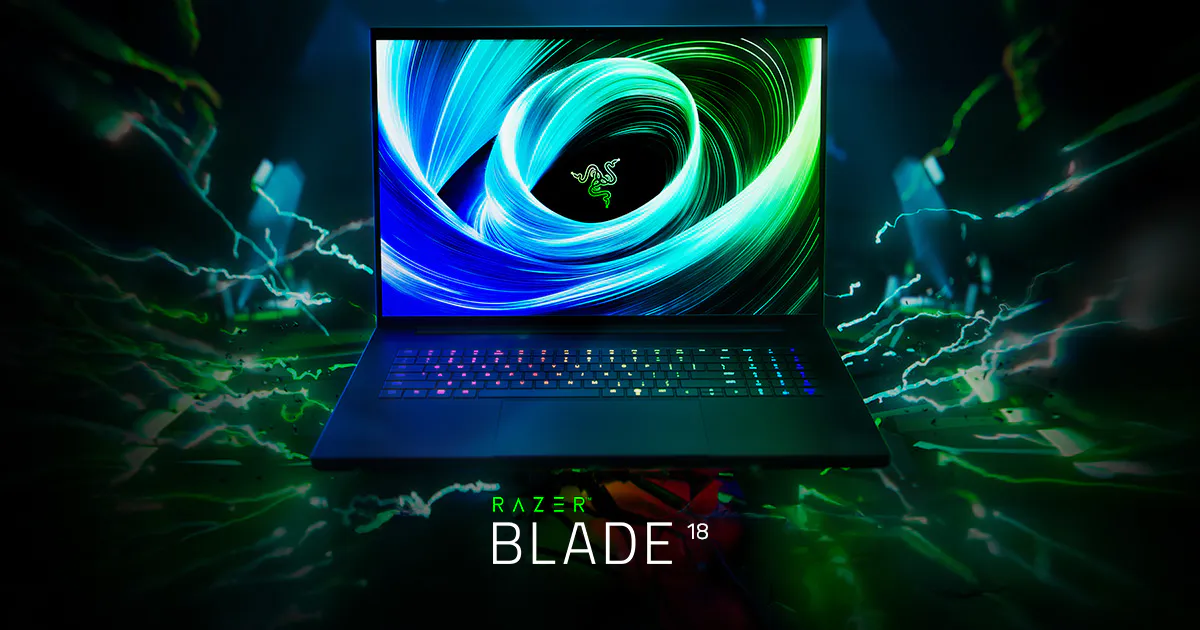
If best means maximum performance with fewer compromises than most gaming laptops, the Razer Blade 18 (2025) is one of the clearest answers this year. It aims squarely at the desktop-replacement crowd, pairing flagship-class components with a surprisingly practical set of ports for an 18-inch machine.
It is also extremely expensive, heavy, and realistically a laptop you move between rooms (or flights) rather than one you carry all day.
Product Snapshot
Product: Razer Blade 18 (2025)
Category: Premium 18-inch desktop replacement gaming laptop
Key highlights (configurations vary by retailer):
- CPU: Intel Core Ultra 9 275HX (varies by configuration)
- GPU options: up to NVIDIA GeForce RTX 5090 Laptop GPU (varies by configuration)
- Display: 18-inch dual-mode panel (UHD+ 3840×2400 up to 240Hz, or FHD+ 1920×1200 up to 440Hz, depending on mode)
- Ports: Thunderbolt 5, Thunderbolt 4, HDMI 2.1, USB-A, UHS-II SD card reader, 2.5Gb Ethernet, 3.5mm audio (port availability can vary by region/config)
- Weight: around 3.1kg (expect a large power adaptor as well)
Design and Build
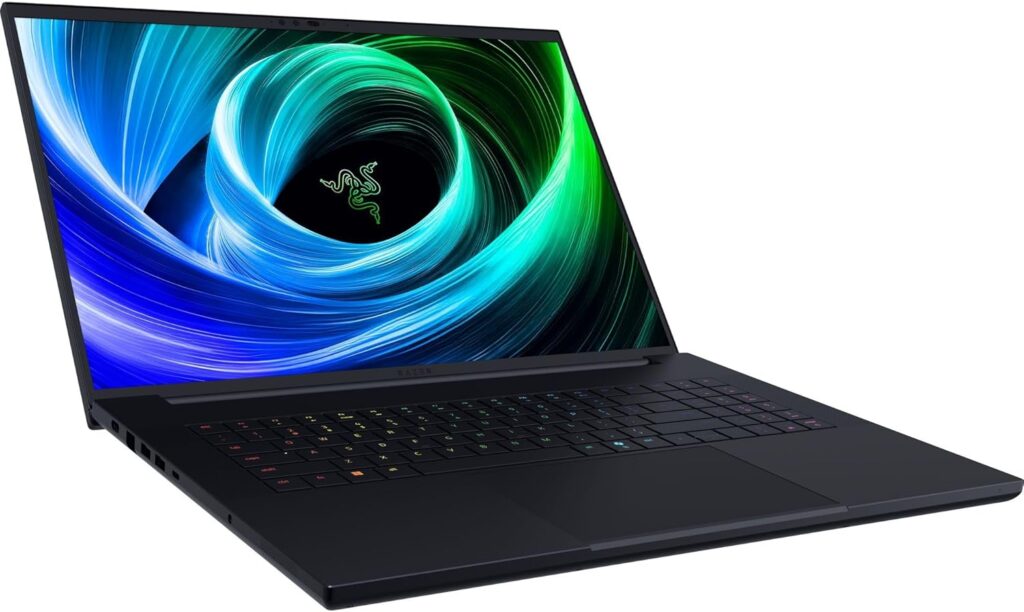
The Blade 18’s chassis is machined aluminium with a matte black finish that resists fingerprints better than previous generations. Build quality is where the premium price starts to justify itself: minimal flex, tight tolerances, and a hinge mechanism that holds the 18-inch panel steady at any angle. The keyboard uses per-key RGB with a layout that includes a full numpad, useful for creators working in spreadsheets or 3D applications.
The trade-off is weight. At roughly 3.1kg before the charger, portability is the cost of desktop-replacement performance, not an oversight. This is a machine that lives on a desk and travels to another desk. Students and creators who bounce between lecture halls and home setups will appreciate the connectivity; commuters who carry their laptop daily will not.
Display
The headline feature is the dual-mode panel. In UHD+ mode, the 3840×2400 resolution at up to 240Hz delivers crisp detail for single-player games, photo editing, and video work. Switch to FHD+ mode and the refresh rate climbs to 440Hz, useful for competitive shooters where frame clarity matters more than pixel density. The switching is practical rather than gimmicky.
One note of caution: colour accuracy and peak brightness can vary between panels and configurations. If colour-critical work is a priority, confirm the panel characteristics before buying. For gaming, the dual-mode flexibility is a genuine differentiator that most competitors at this price do not match.
Performance
With the Core Ultra 9 275HX and up to the RTX 5090 laptop GPU, the Blade 18 is built for high settings at high resolutions. In practice, that means AAA gaming at native 4K with ray tracing, GPU-accelerated creative workloads in Premiere Pro and DaVinci Resolve, and heavy multitasking without thermal throttling becoming an immediate concern.
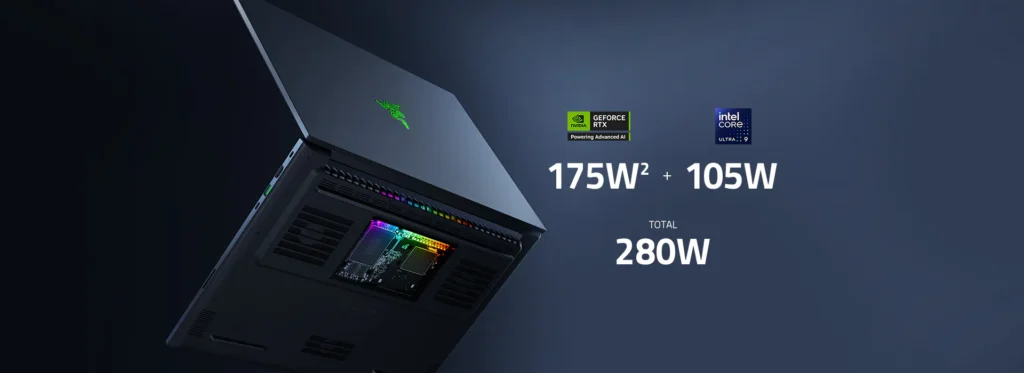
The real-world caveat is configuration variance. Actual results depend on the exact GPU tier, power limits, and cooling profile in the SKU you buy. An RTX 5080 configuration will perform meaningfully differently from an RTX 5090 one. Read the listing carefully. Independent reviews report that the RTX 5090 configuration sustains high clock speeds under load, but sustained performance is always contingent on thermal headroom and power delivery.
Cooling, noise, and battery reality
Big performance requires big cooling. Fan noise is part of the deal. The 18-inch chassis gives Razer more thermal headroom than a 14-inch ultrabook, but under sustained loads, fans are audible and the keyboard deck warms noticeably. For gaming in shared spaces at night, this matters.
Battery life is not the point of a machine like this. Expect 6-8 hours for light productivity (web browsing, documents, video playback) and under 2 hours for gaming. Treat the battery as a convenience for moving between power outlets, not a feature to rely on.
Ports and connectivity
Ports are the Blade 18’s quiet advantage over slimmer flagships. Thunderbolt 5 enables high-bandwidth docks and fast external storage at speeds that Thunderbolt 4 cannot match, useful for video editors working with large files. HDMI 2.1 connects directly to modern 4K/120Hz displays without an adapter. The UHS-II SD card reader and 2.5Gb Ethernet are practical bonuses that many premium laptops still omit, and both matter for creators who regularly transfer footage or need reliable wired networking.
Where competitors like the ASUS ROG Zephyrus rely on dongles and docks for basic connectivity, the Blade 18 builds it in.
Upgrades and longevity
SSD upgrades are straightforward across configurations. RAM upgradeability depends on the specific SKU: some use slotted SO-DIMMs, others use soldered memory. Confirm before buying. For a machine at this price point, soldered RAM in any configuration would be disappointing
Razer’s standard warranty is one year, shorter than Lenovo’s typical two-year offering on Legion Pro machines. Extended warranty options exist but add to an already high total cost.
Who it is for / Who should skip it
Buy it if:
- You want a true desktop replacement and are willing to pay for top-end components, a premium chassis, and a dual-mode display
- You value built-in ports (Thunderbolt 5, Ethernet, SD card) as much as raw frame rates
- You mostly game plugged in and regularly connect to external monitors or docks
Skip it if:
- You commute daily with your laptop and want something under 2kg
- You prioritise quiet operation and long battery life over peak performance
- You want the best gaming performance per pound rather than the best at the top end, in which case the Lenovo Legion Pro 7i Gen 10 often delivers more for less
Alternatives
If you want a different balance of price, portability, and performance, these are strong alternatives that are commonly available on Amazon.com. Availability and configurations change often, so use these as starting points.
Razer Blade 16 (2025): More portable than the 18-inch model, still premium, often a better fit if you travel frequently. Check price on Amazon
Lenovo Legion Pro 7i (Gen 10): A performance-focused workhorse that often competes strongly on value versus ultra-premium designs. Check price on Amazon
HP OMEN MAX 16 (2025): A more mainstream high-end pick if you want strong gaming performance without going all the way to 18-inch luxury pricing. Check price on Amazon
Verdict
The Razer Blade 18 (2025) is the desktop replacement that commits fully to the concept. It does not pretend to be portable, does not chase battery life, and does not apologise for its price. What it delivers is flagship performance, comprehensive connectivity, and a dual-mode display that no direct competitor matches. The kind of machine you set up on a desk, plug into a monitor, and forget is a laptop, until you need to carry it to the next room and remember the 3.1kg. For buyers who value that proposition and can afford it, this is the benchmark. For everyone else, the Legion Pro 7i offers most of the performance at a fraction of the cost.
FAQ
Is the Razer Blade 18 (2025) worth it?
If your definition of ‘worth it’ is maximum performance in a premium desktop-replacement chassis with comprehensive ports and a dual-mode display, yes. At north of £3,500, the price demands that you value those specific qualities. For buyers prioritising value per pound, the Lenovo Legion Pro 7i Gen 10 delivers comparable performance for significantly less.
Which Razer Blade 18 configuration should I buy?
Start with the GPU tier, as it determines your performance ceiling. The RTX 5080 configuration offers strong 1440p and entry-level 4K gaming at a lower price. The RTX 5090 is for native 4K with ray tracing and GPU-heavy creative work. Prioritise 32GB RAM for heavy multitasking, and confirm whether your chosen SKU uses slotted or soldered memory before buying.
Is the Razer Blade 18 good for university or creative work?
Yes, provided you accept the weight. The Core Ultra 9 275HX handles demanding creative applications (Premiere Pro, DaVinci Resolve, Blender) comfortably, and the dual-mode display’s UHD+ resolution suits colour-sensitive work. The comprehensive port selection, including Thunderbolt 5 and an SD card reader, makes it practical for creators. The 3.1kg weight and large charger are the main trade-offs for campus use.
How long does the Razer Blade 18 battery last?
Expect 6-8 hours for light productivity (web browsing, documents, video) and under 2 hours for gaming. Battery life is not the selling point of a desktop-replacement laptop. Treat the battery as a bridge between power outlets, not a feature to plan around.
Is the Razer Blade 18 too heavy for daily use?
At approximately 3.1kg plus charger, it is a desk-to-desk machine rather than a daily carry. Students and professionals who move between fixed workspaces will manage. Daily commuters who carry their laptop for extended periods should consider the Razer Blade 16 (2025) at ~2.4kg or the HP OMEN MAX 16 as lighter alternatives.
Do I need Thunderbolt 5?
Only if you use high-bandwidth docks, fast external storage (NVMe enclosures, RAID arrays), or plan to drive multiple 4K displays through a single cable. For buyers who mainly plug in a monitor and peripherals, Thunderbolt 4 or USB4 on competing laptops is often sufficient. Thunderbolt 5’s advantage is future-proofing and professional workflows that demand sustained high data throughput.
Ready to buy? Razer Blade 18 (2025) on Amazon.com
Please note that some links in this article are affiliate links. If you found the coverage helpful and decide to pick up the game, or anything else for your collection, through one of those links, we may earn a commission at no extra cost to you. We use this approach instead of filling Spawning Point with intrusive display ads, and rely on this support to keep the site online and fund future reviews, guides, comparisons and other in-depth gaming coverage. Thank you for supporting the site.






 review covers the RTX 5090 flagship. Is this £3,500+ desktop replacement worth it, or should you buy a mid-tier alternative?)